 66AI papers
Free
66AI papers
Free
66AI Thesis is an AI writing tool for graduation thesis and academic writing. It covers scenarios such as thesis outline, first draft generation, proposal report and assignment letter, and focuses on high-efficiency output and low-repetition rate writing support.
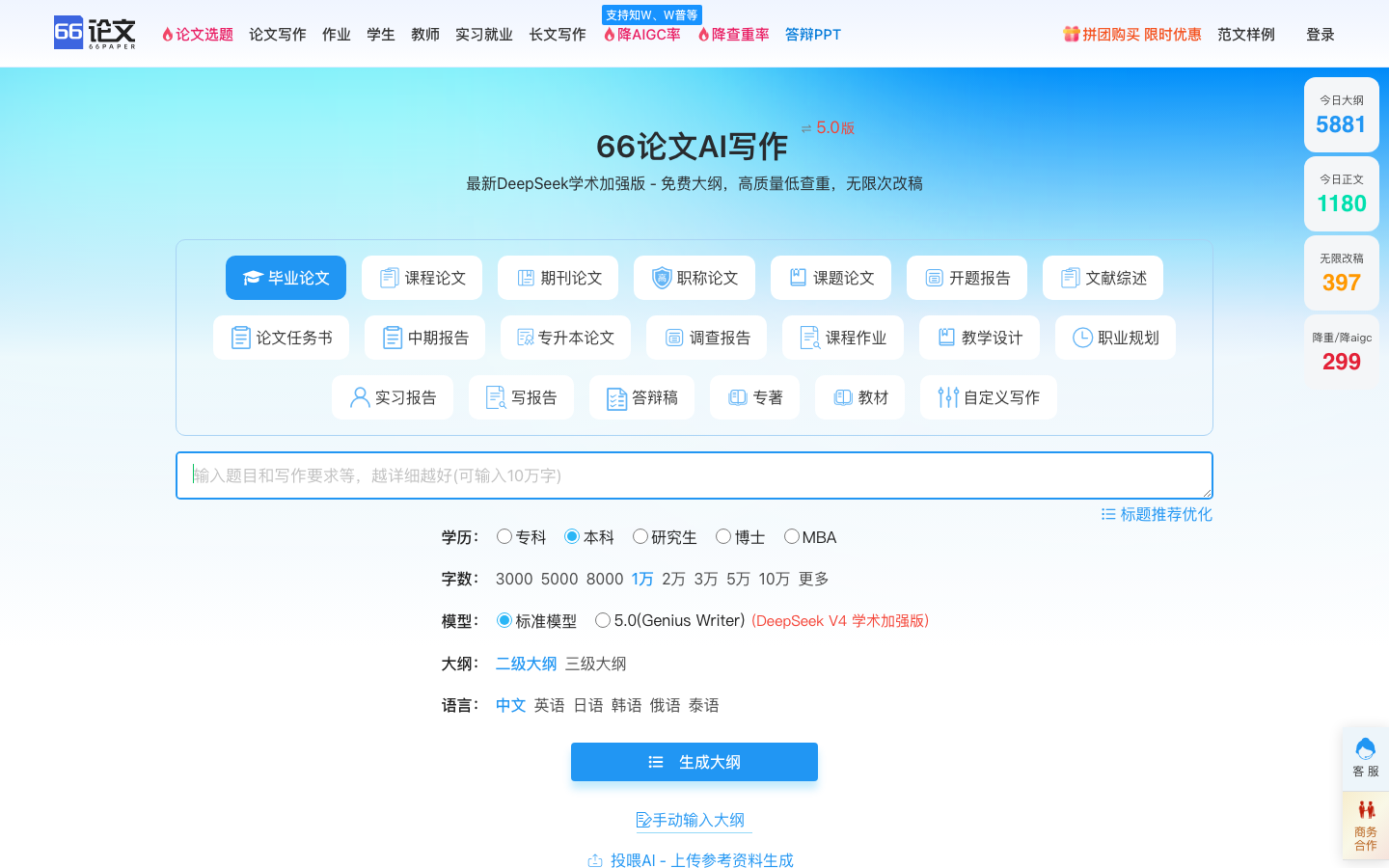
66AI Paper
Core parameters and statistics
66AI Paper (operated by Guangzhou Wanzhihe Technology Co., Ltd., website registration number: Guangdong ICP No. 17004104) is an AI paper auxiliary platform positioned in the Chinese academic writing market. Its core competitiveness is not in the size of the model parameters, but in the scenario encapsulation of the entire process of the graduation thesis - from outline generation, first draft writing to weight reduction and AIGC, packaging into a closed link that does not require switching tools. The current public data on the homepage shows that among the single-day daily activity indicators, "Today's outline was generated about 3,330 times, and today's text was generated about 667 times." This reflects its product funnel design that uses the outline as the traffic entrance and the text as the paid conversion.
| Projects | Public Information |
|---|---|
| Official positioning | AI essay writing assistance platform |
| Current version | 5.0 (Genius Writer, based on DeepSeek V4 academic enhanced version) |
| Underlying model | DeepSeek V4 academic enhanced version (non-public custom fine-tuning) |
| Paper scene coverage | Graduation thesis, course paper, journal paper, professional title paper, project paper, proposal report, literature review, assignment letter, mid-term report, defense draft, etc. 17+ categories |
| Duplicate check guarantee | CNKI/VIP duplication check rate is about 10%, and refunds are available if it exceeds 15% |
| AIGC Guarantee | Automatically reduce AIGC rate, CNKI/VIP Super 25% refundable |
| References | 40 authentic references from CNKI/Chinese Academy of Sciences (with in-text citations) |
| Multi-language support | Chinese, English, Japanese, Korean, Russian, Thai |
| Educational qualification adaptation | College, undergraduate, graduate, doctoral MBA |
| Word Range | 3,000 to 100,000+ words |
| Place of Belonging | CN |
| Support Platform | Web |
Version Difference: The website provides dual model entrances, "Smart Edition" (Standard Model) and "5.0 Advanced Edition" (Genius Writer). Version 5.0 is based on DeepSeek V4 and has been enhanced for academic scenarios. There are obvious differences in the accuracy of professional terminology and the standardization of paper structure. Free users can use the standard model to experience outline generation, and text generation requires paying to unlock the premium version.
Essential meaning of plagiarism checking commitment: The "duplication checking rate of CNKI and VIP is about 10%" promoted by the platform refers to the duplication rate performance of the original output without manual rewriting in the duplication checking system after normal use of AI generation. The actual duplication check rate will be affected by the popularity of the topic, the citation density of the subject field and the extent of user modifications, and cannot be regarded as an absolute guarantee. The refund terms require users to provide a third-party plagiarism check report as evidence and keep the plagiarism check documents.
Users and market recognition of 66AI papers
The market recognition of 66AI papers is mainly reflected in word-of-mouth communication among Chinese university students, rather than public financing or enterprise-level signings. Its operating entity, Guangzhou Wanzhihe Technology Co., Ltd., has been operating paper-related services since 2018, and has accumulated a vertical user base in paper writing scenarios.
C-side user structure: With undergraduate and graduate thesis users as the core, supplemented by a small number of journal article and professional title thesis writers. The typical user portrait is a group of students who are "time-pressed, unfamiliar with paper format specifications, and want to quickly produce a first draft and then make detailed revisions." The website generates more than 3,000 outlines every day, which shows that its free outline function plays a clear role in attracting customers - users first experience the quality of the outline for free, and then decide whether to pay to generate the text.
Competitive Landscape: In China’s AI paper writing track, 66AI Paper’s direct competitors include similar platforms such as Meizi AI Paper and Wenfu AI Paper, as well as the AI functional modules of traditional academic service platforms such as Academic Journal and CNKI. Compared with competing products, the core difference of 66AI papers lies in three points: First, the "unlimited revision" mechanism - paying users can revise the same paper repeatedly, and no charge is charged; second, the promise of plagiarism checking - 15% refundable by CNKI/VIP, which reduces the user's decision-making risk; third, it is combined with the "feeding AI" function, allowing users to upload reference materials for the model to learn specific content and then generate it, which improves the match between the generated content and the course requirements.
Market limitations: Almost all of the platform’s traffic comes from academic writing keyword bidding and SEO from search engines in mainland China (Baidu/360/Sogou), and lacks active coverage of overseas or Hong Kong, Macao and Taiwan markets. For users who need to write English papers, although the English mode is supported, its core training data and optimization focus are still on the Chinese paper scenario, and the English output quality is weaker than native English writing tools such as Grammarly and Paperpal.
The cost advantage of 66AI papers
The cost value of 66AI papers is not reflected in "absolutely cheap", but in "compared to the time cost of manually writing papers + the risk cost of duplication checking, the ROI is clear and calculable".
C client/individual users: The website provides free outline generation, and users can evaluate the quality of the generation without paying. Text generation uses a per-article or per-word billing model (specific prices), and periodic discounts such as group purchases are launched. For an undergraduate thesis of 8,000-15,000 words, the AI generation time from outline to first draft is usually 3-10 minutes, while it usually takes 3-7 days to manually complete the first draft of the same length. Cost reduction and efficiency improvement: Taking an undergraduate thesis writer as an example, the traditional process of "topic selection → literature search → outline construction → first draft writing" takes about 40-60 hours on average; after using 66AI paper, the total time of outline (5 minutes) + text generation (10 minutes) + manual review and revision (8-15 hours) can be compressed to 10-16 hours, and the efficiency of the first draft stage is improved by about 60%-75%. But what needs to be made clear is that this deduction is based on a scenario where users are highly receptive to AI output. For papers that require a high degree of originality, in-depth theoretical analysis, or strict discipline specifications, manual revision time will increase significantly.
Hidden costs of weight reduction and AIGC: The platform's promise of "refundable if the duplication check rate exceeds 15%" and "refundable if the AIGC rate exceeds 25%" reduces users' purchasing risks, but it also means that users must use designated duplication check channels for verification to trigger the refund clause. If the user uses other plagiarism checking systems designated by the school (such as Gezida PaperPass), the results may be different from CNKI/VIP, and the refund terms may not apply. In addition, over-reliance on AI weight reduction may result in a loss of subject-specific depth in the content—the model may replace accurate academic terms in order to reduce repetition rates.
Enterprise/Bulk Purchase: The website clearly provides the entrance for "bulk purchase, business cooperation OEM customization, and partner agency", targeting B-end customers such as universities, education and training institutions, and thesis tutoring institutions. The cost structure of bulk purchases has not been disclosed and needs to be confirmed through business communication. For training institutions, distributing 66AI papers to students as an internal tutoring tool can reduce the labor cost of one-on-one tutoring, but attention must be paid to the compliance boundaries of AI-generated content - the policies of various universities on AI-assisted writing vary widely, and some universities have explicitly required marking AI participation or limiting the scope of AI use.
Main functions of 66AI paper
The functional design of 66AI Paper is centered around "coverage of the entire paper writing process". Rather than providing a universal conversational AI, the paper is broken down into modular nodes that can be operated independently.
-
Thesis outline generation (free diversion layer): Supports three-level outlines (first-level chapter → second-level section → third-level subsection). Users can select the subject direction, academic level and word count requirements and then generate it with one click. This is the core customer acquisition function of the platform - the quality of the outline directly affects the user's expectations for the quality of the text and the payment conversion rate. Focus of actual measurement: The subject subdivision granularity of the syllabus (such as whether "natural language processing" and "computer network" under "computer science" are clearly distinguished) is the primary indicator for judging the academic understanding ability of the underlying model.
-
Paper text generation (core paid tier): Generate text content section by section based on the outline, supporting the insertion of data tables, formulas, code blocks and pictures. Version 5.0 claims to use the academic enhanced version of DeepSeek V4, which is superior to the standard model in terms of accuracy of academic terms and logical coherence of paragraphs. The generated text contains in-text citations (the citation format is numbered reference marks), which is directly linked to the subsequent reference list.
-
40 real references + automatic citations: The platform claims to match 40 real references for each paper from the CNKI/Chinese Academy of Sciences database, and automatically mark the citation locations in the text. This function directly responds to the core pain point of "irregular citations" in academic writing. Items to be verified: The authenticity and timeliness of references need to be spot-checked by users themselves - cited documents generated by AI may have problems such as spelling errors in titles, missing author names, or year mismatches, and cannot completely replace manual document verification.
-
"Feeding AI" function (differentiation capability): Users can upload reference materials (PDF/Word/TXT and other formats), allowing the model to learn the content and style of the specified materials before generation. This is especially practical for scenarios where specific textbooks, courseware, or instructor-specified documents need to be used as the basis for writing. This function is equivalent to providing a "temporary knowledge base" for the model, but the size and quantity limits of uploaded files are subject to the real-time instructions on the official website.
-
Unlimited revisions and weight reduction/AIGC reduction: Paid users can make unlimited revisions to generated papers, and the platform has built-in post-processing capabilities for weight reduction and AIGC reduction. Duplication reduction reduces the text repetition rate through synonym replacement, sentence reconstruction and other means; AIGC reduction reduces the probability of being recognized by AI detection tools by adjusting vocabulary distribution and adding artificial expression features. Hidden costs: Excessive weight reduction/AIGC reduction may result in blunt expressions or professional terminology being replaced with inaccurate colloquial expressions. It is recommended that users check the professional accuracy paragraph by paragraph after weight reduction.
-
Multi-language essay writing: Supports output in six languages: Chinese, English, Japanese, Korean, Russian, and Thai. However, there are significant differences in the actual availability of multilingual capabilities - Chinese writing quality is the highest, followed by English, and the output stability and academic standardization of minor languages (Thai, Russian) may be significantly weaker than Chinese.
Model and version evolution of 66AI paper
The version iterations of 66AI papers are marked with the "version number" on the official website instead of the traditional software version number. The main lines currently visible are as follows:
Early version (~2024-07)
Taking paper outline generation and first draft generation as its core functions, the model accuracy and subject coverage are limited. This stage completed the basic productization of the paper writing process: outline → text → export, verifying the market feasibility of AI-based academic writing.
Version 3.0 (2025, exact date undisclosed)
Introduce support for more paper types (expanded to course papers, proposal reports, literature reviews, etc.), and begin to integrate automatic reference generation and citation annotation functions. The product form has evolved from "paper writing tool" to "paper writing full process platform".
Version 4.0 (~Late 2025 to Early 2026)
Adopt an updated underlying model to enhance academic terminology understanding and long-text coherence. The "feeding AI" function and the ability to reduce AIGC were introduced for the first time, and began to respond to the testing requirements of universities for AI-generated content.
Version 5.0 / Genius Writer (2026-06, currently the latest)
Based on the academic enhanced version of DeepSeek V4 (officially called "DeepSeek V4 Academic Enhanced Edition"), it is the most powerful version currently. Core improvements include: more accurate understanding of subject terminology, a more complete citation annotation format, and a unified weight reduction + AIGC post-processing pipeline. Version 5.0 is available in parallel with the "Smart Edition" (standard model), which is user-selectable at build time, with differences in price and build quality.
Underlying model strategy: The 66AI paper did not develop its own base model, but did directional fine-tuning (SFT) of academic scenarios and optimization of prompt word engineering based on DeepSeek V4. This "borrowing base + scene tuning" strategy reduces research and development costs, but means that the upper limit of its capabilities is limited by the basic capability boundaries of DeepSeek V4 - when DeepSeek upgrades the version or adjusts the API strategy, the quality of 66AI paper generation may fluctuate. For paying customers who rely on the quality of their writing, this is an external risk to be concerned about.
Technical advantages of 66AI papers
The technical competitiveness of 66AI papers does not come from underlying model innovation (the base is DeepSeek V4), but from the vertical optimization engineering of academic writing scenarios.
Prompt word engineering and fine-tuning for academic scenarios: The general large model is good at dialogue and pan-content generation, but there are three typical problems in academic paper writing - confusing chapter structure, irregular citation format, and inaccurate use of academic terms. 66AI Paper uses customized system prompt words and scene fine-tuning to inject the paper structure template (such as the standard process of "Abstract→Introduction→Literature Review→Methodology→Result Analysis→Conclusion") into the model output layer, making the format standardization of the generated content significantly better than directly using general dialogue products.
Multi-level outline-driven writing process: The platform breaks down the writing process into a phased process of "topic selection → outline → section-by-section generation → revision", instead of letting the model generate the full text at once. This segmented generation strategy has two practical benefits in engineering: First, the length of each context is controllable, which reduces the reasoning delay and logical drift risk of extremely long texts; second, users can intervene to adjust the structure at the outline stage, avoiding starting over after generating the full text and finding that the framework does not meet the requirements.
Duplicate checking and AIGC post-processing pipeline: This is the most engineering differentiated part of the platform. The generated text needs to go through multiple post-processing processes such as synonym replacement, sentence restructuring and artificial feature injection in order to achieve the claimed low rate in CNKI/VIP's duplication checking system and AIGC detection system. The effectiveness of this pipeline depends on two variables: one is the intensity threshold of post-processing (if the intensity is too high, the readability of the text will decrease); the other is the update frequency of the duplicate checking database (HowNet continues to update the comparison database, and old post-processing strategies may become invalid with versions).
Architectural risks of relying on third-party APIs: The platform does not expose whether its underlying model is deployed locally or calls a remote API. If it is an API call mode, the generation speed, stability and cost are all affected by the upstream service provider. Users may encounter generation delays or queues during peak periods (such as the graduation thesis season from March to June each year). This potential bottleneck requires confirming the SLA with the platform before bulk purchasing.
How to use 66AI paper
The 66AI paper only has a Web entrance, and there is no need to install any software, making it suitable for quick start.
| How to use | Suitable for people | Key steps | Cost |
|---|---|---|---|
| Web free version (outline) | All users | Visit the official website → Select the paper type → Enter the topic → Generate outline | Free |
| Web paid version (text + full functionality) | Users who need a first draft | Based on the outline → Select the model version (smart version/version 5.0) → Set academic qualifications/number of words → Generate text → Revise/reduce weight | Billed by article/number of words |
| Bulk purchasing/business cooperation | Institutions, universities, training institutions | Contact customer service → Confirm usage and price → Sign contract → Open batch account | Business confirmation required |
Typical usage process (take undergraduate thesis as an example):
-
Topic selection and outline stage: Visit the official website → Select "Graduation Thesis" → Enter the thesis title or keywords → Select academic qualifications (undergraduate) → Select the outline level (three-level outline) → Click to generate an outline. It takes about 10-30 seconds to generate and is free. If you are not satisfied with the outline, you can adjust the keywords and regenerate it or manually edit the outline.
-
Text generation stage: After confirming the outline → Select the model version (5.0 Genius Writer is recommended) → Set the word count (undergraduate thesis is usually 8000-15000 words) → You can choose "Feed AI" to upload reference materials for the model to learn → Click to generate the text. The generation time is about 3-10 minutes (depending on the number of words), this step requires a fee.
-
Revision and weight reduction stage: After the text is generated, enter the "unlimited revision" mode → you can modify it paragraph by paragraph or use the "weight reduction/AIGC reduction" function for batch processing → export to Word or PDF format when you are satisfied.
-
Manual review stage: AI output cannot be submitted directly. Users need to manually verify the following content one by one: the authenticity and format accuracy of the references, whether the use of professional terms is appropriate, whether the data tables and formulas are incorrect, and whether the overall logical chain is coherent.
Usage Tips: It is recommended to use the free outline function to test the platform’s depth of understanding of the target subject before formally generating the text. If the chapter division of the outline obviously deviates from the regular structure of the discipline (for example, engineering papers lack an "Experimental Design" chapter, liberal arts papers lack a "Literature Review" chapter), the quality of the text may also be deviated. At this time, you should consider changing the topic description or using other platforms.
Product Pricing of 66AI Papers
The pricing of 66AI paper covers the free trial tier and the paid premium tier, but the complete price list is not stably displayed on the public page, specifically. The following is based on verifiable public information.
C client/individual users: Outline generation is completely free, with no limit on the number of times. Text generation is paid per article or per word, and the price varies depending on the model version (smart version vs 5.0 premium version), word length, and whether the "feeding AI" function is used. The platform provides limited-time promotions such as "group purchase", and the actual transaction price may be lower than the standard price. Paying users enjoy unlimited draft revision, weight reduction, AIGC reduction and other supporting capabilities.
Refund Guarantee Mechanism: This is the key design in its pricing system to lower the user decision-making threshold - refunds are available if the CNKI/VIP AIGC detection rate exceeds 15%, and refunds are available if the CNKI/VIP AIGC detection rate exceeds 25%. However, refunds require users to provide a test report issued by a third-party plagiarism checking platform as evidence, and the application must be made within a specific time. This means that users need to pay extra for plagiarism checking (usually 30-50 yuan per time for CNKI plagiarism checking) to verify whether the refund conditions are triggered.
Business side/bulk purchase: Provide batch accounts and OEM customized solutions for customers such as education and training institutions, thesis tutoring centers, universities, etc. Specific price gradients, account management permissions and terms of use must be communicated and confirmed through the website customer service or business cooperation portal. The minimum order quantity and discount range are not disclosed on the public page.
Hidden cost list: The cost of plagiarism checking after AI generates the paper (if the user uses a third-party plagiarism checking system other than CNKI/VIP, the refund terms do not apply); manual review time (the more professional the subject, the higher the instructor's requirements, the greater the investment in manual revision); repeated revisions caused by AI output (although there is no limit to the number of revisions, each generation still requires waiting and review). These hidden costs should be factored into total cost of ownership (TCO) assessments in purchasing decisions.
Application scenarios of 66AI papers
The implementation scenarios of 66AI papers are highly focused on the field of academic writing. The following four scenarios have been verified by a large number of users:
-
Generation of the first draft of graduation thesis (the core scenario): Undergraduate and master's graduation thesis are the main scenarios of 66AI thesis. After opening the topic, the user enters the writing stage, using AI to quickly generate the first draft framework and content, and then revise it chapter by chapter. Benefits: Compress the "from zero to first draft" cycle from weeks to days, leaving more time for subsequent revisions and tutor feedback. Key points of verification: The subject standardization of the paper (such as whether economics papers have empirical analysis, whether engineering papers have experimental design) and the authenticity of cited documents.
-
Quick production of proposal reports and task statements: Proposal reports and task statements are usually the "pre-copywriting" for thesis writing, and the format is relatively fixed (topic background, research significance, literature review, research methods, schedule, etc.). 66AI Paper has specially set up an entrance to generate the proposal report and task statement. Users can enter the topic selection to obtain a complete document structure. The usability of AI output in this type of scenario is high because the format is fixed and the innovation requirements are lower than the main text.
-
Literature review and abstract writing: When the title and reference list are already available, AI can help quickly generate the first draft of the literature review and the Chinese and English abstracts. Prerequisites: Users need to provide clear literature classification or topic direction, otherwise the AI-generated review may list literature rather than comprehensively review it.
-
Weight reduction and AIGC risk control: For draft papers that have been completed through other methods, users can use the platform's weight reduction and AIGC reduction functions for post-processing. This is particularly important in the final revision stage before the graduation thesis defense. Risk Warning: The weight reduction process may change the academic expression of the original text. It is recommended to check whether key data and professional expressions have been incorrectly replaced sentence by sentence after weight reduction.
Applicable groups of 66AI papers
The value proposition of 66AI papers is most prominent among specific groups of people and scenarios, and may not be applicable under other boundary conditions.
-
Undergraduate thesis writers: This is the most suitable user group. Undergraduate thesis has relatively low requirements for theoretical innovation and pays more attention to standardized format, complete structure and compliance with duplication checking rate. The process output of 66AI paper exactly meets this demand. Prerequisite: Users need to have basic knowledge of essay writing (can judge the quality of AI output), and the school's policy on AI-assisted writing allows or does not explicitly prohibit it.
-
Time-pressed graduate students (Master/Ph.D.): When graduate students face time pressure in scenarios such as course papers, short papers, and proposal reports, they can use 66AI papers as a first draft generation tool. However, the theoretical depth and academic innovation requirements for graduate thesis are significantly higher than those for undergraduates. AI-generated content is only recommended as a "material draft" rather than a usable first draft, and the proportion of investment in manual reconstruction and deepening usually exceeds 60%.
-
Thesis tutoring institutions and education and training institutions: Institutions that provide essay writing tutoring services to students can use 66AI essays as an auxiliary tool to reduce the labor cost of one-to-one tutoring. Key concerns: The price of bulk purchases, the functional integrity of the account management backend, and whether institutions need to use AI output as "coaching material" rather than direct deliverables.
Not suitable for the crowd:
- Researchers who require in-depth academic innovation and theoretical construction (such as authors of SCI journal papers, scenarios with high originality requirements for doctoral dissertations) - The risk of homogeneity and high duplication detection risks of AI-generated content are much higher than the benefits.
- Users who are not familiar with paper specifications or who rely entirely on AI output without manual modification - Submitting AI content directly may face the risk of academic misconduct, and many universities have introduced declaration and restriction regulations for AI-assisted writing.
- High-frequency writers of English papers - Although the platform supports English writing, its core optimization is in the Chinese paper scenario, and the quality of English writing is not as good as native English tools such as Grammarly, Paperpal, and Writefull.
Summary and outlook of 66AI papers
The core value of the 66AI paper is to integrate the "format anxiety + plagiarism checking anxiety + time anxiety" of the Chinese academic writing scene into an AI product that can be mass-produced. It is not a general LUI (Language User Interface) product, but a "process AI" tool for vertical scenarios - using a structured process (outline → text → revision → weight reduction) to encapsulate the academic writing ability of a general model, allowing users to obtain a relatively standardized first draft of the paper without understanding the prompt word project.
Current limitations: First, the dependence of the underlying model on DeepSeek V4 means that the upper limit of the platform's capabilities is affected by external API fluctuations and lacks an independent model iteration rhythm. Secondly, although the automatic generation function of references greatly reduces the input cost of citation formats, the authenticity and accuracy of references still need to be verified by users one by one and cannot be regarded as the output of a "trusted academic database". Third, there is a trade-off in the post-processing pipeline of weight reduction and AIGC reduction - the higher the intensity, the greater the loss in text readability and professional accuracy. Finally, universities’ policies on AI-assisted paper writing are still changing rapidly. Some universities have explicitly required labeling of AI-involved content or restricted the scope of AI use. This compliance risk will directly affect the user base of the platform.
Procurement/Adoption Risk Assessment: For individual users, it is recommended to use the free outline function to evaluate the platform’s depth of understanding of their own subjects before deciding whether to pay. After payment, keep all modification records and duplication check vouchers for school review. For institutional bulk purchases, SLA terms (generation speed guarantee during the peak period of graduation season), data privacy terms (thesis content will not be used for model training or shared with third parties), and the actual implementation process of refund terms must be clearly stated in the contract. For technical evaluation, it is recommended to continuously observe the frequency of platform version updates and changes in generation quality within a time span of 3-6 months - if the platform experiences a regression in generation quality and slow response to patches after the DeepSeek base model version is upgraded, it means that its scene adaptation layer has limited independent iteration capabilities and a high risk of long-term dependence.
Related tools:  Notion AI,
  Jasper
Version Info
- 66AI paper online version :The current online version of the official website supports the ability to generate paper outlines in seconds, quickly generate first drafts, proposal reports, and task documents. There is no official precise release date yet.
- 66AI paper early version :The early version focused on the generation of paper outlines and first drafts, and subsequent efforts will continue to enhance the ability to check for plagiarism and support papers. There is no official precise release date yet.
User Reviews