 Cu men's paper
Free
Cu men's paper
Free
Cunzhi is suitable for individuals and teams to quickly verify and implement.
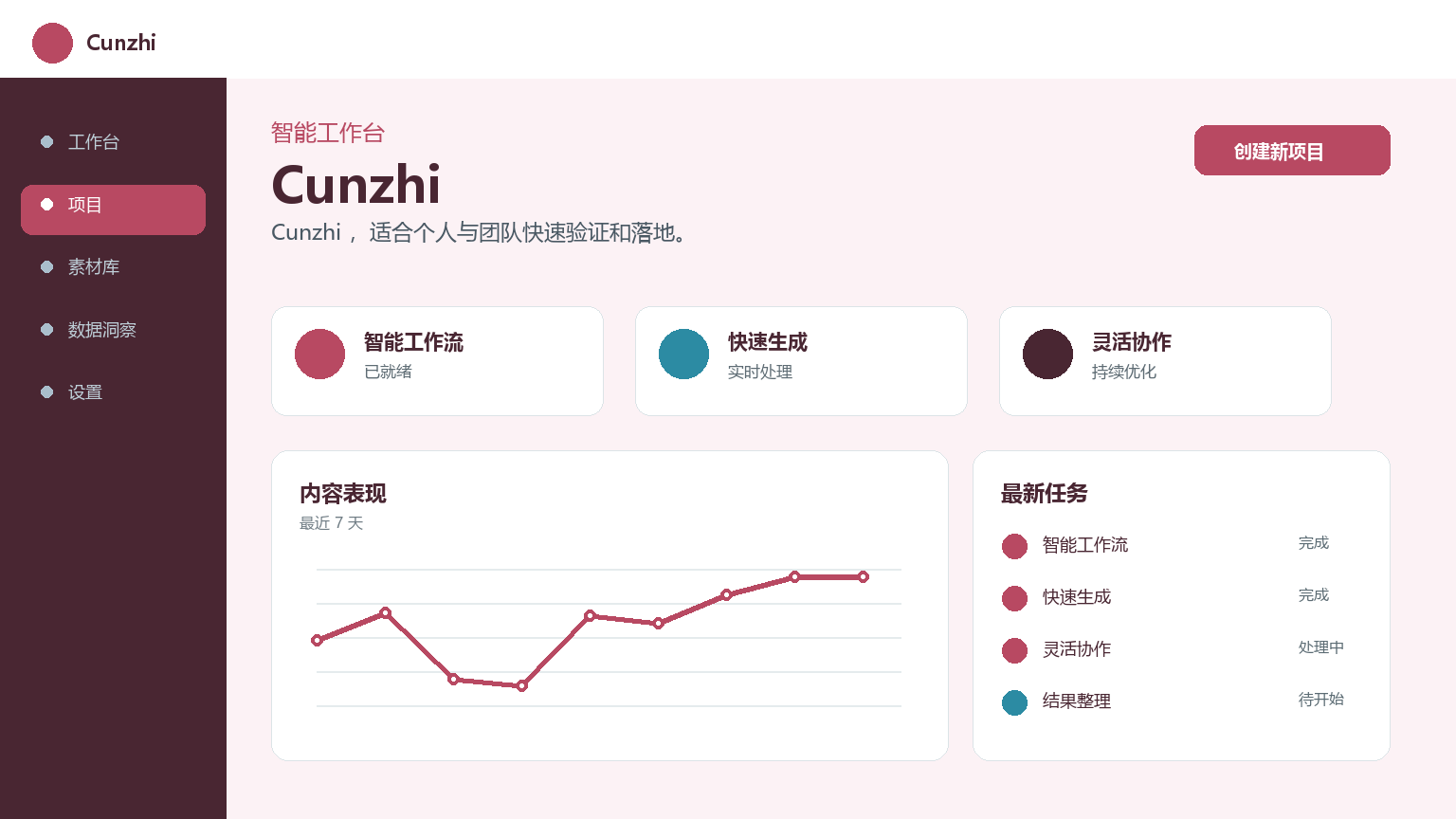
Cunzhi (cunzhi)
Core parameters and statistics
| Project | Specifications |
|---|---|
| Product Name | Cunzhi (Cunzhi) |
| Category | AI Knowledge Management |
| Delivery form | Web/SaaS |
| Support Platform | Web |
| Supported languages | zh-CN, en-US |
| Target users | Knowledge workers, research teams, content managers |
| User scale | Undisclosed |
| Pricing Model | Freemium / Subscription |
Platform coverage and user scale data are based on the official real-time page and third-party statistics. The core positioning of Cunzhi (Cunzhi) can be seen from the product naming - the storage and management of knowledge. The starting point of differentiation lies in the word "intelligence": it not only provides storage space and search functions, but also uses AI to actively structure, associate and refine the stored knowledge.
User and market recognition
In the knowledge management track, there are many players on the market such as Notion AI, Mem, and Obsidian. Cunzhi's differentiation lies in "active knowledge association and discovery" - it is not just passive storage and retrieval, but actively reveals connections between items that users themselves may not have discovered through the knowledge graph. Functions such as automatic tag generation, relevance scoring between content, and knowledge graph visualization are all designed to address the core pain point of "information is easy to store but difficult to find".
Since the product is in a relatively early stage, there are currently limited publicly available user cases and third-party reviews. Potential users can import actual content for testing through the free version, focusing on the two core indicators of automatic parsing quality and retrieval hit rate.
Cost advantage
| Cost Dimension | Description |
|---|---|
| Free version | About 5,000 knowledge items, basic AI analysis, basic search |
| Personal version | 50,000+ entries, in-depth semantic analysis, map export, advanced search |
| Team Edition | Shared Knowledge Base + Member Rights Management + Collaborative Annotation |
Compared with self-built knowledge management systems (such as self-deploying Wiki.js or purchasing a Confluence license), Cunzhi has lower initial deployment costs (zero deployment) and operation and maintenance complexity (no need to maintain servers). Taking a team of 5 people as an example: the annual cost (server + license) of self-built Confluence is about 5,000-15,000 yuan, plus maintenance time of about 2 man-days/month; the annual subscription cost of using Cunzhi Team Edition is much lower than this. However, as a SaaS product, long-term usage costs will increase linearly with the amount of storage and number of members.
Main functions
- Intelligent knowledge collection and storage: Supports collecting content from multiple sources (webpage clipping, browser plug-ins, Markdown/PDF/Word file import, direct paste, API access), AI automatically parses and extracts key information (core concepts, key data, opinion summaries), and generates structured knowledge entries.
- Association Discovery and Knowledge Graph: Automatically analyze the semantic correlation between each knowledge item (similar themes, complementary concepts, opposing views, etc.), and build a visual knowledge map. The graph supports interactive exploration: click on a node to view details, drag the layout, and filter by correlation strength.
- Intelligent Q&A and retrieval: Semantic search and Q&A based on the existing knowledge base. Users can ask questions in natural language, and Cunzhi locates relevant fragments from the stored knowledge and gives answers. Semantic retrieval can understand the intent of the question and find relevant content even if the question is asked in a way that is inconsistent with the original statement.
- Knowledge item version management: Automatically save the version history every time you edit a knowledge item, and support going back to any historical version. Reference relationships between items are also automatically maintained with version updates.
- Content tags and custom classifications: In addition to tags automatically generated by AI, users can manually add custom tags and categories to form a hybrid model of "AI automatic classification + manual fine management".
Model and version evolution
| Version | Date | Key Changes |
|---|---|---|
| v1.0 (Public Beta) | 2026-07-14 | Multi-source import + map visualization + version management |
| v0.9 (internal beta) | — | Semantic retrieval + single source import |
The version record shall be subject to the official release notes. Early versions had problems with unclear segment boundaries and inconsistent concept extraction granularity in long document parsing. The current public beta version has significantly improved the automation of knowledge warehousing and retrieval accuracy.
Technical advantages
- Knowledge structuring driven by semantic understanding: Automatically extract concepts and relationships through semantic understanding, reducing the labor cost of knowledge storage. The user only needs to "save" it in, and the rest of the "organizing" work is left to AI.
- Real-time update of knowledge graph: When new content is added to the knowledge base, the graph relationship will be dynamically and incrementally updated instead of relying on full batch reconstruction. For a rapidly evolving research project, in a scenario where 50 new articles are added every week, the graph can instantly reflect the connection between new content and existing knowledge.
- Hybrid retrieval architecture: combines the advantages of keyword search (based on Elasticsearch's inverted index) and semantic search (based on vector embedding) to strike a balance between precise matching and fuzzy understanding. Users can adjust the weight preference of keywords/semantics.
- Incremental indexing and low latency: After new content is put into the database, the semantic index is updated within seconds, and the retrieval response time is usually controlled within 500ms.
- Data Privacy and Encryption: User data is stored using AES-256 encryption, and TLS 1.3 is used during transmission. Knowledge base data is isolated at the user level.
How to use
| Entrance | How to use |
|---|---|
| Web official website | Create a knowledge base after registration and save content by importing, pasting or browser plug-ins |
| Browser plug-in | Clip to Cunzhi knowledge base with one click when browsing web pages, automatically parse and classify |
Typical process: Visit the official website → Register an account → Create a knowledge base → Save content by importing, cutting or directly pasting → AI automatically parses and generates structured knowledge entries → View the correlation between entries in the knowledge graph → Obtain existing knowledge through search or Q&A.
Product Pricing
| Package | Price | Contents |
|---|---|---|
| Free version | $0 | 5,000 knowledge items, basic AI analysis, basic search |
| Personal version | — | 50,000+ entries, in-depth semantic analysis, map export, advanced search |
| Team Edition | — | Shared Knowledge Base + Member Rights Management + Collaborative Annotation |
Pricing. Compared to similar knowledge management tools (Notion AI $10/month, Mem $14.99/month), Cunzhi’s pricing is in the mid-range. The key to determining cost-effectiveness is how often the AI functionality is actually used.
Application scenarios
- Personal knowledge system construction: Researchers and analysts integrate information scattered from different sources into a unified knowledge base, and accumulate it over a long period of time (6-12 months) to form an important asset in the personal professional field - a "searchable, relevant, traceable" second brain.
- Industry Research and Competition Analysis: Industry analysts continuously import industry reports, news, competitive products and other materials, use knowledge graphs to quickly establish industry knowledge systems, and discover previously unnoticed connections.
- Team Knowledge Precipitation and Inheritance: Even if members move, core knowledge remains in the platform. Newcomers can quickly understand the project background and technical decisions through the knowledge base, and can quickly build awareness through natural language questions in the first week of employment.
- Learning and Research Note Management: Students and researchers can clip and save while reading through browser plug-ins. Fragmented learning materials can be automatically classified and sorted. During review, they can quickly review the connections between knowledge points through the knowledge map.
Applicable people
- Research Knowledge Workers: Analysts, researchers, technical writers and other people who need to frequently process large amounts of information and establish conceptual frameworks. When processing 20-50 information sources per week, information sorting time can be compressed from hours to tens of minutes.
- Small and medium-sized knowledge management team: A team of 5-10 people can complete the initial knowledge base construction within 1-2 weeks, changing the state of "information scattered in various chat records and emails".
- Lifelong Learners and Information Lovers: Individual users who have a lot of reading and information intake habits on a daily basis, Cunzhi serves as a "second brain" to help manage growing knowledge assets.
- Not suitable for boundaries: For large enterprises that already have mature Confluence or SharePoint architecture, Cunzhi is more suitable as a supplementary tool. Businesses storing highly sensitive information need to confirm that data storage, encryption schemes and compliance certifications meet internal security requirements.
Comparison of competing products
| Comparative Dimension | Cunzhi (Knowledge) | Notion AI | Mem |
|---|---|---|---|
| Core differences | Active knowledge association and discovery | AI-assisted writing and content creation | Automatically organize notes |
| Price | Freemium | $10/month | $14.99/month |
| Covered scenarios | Knowledge storage + association + retrieval | Document + database + AI | Notes + automatic organization |
| User Rating | Unpublished | High | Medium |
| Technical threshold | Low | Low | Low |
Summary and Outlook
With "intelligent knowledge management" as its core positioning, Cunzhi finds a valuable combination between traditional knowledge management tools and emerging AI capabilities. The current product has formed a preliminary closed loop of capabilities in the three directions of automatic knowledge structuring, association discovery and semantic retrieval. AI is responsible for "roughing" (automatic parsing and correlation), and users are responsible for "finishing" (review, addition, and adjustment).
Risk Disclosure: The product is in an early stage, and user cases and third-party evaluation data are not disclosed. The accuracy of knowledge extraction may not be ideal on long documents and complex concepts. In the future, we need to pay attention to whether the accuracy of knowledge extraction continues to improve, whether it can access more content sources (such as Feishu documents, DingTalk documents and other collaboration tools commonly used by Chinese users), and the mobile experience. It is recommended to start with the personal free version and spend 1-2 weeks importing actual content in daily work for testing, focusing on the two core indicators of "automatic parsing quality" and "retrieval hit rate".
Related tools:  CrewAI,
  LangChain
Version Info
- Public beta version :It is currently a publicly accessible version, and specific functions will be updated at a specific pace.
- earlier version :An early trial version, the core direction is consistent with the current version.
User Reviews