 DeerFlow
Free
DeerFlow
Free
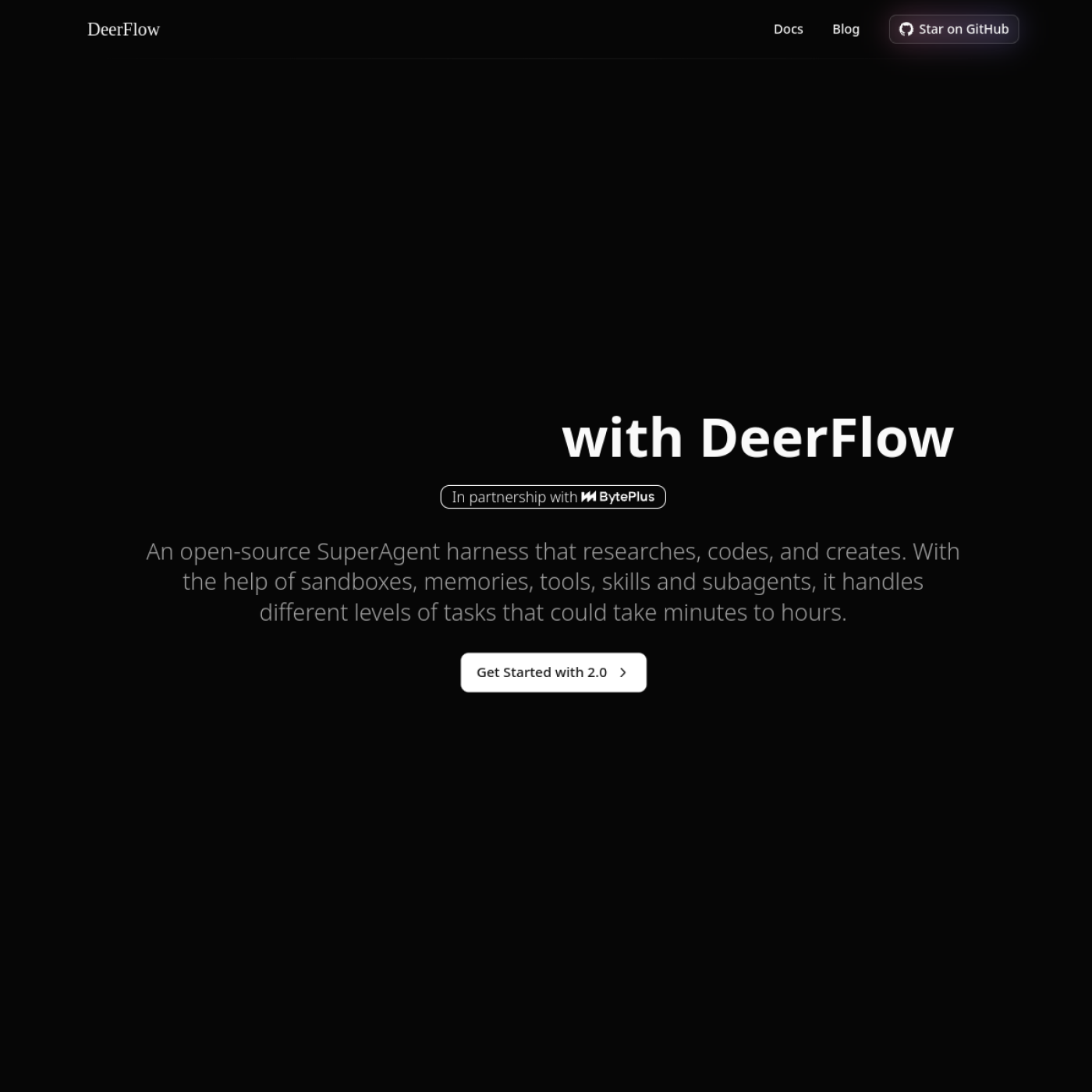
DeerFlow is ByteDance's open source AI agent framework. The official website describes it as "A LangChain-based framework for building super agents." The GitHub repository emphasizes that it is oriented to long-term task execution and has capabilities such as sandbox, memory, tools, skills, subagents, and message gateway.
DeerFlow
Core parameters and statistics
DeerFlow is ByteDance's open source long-range task SuperAgent framework. The official website describes it as "A LangChain-based framework for building super agents." The GitHub repository emphasizes that it is oriented to long-term task execution and has built-in capabilities such as sandbox, memory, tools, skills, subagents, and message gateway.
| Projects | Public Information |
|---|---|
| Official positioning | LangChain-based framework for building super agents |
| Mission form | long-horizon SuperAgent harness (long-range mission) |
| Core components | sandbox, memory, tools, skills, subagents, message gateway |
| Open Source Attribution | ByteDance Open Source Team Public Project |
| Community size | About 70,648 stars, 9,564 forks |
| Latest version | v2.0-m1-rc1 (2026-05-18) |
| Support Platform | Web, API |
Framework positioning: DeerFlow breaks down "long-range task execution" into a set of manageable framework capabilities, and builds SuperAgent for R&D and platform teams, rather than a lightweight assistant for end users.
Component combination: A combination of sandbox, memory, tools, skills, subagents, and message gateway, indicating that it is not a single Agent, but a framework skeleton that can carry complex task orchestration.
Official Endorsement: Released by the ByteDance open source team. The market has high expectations for its continued evolution, but the governance model still needs to be observed.
User and market recognition
DeerFlow has received high attention in the developer ecosystem, but enterprise implementation cases and business data have not been officially disclosed.
Community Popularity: GitHub API shows about 70,648 stars and 9,564 forks. For a newer Agent framework, the attention is already high.
Official Expectation: Released by the ByteDance open source team, making it more imaginative in terms of continuous investment and ecological expansion.
Evaluation premise: Attention only means "worth watching". Whether it can be put into production depends on whether the team really has long-term task requirements, whether it needs composite capabilities such as memory/subagents/sandbox, and whether there is engineering resource processing framework integration and tuning.
Cost advantage
- C-side/Individual: Usually a free version is provided to experience the core functions, and high-frequency use requires a paid package subscription.
- API/Developer: Billed by call volume, suitable for development teams that can be flexibly integrated into their own systems.
- Enterprise/Privatized: Contact the business owner for customized quotation and deployment plan. The specific price is subject to the official real-time pricing page.
Main functions
The core functions of DeerFlow revolve around long-range task orchestration, forming a framework skeleton:
- Sandbox: Provides an isolated execution context for long tasks.
- Memory: Maintain context across tasks across stages.
- Tools and Skills: Combine external tools and reusable skills.
- Subagents sub-agent: delegate complex tasks to multiple cooperating Agents.
- Message Gateway: Unified messaging and collaboration channel.
This set is suitable for research, coding, and authoring tasks that require multi-step reasoning, multi-tool invocation, and cross-stage context preservation. Three points should be paid attention to during acceptance: whether each component is easy to replace, whether the context memory is controllable, and whether the collaboration overhead between subagents is acceptable.
Model and version evolution
Continuous iterative updates, the latest version introduces performance optimization and new features. Historical version information can be viewed on the official release page. There is no complete public version evolution timeline yet. It is recommended to pay attention to the official announcement to understand the rhythm of feature updates.
Technical advantages
The technical advantage of DeerFlow lies in the complete modeling of the long task Agent structure, which can be broken down into two points:
Complete structure: It not only provides prompts and tool calls, but puts sandbox, memory, skills and subagents into a unified framework, so that complex tasks can be split, delegated, remembered and restored.
Engineering maintainability: The R&D team can turn complex Agent systems into maintainable projects instead of one-time experimental scripts.
The price is also clear: the more complete the framework capabilities, the higher the initial integration complexity, so it is more suitable for teams with platform requirements, rather than just pursuing the fastest demo scenario.
How to use
DeerFlow uses open source framework self-hosting as the main path, and the implementation method is as follows:
| How to use | Suitable for people | Features | Cost |
|---|---|---|---|
| Open source self-hosting | R&D and platform team | Complete framework, capable of in-depth secondary development | Model + infrastructure + engineering manpower |
| Community trial | Evaluation period team | Verify long task execution link | Free |
| Pro/Business Support | Team requiring enterprise support | Terms not fully disclosed | Business confirmation required |
When using it, don't pursue "full functionality" in the first round. A more reliable way is to lock a long task link first, run through the memory and tools paths, and then decide whether to introduce subagents to judge whether the complexity of the framework is worth its upper limit.
Product Pricing
The pricing model is subject to the official real-time page. Usually a freemium or subscription system is used, and basic functions can be used for free. Advanced functions or high-frequency use require paid subscriptions, and users are advised to evaluate the optimal solution based on actual usage.
Application scenarios
DeerFlow is suitable for tasks that require maintaining goals and context for a long time:
- Long-term research: continuous research, information integration, and multi-source analysis.
- Complex Coding: Engineering assistants that require splitting steps, calling tools, and persisting context.
- Creative tasks: multi-stage generation, modification and delivery.
If the task is just a round of Q&A or a single API call, the advantages of framing will be difficult to realize.
Applicable people
DeerFlow is suitable for three types of roles:
- Agent Platform R&D Team: Do complex task orchestration and long-term execution.
- Technical Organization: Build long-running research or coding assistants.
- Teams pursuing plasticity: Willing to accept framework-level integration costs in exchange for higher degrees of freedom.
Scenarios that are less suitable are: there is no secondary development capability, the business only requires light Q&A, or the project cannot accept the RC/milestone version rhythm. The upper bound capabilities of the framework in these cases are not sufficient to offset the engineering complexity.
Summary and Outlook
The value of DeerFlow lies in systematizing the key components required for long-range task Agents. It is suitable for teams that want to take Agents from experiments to platform-level projects. Its advantage is not its low threshold, but its complete structure and scalability. Coupled with ByteDance's open source endorsement and active community, it has the potential to evolve in the direction of the SuperAgent framework.
If you want to implement it, it is recommended to first fix a 2.0 candidate tag for internal sealing, run through memory and tools on a long task link, and then decide whether to introduce subagents and expand the scale; before formal adoption, you still need to confirm the stability of the commercial support terms, RC version, and the operating costs of each component under production load.
Related tools:  CrewAI,
  LangChain
Version evolution of DeerFlow
DeerFlow currently does not have a traditional Releases list, but the official tag clearly gives the main line of the 2.0 milestone.
2.0 Milestone
- v2.0-m1-rc1 (2026-05-18): The latest candidate version, indicating that 2.0 is converging.
- v2.0-m1-rc0 (2026-05-04): The first batch of candidate nodes for 2.0.
- v2.0-m0 (2026-04-12): An early version of the 2.0 milestone, which can be used as a starting point for evolution.
Since the main line is still in the milestone/RC form, it is best to fix the tag for internal sealing and secondary packaging before entering production, rather than letting the framework continue to change with the remote end.
Version Info
- DeerFlow v2.0 milestone 1 RC1 :The latest public tag currently corresponds to the candidate version of the 2.0 milestone, showing that the project is still rapidly advancing its mainline capabilities.
- DeerFlow v2.0 milestone 1 RC0 :The previous release candidate of the 2.0 milestone can be used to observe the cadence of revisions between release candidates.
- DeerFlow v2.0 milestone 0 :The 2.0 milestone is an earlier node, used to review the evolution and stabilization process of mainline capabilities.
User Reviews