 Food Mood
Free
Food Mood
Free
Food Mood is a creative recipe generation tool launched by Google AI that allows users to fuse two different national cuisines, customize the dish category, number of diners, specific ingredients and dietary preferences, quickly generate unique recipes and provide detailed ingredient lists, production steps and exquisite illustrations.
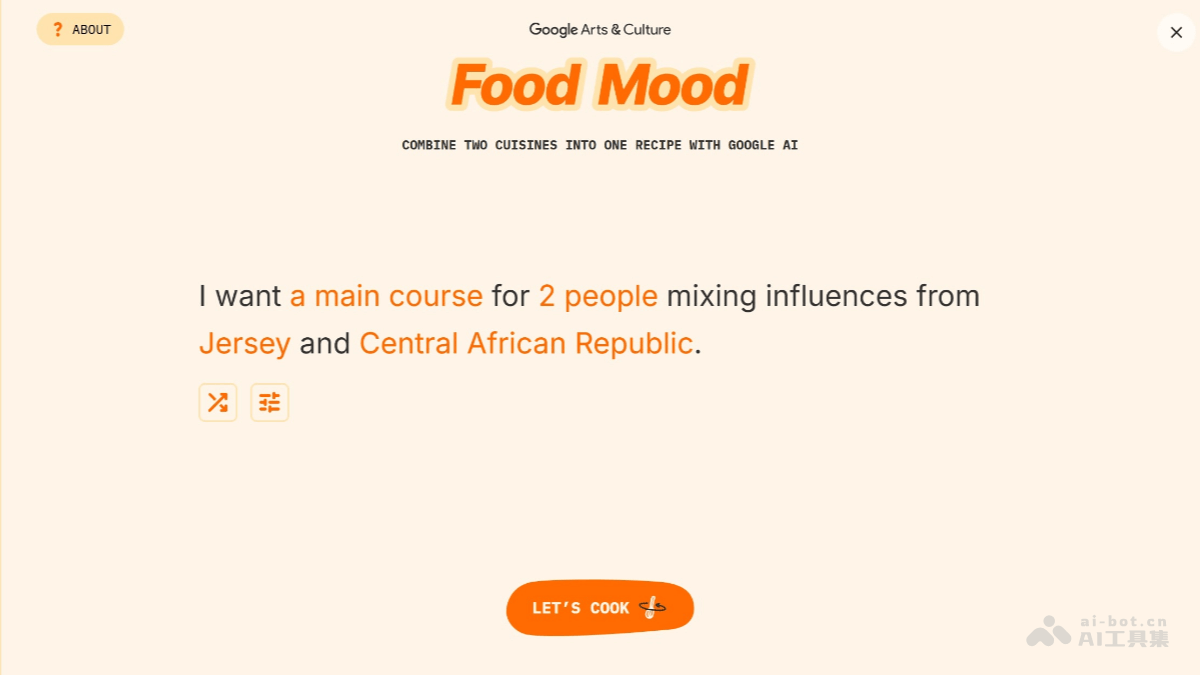
Food Mood — Google AI creative recipe fusion generation tool
Core parameters and statistics
Food Mood is a creative recipe generation experimental project launched by Google AI through the Google Arts & Culture platform. Its core logic is not to search for existing recipes, but to "fuse" two different national cuisines and use AI to generate new cross-cultural recipes. After the user selects a cuisine combination, sets the meal category and dietary preferences, the AI will output an original recipe containing a complete ingredient list, step-by-step preparation tutorials and exquisite illustrations. It does not solve the choice problem of "what to eat today", but the creation problem of "how to eat something new".
| Parameter item | Value |
|---|---|
| Developer | Google AI (Google Arts & Culture) |
| Product form | Web-side AI experimental project |
| Core Competencies | Dual Cuisine AI Fusion Recipe Generation |
| Supports cuisine combinations | Multi-national integration of Chinese, Italian, French, Vietnamese, Mexican, Japanese, Indian and Thai, etc. |
| Menu categories | Appetizers, soups, main courses, desserts |
| Dietary preferences | Vegetarian, gluten-free, etc. |
| Generate content | Ingredients list + step-by-step preparation steps + exquisite illustrations + practical tips |
| Is registration required | No registration required, use directly online |
| Access restrictions | Requires access to Google services |
From the perspective of product form, Food Mood is not a complete commercial application, but a creative demo of Google’s internal “AI Experiment” series. This means that its functional scope is focused and interactions are lightweight, but it does not provide product-level functions such as user system, collection history, and community interaction. Its technical value is more reflected in AI's understanding of cross-cultural cooking knowledge and its ability to creatively recombine, rather than its large-scale service capabilities.
User and market recognition
Food Mood is an experimental project of Google Arts & Culture, and its user base is tied to the organic traffic of the Google platform. Since there is no need to register or log in, any user with access to Google services can experience it directly. After the project went online, it gained high attention among food lovers, cooking creative communities and AI experiment enthusiasts. Users generally report that the most attractive aspect is the "unexpected cross-cultural combinations" - such as the fusion of Chinese food and Italian food, and the collision of Mexican and Japanese food. These combinations are almost impossible to appear on traditional recipe platforms.
It should be noted that Google does not separately disclose Food Mood’s user data. As an experimental project, it does not have an independent marketing budget or operations team. Its influence mainly relies on internal distribution on the Google Arts & Culture platform and spontaneous spread on social media. In the field of AI cooking creativity, it is one of the pioneer explorers and has few similar competitors.
Cost advantage
| Comparison dimensions | Food Mood | Traditional recipe platforms (such as AllRecipes) | General AI assistants (such as ChatGPT) |
|---|---|---|---|
| Cuisine fusion capabilities | Native support, AI automatically generates cross-cultural recipes | Only supports search for existing recipes | Users are required to manually describe fusion requirements |
| Cost of use | Completely free, no registration required | Free basic version + subscription 5–15 USD/month | Free quota + subscription 20 USD/month |
| Visual output | Each recipe comes with AI-generated illustrations | User uploads photos or no illustrations | Plain text, requires a plug-in to generate images |
| Operation threshold | Select cuisine + category to generate | Search and filter required | Accurate prompt words required |
| Generate uniqueness | Each combination may produce a new recipe | Only search existing content | Depends on prompt word quality |
Food Mood's zero-threshold usage (no registration required, free, no need to learn prompt skills) gives it an obvious friction advantage in the scenario of "quickly getting cooking inspiration". Traditional recipe platforms rely on user-generated content (UGC), and the degree of integration is limited by user uploads; although general AI assistants can also generate fusion recipes, they require users to design prompt words themselves and do not have accompanying pictures. Food Mood compresses the entire process into 2–3 clicks, which is its core cost value.
Main functions
- Dual Cuisine AI Fusion: Select two different national cuisines (such as Chinese + Italian, French + Vietnamese, Mexican + Japanese), and AI will automatically analyze the characteristics of the two cooking systems and generate fusion recipes. This is not a simple mixing, but a cross-cultural adaptation at the level of ingredient matching principles, cooking techniques and seasoning logic. For example, Chinese-Italian fusion may retain the form of pasta but use Chinese seasonings and ingredients.
- Dish Category Selection: Supports four categories: appetizer, soup, main course, and dessert. The same group of cuisine fusion will show completely different creative directions under different categories. For example, the appetizer of "French-Vietnamese fusion" may be a French-style version of Vietnamese spring rolls, and the main course may be French sauce with Vietnamese herbs.
- Number of diners and ingredient specification: The number of diners (1–8 people) can be set, and AI will automatically adjust the amount of ingredients in proportion. It also supports adding specific ingredient keywords, allowing AI to prioritize the use of specified ingredients within the integration framework, increasing controllability.
- Dietary Preference Adaptation: Supports two common dietary preferences, vegetarian and gluten-free. When turned on, AI will adjust protein sources and flour ingredients to ensure that recipes comply with corresponding dietary restrictions. It should be noted that this is not comprehensive allergen management, and manual verification is still required if there are special dietary needs.
- Random inspiration generation: If the user does not have a specific fusion direction, the random mode can be used to allow the AI to freely combine cuisines and categories to explore inspiration. Randomization can produce completely unexpected combinations every time, perfect for when you lack creative direction.
- Detailed recipe output: Each generation includes a complete ingredient list (including dosage), step-by-step production steps (including time/temperature tips), exquisite illustrations (AI-generated dish display) and practical tips (replacement ingredients, storage methods, precautions). Output structure clear
It is clear and can be used directly for cooking practice.
Model and version evolution
Food Mood is an experimental project of Google Arts & Culture. Unlike traditional commercial software, it does not have a traditional version number system. The following is based on publicly accessible time points:
| Milestones | Approximate time | Change points |
|---|---|---|
| Initial public version | ~2025-06 | Launched on Google Arts & Culture platform, supporting basic two-cuisine fusion function |
| Current version (1.0) | ~2025-06 to present | Continuous maintenance, core functions are stable, no major version updates |
Since it is an experimental project, Google has not announced a specific version update log or iteration route. Judging from product performance, the current version can stably handle the fusion generation of multiple cuisine combinations, and the illustration quality and recipe rationality remain at usable levels. Whether there will be subsequent functional expansion depends on Google's resource investment strategy for the project.
Technical advantages
The technical value of Food Mood does not lie in the size or computing power of the model, but in AI’s ability to understand and creatively apply cross-cultural cooking knowledge:
- Structured cooking knowledge: Google AI needs to transform the ingredient systems, cooking techniques, seasoning logic and presentation methods of different cuisines into computable structured representations. For example, how to find a balance between the "tomato sauce base" of Italian cuisine and the "soy sauce + cooking wine" seasoning system of Chinese cuisine - this requires AI to not only understand the knowledge of a single cuisine, but also to identify the compatibility, conflict and complementary relationships between the two systems.
- Multi-modal content generation: Rather than pure text generation, Food Mood simultaneously outputs structured ingredient lists, step-by-step cooking instructions, and AI-generated dish illustrations. The consistency of style between text and illustrations is a major technical challenge - AI needs to ensure that the ingredients and presentation in the illustrations match the text descriptions, to avoid the inconsistency problem where the text says "grilled salmon" but the illustrations show "boiled fish soup".
- Creative generation under constraints: Unlike the free creation of general AI, Food Mood needs to meet multi-dimensional constraints: cuisine combination + dish category + number of people + ingredient specification + dietary preferences. Reasonable and interesting recipes can still be generated under the combined effect of these constraints, which places high demands on AI's combinatorial reasoning capabilities. This is also the core difference between Food Mood and general AI assistants - the latter performs well when the degree of freedom is high, but easily ignores some conditions in multi-constraint scenarios.
From an engineering perspective, the technical link of Food Mood is: user selection → constraint combination → calling the underlying large model to generate text recipes → calling the image model to generate accompanying images → structured output presentation. The entire link has high real-time requirements, and Google has not disclosed the specific model stack and response time data.
How to use
| Entrance | Address | Instructions |
|---|---|---|
| Web page | https://artsandculture.google.com/experiment/food-mood/HwHnGalZ3up0EA, hl=en | Direct access, no need to register and log in, you need to be able to access Google services |
Typical usage steps:
- Open the above link and enter the Food Mood experiment page.
- Select two cuisines you want to combine (such as "Chinese + Italian", "French + Vietnamese", etc.), or click "Random" to let the AI combine it by itself.
- Select the menu category: Appetizer, Soup, Main Course or Dessert. If you are not sure, you can choose random mode.
- Set the number of people to eat (1–8 people), and optionally fill in keywords for specific ingredients.
- If necessary, enable "vegetarian" or "gluten-free" dietary preferences.
- Click Generate and wait for the AI to output the complete fusion recipe. The generated results include ingredient lists, step-by-step preparation steps, and dish illustrations.
- The parameter combination can be adjusted repeatedly, and a completely different recipe may be obtained each time it is generated.
Note: Since it is deployed on the Google platform, direct access in mainland China may require network boundary adaptation.
Product Pricing
Food Mood is an experimental project of Google Arts & Culture and is currently completely free and open to all users. No registration, no payment, no usage limit. Users can adjust the cuisine combinations, categories and preferences at will, and generate different fusion recipes unlimited times.
Since this is an experimental product and not a commercial SaaS, Google does not offer any paid upgrade options or enterprise plans. All features are provided for free, but there is no service level agreement (SLA), technical support or data retention guarantees. If Google subsequently adjusts the operational strategy of the project (such as offline experiments or migrating to paid products), user data (such as collected recipes) may not be migrated. It is recommended to save the generated recipe content yourself.
Application scenarios
- Cooking Inspiration Exploration: When traditional recipe platforms can no longer provide a sense of freshness, Food Mood’s cuisine fusion function can produce unexpected combinations. Perfect for home cooking scenarios where you want to try new flavors on the weekends. For example, use "Mexican + Japanese" fusion to make a creative dinner, and the finished product may include novel combinations such as miso enchiladas.
- Food content creation: Food bloggers and cooking video creators can use Food Mood to generate unique fusion recipes as video topics. AI-generated cross-cultural combinations are topical and help spark discussions on social media. The illustrations that accompany each recipe can also be used directly on the cover or as content material.
- Special Diet Adaptation Exploration: Users with vegetarian or gluten-free needs can use Food Mood to explore the possibility of integrating different cuisines within these two restrictions. For example, the "Indian + Italian" vegetarian fusion may produce curry-flavored pasta or vegetarian pizza, enriching the variety of daily choices.
- Cooking Education Aid: Cooking teachers and nutrition educators can use the fusion recipes generated by Food Mood as teaching cases to show students the commonalities and differences between different food cultures. For example, analyzing the balance points of the two seasoning systems in Chinese-Italian fusion is more intuitive than purely theoretical explanations.
Applicable people
- Food Lovers and Home Cookers: This is the largest user group. For home cooks who like to try new dishes but lack creativity, Food Mood offers a low-risk way to explore – where dissatisfaction can be regenerated and no ingredients are wasted. However, it should be pointed out that the practicality of some steps in recipes generated by AI may differ from the experience of professional chefs, and beginners may need to adjust the heat and time according to the actual situation.
- Food content creators: Food bloggers, short video creators, and recipe writers can use the AI-generated fusion recipes as a starting point for topic selection, and then conduct secondary optimization and real-life shooting based on their own experience. It can greatly shorten the cycle of "creative idea → recipe finalization".
- Culinary Educator: Used for teaching demonstrations on cross-cultural food culture, showing the possibilities of fusion of different cuisines. However, it is not recommended to use AI-generated recipes directly in professional cooking textbooks, as they lack verification by professional chefs.
- Not applicable to the group: Users who pursue traditional and authentic recipes (Food Mood produces a creative fusion, not the authentic practice of traditional cuisine); people who have strict allergen management needs (the tool does not support comprehensive allergen filtering); users who need a structured recipe database search (it is not a recipe collection and cannot search existing recipes).
Summary and Outlook
Food Mood is a lightweight experiment from Google AI at the intersection of food and creativity. With a very low threshold for use—no registration, no prompt words, free to use—it provides users with a creative tool to explore the possibilities of cross-cultural cooking. Its core value does not lie in the perfection of recipes, but in breaking through the "existing content" boundaries of traditional recipe platforms and using AI's creative combination capabilities to generate fusion solutions that did not exist before. This product logic of "AI as a creative amplifier" is different from the current mainstream AI tools' pursuit of efficiency improvement.
Current limitations and uncertainties: As an experimental project, Food Mood lacks continuous product iteration commitment and commercial guarantee; the practical reliability and nutritional integrity of the recipes have not been professionally verified, and there may be missing details in the steps in complex recipes; the coverage of regional niche cuisines is limited; and it is limited by the access conditions of the Google platform. In addition, the copyright ownership of AI-generated recipes is unclear—whether users can use the generated recipes for commercial publishing or video monetization needs to refer to Google’s terms of service.
Procurement/Adoption Risk Assessment: For individual users, Food Mood has zero cost, zero threshold, and no procurement risk. It is worth experiencing as a cooking inspiration tool. For users who intend to use it for commercial content creation, it is recommended to read the terms of Google Arts & Culture before use to confirm the scope of commercial authorization for AI-generated content. For professional catering or nutrition institutions, Food Mood currently does not have sufficient reliability verification and customization capabilities and is not suitable for introduction as a production-level tool. If Google later upgrades it from an experimental project to an independent product (such as opening an API or launching a paid version), it can then re-evaluate its commercial maturity.
Related tools:  CrewAI,
  LangChain
Version Info
- public version :Google Arts & Culture experimental project supports dual cuisine fusion, category selection, number setting, ingredient addition and dietary preferences, and randomly generates unique recipes.
- initial version :There is no official precise date yet. The initial version is released to the public, supporting basic cuisine fusion and recipe generation functions.
User Reviews