 Fourier N1
Free
Fourier N1
Free
Fourier N1 is the first open source humanoid robot platform released by Fourier Intelligence. He is 1.3 meters tall, weighs 38 kilograms, has 23 degrees of freedom, is equipped with an FSA 2.0 integrated actuator, and has a maximum stable running speed of 3.5 meters/second. Synchronize open source bill of materials (BOM), design drawings, assembly guides and basic operating software to provide global developers with a complete humanoid robot research and secondary development platform.
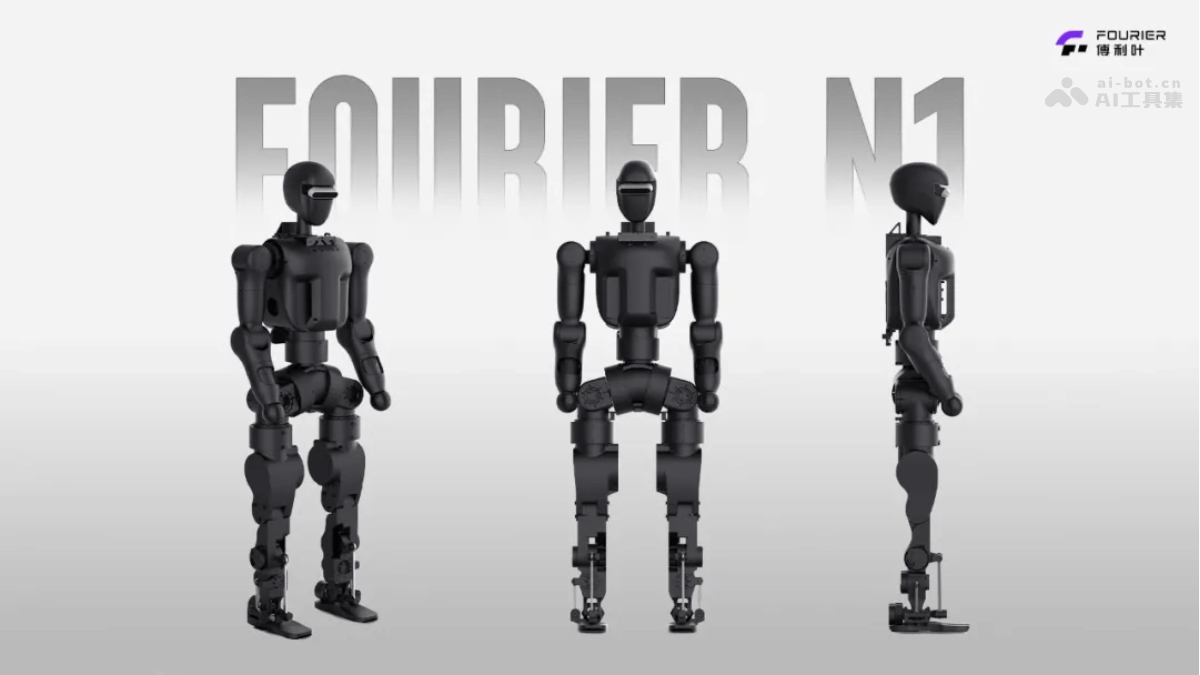
Fourier N1 — Fourier’s open source humanoid robot platform
Core parameters and statistics
Fourier N1 is the first open source humanoid robot released by the general robotics company Fourier Intelligence. Different from the closed humanoid robot solutions on the market, Fourier N1 not only provides a complete hardware body, but also synchronizes open source bill of materials (BOM), design drawings, assembly guides and basic operating software, allowing global developers to conduct secondary development and algorithm verification based on real hardware platforms.
| Parameter item | Value |
|---|---|
| Height | 1.3 meters |
| Weight | 38 kg |
| Degrees of freedom | 23 |
| Body material | Aluminum alloy + engineering plastic composite structure |
| Actuator | FSA 2.0 integrated actuator (self-developed) |
| Maximum stable running speed | 3.5 m/s |
| Battery life | More than 2 hours (removable battery on the back) |
| Terrain adaptation | 15°–20° slope access 20cm Stair climbing |
| Special abilities | Standing on one foot, climbing up on the ground |
| Development with context | Ubuntu 22.04 LTS, Python 3.11 |
| Communication protocol | Zenoh (supports User / Developer / PubSub three-layer interface) |
| Open source scope | BOM, design drawings, assembly guide, basic operating software |
From the perspective of technical architecture, Fourier N1 is designed around the dual-track design of "open source hardware + open SDK". On the hardware side, the self-developed FSA 2.0 actuator is used to achieve high dynamic response; on the software side, it provides a three-layer SDK interface—the application-oriented User interface (based on the Zenoh protocol), the Developer interface (Python) for underlying control, and the PubSub interface in the publish/subscribe mode, covering the full link requirements from algorithm research to product integration.
User and market recognition
Fourier N1 is positioned as the first mass-production open source humanoid robot platform for the global developer community. In the context of the rapid heating up of the Embodied AI track, N1 has entered the market with a "real machine open source" strategy. Unlike most solutions that only open algorithm simulations, developers can directly verify motion control, reinforcement learning and multi-modal interaction algorithms on physical robots.
As of mid-2026, Fourier N1 has been adopted by many university robotics laboratories as a teaching and scientific research platform, involving research directions such as motion planning, reinforcement learning training, and human-computer interaction. Its open source strategy lowers the hardware threshold for humanoid robot research—the price of a Fourier N1 is much lower than a customized humanoid robot experimental platform of the same specifications, and there is no need to design the mechanical structure and drive system from scratch.
In terms of engineering verification, N1 has completed more than 1,000 hours of outdoor complex terrain testing, with a single continuous operation time of more than 72 hours, and its structural stability and durability have been fully verified. This test duration is at the leading level among similar open source humanoid robots.
Cost advantage
| Comparative dimensions | Fourier N1 | Similar humanoid robots (such as Unitree H1) | Independent research and development experimental platform |
|---|---|---|---|
| How to obtain | Open source hardware + commercial machine purchase | Commercial machine purchase | Completely independent design and manufacturing |
| Development starting point | Ready to use, including SDK and documentation | Application/waiting required | R&D cycle of several months to several years |
| Software Ecology | Three-tier SDK + Open Source Community | Manufacturer’s Private SDK | Build by yourself |
| Hardware customizability | Open source BOM and drawings, can be modified | Closed, cannot be modified | Fully customizable |
| Initial investment | Medium (hardware purchase price) | High | Extremely high |
| Iteration speed | Community driven | Manufacturer driven | Self-research team driven |
For university laboratories and small and medium-sized robot startups, Fourier N1's "open source hardware + commercial machine" model provides the most cost-effective entrance to humanoid robot research. Developers can either directly purchase the entire machine for research, or carry out customized transformations based on open source design files - this flexibility finds a balance between purely commercial products and purely self-developed solutions.
Main functions
- Full body motion control: 23 degrees of freedom covering the neck, shoulders, elbows, wrists, hips, knees and ankles, simulating the movements of various parts of the human body. The FSA 2.0 integrated actuator achieves precise joint angle, speed and torque control, supporting a variety of gait and operation actions such as walking, running, turning, going up and down slopes, going up and down stairs, standing on one foot and climbing on the ground.
- Multi-modal interaction: Integrate multi-modal input channels such as voice, vision and touch, and can understand and respond to the user's voice commands, gestures and contextual tactile feedback. Multimodal fusion processing enables robots to make more natural interactive responses in dynamic environments.
- Open Source Hardware and Software Resource Package: Open source covers the complete bill of materials (BOM), structural design drawings (3D CAD files), assembly instruction manual and basic operating software. Developers can freely modify the design, replace parts or extend functions on this basis without being restricted by the manufacturer's closed ecosystem.
- SDK three-layer interface architecture: Provides User / Developer / PubSub three-layer API. The User interface is based on the Zenoh protocol and is suitable for upper-layer application development; the Developer interface provides a Python library to directly control joint movements; the PubSub interface supports efficient publish/subscribe data flow and is suitable for sensor data collection and remote monitoring.
- Reinforcement learning and model training support: The SDK has built-in docking capabilities with mainstream reinforcement learning frameworks. Developers can complete strategy training in a physical simulation environment and then directly deploy it to the N1 real machine for verification, shortening the Sim-to-Real migration cycle.
Model and version evolution
| Version | Release Date | Major Changes |
|---|---|---|
| 0.9 (Engineering Verification Version) | ~2025-01 | Engineering prototype verification, completing 1000+ hours of outdoor terrain testing |
| 1.0 (open source initial version) | ~2025-04 | The first open source version, open BOM/drawings/assembly guide/SDK, equipped with FSA 2.0 |
The evolution from 0.9 to 1.0 reflects the product's leap from engineering verification to mass production open source. Version 0.9 focuses on verifying the reliability of the mechanical structure, drive system and motion algorithm - more than 1,000 hours of outdoor testing covering a variety of unstructured terrains such as slopes, stairs, gravel roads, etc. Version 1.0, on the basis of mature verification, fully opens up the hardware design and software ecosystem to the outside world, turning to a community-driven iterative model. The future roadmap includes: actuator upgrades with higher load capacity, more sophisticated hand dexterity operation capabilities, and specialized kits for specific industries (such as logistics, inspection).
Technical advantages
The technical architecture of Fourier N1 revolves around the three dimensions of "high dynamic response + full-stack open source + layered SDK":
- Self-developed FSA 2.0 integrated actuator: Integrate motor, reducer, encoder and driver into a single module, reducing joint volume and wiring complexity. While ensuring high torque density, it also achieves low-latency torque response, which is the hardware foundation for N1 to achieve a running speed of 3.5m/s and precise posture control. Compared with the solution of outsourcing actuators, self-developed actuators have the initiative in cost control, supply chain stability and performance optimization.
- Aluminum alloy-engineering plastic composite structure: The fuselage uses an aluminum alloy frame to provide structural strength, and the outside is covered with engineering plastic to reduce the overall weight. The overall weight of 38 kg reduces the difficulty of transportation and deployment while ensuring motion stability, and also significantly reduces the power consumption and heat dissipation pressure of the robot.
- Three-layer SDK interface design: Unlike robot development kits with a single API, N1's SDK is designed with three levels of abstraction - the User interface hides underlying details and is suitable for quickly building applications; the Developer interface exposes joint-level control and is suitable for motion algorithm research; the PubSub interface provides efficient sensor data flow and is suitable for data collection and distributed system integration. Developers can choose the appropriate interface according to their role without wasting energy on unnecessary abstraction layers.
- Open Source Hardware Ecosystem: Completely open BOM and design drawings mean that the community can freely reproduce, modify and expand the N1 design. This strategy is analogous to Android’s open source model in the field of smartphones—attracting global developers by lowering entry barriers and accelerating the technology iteration and application scenario exploration of humanoid robots.
How to use
| Entrance | Address | Instructions |
|---|---|---|
| Project official website | https://fourier-grx-n1.github.io/ | Project homepage, providing document entry and quick start guide |
| SDK Documentation Site | https://fftai.github.io/fourier-grx-N1/ | Complete SDK usage documentation API reference and sample code |
| GitHub repository | https://github.com/FFTAI/fourier-grx-N1 | Open source code repository, including SDK source code and firmware |
| Hardware procurement | Fourier official website (https://www.fftai.com/) | Machine procurement and business consulting |
Typical getting started process
- Hardware initialization: After unboxing, install the back battery (plug-in design, no tools required), press the power button to start the robot, and log in to the system through a network connection.
- SDK installation: Install Fourier-GRX-N1 Python SDK in Ubuntu 22.04 LTS environment. Python 3.11 is recommended.
- Run Sample: Select the appropriate interface level (User / Developer / PubSub) from the SDK sample code to run the basic joint control or motion demonstration program.
- Firmware Calibration: Complete the robot calibration operation according to the SDK documentation, including joint zero position calibration and sensor offset correction.
- Secondary development: Develop motion algorithms based on the Developer interface, or build upper-layer applications based on the User interface; support training strategies in the simulation environment and then deploying to real machines.
- Model training: Use the training module of the SDK and the reinforcement learning framework to complete the entire Sim-to-Real process of the sports strategy.
Product Pricing
The pricing model of Fourier N1 is "hardware complete machine fee + software open source free":
- Hardware side: Users need to purchase the complete machine hardware, and the specific price is based on Fourier's official commercial quotation (as of mid-2026, the complete machine price of similar open source humanoid robots usually ranges from tens of thousands to more than 100,000 yuan).
- Software side: The full set of software resources including SDK, firmware, design drawings and assembly guides are completely open source and free, released under MIT or similar loose license. Developers can use and modify it without paying any licensing fees.
- Community Resources: Documentation site, sample code and community forum are free and open. Enterprise-level technical support or customized development services need to be contacted separately.
This pricing strategy reduces the marginal cost of software usage and is suitable for on-demand purchasing in education and scientific research scenarios.
Application scenarios
- Robot Teaching and Research: Undergraduate and graduate laboratories majoring in mechanical engineering, electronic engineering and computer science can carry out course experiments and research projects in directions such as motion planning, reinforcement learning, multi-modal perception, and human-computer interaction based on Fourier N1. Expected benefits: The laboratory hardware platform can be set up in one or two weeks, shortened from one semester to one or two weeks. Students can directly verify algorithms on real machines instead of just staying in the simulation environment.
- Embodied Intelligence Algorithm Verification: Reinforcement learning and robotics researchers do not need to design and manufacture humanoid robot hardware by themselves. They can quickly verify motion control, navigation and obstacle avoidance, object manipulation and other algorithms based on N1's standard platform and SDK. Key Difference: Open source hardware means researchers can modify the design to fit specific experimental needs, which is not possible with commercial closed platforms.
- Open Source Community and Developer Ecosystem: Independent developers, maker teams, and geek enthusiasts who are interested in robots can obtain N1’s design resources in the open source community for personalized transformation or function expansion. Similar to the Arduino/ROS ecosystem, N1 aims to become the "standard reference platform" in the field of humanoid robots.
- Special Environmental Operation Prototype: In scenarios such as disaster rescue, construction site inspections, and high-risk environmental detection, based on the movement capabilities and open source features of Fourier N1, special robot prototypes adapted to specific tasks can be quickly modified for concept verification and functional demonstration.
- Rehabilitation Assistance Research: Relying on Fourier's accumulation in the field of rehabilitation robots, N1 can be used to study the application potential of humanoid robots in patient assistance, rehabilitation training guidance, etc.
Not suitable for boundaries: Fourier N1 is not a robotic arm system designed for batch operations in industrial production lines. It is not suitable for precision manufacturing scenarios that require extremely high repetitive positioning accuracy (<0.1mm) or ultra-large loads (>50kg); its 2-hour battery life does not support all-weather uninterrupted operations.
Applicable people
- Graduate students and scientific researchers in the field of robotics: Academic researchers who need a real humanoid robot platform to verify algorithms and collect experimental data. Compared with building from scratch, N1 provides standardized hardware abstraction, allowing researchers to focus on algorithm innovation rather than mechanical design.
- Undergraduate Teaching Team of Robotics Engineering: Teachers who offer courses in robotics, automatic control or artificial intelligence can design progressive experimental courses through N1's SDK examples and open source drawings. From assembly understanding to programming control to algorithm development, students can complete a complete learning process on the same platform.
- Embodied Intelligence Startups and Algorithm Teams: Startup teams that need to quickly verify the application scenarios of humanoid robots in the early product prototype stage. N1's open source hardware allows teams to customize hardware at a lower cost, rather than being bound by a manufacturer's closed ecosystem.
- Robotics Enthusiasts and Open Source Contributors: Independent developers who are familiar with ROS/Python can contribute code, share transformation plans or participate in firmware optimization through the N1 community. The quality and activity of the open source community will directly affect the development speed of the N1 ecosystem.
- Skills Competition Teams of Vocational Colleges: Robot competition teams can quickly build participating robot platforms based on N1's standardized hardware and open SDK, reducing the time loss in hardware debugging in preparation for competitions.
Summary and Outlook
With the vision of "the Android moment of humanoid robots", Fourier N1 attempts to break the long-standing closed ecosystem in the field of humanoid robots through a combination strategy of open source hardware design + layered SDK + commercial machine. Its core competitiveness does not lie in the ultimate in individual performance indicators - the running speed of 3.5m/s is not the fastest in the industry, nor is the 23 degrees of freedom the most - but in the fact that the three points of "real machine running, drawings fully open, and interface layering" have simultaneously achieved the engineering implementation of mass production. For university laboratories and the developer community, this is currently the only mass-produced open source humanoid robot that can fully verify the algorithm on real hardware and has the freedom to modify the design.
Current limitations include: 2 hours of battery life limits long-term outdoor tasks; the purchase price of the whole machine is still high for individual developers; the open source hardware ecosystem is still in its early stages, and the number of third-party modules and expansion solutions contributed by the community is limited; the depth of documentation and Chinese support for the underlying real-time control interface still have room for improvement.
[Purchase/Adoption Risk Assessment]: For teams planning to purchase Fourier N1, it is recommended to evaluate the following risk points before making decisions - ① Open source community maturity: N1's community is in its infancy, ready-made third-party extensions and fault solutions are relatively limited, and some technical problems may need to be checked by themselves; ② Supply chain dependence: The core actuator FSA 2.0 is developed and produced by Fourier, and spare parts procurement and maintenance services rely on the manufacturer's after-sales system; ③ Rhythm of technology iteration: The humanoid robot industry is still in a period of rapid evolution, and competing products with stronger specifications may appear in the next 1-2 years. It is necessary to evaluate the match between the life cycle of the platform and its own research and development cycle. It is recommended to conduct sufficient software adaptation verification through SDK documentation and simulation environment before purchasing to confirm that the stability and functional completeness of the SDK interface meet the research needs.
Judging from industry trends, as the implementation of embodied intelligence technology driven by large models accelerates, the demand for standardized hardware platforms for humanoid robots will continue to grow. If Fourier N1 can establish an ecological effect similar to ROS or Arduino around the open source community, it is expected to occupy a key ecological niche in the humanoid robot development platform track.
Related tools:  CrewAI,
  LangChain
Version Info
- Open source initial release :The first open source humanoid robot version, it simultaneously opens the bill of materials, design drawings, assembly guides and basic operating software; equipped with FSA 2.0 integrated actuator, it supports 23 degrees of freedom motion control and multi-modal interaction.
- Engineering verification version :The engineering prototype verification version has completed more than 1,000 hours of outdoor complex terrain testing, with a single continuous operation of more than 72 hours, verifying structural stability and environmental adaptability.
User Reviews