 FoxBrain
Free
FoxBrain
Free
FoxBrain is an industrial-grade reasoning large language model (LLM) launched by Hon Hai Research Institute (Foxconn). It is based on the Meta Llama 3.1-70B architecture and covers data analysis, mathematical reasoning, code generation and other functions. It is oriented to intelligent manufacturing, supply chain management and intelligent decision-making scenarios.
FoxBrain — Hon Hai Research Institute’s industrial-grade reasoning large language model
Core parameters and statistics
FoxBrain is the first Traditional Chinese industrial-grade reasoning large language model (LLM) launched by Hon Hai Research Institute (a subsidiary of Foxconn). It is based on the Meta Llama 3.1-70B architecture and uses 120 NVIDIA H100 GPUs to complete training within four weeks. Its core capabilities cover data analysis, mathematical reasoning, code generation, text summarization and question and answer dialogue, and are oriented to industrial scenarios such as intelligent manufacturing, supply chain management and intelligent decision-making.
| Parameter item | Value |
|---|---|
| Infrastructure | Meta Llama 3.1-70B |
| Parameter amount | 70B |
| Context window | 128K tokens |
| Training hardware | 120 × NVIDIA H100 GPU |
| Training time | About 4 weeks (2,688 GPU days) |
| Training data | 98B tokens high-quality Chinese pre-training data |
| Supported languages | Traditional Chinese (mainly), English |
| License | Llama 3.1 Community License |
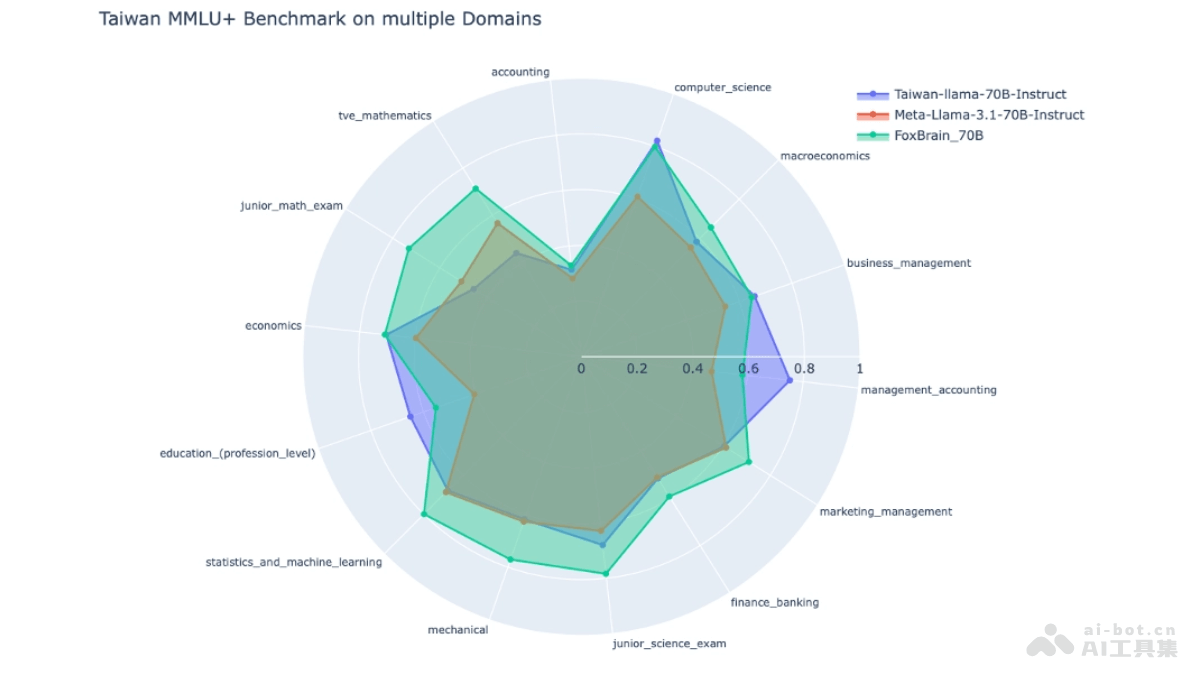
FoxBrain adopts an efficient training strategy and focuses on optimizing the training process rather than blindly stacking computing power. Through self-developed 24-category topic data enhancement methods and quality assessment methods, high-quality Chinese pre-training materials of 98B tokens were generated, and Adaptive Reasoning Reflection technology was used to train the model to learn autonomous reasoning. In the TMMLU+ test, FoxBrain outperformed the Llama-3-Taiwan-70B of the same size in most areas, especially in mathematics and logical reasoning.
User and market recognition
As Taiwan's first Traditional Chinese large language model with reasoning capabilities, FoxBrain has received widespread attention from the industry and academia since it was released by Hon Hai Research Institute in March 2025. The model performed well in the TMMLU+ academic benchmark test, surpassing Meta Llama 3.1-70B and Llama-3-Taiwan-70B of the same scale in the fields of mathematics and logical reasoning, demonstrating its powerful understanding and reasoning capabilities.
In July 2025, FoxBrain was officially open sourced on the Hugging Face platform (authorization required) and integrated into the NVIDIA NIM microservice architecture to facilitate developers to build customized applications based on the model. At the 2026 NVIDIA GTC Conference, FoxBrain demonstrated its application in the field of smart electric vehicles and announced a strategic cooperation with SAP to accelerate the implementation of enterprise AI in the Asia-Pacific region. The product is still in the early growth stage, and specific user numbers and corporate customer data have not yet been disclosed.
Cost advantage
| Comparative dimensions | FoxBrain (LLM) | Commercial closed-source large models (such as GPT-4) | Self-training open source models |
|---|---|---|---|
| Model architecture | Meta Llama 3.1-70B | Closed source proprietary architecture | Self-selection required |
| Training cost | Limited open source, 2,688 GPU days | Externally agnostic | Depends on computing power investment |
| Inference deployment | 2–8 H100 GPUs | API pay-as-you-go | Self-operation and maintenance |
| Chinese optimization | Specially optimized for Traditional Chinese | Universal multi-language | Need to fine-tune by yourself |
| License | Llama 3.1 Community (Free and Open Source) | Pay per Token | Depends on base model |
FoxBrain adopts an open source strategy and is released based on the Llama 3.1 Community License. Enterprises and developers can obtain model weights for free and perform deployment and secondary development. Compared with the ongoing cost of billing by token for large commercial closed-source models, FoxBrain's one-time deployment model has significant cost advantages in long-term large-scale use scenarios. At the same time, the model is specially optimized for Traditional Chinese and industrial scenarios, and can achieve performance close to the world's leading level in specific field tasks.
Main functions
- Multi-step reasoning (Chain-of-Thought): Using Adaptive Reasoning Reflection technology, the model can perform multi-step reasoning and logical inference, and performs well in mathematical problems, logic puzzles and complex decision-making tasks. Visual output that supports step-by-step thinking processes.
- Data Analysis and Understanding: Able to process structured data (table CSV) and unstructured text, and perform analysis tasks such as data classification, trend identification, and anomaly detection. Suitable for financial report analysis, operation data interpretation and other scenarios.
- Code Generation and Interpretation: Supports code generation, code review, and natural language interpretation in multiple programming languages. It can assist developers in locating bugs and optimizing code in function implementation.
- Traditional Chinese Optimization: Fine-tuned on the high-quality Taiwanese Traditional Chinese data set, it has a better understanding of Taiwanese language habits and cultural background, and the generated text is more suitable for the local context.
- Long context processing: Supports a context window of 128K tokens, which can process long documents, multiple rounds of conversations or large-scale code bases at one time, meeting the complex needs of industrial scenarios.
- VLLM Rapid Deployment: Supports efficient deployment through the VLLM inference framework, which can run with 2–8 H100 GPUs and has ultra-low latency inference capabilities.
Model and version evolution
| Version | Release Date | Major Changes |
|---|---|---|
| 0.9 (internal training version) | 2025-03 | Based on Meta Llama 3.1-70B, trained in 4 weeks using 120 H100 cards |
| 1.0 Preview (current version) | 2025-07 | Open source in Hugging Face, integrate NVIDIA NIM, support VLLM deployment |
Version 0.9 verified the feasibility of the efficient training strategy—it only took 2,688 GPU days to complete the training of the 70B parameter model, which is much lower than similar models. The 1.0 preview version further optimizes the inference capabilities based on model weights, and provides a complete VLLM deployment plan and API access guide. Subsequent Roadmaps include: Version 2.x gradually enhances industrial knowledge, domain-specific reasoning, and smart manufacturing expertise. The long-term goal is to build an AI basic model that truly understands manufacturing, automation, and smart city ecology.
Technical advantages
FoxBrain’s technical advantages are reflected in its efficient training strategy and special optimization for industrial scenarios:
- Efficient training strategy: Using 120 NVIDIA H100 GPUs through the NVIDIA Quantum-2 InfiniBand network for multi-node parallel training, it only took about 4 weeks (2,688 GPU days). Compared with similar 70B models that often consume tens of thousands of GPU days, FoxBrain has significant advantages in computing power efficiency. Through the 24-category topic data enhancement method established by independent technology, high-quality Chinese pre-training data of 98B tokens was generated.
- Adaptive Reasoning Reflection: Unique reasoning reflection technology, trains the model to learn autonomous reasoning instead of simple pattern matching. This technology significantly improves model performance in mathematical and logical reasoning tests, enabling it to surpass baseline models of the same size on TMMLU+.
- Industrial Scenario Adaptation: The model is specially optimized for Traditional Chinese and industrial fields, and is superior to general models in semantic understanding of manufacturing knowledge, supply chain management, smart decision-making and other scenarios. The context window of 128K tokens enables it to handle complete industrial documentation and technical specifications.
- NVIDIA NIM integration: Integrated into the NVIDIA NIM microservice architecture, developers can quickly build customized applications based on standard APIs without having to manage the underlying inference infrastructure.
This efficient training path focused on the industrial field allows FoxBrain to achieve near-world-leading performance at lower computing power costs in specific scenarios.
How to use
| Entrance | Address | Instructions |
|---|---|---|
| Hugging Face model page | https://huggingface.co/FoxconnAI/Llama_3.1-FoxBrain-70B | Download the model weights for deployment after applying for authorization |
| GitHub repository | https://github.com/Foxconn-Research/FoxBrain | Get deployment scripts and documentation |
| Announcement from Hon Hai Research Institute | https://www.honhai.com/zh-tw/press-center/press-releases/latest-news/1548 | Official release information |
Typical usage steps (based on VLLM deployment):
- Go to the Hugging Face model page to apply for authorization (you need to log in and agree to the license agreement).
- Install the VLLM inference framework (
pip install vllm==0.8.4). - Use VLLM to start the inference API service and configure the number of GPUs and context length of the model path.
- Use the standard OpenAI compatible API calling model to perform text generation, question and answer, code assistance and other tasks.
- The model can also be integrated into enterprise applications and deployed through the NVIDIA NIM microservice architecture.
- Check out the documentation in the GitHub repository and the Google Colab sample notebook to get started quickly.
Note: The model requires 2–8 H100 GPUs to run, and it is recommended to use an environment that supports CUDA.
Product Pricing
FoxBrain is released as open source based on the Llama 3.1 Community License, and the model weights are available for free (you need to apply for authorization at Hugging Face). Enterprises and developers can download models for deployment and secondary development without paying licensing fees.
The usage cost is mainly reflected in the infrastructure: running FoxBrain requires 2–8 NVIDIA H100 GPUs. According to the cloud service provider’s pricing, the GPU rental cost is about tens to hundreds of dollars per hour. For scenarios that require API calls, you can deploy your own VLLM service and bill based on Token usage. The cost is much lower than a commercial closed-source model with the same capabilities.
Application scenarios
- Intelligent Manufacturing Optimization: FoxBrain can be applied to production planning and scheduling, quality defect analysis, equipment predictive maintenance and other scenarios. By understanding the professional terminology and process flow in the manufacturing field, engineers can quickly locate production anomalies.
- Intelligent Supply Chain Management: Use the reasoning capabilities of the model to analyze supply chain data, identify potential risk points, and optimize inventory management and logistics scheduling. Integration with enterprise systems such as SAP further amplifies this value.
- Enterprise Knowledge Q&A: Based on the 128K context window, it can process long industrial documents, technical specifications and operation manuals, and build an intelligent knowledge base Q&A system within the enterprise.
- Code Assistance and Automation: Assist the development team in code generation, review and refactoring, especially to improve efficiency in manufacturing-related automated scripts and data analysis pipeline construction.
Applicable people
- AI Research Team: Researchers who want to conduct secondary fine-tuning or study on improving reasoning capabilities based on open source models. FoxBrain’s efficient training strategies and complete training method documents have high reference value.
- Manufacturing Enterprises: Industrial enterprises that need to deploy privatized large language models to process manufacturing data and optimize production processes. FoxBrain’s specialized optimization in industrial scenarios makes it a more suitable choice than general-purpose models.
- System Integrators and ISVs: Developers building AI solutions for enterprise customers can quickly deploy custom applications through FoxBrain’s NVIDIA NIM integration.
- Academic Institutions: Scholars and students who need the Traditional Chinese large language model for teaching or research. FoxBrain’s open source release lowers the barrier to research.
It should be noted that FoxBrain is still in the preview stage, and some functions are still being improved. The model is mainly optimized for Traditional Chinese and industrial scenarios, and its performance in general English tasks and other fields may not be as good as a general model of the same scale. Deployment requires certain GPU infrastructure and is not suitable for direct use by individual users.
Summary and Outlook
FoxBrain is Taiwan's first industrial-grade Traditional Chinese language model with reasoning capabilities. Its core value lies in training a 70B parameter model that is close to the world's leading level in the fields of mathematics and reasoning at extremely low computing power costs (2,688 GPU days). Through open source strategy and NVIDIA NIM integration, the threshold for enterprises and developers to use industrial-grade AI models is lowered. Current limitations include: it is still in the preview stage, and some functions are still being improved; the model is mainly optimized for Traditional Chinese and industrial scenarios, and the coverage of general fields is not as good as that of general models of the same scale; access rights require application review and are not yet fully open.
Directions worthy of attention in the future include: the gradually enhanced industrial knowledge and domain-specific reasoning capabilities of version 2.x, deep integration with enterprise systems such as SAP, and proprietary model variants for scenarios such as smart manufacturing and smart cities. As FoxBrain moves from preview to official release, its influence in global manufacturing AI applications is expected to further expand.
Related tools:  CrewAI,
  LangChain
Version Info
- Preview :The preview version, based on the Meta Llama 3.1-70B architecture, has capabilities such as data analysis, mathematical reasoning, code generation, text summarization, etc., and is open to partners for testing.
- Internal training version :For the internal training version, Hon Hai Research Institute used 120 NVIDIA H100 GPUs to complete training within four weeks, with basic reasoning and data analysis capabilities.
User Reviews