 FunGPT
Free
FunGPT
Free
FunGPT is an open source AI emotion regulation project based on the InternLM2.5 series of large models. It provides sweet talk mode and sharp talk mode, and supports LLM + ASR + TTS full-link interaction.
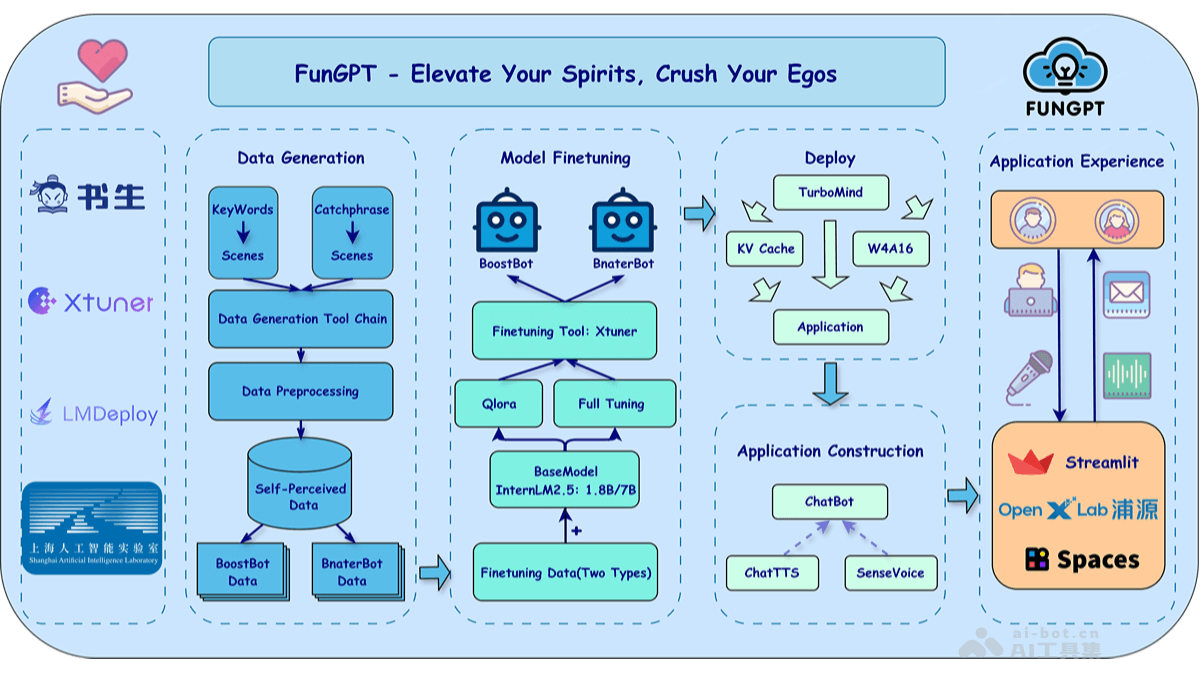
FunGPT
Core parameters and statistics
| Project | Details |
|---|---|
| Product Name | FunGPT |
| Product Type | AI Emotion Regulation / Open Source Project |
| Delivery Form | Open Source Code + Self-Deploying Web |
| Supported languages | Chinese, English |
| Basic model | InternLM2.5 (1.8B / 7B) |
| Target users | Developers, AI learners, emotional interaction researchers |
The above information is based on the GitHub warehouse and project README.
User and market recognition
FunGPT is a personal project open source on GitHub and has received 57 Stars and 10 Forks as of July 2026. The project is maintained by independent developer Alannikos and was originally used as a learning and practice project for the InternLM series models of the Shanghai Artificial Intelligence Laboratory.
- Open Source Community Recognition: The project was included in Chinese AI resource sites such as AI Toolset Navigation and received positive feedback from the community.
- Academic Research Positioning: The project clearly states that it is only for academic research purposes and does not involve commercial operations.
- Model Ecological Contribution: A total of 8 fine-tuned models of the BanterBot / BoostBot series were released on HuggingFace, covering 7B and 1.8B specifications and INT4 quantized versions.
Cost advantage
| Cost Dimension | Description |
|---|---|
| Open source and free | Open source based on the MIT license, free to use, modify and distribute |
| Self-deployment cost | Need to prepare GPU server by yourself (recommended A100 80GB or equivalent computing power) |
| Cloud model cost | Optional access to external APIs (such as ChatGLM4-Flash free quota) to reduce local inference costs |
As a purely open source project, FunGPT has no paid subscription or enterprise licensing fees. The main cost is the GPU resources and time investment required for local deployment. The project provides a 1.8B lightweight model and an AWQ INT4 quantized version that can run at lower configurations.
Main functions
- Sweet Talk Mode (BoostBot): Respond to users in a warm and complimentary tone to help improve mood and self-confidence. Based on the InternLM2.5 model fine-tuned with instructions, personalized praise content is generated.
- Sharp Talk Mode (BanterBot): Respond to users in a humorous and sharp tone, providing an outlet for emotional release. Supports imaginative ways of attacking people, which is both entertaining and entertaining.
- Full-link voice support: Integrated ASR (SenseVoice) speech recognition and TTS (ChatTTS) speech synthesis, supporting complete interaction of speech input → LLM processing → speech output.
- Model Quantization Deployment: Implementing AWQ INT4 quantization based on the LMDeploy tool can reduce the memory usage of the 7B model by about 60% and can also run on consumer-grade GPUs.
- Full-process teaching resources: Open source complete data generation, fine-tuning (LoRA/QLoRA), quantification, deployment code and documentation, accompanied by Bilibili video tutorials.
Model and version evolution
| Time | Milestones |
|---|---|
| 2024-09 | Completed initial single function testing of LLM (InternLM2.5), ASR (SenseVoice), and TTS (ChatTTS) |
| 2024-10 | Released the first fine-tuned version of BoostBot v1 and completed the Streamlit Web interface |
| 2024-11-10 | Release of 7B series models (BanterBot-7b-chat / BoostBot-7b-chat) |
| 2024-11-13 | Release of 1.8B series lightweight models |
| 2024-11-14 | Completed AWQ INT4 quantification of 4 models based on LMDeploy |
| 2024-11-19 | Integrate sensitive word processing module to enhance content security |
| 2025-05-29 | Fix path-related bugs and optimize the deployment experience |
| 2025-05-30 | Open source compliment fine-tuning dataset ComplimentCorpus |
The model family covers two product lines: BanterBot (Talk) and BoostBot (Sweet Talk). Each series provides a total of 8 models in standard version and INT4 quantized version in 7B and 1.8B specifications. All models are open for download from HuggingFace and OpenXLab.
Technical advantages
- Basic model selection: Using the InternLM2.5 series as the base model, it has an 8K context window and excellent Chinese understanding capabilities, and behaves naturally in Chinese emotional interaction scenes.
- Fine-tuning technology stack: Use the Xtuner tool for instruction fine-tuning and full-scale fine-tuning (LoRA/QLoRA) to support model customization on consumer-grade graphics cards. The 1.8B lightweight model further lowers the hardware threshold.
- Quantification deployment optimization: Implement AWQ (Adaptive Weight Quantization) INT4 quantization based on LMDeploy, which significantly reduces video memory usage and inference latency while maintaining model performance.
- Full-link architecture: LLM (core dialogue) + ASR (speech recognition) + TTS (speech synthesis) three-stage architecture, each module can be replaced and upgraded independently. Model loading/unloading mechanism optimizes GPU memory utilization.
- Streamlit Web interface: An interactive page is built based on Streamlit, supports dual-mode switching between sweet words and sharp words, and comes with a recording component for voice input.
How to use
FunGPT is an open source project and needs to be deployed by yourself. The following is the quick start process:
Situated requirements
- Operating system: Ubuntu 20.04+ (recommended)
- GPU: NVIDIA A100 80GB / equivalent computing power (quantized version can reduce requirements) -Python 3.10
Deployment steps
# 1. Clone the repository
git clone https://github.com/Alannikos/FunGPT
cd FunGPT

# 2. Create Conda context
conda create -n FunGPT python==3.10.0
conda activate FunGPT
pip install -r requirements.txt

# 3. Download the model (required for LLM, optional for ASR/TTS)
# LLM model example (version 1.8B):
git lfs install
git clone https://huggingface.co/Alannikos768/BanterBot_1_8b-chat LLM/weights/
git clone https://huggingface.co/Alannikos768/BoostBot_1_8b-chat LLM/weights/

# 4. Start the Web service
streamlit run app.py --server.address=127.0.0.1 --server.port=7860
Online experience
The project provides HuggingFace Spaces online demo: https://huggingface.co/spaces/Alannikos768/BoostBot-1_8B-chat-Demo
Product Pricing
FunGPT is a completely open source project (MIT license) without any subscription or licensing fees.
- Software Cost: $0 (free for open source)
- Hardware cost: Bring your own GPU server, the 1.8B quantitative version can run on consumer-grade graphics cards, and the 7B version recommends A100 level
- Optional API Cost: ChatGLM4-Flash free quota can be used for data generation without additional expenditure.
Note: The project clearly states that it is for academic research purposes only and commercial use is prohibited. If third-party code is involved, their respective open source licenses must be followed.
Application scenarios
- AI/LLM Learning Practice: Completely covers the entire process of data generation → fine-tuning → quantification → deployment. It is an ideal reference project for entry-level large model development. Supporting documentation and video tutorials lower the threshold for getting started.
- Emotional Interaction Research: Provides a reproducible experimental baseline for research on emotional computing and conversational AI's emotion regulation capabilities.
- Entertainment and Stress Reduction: Sweet talk mode is suitable for daily mood adjustment, and sharp talk mode can be used as a fun social interaction tool.
- Voice interaction prototype: ASR + LLM + TTS three-stage architecture can be used as a reference implementation of the voice dialogue system.
Applicable people
- AI Developer/LLM Learner: Technical personnel who want to practice the entire process of fine-tuning, quantification, and deployment of large models through complete projects.
- Academic Researchers: Researchers engaged in affective computing, human-computer interaction, and dialogue systems can use FunGPT as a baseline system.
- Open Source Enthusiasts: Individuals who are interested in AI emotional interaction and are willing to explore and contribute to open source projects.
Not suitable for the crowd:
- Users who need out-of-the-box SaaS products (FunGPT requires self-deployment, non-zero threshold)
- Teams pursuing serious commercial applications (projects are for academic use only and have no commercial support)
- Scenarios that require extremely high quality of generated content (the model has limitations in randomness and quantification accuracy)
Summary and Outlook
FunGPT is an open source AI emotion regulation project with complete functions and detailed documentation. It uses InternLM2.5 as the base and realizes two interesting interaction modes of sweet words and sharp remarks through LoRA/QLoRA fine-tuning. The greatest value of the project is that it provides LLM learners with a complete practical path from data preparation to model quantitative deployment.
Future plans include supporting GPT-SoVITS speech synthesis, large model API access, improving data generation guidelines, and enhancing sensitive word filtering modules.
Procurement/Adoption Risk Assessment: FunGPT is positioned as an academic research and personal learning project. The MIT license allows free use, but the project has no commercial support team, no SLA guarantee, and no stable version release rhythm. Production bounded deployments are responsible for GPU cost and maintenance. It is recommended that this project be used as a learning and prototyping tool rather than a critical business dependency.
Related tools:  CrewAI,
  LangChain
Architecture design and technology selection
As an open source project, FunGPT's architecture design, community health, and operation and maintenance maturity are core dimensions that need to be comprehensively considered when selecting technology. The following is a systematic framework for assessing the production readiness of open source projects.
Architecture and Modular Design The architectural design of the project directly determines the flexibility of secondary development and integration. Projects that adopt microservices, plug-in or event-driven architecture usually have better scalability and functional isolation, making it easier for the team to expand and customize specific modules on demand; the monolithic architecture is simple to deploy, intuitive to operate and maintain, and is suitable for small-scale use and rapid verification. However, as functions increase, they may face problems such as increased maintenance complexity and accumulation of technical debt. It is recommended to read the project's architecture documents and developer guides before selecting, and evaluate the adaptability of the architecture design to the team's existing technology stack, as well as the scalability of the architecture as business grows in the future.
Community health and long-term maintenance The community health of an open source project is a key indicator of whether the project can be maintained and developed over the long term. It is recommended to comprehensively evaluate the following dimensions: the growth trend and absolute value of GitHub Stars (reflecting community attention and user base), the number and composition of contributors (the ratio of core maintainers to temporary contributors, ideally there are at least 3 active core maintainers), the median issue response time (ideally within 24 hours, reflecting the response efficiency of the maintenance team), PR merge rate and merge delay (reflecting the standardization and efficiency of project governance), and the time of the latest major Release (more than 6 Months without updates should be taken as a sign that project maintenance is stalled). An active community means faster bug fixes, more frequent feature updates, a richer third-party integration ecosystem, and it’s easier to get help from the community when you encounter problems.
Deployment, operation and maintenance and production readiness Production environment deployment needs to focus on evaluating the following aspects: the completeness of the Docker image and version labeling strategy (whether multi-architecture mirroring is provided), the availability and document quality of one-click deployment scripts (docker-compose, Helm Chart, Terraform, etc.), the number and management complexity of runtime dependent components (the more dependencies, the complexity of operation and maintenance increases exponentially), the integration support of monitoring and logging infrastructure (Prometheus indicator exposure, Grafana dashboard, structured log output), and complete documentation of backup, recovery, and high-availability solutions. It is strongly recommended to go through the entire deployment process in the test environment, strictly follow the documentation from scratch, verify the accuracy of each step and the compatibility of the environment, and put it into production after all functions have been verified.
Version Info
- Official release version :Based on the InternLM2.5 series model, it provides two emotional regulation modes: sweet words and sharp words, and supports the full link of LLM + ASR + TTS.
- initial version :Complete the initial testing and evaluation of LLM, ASR, and TTS single functions, based on the InternLM2.5_1.8b model.
User Reviews