 Gumloop
Free
Gumloop
Free
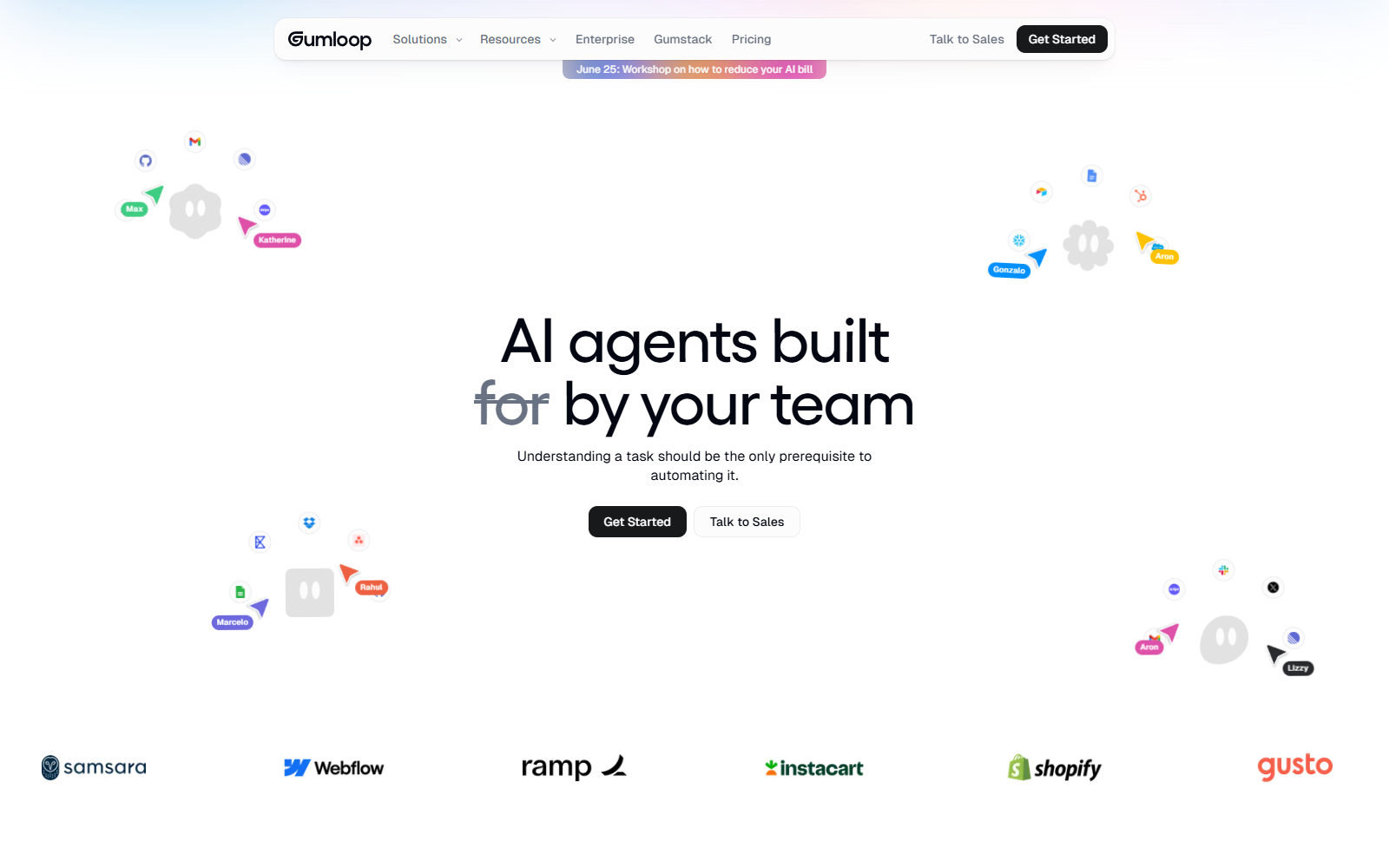
Gumloop is a team-oriented AI Agent and codeless workflow automation platform. It is officially positioned as "build and host AI-powered business automations" and supports the automation of repetitive processes such as sales, operations, support, and marketing through canvas Agents, Workflows, MCP integration, and team permissions.
Gumloop
Core parameters and statistics
At its core, Gumloop is not a single chatbot, but a combination of AI Agents, Workflow Canvas, Enterprise Tool Connectors, and Team Governance. The homepage of the official website positions it as an "AI Automation Framework" for building and hosting AI-driven business automation; the official documentation further splits the product into two basic concepts: Agents and Workflows. The former is an AI assistant that calls tools to complete tasks, and the latter allows these Agents to run according to plans, batches, or event triggers.
| Parameters | Current information | Sources and remarks |
|---|---|---|
| Official entrance | https://www.gumloop.com/ | Official website |
| Official positioning | No-code platform to build and host AI-powered business automations | Official website homepage and Pricing meta information |
| Product form | Agents, Workflows, Triggers, Interfaces, MCP, Hosted/Proxied MCPs | Official document directory |
| Main platform | Web, API | Official website and document entrance |
| Team/Company | AgentHub Inc. / Gumloop | Official website footer and YC company page |
| Home | US | YC company page shows San Francisco, CA, USA |
| Latest public update | 10.0.0, 2026-06-16 | Official Changelog |
| Price model | Free, Pro, Enterprise; stratified by credits/month and team capabilities | Official Pricing, the real-time price is subject to the official page |
For business users, the value of Gumloop lies in putting "model reasoning" into a reusable, triggerable, and auditable process. It’s suitable for automated tasks that require reading and writing data across multiple SaaS tools, require human confirmation midway, and are not worth developing separate backend services for each process.
User and market recognition
Official public materials do not provide operating indicators such as total number of users or ARR, so no speculation can be made on such data. Verifiable market signals mainly come from three categories: First, the Y Combinator company page shows that Gumloop belongs to the Winter 2024 batch and was founded in 2023. The founders are Rahul Behal and Max Brodeur-Urbas; second, the Use Cases page of the official website lists Agent scenarios for marketing, sales, operations, support, e-commerce and other teams; third, Shopify related case links appear in the customer case entrance of the official website, indicating that its narrative has expanded from personal automation to enterprise AI adoption.
| Dimensions | Exposed signals | Description |
|---|---|---|
| Incubation/Company Information | Y Combinator Winter 2024 | YC Company Page is authoritative startup company information |
| Founding Team | Rahul Behal, Max Brodeur-Urbas | Cross-verification of YC company page and Gumloop official About author information |
| Company Location | San Francisco, CA, USA | YC Company Page Public Fields |
| Scenario coverage | SEO, content, advertising, competitive product CRM, leads, meeting preparation, call analysis, support for Shopify operations | Official website Use Cases |
| Enterprise capabilities | Permissions, teams, audit MCP activities, organizational analysis SOC 2/GDPR and other security and governance signals | Official website and Changelog mentioned, the specific certification scope is subject to the official Trust page |
It’s important to note that Gumloop’s official narrative is closer to an “AI Agent builder for teams” than a traditional RPA or common Zapier-style integration tool. It emphasizes that Agents can run in Slack, Email, Microsoft Teams, standalone pages, and background triggers, which places its market position closer to enterprise Agent platforms.
Cost advantage
- C-side/Individual: Usually a free version is provided to experience the core functions, and high-frequency use requires a paid package subscription.
- API/Developer: Billed by call volume, suitable for development teams that can be flexibly integrated into their own systems.
- Enterprise/Privatization: Contact the business owner to obtain customized quotation and deployment plan. The specific price is subject to the official real-time pricing page.
Main functions
Gumloop's functions can be divided into five groups: Agent construction, workflow orchestration, enterprise integration, manual confirmation and governance analysis.
- Agent construction: Official documents define Agents as AI-powered assistants that use tools to solve tasks. They can configure models, tools, skills, and contexts, and are suitable for tasks such as sales research, support offloading, content generation, and data question and answer.
- Workflow orchestration: Connect modular components through a code-free canvas, support scheduled tasks, batch processing and event triggering, so that the Agent does not just stay in the chat window, but can automatically execute processes.
- MCP integration: The official MCP page shows that Gumloop provides 100+ fully hosted MCP servers, which can connect Claude, Cursor and Gumloop workflows, lowering the threshold for teams to deploy MCP by themselves.
- Human-machine collaboration: The 10.0.0 update adds Human-in-the-Loop for Agents. Agents can request human selection or confirmation during the task before continuing.
- Multi-channel deployment: Changelog display Agent can connect to Slack, Microsoft Teams, Email inboxes, and can also be published as an independent page through hosted pages.
- Team governance: The official update mentioned organizational skills, access requests, audit logs, role permissions Analytics Agent and MCP activity monitoring many times, which is suitable for scenarios that require team-level management.
Together, these capabilities form a "build to run to govern" package. For business teams, it’s not just about generating text, but putting AI into repeatable business actions.
Model and version evolution
Gumloop is a continuously iterative cloud service, but the official Changelog already provides clear version numbers and dates, so it can be recorded directly according to the official node. Recent updates show that the product focus is rapidly expanding from "codeless AI workflow" to "enterprise agents that can be hosted, governed, and can run across channels."
| Version Node | Date | Major Changes | Product Implications |
|---|---|---|---|
| 10.0.0 | 2026-06-16 | Human-in-the-Loop for Agents, Agent Chat Evaluations, Agent Composer Reconstruct Agent Code Sandboxes Accelerate Analytics Agent data expansion MCP Improvements | Strengthen Agent reliability, evaluability and human participation |
| 9.12.0 | 2026-06-09 | Agents in Microsoft Teams, Agent credit efficiency, audit log extensions | Expand enterprise collaboration channels and optimize large toolset costs |
| 9.8.0 | 2026-05-26 | Hosted Pages for Agents, HTML artifacts, multiple MCP integrations | Make Agents more like releasable small applications |
| 9.0.0 | 2026-04-27 | Agent Email Inboxes, Subagents, Organization Analytics Agent, new model support | Introducing multi-Agent collaboration and organization-level analysis |
At the model level, Gumloop will disclose new model support in the Changelog. Since model supply and package availability change rapidly, the specific available models are subject to the official in-app and Changelog.
Technical advantages
Gumloop's technical route emphasizes "engineering Agents." It does not hand over all tasks to a large model long link to complete, but separates determinable system actions from necessary model reasoning through nodes, tools, skills, triggers and MCP services. This design has three advantages.
First, the process is observable. Teams can track workflow running agent chats, credit consumption MCP activity and organization-level usage, rather than just getting an output that is difficult to review. Second, the integration boundary is clear. Hosted MCP and Proxied MCP make the connection method of enterprise tools more standardized, reducing the burden of each Agent handling OAuth, credentials and tool schema independently. Third, governance can be implemented. Capabilities such as role permissions, access requests, audit logs, organizational skills, and app policies make it easier for automated processes to enter real team contexts.
Judging from the official update rhythm, Gumloop is also continuing to improve the infrastructure capabilities of the Agent platform such as long-term task stability, sub-agent collaboration, manual confirmation, model selection, file and artifact management, etc.
How to use
Gumloop's entrance is mainly divided into product application, official document MCP page and sales/enterprise entrance. New users can start with the Free package or template scenario, while team users should first clarify the business processes to be automated, the system accounts involved, permission boundaries and manual confirmation points.
| Entrance | Address | Fit for task |
|---|---|---|
| Official website / Login | https://www.gumloop.com/ | Learn about the product, enter the web application, view templates and use cases |
| Official Documentation | https://docs.gumloop.com/getting-started/introduction | Learn Agents, Workflows, Triggers, Interfaces and MCP |
| MCP Integration | https://www.gumloop.com/mcp | See how 100+ hosted MCP servers connect to Claude/Cursor/Gumloop |
| Pricing | https://www.gumloop.com/pricing | Check real-time pricing credits and team benefits for Free, Pro, and Enterprise |
| Changelog | https://www.gumloop.com/changelog | Track Agent, MCP, model and enterprise capability updates |
The typical usage path is: select a business scenario, create an Agent or Workflow, connect the required applications and MCP tools, configure the triggering method and permissions, and then observe the output quality and credits consumption through small-scale operation. When it comes to customer data, email CRM writing or financial data, it is recommended to include a Human-in-the-Loop confirmation step.
Product Pricing
The pricing model is subject to the official real-time page. Usually a freemium or subscription system is used, and basic functions can be used for free. Advanced functions or high-frequency use require paid subscriptions, and users are advised to evaluate the optimal solution based on actual usage.
Application scenarios
Gumloop covers a wide range of scenarios, and marketing, sales, operations, support and e-commerce directions have been listed in the official Use Cases. What is more suitable for it is not one-time content generation, but work that "has to be processed repeatedly every week, every day, and every hour, and requires reading and writing across systems."
- Marketing and growth: SEO brief, content generation, advertising account audit, competitive product pricing and advertising monitoring, which can combine research, sorting, generation and reporting into a fixed process.
- Sales and CRM: CRM agent, lead generation, meeting prep, call analysis and other scenarios are suitable for automatically completing account information, summarizing calls, identifying objections and updating transaction records.
- Customer service and operations: Support agents can be used to triage issues, extract patterns, generate response drafts, and write the results back to work orders or team communication tools.
- Data and Management: Data Analysis Agent and Organization Analytics Agent can be used to ask questions and generate reports from business tools, files, and Agent activities.
- E-commerce operations: Shopify operations scenarios can connect inventory, advertising, customer support, and reporting tasks, allowing operations teams to reduce duplicate checks.
What these scenarios have in common is that the task structure is stable, but the input is different each time and requires a little reasoning and judgment. Gumloop uses Agent to handle judgment and Workflow/MCP to handle system actions.
Applicable people
Gumloop is suitable for three types of users. The first category is business team leaders who know which processes are repetitive, time-consuming, and could be standardized, but don’t want to develop requirements for each automation queue. The second category is front-line teams such as operations, growth, sales, and customer service, which need to string together multiple SaaS tools and hope that AI can automatically complete research, summary, updates, and reminders. The third category is the enterprise AI/automation leader who needs to introduce Agents to the team, but must control permissions, credentials, auditing, and costs.
Situations that are not suitable should also be clarified: if the task only requires one-time Q&A or writing, the cost of ordinary chat tools is lower; if the process involves strict real-time control, deep private systems, complex approval chains, or strong regulatory data, additional evaluation of Gumloop's corporate terms, security certificates, data processing protocols, and integration methods is required before implementation; if the team does not have a clear process owner, even if the tool is available, it is easy to stay at the demo level.
Summary and Outlook
Gumloop’s competitiveness lies in advancing AI Agent from “chat interface” to “deployable business automation system”. It has a no-code canvas to lower the threshold for building, MCP and enterprise application connectors to expand tool boundaries, and it also improves the credibility of production environments through Human-in-the-Loop, assessment, auditing, organizational skills and team permissions.
The current main limitation is that the public information is still mainly on the official website, documents and changelog. User scale, income, complete capability boundaries of different packages, model availability and enterprise prices are not fully disclosed; when it comes to procurement, the official real-time Pricing, Trust page and sales contract must prevail. It is worth continuing to observe three points in the future: whether the MCP hosting ecosystem continues to expand, whether Agent evaluation and security governance are mature, and the cost transparency of the credits model in large-scale team use.
Related tools:  CrewAI,
  LangChain
Version Info
- Human-in-the-Loop for Agents :The official Changelog 10.0.0 node adds Human-in-the-Loop for Agents, Agent Chat Evaluations, Revamped Agent Composer, faster Agent Code Sandboxes, Analytics Agent data extensions, and MCP Improvements.
- Agents in Microsoft Teams :The official Changelog 9.12.0 node joins the Microsoft Teams external channel connection and optimizes Agent credit consumption efficiency under the large-scale MCP tool set.
- Hosted Pages for Agents :The official Changelog 9.8.0 node supports publishing independent gumloopagents.com pages for Agents, and extends capabilities such as HTML artifacts and Freshdesk/Freshsales MCP.
- Agent Email Inboxes and Subagents :The official Changelog 9.0.0 node adds Agent mailbox Subagents and Organization Analytics Agent, and provides new models and organizational collaboration capabilities.
User Reviews