 HoneyHive
Free
HoneyHive
Free
HoneyHive is an observation and evaluation platform for AI Agent and LLM applications, covering production tracking, online evaluation, offline experiments, data sets, alarms, prompt word management, and enterprise-level deployment. It is suitable for teams that need to advance AI systems from prototypes to monitorable, regressable, and manageable production environments.
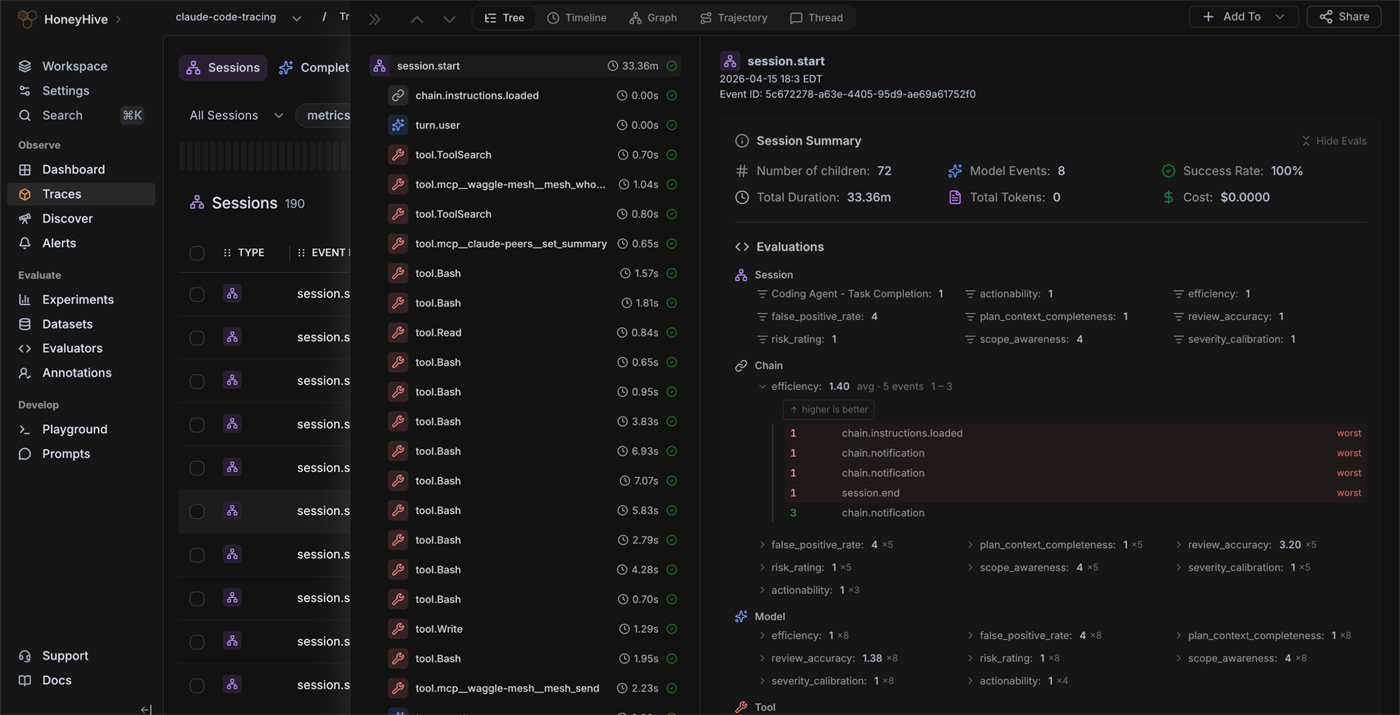
HoneyHive
Core parameters and statistics
HoneyHive is an observation, evaluation and continuous improvement platform for production-level AI Agent and LLM applications. It is not a lightweight panel that only records API call logs, but puts distributed tracing, online evaluation, offline experiments, data set management, prompt word management, alarms and enterprise-level deployment in the same engineering link to help the team answer three key questions: what happened online, whether a change is really good, and which failed samples should enter the next round of testing.
| Projects | Information |
|---|---|
| Official name | HoneyHive |
| Product positioning | AI observability and evaluation platform |
| Official website | https://www.honeyhive.ai/ |
| Documentation | https://docs.honeyhive.ai/ |
| Main objects | Production AI Agent, RAG, LLM applications, automated workflow |
| Core Paradigm | Evaluation-Driven Development, based on evaluation-driven AI system iteration |
| Technology Base | OpenTelemetry, Python SDK, TypeScript SDK, API, integrated instrumentor |
| Latest public version | HoneyHive v2, released on 2026-05-05 |
From a tool catalog perspective, HoneyHive is most suitable to be classified as an AI development and governance tool: it does not serve terminal content generation, but helps developers, platform teams, and enterprise AI teams turn model calls, tool calls, context, feedback, and quality indicators into trackable, comparable, and auditable production assets.
User and market recognition
The HoneyHive official website describes itself as an observability layer for production agents, and the documentation further defines it as a complete platform for tracing, evaluating, monitoring, and improving AI agents. This means that it is more suitable for AI applications that have already entered real users, real data, or quasi-production environments, rather than lightweight toy links that are just early demos.
| Stage | Value of HoneyHive | Typical judgment points |
|---|---|---|
| Prototype verification | Quickly access tracing to locate obvious problems in prompt words, models and tool calls | Whether the first trace can be seen within 5-10 minutes |
| Test iteration | Precipitate failed samples into dataset, use experiment to compare different solutions | Whether the fixed evaluation set can be used to measure the benefits of changes |
| Production monitoring | Observe costs, delays, success rates, quality scores, and abnormal trends | Whether quality declines or error spikes can be detected in time |
| Enterprise promotion | Control sensitive data, permissions, deployment location and cross-team governance | Whether you need RBAC, self-hosting, hybrid deployment and audit capabilities |
For enterprise teams, the core selling point of HoneyHive is to transform "AI quality" from subjective experience into engineering indicators: the same production trace can be debugged, annotated, played back, evaluated, and entered into subsequent regression testing. In this way, Agent improvement no longer relies solely on artificial perception, but can form continuous feedback around real failure samples.
Cost advantage
The HoneyHive pricing page shows the two main plans, Developer and Enterprise. The Developer tier is Free and is for individual developers and early-stage projects. The official page lists 10K events per month, up to 5 users, single workspace, 30 days of data retention, and a complete observability and evaluation suite. Enterprise is geared toward large organizations and emphasizes custom usage, unlimited users and workspaces, Custom Roles, Enterprise SSO/SAML, dedicated support SLA, and hybrid or self-hosted deployments.
| Plan | Public Information | Applicable Targets |
|---|---|---|
| Developer | Free, no credit card required, 10K events/month, up to 5 users, single workspace, 30-day retention | Individual developer, early verification, small team pilot |
| Enterprise | Business communications, custom usage, SSO/SAML, dedicated support, hybrid or self-hosted available | Large enterprises, regulated businesses, multi-team production deployments |
| Hidden costs | Buried point transformation, evaluation set construction, permission design, evaluation function maintenance, data governance | Any production-level AI system needs to be included in the budget |
Don’t just compare subscription prices when making actual purchases. HoneyHive's benefits come from reducing online black box problems, shortening regression positioning time, and reducing the risk of incorrect Agents going online; costs come from access, data annotation, indicator caliber alignment, and organizational process construction. For high-risk industries, whether the data plane can be supported in the customer environment is often more critical than the functionality of the panel.
Main functions
HoneyHive’s capabilities can be broken down into four groups based on the AI application life cycle. The first set is production observations: capturing LLM calls, tool calls, chained steps, session context, cost, latency, and feedback through tracing, allowing teams to go from a single exception back to full execution. The second group is evaluation and experiments: comparing prompt words, model RAG, retrieval agent strategies or code changes through datasets, evaluators and experiments.
The third group is monitoring and alerting: putting indicators such as quality, errors, delays, costs, and feedback into dashboards and alerts to help the team discover drift before a large number of users perceive problems. The fourth group is iteration management: turning online samples into reusable test assets through prompt management, annotation queues, human evaluation, LLM-as-judge and code evaluators.
| Function module | Function | Applicable issues |
|---|---|---|
| Traces | View the details of each LLM, tool and link execution | Why the Agent answered wrong this time |
| Trajectories | Analyze the loops, stagnation and abnormal paths of long-running Agent | Why the Agent is stuck at a certain step |
| Experiments | Compare different versions of prompt words, models and pipelines | Whether the changes really improve the quality |
| Datasets | Manage test samples, failure cases and annotated data | How to reuse online problems for regression |
| Evaluators | Measuring quality with code LLM-as-judge or human scoring | How to turn subjective quality into indicators |
| Alerts | Monitor quality degradation, error spikes, and metric drift | How to spot online degradation in a timely manner |
| Prompt Management | Management, versioning, and deployment prompts | How to reduce prompts scattered in the code |
Model and version evolution
HoneyHive v2 is a platform-level refactoring. The official v2 article focuses on the sensitive log boundaries of enterprise production agents: Agent traces often contain real conversations, tool input and output PII/PHI/PCI, internal prompt words, and business context, and these contents happen to be the data necessary to evaluate quality. v2 therefore adopts an architecture in which the control plane and data plane are separated.
The control plane is responsible for non-sensitive metadata such as project structure, evaluator definition, alarm rule schema, identity, permissions and auditing; the data plane saves original logs, input and output, data sets and evaluation calculations. This design allows enterprises to choose multi-tenant SaaS, Dedicated SaaS, Hybrid or Self-hosted, placing sensitive data and measurement calculations in a location that is more consistent with compliance requirements.
| Version | Key changes | Impact |
|---|---|---|
| v1/GA | Supports observation and evaluation of teams advancing LLM applications from prototype to production | Suitable for early production and single-team use |
| v2 | Control plane/data plane split Custom Roles, Python/TypeScript SDK, CLI, Trajectories | More suitable for enterprise-level, cross-team, supervised AI Agent |
| Next steps for v2 | Coding agent integrations, enhanced online reviews, higher-level TypeScript SDK | Expansion to development agents and more automated quality control |
This architectural choice is pragmatic: AI reviews cannot simply rely on desensitized summaries, because many quality judgments must look at the original context. The direction of HoneyHive v2 is to keep sensitive data where it should be, while allowing non-sensitive indicators and governance information to be managed uniformly by the platform team.
Technical advantages
HoneyHive is built on OpenTelemetry, and the official documentation emphasizes model agnostic, framework agnostic and runtime agnostic. It can cooperate with model providers such as OpenAI, Anthropic, Bedrock, and open source models, and also covers agents or application frameworks such as LangChain, CrewAI, Google ADK, AWS Strands, and OpenAI Agents SDK.
In terms of access methods, developers can use Python SDK, TypeScript SDK, OpenTelemetry collector, REST API or automatic instrumentor. The path given by the official tracing quickstart is very straightforward: create the project, obtain the API key, install honeyhive and related instruments, initialize the tracer, and then view the results on HoneyHive's Traces page.
The benefit of this ecological strategy is reduced vendor lock-in. The team does not have to be forced to bind a certain model, a certain Agent framework, or a certain runtime for observation and evaluation; for the platform team, unifying the trace schema and evaluation process has more long-term value than unifying the underlying model.
How to use
The recommendation process for using HoneyHive can be summarized as "observe first, then evaluate, and finally close." The first step is to plug in tracing in key Agent or LLM applications to capture session spans, tool calls, model responses, costs, latencies, and metadata. The second step is to organize real problem samples into datasets and define the code evaluator LLM-as-judge or manual annotation rules.
The third step is to compare different prompts, models, retrievals, tool policies or code versions in the experiment to confirm the impact of the changes on the indicators. The fourth step is to connect the review to the CI/CD or release process to avoid regressions. The fifth step is to continue running online evaluations, dashboards and alerts in the production environment, so that online feedback can continue to enter the next round of data sets and experiments.
| Process | Key Actions | Output |
|---|---|---|
| Access | Initialize tracer, access model/framework instrumentor | Viewable production trace |
| Labeling | Collect user feedback and expert judgment | More reliable quality labels |
| Evaluation | Run experiments and compare multiple versions | Quantifiable quality conclusions |
| Publish | Incorporate evaluation results into CI or release gate | Reduce the risk of online regression |
| Monitoring | Configure dashboard and alert | Detect online degradation faster |
Product Pricing
Much of HoneyHive's enterprise value comes from its deployment and governance capabilities. The official website pricing page and v2 articles both emphasize Enterprise scenarios, including Enterprise SSO/SAML, Custom Roles, dedicated support SLA, hybrid deployment and self-hosting. The pricing page FAQ also states that data is encrypted at rest and in transit, and mentions SOC 2 Type II, GDPR, HIPAA compliance, and penetration testing with third-party audits.
HoneyHive v2’s control plane/data plane split is especially important for highly regulated industries. Platform teams can centrally manage projects, evaluators, permissions, and audits, while business units or regional teams can keep sensitive traces and measurement calculations within their own data boundaries. This maintains unified governance and avoids concentrating all raw Agent logs into a single shared environment.
When implemented, the team still needs to define permission boundaries, data retention strategies, desensitization strategies, evaluation data usage, and audit processes. HoneyHive provides platform capabilities, but the responsibility for AI data governance still needs to be shared between the organization, legal, security, and business.
Application scenarios
HoneyHive is suitable for any scenario where the quality of AI output needs to be continuously proven. Customer service agents can use it to track multiple rounds of conversations, tool calls, and manual feedback; financial or insurance processes can use it to evaluate consistency and error patterns in claims, risk control, and loan assistance decisions; RAG systems can use it to compare retrieval strategies, contextual relevance, and answer fidelity; code or operations agents can use it to analyze long task execution trajectories and failure patterns.
Within product teams, HoneyHive helps PMs and engineers discuss “is it getting better” around the same set of metrics. In the platform team, it can become a unified AI observability layer, avoiding the need for each business line to work on logs, tables, and manual review. For compliance teams, it provides a clearer audit entry: who accessed what, which data was evaluated, and which versions triggered exceptions.
The most worthy of priority piloting are processes that are high-frequency, have definable success criteria, and have high failure costs but are still controllable. For example, customer service answer quality, work order classification RAG search Q&A, internal knowledge assistant, sales lead processing, automated research agent, etc.
Applicable people
HoneyHive is most valuable to four types of people. The first category is AI application engineers, who need to understand why every model and tool call fails. The second category is ML/LLMOps or platform engineering teams, who need unified observation, measurement, alerting and deployment governance. The third category is product and operations teams, who need to incorporate user feedback and business quality indicators into iterations. The fourth category is security, compliance and enterprise architecture teams, who focus on data boundaries, permissions, auditing and self-hosting capabilities.
The situation where it is not suitable is also clear: if the project is still stuck in a one-time prompt demo, with no real users, no quality indicators, and no online plan, HoneyHive's governance capabilities may appear to be too heavy. On the contrary, once the team starts to face problems such as "Will the model be degraded after changing the model?" "Why does the Agent fail occasionally?" "How to prove that the new version is more reliable" and "Where should sensitive traces be placed?", the value of HoneyHive will quickly become apparent.
From the perspective of procurement and piloting, it is recommended to first select an Agent with clear business relationships, define 3-5 core indicators, and then connect tracing and experiment. Don’t try to monitor every AI system right from the start; run a high-value process through observations, measurements, datasets, and alerts first, and the benefits will be clearer.
Summary and Outlook
The core advantage of HoneyHive is to connect the production observation and quality evaluation of AI Agent into a continuous improvement system. It not only allows engineers to view single traces, but also allows the team to use datasets and experiments to determine whether changes are effective; it covers prompt iterations in the development phase, as well as online evaluations, dashboards, and alerts in the production phase.
If the team is pushing LLM applications or agents into production and has encountered problems such as quality drift, long link debugging, inconsistent evaluation standards, weak regression testing, and sensitive log management, HoneyHive is a tool worthy of priority evaluation. Its v2 architecture is particularly suitable for enterprise environments with requirements for permissions, data residency, self-hosting and cross-team governance.
When selecting, it is recommended to focus on verifying four things: the cost of integrating existing models and frameworks, whether the evaluator can express business quality, whether production traces comply with security policies, and whether pricing and deployment methods match expected usage. As long as these four points are true, HoneyHive is not just a visualization panel, but a quality infrastructure for the AI engineering team.
Related tools:  Hugging Face, replicate
Version Info
- HoneyHive v2 :HoneyHive v2 is a platform-level reconstructed version. The official description includes new architecture Custom Roles, new Python and TypeScript SDKs, HoneyHive CLI, Trajectories for long-running Agents and other capabilities, and emphasizes the observation and evaluation of enterprise-level production Agents.
- HoneyHive v2 :The new architecture separates the control plane from the data plane and strengthens RBAC, enterprise deployment SDK, CLI, Trajectories and Agent development life cycle support.
- HoneyHive GA/v1 :The v2 release article mentioned that HoneyHive was GA last year. v1 is oriented to the team's observation and evaluation workflow from LLM application prototype to production, and subsequent customers will migrate to v2.
User Reviews