 HubSpot
Free
HubSpot
Free
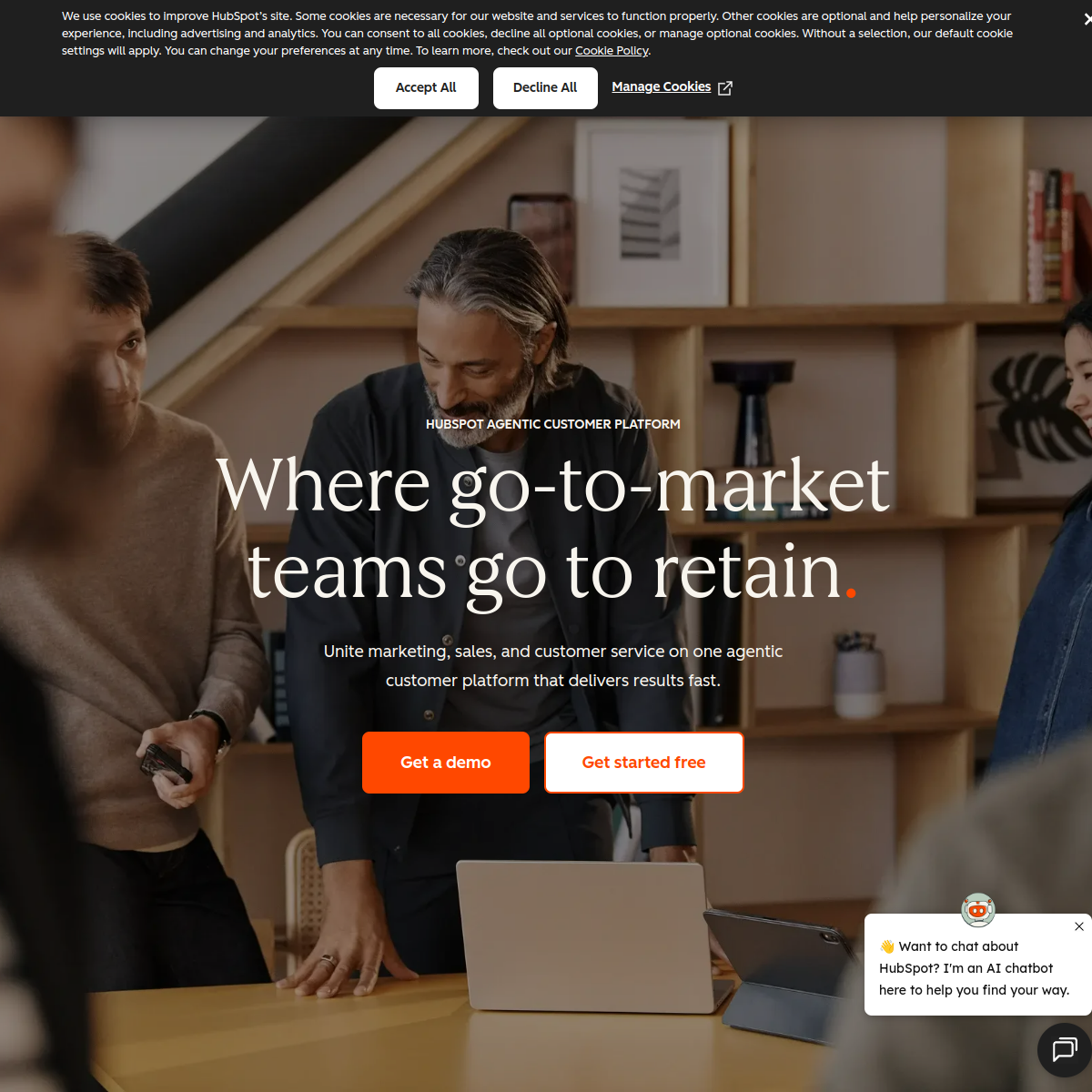
HubSpot is an integrated customer platform that falls under the AI Office and Productivity category, integrating CRM, marketing, sales and service, and providing lead scoring, content generation and intelligent assistant capabilities through Breeze AI.
hubSpot
Core parameters and statistics
HubSpot is one of the world's largest inbound marketing (Inbound) and integrated CRM platforms. Its core value lies in unifying the five major modules of marketing, sales, customer service CMS and operations on the same customer data base, rather than a package of packages that each module operates independently. The Breeze AI suite launched in September 2024 will embed AI capabilities (Copilot, Agents, content generation, intelligent prediction) directly into the CRM native process instead of plugging in an independent AI chat window.
| Dimensions | Key information |
|---|---|
| Official Positioning | Integrated Customer Platform (CRM) |
| Core modules | Marketing Hub, Sales Hub, Service Hub, Content Hub (formerly CMS Hub), Operations Hub |
| AI Suite | Breeze (including Breeze Copilot, Breeze Agents, intelligent content generation, predictive lead scoring) |
| Business Model | Freemium (Free CRM + Paid Hub Subscription) |
| Deployment method | Cloud SaaS; no self-hosted option |
| Customer scale | The public cumulative number of customers is about 238,000+ (including free and paid subscribers, the specific number is subject to official real-time disclosure) |
| Listing information | 2014 IPO (NYSE: HUBS), peak market value in 2020 exceeding US$40 billion |
| Home | US |
The practical significance of the unified data base: When the leads generated by marketing activities are automatically synchronized to the sales pipeline, service orders are associated with customer historical data, and content assets are reused as marketing materials, the workload of "data handling" across teams is compressed to close to zero. This is the biggest difference in experience between HubSpot and traditional CRMs like Salesforce - which require a lot of integration configuration to achieve a similar level of data connectivity.
Breeze’s architectural position: Breeze AI is not an independent product, but a capability layer embedded in each Hub. When editing emails, marketers can directly call Breeze to generate copy and "flower character" illustrations, sales staff can get next-step action suggestions from Copilot, and customer service can automatically respond to frequently asked questions through Agent. This "AI-in-every-flow" design model allows users to naturally use AI in daily operations instead of actively switching to another AI tool interface.
User and market recognition
HubSpot's market position is based on the differentiated logic of "ease of use and integration" rather than "deep customization", which is in sharp contrast to Salesforce's enterprise-level depth route.
Customer scale and stratification: Public reports show that the cumulative number of customers worldwide is approximately 238,000+ (including free CRM users), among which paying customers are concentrated in small and medium-sized and growing enterprises. The industry distribution is mainly technology, professional services, education, medical and consumer goods, because these industries require more inbound content marketing than strong relationship sales. Specific industry coverage and the latest number of customers are subject to official real-time disclosure.
Industry benchmarking: In the same track of "integrated CRM + marketing automation", HubSpot's strengths are product ease of use and free entry customer acquisition funnel, while its weaknesses are enterprise-level customization, audit links and complex process orchestration in high-compliance industries. Compared with Salesforce, which requires professional administrator maintenance, HubSpot has a lower operational threshold, but it lacks flexibility when encountering very large deployments.
Analyst Comments: Gartner and Forrester typically place HubSpot in the niche or challenger areas of the CRM and Marketing Automation "Leaders" quadrant, focusing on customer experience ease of use rather than feature breadth. Its NPS (Net Promoter Score) has always been at a high level in the same category, reflecting users' recognition of the "ready-to-use" experience.
Market Questions: Under the multiple Hub charging model, users often encounter the situation of "the free CRM is easy to use, but once advanced functions are needed, each Hub is billed separately, and the total bill quickly expands". This means that when evaluating costs, you must estimate the "module expansion path" rather than just looking at the starting price of a single Hub.
Cost advantage
- C-side/Individual: Usually a free version is provided to experience the core functions, and high-frequency use requires a paid package subscription.
- API/Developer: Billed by call volume, suitable for development teams that can be flexibly integrated into their own systems.
- Enterprise/Privatization: Contact the business owner to obtain customized quotation and deployment plan. The specific price is subject to the official real-time pricing page.
Main functions
HubSpot's functional system is designed around "customer acquisition-conversion-service-retention" and can be summarized into five capability groups. There are embedded nodes of Breeze AI in each capability group, rather than independent AI modules.
- CRM Data Base: Unified management of contacts, companies, transactions, work orders, custom objects and related data. Applicable tasks: Sales staff no longer need to manually record customer interaction history, AI automatically tracks emails, meetings and call summaries. Hidden linkage: CRM data is the shared context of all modules. Marketing reach, sales follow-up, and service responses are all based on the same customer portrait, eliminating the need for manual synchronization.
- Marketing Hub: landing page construction, email marketing, social media scheduling, lead scoring and nurturing process. Applicable tasks: The marketing team completes lead nurturing through visual workflows without development assistance. Breeze AI embedding point: AI generates email copy and landing page content, predictive lead scoring (predicts transaction probability), and social media intelligent scheduling.
- Sales Hub: deal stage management, sequence automation, live chat, meeting links and quote templates. Applicable tasks: Sales representatives automatically follow up on leads through sequence automation, reducing repetitive manual operations. Breeze AI Embedding Point: Copilot recommends next actions in real time, automatically generates follow-up email drafts, and intelligently extracts call summaries.
- Customer Service (Service Hub): work order system, knowledge base, customer feedback survey and chatbot. Applicable tasks: The customer service team handles multi-channel work orders on a unified panel. Breeze AI embedding point: AI Agent automatically responds to frequently asked questions, automatically categorizes and routes work orders, and automatically generates knowledge base content.
- Content Hub (formerly CMS Hub): Website content management SEO recommendations, content analysis and adaptive testing. Applicable tasks: Marketers manage website content and optimization in one place. Breeze AI embedding point: AI generates blog and landing page content, smart graphics, and SEO optimization suggestions with one click.
Hidden linkage:
- Lead Scoring → Sales Priority Queue: Breeze AI’s predictive lead scoring can automatically push high-intent leads to the head of the sales queue, rather than just generating a score for people to see. This means that the end point of marketing automation is directly connected to the starting point of sales behavior.
- Email content → Flower word matching → Social publishing: While generating email copy, Breeze can automatically extract core selling points to generate "flower word" pictures and match the social channel size. It completes content production, visualization and release scheduling in one operation, eliminating the need for handovers between the three positions of "copywriting → design → publishing" in the traditional marketing process.
- Service Work Order → Knowledge Base → Content Hub: AI extracts repetitive work orders into knowledge base article drafts, and automatically publishes them to Content Hub after review, forming a "service data → content asset" package, reducing the labor cost of knowledge accumulation.
Model and version evolution
HubSpot's platform evolution can be divided into three milestone stages, each stage corresponding to the transition of core capabilities:
- Inbound Marketing Tools (2006–2014): Started with blogging tools SEO, social media monitoring and landing page builder, established the product philosophy of "content is to gain customers". Launched in 2014.
- Multi-Hub Integrated Platform (2014–2024): Sales Hub (2015), Service Hub (2017), Free CRM (2019), CMS Hub (2020), Operations Hub (2021) are successively launched, forming a complete five-Hub system. The core logic of this period is "each Hub is on the same CRM data base" to avoid data breakpoints caused by multiple tools.
- Breeze AI embedding period (September 2024 to present): The Breeze AI suite will be released at INBOUND 2024, including Breeze Copilot (cross-Hub conversational assistant), Breeze Agents (automated task Agents, such as social media Agent, data quality Agent), and AI capabilities embedded in each Hub (content generation, intelligent scoring, summary extraction). Breeze is not positioned as a standalone product, but as a full-process intelligence layer for CRM.
| Version Milestones | Time | Core Changes |
|---|---|---|
| HubSpot CRM Free Edition | ~2014 | Launched free CRM to lower the adoption threshold for small and medium-sized teams |
| Five Hub system formation | 2015–2021 | Marketing/Sales/Service/CMS/Operations launched one by one |
| Breeze AI released | 2024-09-18 | AI suite embedded in the whole process; Copilot, Agents, intelligent content |
| Breeze continues to iterate | 2025–2026 | Agent type extension Copilot depth and configurability improvement; the specific function list is subject to the latest official release |
Version Notes: HubSpot adopts a continuous SaaS delivery model and does not announce a "big version number" in the traditional sense; Breeze AI is the largest functional layer upgrade in the past decade. Subsequent version iterations shall be subject to the official real-time update log.
Technical advantages
The technical barrier of HubSpot is not the performance of a single model, but the deep coupling between the CRM data base + AI embedding layer + cross-Hub automation engine.
- Unified Object Model: All entities such as contacts, companies, transactions, work orders, custom objects, etc. are in the same data model and on the same platform, without the need for cross-system ETL. Taking the leads generated by marketing activities as an example, from the first touch point → MQL → SQL → business opportunity → transaction → value-added → service, data changes throughout the entire life cycle are completed on the same object relationship diagram, without manual association.
- AI embedded in native processes: Breeze AI's capabilities (Copilot, Agents, generation, scoring) are not independent pages, but appear in the context of users' daily operations in the form of panels/sidebars/buttons. When marketers edit emails, AI appears directly in the editor; when sales representatives view leads, Copilot automatically appears in the sidebar. This kind of design that "does not drag people out of the workflow" is still a minority in the CRM category.
- Automation engine + AI node: The workflow automation of each Hub supports standard capabilities such as conditions, branches, waiting, and notifications; Breeze Agents act as central nodes in the automation process - for example, social media agents can independently complete content creation, approval submission, scheduled publishing and performance tracking, and users only need to confirm at key approval points.
- Predictive AI and real results: Breeze’s predictive lead scoring is based on training on historical transaction data within the CRM, not a general model. This means that as the platform usage time accumulates, the scoring model will continue to converge to the unique transaction pattern of the enterprise. The disadvantage is that the scoring accuracy during the cold start period is low, and it takes 3-6 months of data accumulation to enter the effective range.
Performance and scalability: As a SaaS native platform, HubSpot promises a 99.9%+ availability SLA (Enterprise tier). However, enterprise-level requirements such as large-capacity data export, high-performance API frequency control, and custom object upper limits still have scale limitations. Please refer to the official technical documentation for details.
How to use
HubSpot is delivered using SaaS, and the main portals are accessed through the official cloud system:
| How to use | Applicable people | Core features |
|---|---|---|
| Web browser | All users | Full function panel, including Hub, Breeze Copilot, Automation |
| Mobile App | Sales and Customer Service | iOS/Android, manage address book, transactions, tickets and chats |
| API (REST + GraphQL) | Developer/IT integration | Data import/export, custom integration Webhook |
| Marketplace | Users with expanded needs | 1,500+ connectors and custom applications |
Typical implementation steps:
- Free CRM Verification: After registration, you can immediately import contacts, create transactions, use basic pipelines, and verify whether the data model matches the business objects. There is zero cost at this stage.
- Select the first Hub: Prioritize subscribing to a Professional-level Hub (usually Marketing or Sales) based on the team's current pain points, and enable the corresponding Breeze AI capabilities (such as content generation Copilot).
- Data cleaning and migration: Export contact/company/transaction data from the old system, and use Operations Hub's data quality automation (Breeze Data Quality Agent) to complete deduplication and standardization.
- Process Modeling: Use the visual workflow editor to build core processes (such as lead scoring, email cultivation sequence, work order routing), and embed AI nodes into key decision points.
- Training and piloting: Select 1-2 high-value, low-risk processes to go online first, and measure the efficiency difference against the old processes. Focus on: AI content generation pass rate, lead scoring and actual transaction convergence rate, Copilot recommendation adoption rate.
Practical Implementation Tips: HubSpot's ease of use does reduce training costs - in theory, a marketing operations staff with a non-technical background can usually independently build an automated workflow in 1-2 days - but this does not mean that there is no need for an internal Champion. It is recommended to configure a HubSpot platform administrator (a role that understands both business and configuration), otherwise permissions, data mapping and billing management can easily get out of control when multiple Hubs are expanded.
Product Pricing
The pricing model is subject to the official real-time page. Usually a freemium or subscription system is used, and basic functions can be used for free. Advanced functions or high-frequency use require paid subscriptions, and users are advised to evaluate the optimal solution based on actual usage.
Application scenarios
The implementation value of HubSpot + Breeze AI is focused on the standardized B2B customer acquisition and customer operation chain. Each scenario can be quantified and compared with before and after efficiency (the following is a deduction, unofficial commitment).
- B2B content marketing and lead cultivation: The marketing team completes the entire link from blog → landing page → email sequence → lead scoring through Content Hub + Marketing Hub. Breeze AI Benefits: AI generates the first draft and accompanying pictures, shortening the "topic selection → publishing" cycle of a standard blog from the traditional 3-5 days to 1-2 days (including manual review and optimization); AI predictive lead scoring replaces manual MQL judgment, and the operation staff changes from reviewing leads one by one to only processing the Top 20% of high-intent leads. As a deduction, a 5-person marketing team can save about 40-60 person-hours of content production and lead screening time per month.
- Sales Follow-up and Pipeline Acceleration: Sales Hub Sequence Automation + Breeze Copilot recommends focusing sales reps on areas that require human judgment. Breeze AI Benefits: Copilot automatically generates follow-up email drafts, records call summaries, and prompts missed cross-sell opportunities, reducing sales representatives’ daily non-revenue-generating activities (writing emails, taking notes, and checking information) by approximately 30-40% (deduction). However, the final decision-making at the transaction node, price negotiation and high-level relationship maintenance still need to be completed by sales representatives, and AI cannot be replaced.
- Customer service work order automation and knowledge accumulation: Service Hub + Breeze Agent changes frequently asked questions from "manual response" to "AI Agent instant response + manual review". Breeze AI Benefits: AI can automatically handle 50-70% of Tier-1 common questions (deductions vary by industry), increasing the customer service team's average daily processing volume from 40-60 orders to 80-120 orders. At the same time, AI automatically summarizes high-frequency questions into knowledge base drafts, reducing manual investment in knowledge accumulation. However, there are scenarios such as emotional complaints, complex troubleshooting, and refund disputes that require manual judgment, and AI is not suitable for independent processing.
- Cross-Hub data-driven operations: Operations Hub's data quality agent + custom reports allow the operations team to complete full-link data cleaning and visual management in one place. Benefits: Reduce cross-system data reconciliation time
, it can be deduced that an operations specialist can save 3-5 hours of table pulling and cleaning work every week.
Not suitable for scenarios:
- High Compliance Industries (Financial, Healthcare Master Data, Government): There is no self-hosted option, data must reside in the HubSpot Cloud, and the Enterprise SLA may not be audit link deep enough to meet strong regulatory requirements.
- Very large enterprises (10,000+ employees): HubSpot's permission model and custom object upper limit are not as flexible as Salesforce, and large-scale deployments are prone to encounter performance ceilings.
- Pure transaction/express consumer goods sales: HubSpot is strong in customer marketing and relationship sales, but lacks native capabilities for "high-frequency, low-customer orders" e-commerce transactions or channel distribution scenarios.
- Teams requiring offline or private deployment: HubSpot does not have a self-hosted option and cannot be deployed with any network isolation.
Applicable people
HubSpot + Breeze AI has clear adaptation boundaries and is not suitable for "everyone":
- Small, medium and growing enterprises (100–2,000 people): Typical matching group. The team needs a unified CRM but doesn't want to hire a dedicated CRM administrator. HubSpot’s ease of use and free entry reduce upfront investment, and Breeze AI enables marketing organizations without data science teams to use predictive scoring and content generation.
- Marketing-led team: The team uses content marketing and customer acquisition as its main growth engines, and needs a set of tools to complete everything from content production to lead management. HubSpot’s Content Hub + Marketing Hub is naturally designed for this.
- Teams who want to "verify for free first, and then gradually expand": Free CRM allows you to test whether the data model matches the core process at zero cost, and then subscribe to a specific Hub after passing the verification. This incremental adoption path remains competitive in the CRM category.
- Teams with people already proficient in the HubSpot ecosystem: If there is someone on the team with HubSpot platform management experience (such as a certified expert CPO), the value of the platform can be maximized, otherwise it is recommended to configure at least one internal Champion before deciding to scale large-scale.
Not applicable to the crowd:
- Financial, government, and medical companies that require privatized deployment: No self-hosting, data must be uploaded to the cloud.
- Large enterprises with strong sales process customization needs: HubSpot's permission model and field-level auditing are not flexible enough in very large organizations.
- People looking for "pure AI tools" rather than CRM: Breeze AI is an enhancement layer of CRM, not a standalone AI product. If you only need AI content generation or chatbots, it is more lightweight to use ChatGPT or Intercom alone.
- Budget-sensitive micro teams (1-3 people): While free CRM is available, you will have to upgrade to a paid tier once you need AI capabilities, and a single Professional Hub may be out of budget for micro teams.
Summary and Outlook
HubSpot's core competitiveness lies in "putting the CRM data base AI embedding layer and cross-Hub automation on the same platform", allowing marketing, sales and service teams to collaborate in a unified data context without the need for data transfer or integration splicing. The launch of Breeze AI further strengthens this advantage - it is not like a traditional CRM plug-in AI window, but allows AI to appear directly in the editor, sidebar or workflow node where the user is operating. This "AI-in-every-flow" design has better experience and implementation costs than the combination of Salesforce + Einstein for medium-sized B2B teams that focus on content customer acquisition.
Current limitations: The types and depth of automation of Breeze Agents are still rapidly expanding, and some advanced Agents (such as data quality agents, social media agents) are only available at the Enterprise layer; the cold start period for predictive scoring requires 3-6 months of data accumulation; the quality and brand consistency of AI content generation still require manual review - this is not a problem unique to HubSpot, but for teams with a large amount of content, it means that "writing can be saved, but review cannot be saved."
Follow-up observation points:
- Agent Ecosystem Expansion: Will Breeze Agents open the third-party Agent market and support custom Agent construction?
- Complete enterprise-level capabilities: HubSpot’s progress in RBAC depth, audit logs, and data residency options will determine whether it can cannibalize Salesforce’s SMB hinterland.
- Pricing Structure Evolution: Will Breeze AI eventually form a standalone AI usage billing model, or will it continue to be embedded in Hub subscriptions?
- Industry vertical depth: HubSpot is currently a general CRM + marketing platform. Will it launch pre-configured industry Hubs for specific industries?
Procurement/Adoption Risk Assessment (Integrated Recommendations):
- Short term (1-6 months): Use free CRM to verify data model matching, give priority to trial Breeze Copilot and content generation to judge the quality of AI output. Start by subscribing to a Professional Hub as a pilot.
- Medium term (6-12 months): Evaluate the total cost versus expected benefits of multi-hub expansion. If 3+ Hub costs $2,000-$5,000 per month, compare to equivalent configurations from Salesforce Essentials or Zoho. Also keep an eye out for Breeze Agents availability and enterprise-grade feature releases.
- Long-term: If your team grows to 1,000+ employees or enters a compliance-sensitive industry, plan ahead for a migration path from HubSpot to an enterprise-grade CRM - because HubSpot's data model is private platform locked, the cost of export migration cannot be ignored.
Related tools:  Notion AI, google-workspace
Version Info
- Breeze AI :Launched the Breeze AI suite, integrating Copilot, Agents and intelligent capabilities into the entire CRM process; please refer to the latest official page for specific capabilities and availability.
- Multi-Hub integration :Form a Marketing/Sales/Service/CMS/Operations multi-Hub system.
- HubSpot CRM Free Edition :Launched free CRM to expand platform user base.
User Reviews