 Hugging Face
Free
Hugging Face
Free
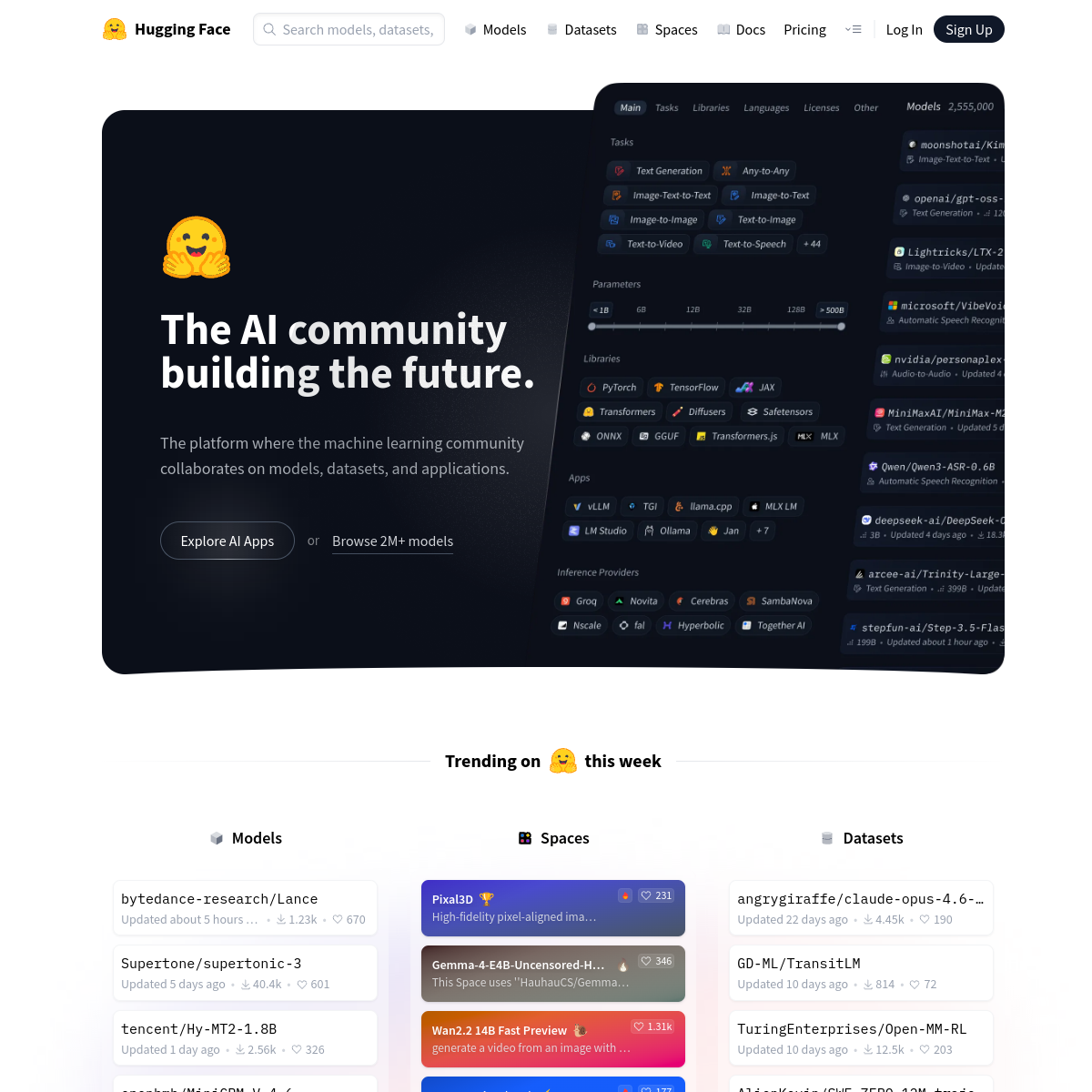
Hugging Face is the central hub of the AI open source ecosystem, providing services such as Models / Datasets / Spaces / Inference Endpoints / AutoTrain, and supporting top open source libraries such as Transformers, Diffusers, and PEFT. It is called the "GitHub of machine learning".
HuggingFace
Core parameters and statistics of Hugging Face
Hugging Face is not a simple tool or model, but an AI open source platform layer integrating "model + data + computing power + library + community". The industry often calls it the "GitHub of machine learning" - but its breadth of capabilities far exceeds that of a code hosting platform, covering the complete ML life cycle from model discovery, data set management, training fine-tuning, inference deployment to community collaboration.
| Dimensions | Key facts |
|---|---|
| Official positioning | The central hub of the AI open source ecosystem, a unified platform for models/data/Spaces/inference |
| Open source license | The platform itself is a commercial product, and the core open source library uses Apache 2.0, etc. |
| Supported platforms | Web, API, Library (Python CLI/SDK), Desktop (part) |
| Model scale | 1 million+ public models, covering NLP / CV / Audio / multi-modal |
| Data set size | 200,000+ public data sets |
| Spaces scale | 500,000+ demo applications (Gradio / Streamlit / Docker) |
| Core open source libraries | Transformers, Diffusers, Datasets, Accelerate, PEFT, TRL, Tokenizers, Smolagents |
| Business Services | Inference Endpoints / Inference Providers / AutoTrain / Argilla / Hub Enterprise |
| Monthly active developers | Millions, one of the platforms with the largest daily visits to AI developers |
| Latest valuation | Series D ~$4.5 billion (2023) |
Parameter Interpretation: Unlike the  GitHub Copilot partial development assistant tool and the Stable Diffusion partial model family, Hugging Face is in a more upstream platform position - it does not produce chips nor monopolize models, but allows all models, data sets and application demonstrations to flow within the same ecosystem. The combination of millions of models and 500,000+ Spaces means: any open source model will appear on the Hub within hours after it is released, with inference examples and community reviews. This "release-ready" link is its irreplaceable core value.
Platform Boundary: The core of HF is "open source + platform". It does not provide end-to-end AI consumer products (such as ChatGPT-style conversation assistants), nor does it directly compete with cloud vendors' GPU computing power - Inference Providers, on the contrary, allows users to obtain the best cost-effectiveness by aggregating multiple GPU suppliers, rather than building a self-built computing power pool.
User and market recognition of Hugging Face
Hugging Face's market influence spans three circles: the open source community, corporate customers, and academic research, and each circle has verifiable quantitative signals.
Open source community influence: The Transformers library has long been ranked first in the AI category Stars on GitHub (130k+ stars), and Diffusers (50k+ stars) and Datasets (20k+ stars) are also standard libraries in their respective fields. This is not achieved by marketing, but because the community has regarded these libraries as "default dependencies" - most NLP/CV paper replication code is based on Transformers, and most Vincent graph applications are based on Diffusers. This depth of embedded workflow gives HF’s open source libraries extremely high migration barriers.
Enterprise Customer Coverage: Almost all major companies in the AI infrastructure layer such as Meta, Google, Amazon, Microsoft, IBM, Intel, NVIDIA, etc. publish model weights on HF or use its commercial services. Major LLM companies (including the Llama series of Meta,  Mistral,
  DeepSeek,
  Cohere, etc.) all use HF As the default platform for weight hosting. This means that HF is not just a tool, but also the "upstream distribution channel" of the AI industry.
Financing and Valuation: The 2023 Series D financing was jointly participated by Salesforce, Google, Amazon, Nvidia, Sound Ventures, etc., with a valuation of approximately US$4.5 billion. This valuation was at the top level in the AI infrastructure layer at the time, reflecting capital's recognition of its "platform-level entry" status.
Industry Standard Projects: HF has led or been deeply involved in a number of open source projects with industry influence: BLOOM (multi-language large model, collaboratively completed by 1000+ researchers), SmolLM series (efficient small model), IDEFICS (open source multi-modal model), Distilabel / Argilla (data quality and annotation tool stack). These projects have established HF's reputation in academic circles and industry as "not just a company, but a promoter of open source governance."
The cost advantage of Hugging Face: layered and progressive, paid path from zero to production
Hugging Face's cost structure is not a simple "free vs paid" dichotomy, but a progressive path designed based on user roles and usage depth, so that each type of user can find a payment point that matches their needs.
| Plan | Price | Core Benefits | Adapted Users |
|---|---|---|---|
| Free | $0 | Full access to public models/data/Spaces, community GPU quota | Learners, researchers, personal experiments |
| PRO | $9/month | ZeroGPU priority scheduling, private Spaces, Endpoints discounts | Individual developers, independent Hobbyist |
| Team | Starting from $20/seat/month | Organizational space SSO, shared quotas and resource pools | Small teams and startups |
| Enterprise | Inquiry | Private deployment, security audit, compliance certification, dedicated computing power and SLA | Large enterprises, finance/medical and other strong compliance industries |
| Inference Endpoints | Billed by GPU hour | One-click deployment of models to cloud GPU instances, supporting automatic scaling | Application side, small and medium-scale inference scenarios |
| Inference Providers | Billing based on call volume | Unified access to third-party GPUs such as Together/Replicate/Fal/Cerebras | Consumers who pursue large-scale inference and pursue optimal cost performance |
C client/individual users: The free plan covers most learning and research scenarios. The real potential cost lies in the queuing and quota limits of community GPUs - ZeroGPU prioritizes PRO users for scheduling, and free users may wait longer during peak hours. If you need private Spaces (such as hosting unpublished model demos), you'll need to upgrade to PRO.
Developers/API Users: The cost of Inference Endpoints depends on the selected GPU model and runtime, and supports automatic hibernation to save on idle charges. Inference Providers are billed on a per-call basis, with actual prices fluctuating based on third-party provider pricing. There is an implicit cost here: from "selecting a model in the Hub" to "running it stably in production", you need to go through deployment configuration, cold start optimization, concurrent stress testing, etc., and these manpower investments are often much higher than the API call fee itself.
Enterprise/Private Users: The main cost of the Enterprise solution is not the subscription fee, but the investment in operation and maintenance and compliance auditing of private deployment. HF's Enterprise supports private Hub instance SSO integration, audit logs, and security compliance certification, but the value of these features requires that the enterprise has a mature ML team and operation and maintenance capabilities. If the team itself lacks experience with ML infrastructure, the total cost of going private may be much higher than using a public platform on the cloud.
Main functions of Hugging Face
Hugging Face's functions cover the entire link from model discovery to production deployment, but the real value is not the individual functions, but the synergy between them.
-
Models Hub: Millions of public models, each model comes with a model card, inference sample code and community discussion. Its core value is not "more models", but the standardization of "models + documents + runnable examples" - this means that you can jump directly to trial, download, training and deployment from a model page, eliminating the traditional jump cost of "reading papers → finding code → setting up the environment".
-
Datasets Hub: Hosting and version management of 200,000+ data sets, supporting streaming loading and online preview. The synergy with Models Hub is that a model page can directly reference the data set page as the source of training data, and the data set page can also list the mainstream models trained based on the data, forming a two-way index of "data ↔ model".
-
Spaces: Hosted Gradio/Streamlit/Docker applications, 500,000+ demo instances. This is one of the most differentiating features of HF - it not only allows model authors to publish interactive demos with one click, but also allows users to run through models without writing code. ZeroGPU technology allows free Spaces to also use GPU, greatly lowering the threshold for model demonstration.
-
Inference Endpoints: Deploy any Hub model as a production-grade REST API, supporting auto-scaling, multi-region deployment and load balancing. The difference from Spaces is that Spaces is suitable for interactive demos, while Endpoints is suitable for actual reasoning traffic embedded in products.
-
Inference Providers: A routing layer launched in January 2025 that allows users to call multiple GPU providers (Together, Replicate, Fal, Cerebras, etc.) through a unified API. Hidden linkage: Inference Providers are deeply bound to Models Hub - you can directly select "Run with Inference Providers" on the model card. The choice of model and the choice of computing power are decoupled. Users do not need to care about which supplier the model is deployed on, and only need to focus on inference quality and price.
-
AutoTrain: Code-free training service, supporting tasks such as text classification, question and answer, image classification, tabular data, etc. Its value is not to replace professional parameter adjustment engineers, but to allow non-ML experts to complete basic model fine-tuning - product managers can quickly verify the feasibility of a classification task without waiting for algorithm engineers to schedule.
-
Argilla: Open source data annotation and RLHF/DPO data management platform. The synergy with Datasets Hub is that the annotated data can be directly pushed to Datasets Hub for publication as a public data set, or used for subsequent AutoTrain fine-tuning.
-
Open source library system: Transformers, Diffusers, Datasets, Accelerate, PEFT, TRL, Tokenizers, Smolagents, etc. These libraries themselves are industry standards in their respective fields and are designed to be used in combination with each other - for example, use Datasets to load data → use Transformers to load models → use PEFT for LoRA fine-tuning → use TRL for RLHF alignment → use Accelerate for distributed training.
-
Evaluation list and community: Open LLM Leaderboard, Chatbot Arena mirror, community competition. These lists form a "third-party verification layer" of model quality, helping users have a relatively objective reference system when making model selections.
Model and version evolution of Hugging Face
Hugging Face's platform evolution is marked by milestone feature releases rather than version number iterations in the traditional sense. The following are the main version nodes:
| Milestones | Timing | Focus of change | Business/ecological impact |
|---|---|---|---|
| Inference Providers | 2025-01 | Unify the inference interfaces of multiple third-party GPU vendors | Extend the platform from "model hosting" to "computing power routing", directly complementing cloud GPUs |
| ZeroGPU + HuggingChat | 2024 | Spaces supports free GPU + platform-native conversation products | Significantly lowers the community trial threshold and attracts a wider range of non-technical users |
| Spaces online | 2021-10 | One-click hosting of Gradio/Streamlit/Docker applications | Upgraded from "model hosting" to "application hosting", forming a relationship between models and demonstrations |
| Transformers library first release | 2018-11 | Python library that unifies model interfaces such as BERT/GPT/T5 | It has established a de facto standard in the NLP field and driven the subsequent growth of the entire open source ecosystem |
| Company establishment and early transformation | 2016 | Transformation from a conversational robot company to an AI open source platform | Decisive strategic shift, abandoning the path of closed products |
Version context description: The evolution of HF has two levels - open source library version and platform function version. The Transformers library has currently been iterated to v4.x (main version number 4, jumping directly from v2 to v4 in 2020), maintaining synchronous adaptation with PyTorch, TensorFlow, and JAX. The milestones at the platform level are as shown in the table above. Currently, there is no concept of "platform version number", and all functions are continuously released in the form of services.
Technical advantages of Hugging Face
Hugging Face's technical advantage does not lie in its leadership in any one indicator, but in the fact that it has built a flywheel in which "library ↔ platform ↔ community" reinforces each other.
Mechanism → Effect → Applicable Scenarios:
-
Full-stack standardized interface: The Transformers library shields the differences in different model architectures through a unified
from_pretrained()/pipeline()interface. This means that developers use almost the same code to load and call whether it is BERT, GPT, LLaMA or Whisper. The effect is that the learning cost of model switching approaches zero, and the applicable scenarios cover almost all mainstream NLP/CV/Audio model inferences. -
Two-way mutual support between platform and library: The weights of the model are hosted on the Hub, and the Transformers library loads the weights directly from the Hub - this means that the model author only needs to upload the weights once, and all users can use them immediately through
model = AutoModel.from_pretrained("username/model-name"). The applicable scenario is the standardization of model distribution and reuse, which eliminates the cumbersome process of "downloading weights → manually placing paths → changing code loading". -
ZeroGPU elastic scheduling: GPU resources on Spaces are not fixedly allocated, but are based on a dynamic scheduling strategy of "occupy only when in use". When a Spaces application is idle, GPU resources are recycled to other applications; they are rescheduled only when users access them. The effect is that the same number of GPUs can serve more Spaces instances, allowing free users to get a GPU experience. The applicable scenario is Demo hosting - interactive applications that do not require 7x24 dedicated GPU.
-
Decoupling design of Inference Providers: The core idea is to decouple "model selection" and "computing power selection". In the traditional model, choosing a model means also choosing which cloud it will be deployed on. Inference Providers allow users to first select a model and then select a computing power provider (or the platform automatically recommends the best provider) to achieve independent optimization of the model and inference infrastructure. The effect is that users can switch providers to reduce costs or optimize latency without switching APIs.
-
Openness as a moat: Unlike closed platforms, all core open source libraries of HF allow self-hosting and secondary development. This means that even if an enterprise is unable to use HF cloud services due to compliance concerns, the full open source tool chain can still be used internally. This openness allows HF to be adopted by developers in "security-sensitive" industries (finance, healthcare, government), and while they may not be paying cloud customers, their use further solidifies the HF standard's market position.
How to use Hugging Face
Hugging Face provides a multi-level usage path from zero code to deep customization:
| Entrance | Adaptable Crowd | Key Capabilities | Cost |
|---|---|---|---|
| huggingface.co (Web) | All users | Browse models/data/Spaces/community lists | Free |
| Transformers / Diffusers SDK | Python Developer | Load model and infer in a single line of code | Free (Open Source) |
| HF CLI / huggingface_hub | Developer/DevOps | Upload/download/manage models and datasets, CI/CD integration | Free (open source) |
| Inference Endpoints | Application side | One-click deployment model to production-grade REST API | Pay by GPU hour |
| Inference Providers | Application side | Call multiple third-party GPU inference through unified SDK | Pay based on the call amount |
| AutoTrain Web UI | Non-engineers | Upload data, select task type, automatic training and deployment | Pay by training time |
| Enterprise Hub | Enterprise | Private Hub Instance SSO, Audit, Compliance | Business Inquiry |
Typical workflow link:
- Filter candidate models by task type or benchmark list in Models Hub
- Directly test run the interactive demo on the Spaces page of the corresponding model (no local context required)
- Use Transformers to load model weights locally or in Colab for customized testing
- Use PEFT + TRL to do LoRA fine-tuning or DPO alignment on your own data
- Deploy the fine-tuned model as an API with one click through Inference Endpoints
- Call Endpoints via REST in production applications and use Inference Providers as a fallback alternative
API call example (Inference Providers):
import requests

API_URL = "https://api-inference.huggingface.co/models/meta-llama/Llama-3.1-8B-Instruct"
headers = {"Authorization": "Bearer <YOUR_HF_TOKEN>"}

payload = {
    "inputs": "Which providers are supported by Hugging Face's Inference Providers?",
    "parameters": {"temperature": 0.7, "max_new_tokens": 512}
}

response = requests.post(API_URL, headers=headers, json=payload)
print(response.json())Note: In actual use, you need to replace <YOUR_HF_TOKEN> with the Access Token generated by the Hugging Face account. The list of available models and providers of Inference Providers is based on the official documentation https://huggingface.co/docs/inference-providers.
Product Pricing for Hugging Face
Hugging Face's pricing system follows the principle of "free for the core platform and paid for value-added services", with a clear three-tier structure:
C client/individual users: Free plan covers most learning, research and lightweight development scenarios. The real limitation isn't in features, but in resource prioritization - free users have lower ZeroGPU quotas and queuing priority than PRO, and may have longer waits during peak times. PRO plan $9/month mainly solves "priority and privacy" rather than "lack of basic functions".
Developers/API users: Inference Endpoints is billed based on the selected GPU model and running time, and supports automatic sleep (Idle Shutdown) to save costs for non-use time. Inference Providers are billed on a per-call basis, and actual prices change dynamically with provider competition. The main hidden cost faced by developers is not the API call fee, but "model selection bias" - choosing a model with insufficient accuracy leading to repeated parameter adjustments, or choosing an overly large model causing inference costs to be far higher than expected.
Enterprise/Team Users: Team plan starts at $20/seat/month and is suitable for organizations that require shared resource pools and SSO management. The Enterprise plan involves private deployment, security audit, compliance certification (SOC2, GDPR, etc.), exclusive SLA and other terms. The price needs to be confirmed by the business. Enterprises need to confirm three items before purchasing: ① the storage capacity and expansion method of the private Hub; ② the deployment plan of Inference Endpoints in the enterprise VPC; ③ the retention period and export format of the audit log.
Application scenarios of Hugging Face
Hugging Face’s implementation scenarios cover the complete life cycle of AI development, but the depth of dependence on platform capabilities varies at different stages:
-
Model Selection and Benchmark Evaluation: Screen candidate models based on task type, parameter volume, and license agreement on Models Hub, and conduct horizontal comparisons based on the benchmark data of Open LLM Leaderboard. Revenue from implementation: Compress the model selection cycle from "several weeks (reading papers + finding weights + repeat evaluation)" to "several hours (screening in Hub + online test run + looking at the list)".
-
Prototype Verification and Demo Production: Use Spaces to build an interactive demo in a few hours - no front-end development skills are required, Gradio's Python API can quickly generate UI. Suitable scenarios: Make technical PoC for customers, present to investors or review committees, and supplement online demo links to papers. Not suitable for scenarios that require highly customized UI or deep integration with internal systems.
-
Training and fine-tuning pipeline: Use Transformers + Datasets + PEFT + TRL to build a complete training pipeline. The streaming loading of Datasets supports efficient processing of terabytes of data, and Accelerate provides zero-cost distributed training adaptation. Implementation Tip: Start fine-tuning from the baseline model on the Hub instead of training from scratch, which can save 90%+ of computing resources and time.
-
Data management and annotation: Use Datasets Hub for data version management (similar to the semantics of Git LFS), and use Argilla for high-quality annotation and RLHF data production. Collaborative scenario: The annotated data can be directly pushed to Datasets Hub as input for subsequent model fine-tuning, forming a "annotation → training → evaluation" concept.
-
Production Inference Deployment: Deploy the model as a stable API through Inference Endpoints, and work with Inference Providers as a buffer layer for cost and availability. Architectural Recommendation: Use Endpoints (controllable fixed costs) for core traffic, and Providers (flexible pay-per-volume costs) for peak or alternative traffic. It is not suitable for extremely large-scale inference scenarios (daily calls are in the hundreds of millions) - at this time it is more suitable to sign a reservation contract directly with the cloud GPU manufacturer.
-
Education Training and Community Operations: Universities and corporate training use Notebooks on Spaces for teaching, and community competitions are used to evaluate and select talents. The free nature of HF makes it an ideal infrastructure for AI education.
Hugging Face is suitable for people
Hugging Face’s multi-layered product form determines that it can serve almost all roles in the AI ecosystem, but the depth of use and scenarios of each role are completely different:
-
Machine Learning Engineer and Researcher: 80%+ of daily work revolves around the HF tool chain - using Hub to find models, Transformers to adjust code, Datasets to manage data, and Spaces to do demos. HF means to them: No need to reinvent the wheel, each new model has ready-made interfaces and community validation.
-
Product Manager and Technical Leader: Use the Demo on Spaces to quickly verify product ideas, and use AutoTrain to complete small-scale model training with non-technical resources. Suitable Boundary: Suitable for early verification and concept prototypes of AI functions, but not suitable as the final delivery carrier for production-level products.
-
Entrepreneurial teams and independent developers: With HF’s free tier + low-cost inference, AI applications can be built with very low funding thresholds. Typical path: Use Spaces to host Demo → Use Endpoints to handle initial inference traffic → Use Providers to handle sudden peaks. Cost deduction: From zero to the first paying customer, the cost of deduction may be controlled within tens of dollars.
-
Data Engineering Team: Use Datasets Hub + Argilla to build a data annotation and version management pipeline. Prerequisite: The team already has or is willing to establish data governance specifications (versioned QC process, permission management), otherwise the Hub's capabilities will be downgraded to "file storage".
-
Enterprise Procurement and Compliance Team: Need to evaluate private deployment options and compliance certification for Enterprise Hub. Boundary Tip: HF Enterprise is suitable for mature organizations with existing ML teams, but not for companies whose "AI capabilities are still in the exploratory stage" - the budget at this time should be invested in talent training rather than infrastructure construction.
-
Unsuitable people: ① Ordinary users who need end-to-end AI consumer products (in this case,
 ChatGPT,
  Claude is more suitable); ② Production-level applications that require highly customized UI (in this case, front-end development is required instead of Spaces); ③ Teams that have extreme requirements for data sovereignty and are unwilling to pay operation and maintenance costs (private deployment requires operation and maintenance investment).
Version evolution of Hugging Face
Hugging Face's platform evolution is marked by functional milestones rather than version numbers. The following is a timeline of the main context:
The era of open source libraries (2018–2021)
- Transformers library first release (2018-11): Unified BERT/GPT/T5 interface, quickly adopted by the NLP community. This is the starting point of the HF ecosystem - without the popularity of this library, subsequent platform businesses would lack a user base.
- Datasets library and Tokenizers library (2019–2020): supporting data processing and word segmentation library, completing the final missing link of the training pipeline.
- Diffusers Library (2022): Expand the influence of HF from NLP to the field of image generation, laying the foundation for subsequent multi-modal ecology.
Platform Transformation (2021–2023)
- Spaces goes online (2021-10): Expanded from model hosting to application hosting, introducing Gradio/Streamlit support for the first time. Strategic Impact: Transform HF from a "developer tool" into a "demonstrable and interactive platform".
- AutoTrain released (2022): Code-free training service, lowering the threshold for model fine-tuning.
- HuggingChat Release (2023-04): Platform-native open source conversation product, directly benchmarked against ChatGPT. Although the user scale is far smaller than that of its closed-source competitors, its positioning in the ecosystem is to "demonstrate the capabilities of the open source model" rather than "pursue maximum daily activity."
Commercialization and computing power layer (2024–present)
- ZeroGPU + Spaces GPU Free (2024): Free users can also use GPU on Spaces, which greatly reduces the computing power threshold for Demo.
- Inference Providers Release (2025-01): Unify the inference interfaces of multiple third-party GPU vendors, marking the extension of HF from "model distribution platform" to "computing power routing layer".
- SmolLM series and self-developed models (2024–2025): HF begins to release self-developed open source models (SmolLM, IDEFICS, etc.), expanding from a pure platform role to a "platform + model contributor".
Summary and Outlook
The core competitiveness of Hugging Face lies in the three-layer stacked flywheel formed by "open source library + model/data hub + inference/training service" - each layer provides a user base and traffic entrance for the previous layer. As a neutral platform for the AI open source ecosystem, it is not only the preferred distribution channel for model authors, but also the default starting point for model users. This "upstream and downstream take all" network effect is its deepest moat.
Current Limitations and Uncertainties:
- The commercialization path is still being explored: The commercialization of Inference Endpoints and Inference Providers is still in its early stages, and the match between revenue scale and valuation (US$4.5 billion) has yet to be verified. The platform's main revenue sources are still dominated by subscriptions and enterprise services, and the scale of reasoning transactions is a key observation point in the next stage.
- Neutrality faces challenges: As the number of HF self-developed models (SmolLM, IDEFICS, etc.) increases, conflicts may arise between its role as a "neutral platform" and its role as a "model competitor". It is worth continuing to observe the community’s attitude towards whether the platform will still treat competing models fairly.
- Competition in the inference layer intensifies: Microsoft, the parent company of GitHub Copilot, directly provides model hosting and inference through Azure AI, and independent inference platforms such as Replicate are also continuing to enclose territory. The continued value of inference providers as an aggregation layer depends on the breadth and depth of their provider networks.
Procurement and Adoption Risk Assessment: For the team, HF's open source tool chain is almost "zero risk adoption" - even if paid services are not used at all, the value of open source libraries such as Transformers, Datasets, and Diffusers is enough to support most development work. The payment decision (PRO/Team/Enterprise/Endpoints) should be considered when the following conditions are mature: ① The team reaches a certain size (5 people+) and needs to share model resources and management permissions; ② The inference traffic is stable and reaches a certain level, requiring SLA guarantee; ③ Compliance requirements require private deployment or audit logs. Prior to purchasing, key verifications are required: the compliance certification scope of the latest version of Enterprise, the supplier availability and stability of Inference Providers, and the operation and maintenance complexity of private deployment.
Version evolution supplement of Hugging Face
API and platform service evolution
| Time | Platform capabilities | Impact on users |
|---|---|---|
| 2025-01 | Inference Providers goes online | Model selection and computing power selection are decoupled, and users can switch across providers to optimize costs |
| 2024-Q3 | ZeroGPU free | Spaces free users can obtain GPU resources, and the interactive experience of community demos has been greatly improved |
| 2023-04 | HuggingChat goes online | The platform obtains C-side entrance, but is positioned as an "open source model display" rather than an independent product |
| 2022 | AutoTrain + Argilla released | Code-free training and data annotation capabilities are complemented, covering "training → data" sections |
| 2021-10 | Spaces goes online | Extended from model hosting to application hosting, forming a complete link of "Model → Demo" |
| 2018-11 | Transformers library first launched | Unified model loading interface, establishing HF’s fundamental position in the open source AI ecosystem |
Open source library version history
- Transformers: v1.x (2018) → v2.x (2019) → v4.x (2020–present). v4 is a major architectural upgrade, split into sub-package architecture and introducing JAX support, and has since been maintained as forward-compatible minor version iterations.
- Diffusers: v0.x (2022) → v0.29.x (2025). Adopting a rapid iteration strategy, new features are released almost every month, reflecting the rapid changes in the field of Vincentian graphics.
- Datasets: v1.x (2020) → v3.x (2024). v3 introduces the reconstruction of streaming loading to support efficient processing of larger-scale data.
Comparison of competing products
| Comparison dimensions | The tool | Competitor A | Competitor B |
|---|---|---|---|
| Core Differences | — | — | — |
| Price | — | — | — |
| Target User | — | — | -- |
Version Info
- Hugging Face Platform 2025 :The Hugging Face platform in 2025 will continue to iterate in the direction of Inference Providers (one-stop call for suppliers such as Together, Replicate, Fal, Cerebras, etc.), Spaces ZeroGPU, HF Endpoints, automatic scaling Argilla data annotation, and the SmolLM series of open source small models.
- Inference Providers :Inference Providers are launched, allowing any model card to uniformly call multiple inference providers such as Together, Replicate, Fal, Cerebras, etc., and charge per call.
- Spaces :Spaces is online, allowing Gradio / Streamlit / Docker applications to be published and shared with one click, forming a de facto standard for open source presentations.
- Transformers Library :The open source Transformers library was released, unifying model interfaces such as BERT, GPT, and T5, becoming the de facto standard for NLP and subsequent multi-modal communities.
User Reviews