 Huizhi Token Factory
Huizhi Token Factory (Agent Cloud Token Factory) is a one-stop large model API aggregation and extremely fast inference cloud platform. It belongs to AI programming developer infrastructure. It integrates 100+ mainstream large model APIs such as Qwen, DeepSeek, Kimi, Doubao, etc., and provides out-of-box use, model fine-tuning hosting and enterprise-level privatized deployment.
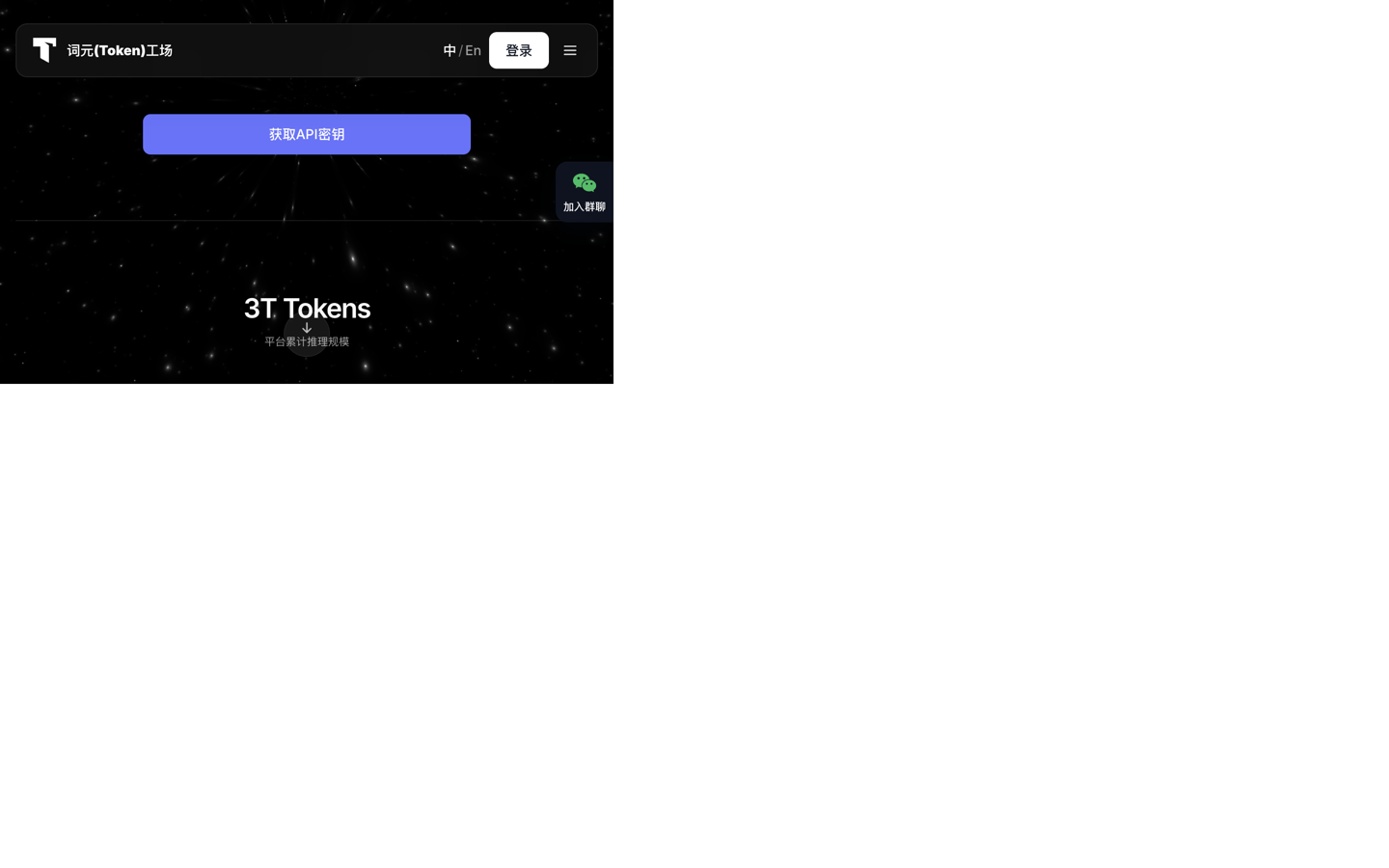
Huizhi Token Factory
Core parameters and statistics
Huizhi Token Factory (Agent Cloud Token Factory) is a one-stop large model API aggregation and reasoning cloud platform. Its core positioning is to allow developers and enterprises to uniformly call multiple mainstream large models on the market through a set of interfaces, without having to interface with each company's authentication, billing and current limiting systems.
| Projects | Public Information |
|---|---|
| Official Positioning | Large Model API Aggregation and Extremely Fast Inference Cloud Platform |
| Model coverage | Official website marked "100+ models", including Qwen, DeepSeek, Kimi, Doubao, etc. |
| Core capabilities | Unified API access, inference acceleration, fine-tuned hosting |
| Deployment form | Cloud call, enterprise-level privatized deployment |
| Platform scale | Official website annotation 3T Tokens Accumulated reasoning 1W+ users |
| Target users | Developer AI application teams, enterprises |
| Supported Platforms | Web Console API |
| Billing dimensions | Billing based on Token usage |
Brief comment in one sentence: It is not another large model, but an "access and scheduling layer" on top of the model - aggregating multiple models such as Qwen, DeepSeek, Kimi, Doubao, etc. into one API entrance. Developers do not need to rewrite the docking code when switching or mixing models.
Publicity Verification: The official website takes "Build·Fine-Tuning·Expand" as the main axis, marking "100+ models, 1W+ users, 3T Tokens cumulative inference scale", and covers multi-modal APIs such as language, voice, pictures, and videos. The pain point is real: as model iteration accelerates, application teams need to frequently compare prices, switch and combine different models, and the engineering and operation and maintenance costs of connecting to various APIs one by one are very high. The aggregation layer is born to reduce this switching cost.
User and market recognition
Gradually build user awareness in the field, and product capabilities are used by content creators and teams to improve work efficiency. Some industry users have incorporated it into their daily workflow. It is recommended to refer to the latest official disclosures for specific user scale and industry adoption rate data.
Cost advantage
- C-side/Individual: Usually a free version is provided to experience the core functions, and high-frequency use requires a paid package subscription.
- API/Developer: Billed by call volume, suitable for development teams that can be flexibly integrated into their own systems.
- Enterprise/Privatization: Contact the business owner to obtain customized quotation and deployment plan. The specific price is subject to the official real-time pricing page.
Main functions
The platform capabilities are designed around "unified access, extremely fast reasoning, and flexible deployment". The public capabilities can be summarized into the following categories:
- Multi-model API aggregation: Access 100+ models (including Qwen, DeepSeek, Kimi, Doubao, etc.) marked on the official website through a unified interface, covering multi-modal scenarios such as language, voice, pictures, videos, etc., and multiple models are available for docking in one place.
- Inference Acceleration Service: Whether self-developed or open source models can be connected to the efficient inference acceleration channel, paying attention to the first token delay and throughput stability.
- Model fine-tuning and hosting: Supports direct hosting of multiple models after fine-tuning, without paying attention to underlying resources and operation and maintenance, making it easier to accumulate private data into exclusive capabilities.
- Enterprise-level privatized deployment: Provides privatized deployment solutions for enterprises with high data compliance requirements, covering performance optimization, deployment and operation and maintenance.
- Unified billing and management: Using Token as the unified billing dimension, centrally manage the usage and bills of multiple models.
Expert view: The hidden value of the platform lies in "model selection decoupling" - when a certain model is reduced in price, upgraded or offline, the application layer only needs to switch parameters to migrate without having to reconstruct the docking code. This decoupling capability has more long-term significance than a simple price advantage in the current era of rapid model iteration.
Model and version evolution
Continuous iterative updates, the latest version introduces performance optimization and new features. Historical version information can be viewed on the official release page. There is no complete public version evolution timeline yet. It is recommended to pay attention to the official announcement to understand the rhythm of feature updates.
Technical advantages
The technical advantages of the platform come from the combination of "aggregation layer + inference optimization + flexible deployment", and the core can be broken down into three points:
Unified access layer: Use a set of APIs to abstract the differences between multiple models, shield the authentication, parameters and billing details of each, allowing the application layer to obtain a stable calling contract and reduce the engineering costs of model switching and combination.
Inference performance optimization: Scheduling and acceleration for delay and throughput, providing more controllable response performance for different loads such as real-time dialogue and batch processing. This is the technical focus of "extremely fast inference" positioning.
Deployment flexibility: Provides both cloud calling and privatized deployment, allowing teams to choose according to data compliance and cost requirements - first use the cloud for quick verification, and then migrate sensitive business to a private environment.
The cost of this architecture is that the aggregation layer itself will introduce a layer of dependencies. The availability, current limiting strategy, and billing transparency of the platform directly affect the upper-layer applications. Therefore, SLA and fault rollback need to be fully verified before production.
How to use
The platform mainly provides services through the console and API, and is integrated for developers:
| How to use | Suitable for people | Features | Cost |
|---|---|---|---|
| Web console | Model selection and usage management | View model list, keys and bills | By usage |
| API access | Application developers | Unified interface calls multiple models | Billing by Token |
| Private deployment | Enterprises with high compliance requirements | Models and data are controlled internally | Business confirmation required |
Typical usage steps: Register and real-name → Obtain the API Key in the console → Select the target model and check the interface documentation → Connect to the unified interface in the application → Monitor usage, delay and billing. It is recommended to first use small traffic to compare the latency, quality and unit price of several candidate models, and then fix the main model and configure downgrade alternatives to avoid business interruption when a single model is limited.
Product Pricing
The platform uses token usage as its main charging model, covering different scales from individual developers to enterprises.
- Developer/Individual: Pay according to the actual amount of tokens called, suitable for trialing multiple models on demand and at low starting cost.
- Enterprise/Team: Packages, fine-tuned hosting, and privatized deployment can be combined. Specific quotations require business confirmation.
- Value-added capabilities: High-end capabilities such as fine-tuning hosting and privatized deployment are usually billed separately.
Since the unit prices of different models, whether new user quotas and tiered discounts are provided by the official may be dynamically adjusted, the actual billing is subject to the instructions on the official website and the console.
Application scenarios
The implementation scenarios of the platform focus on the development of AI applications that require multi-model capabilities:
- AI application quick access: Entrepreneurial teams or developers can quickly integrate large model capabilities using a unified interface, eliminating the need for door-to-door docking, and the benefits are reflected in shortened development cycles.
- Multi-model comparison and mixed use: Call different models according to tasks in the same application (such as one type for dialogues and another for long texts) to optimize quality and cost.
- Enterprise privatization and fine-tuning: Data-sensitive enterprises precipitate private data into fine-tuning models and meet compliance requirements through privatized deployment.
Applicable people
The infrastructure of the platform is positioned to mainly serve three types of people:
- Application developers and entrepreneurial teams: Need to quickly and cheaply access multiple large models, and want to reduce the underlying adaptation work.
- AI Platform/Mid-office Team: Responsible for uniformly providing model capabilities for multiple business lines, focusing on model coverage, scheduling and billing management.
- Enterprises with compliance requirements: Need to fine-tune hosting and privatized deployment, and control models and data internally.
Scenarios that are less suitable are: scenarios where only a single fixed model needs to be called, there are concerns about dependence on the aggregation layer, or there are strict restrictions on data outbound and third-party calls. This kind of demand may be more suitable for official direct connection or self-built reasoning environment.
Summary and Outlook
The core value of Huizhi Token Factory is to expand the "unified access and scheduling layer" on top of the model, using a set of APIs to aggregate 100+ mainstream models, significantly reducing the engineering costs of model selection, switching and billing, and covering enterprise-level needs through fine-tuned hosting and privatized deployment. At a time when models are rapidly iterated and application teams need to frequently compare and select models, this type of aggregation platform is of practical significance.
Directions worth observing in the future include: the timeliness of model coverage updates, the stability of inference latency and availability SLA, as well as billing transparency and data compliance guarantees. For developers, it is recommended to conduct multi-model comparison and downgrade drills with small traffic first, and then put into production after confirming stability; enterprises should focus on verifying data compliance, privatization terms and service level agreements before purchasing.
Related tools:  GitHub Copilot,
  Cursor
Version evolution of Huizhi Token Factory
The platform operates as an online cloud service. The official has not disclosed a strict version number system. The observable evolution is as follows:
Mainline node
- Platform online (approximately 2026-04): Provide large model API aggregation and extremely fast inference services to the outside world, establishing the positioning of unified access to multiple models.
- Capability Expansion (about 2026): Continue to expand model coverage (such as new versions of Qwen, DeepSeek, Kimi, Doubao, etc.), and improve fine-tuned hosting and privatized deployment capabilities.
Since the platform model list and capabilities will be rapidly updated with the large model ecosystem, it is recommended to follow the official console and documentation to track changes in available models and interfaces.
Version Info
- Agent Cloud Token Factory Platform :An online large model API aggregation and inference cloud platform that provides unified access to 100+ mainstream large models, fine-tuned hosting and privatized deployment capabilities. The official version number and release date have not been disclosed. The official version number and release date are subject to observable online platforms.
- Token factory platform is online :The platform provides large model API aggregation and extremely fast inference services to the outside world, establishing the core positioning of "unified access to multiple models + computing power scheduling". The official official release date has not been disclosed, and the observable launch time will prevail for the time being.
User Reviews