 HumanLayer
Free
HumanLayer
Free
HumanLayer is a AI agent tool for AI Agents and software engineering teams. The early SDK focused on human approval and human-in-the-loop of high-risk function calls. The current mainline CodeLayer provides AI Coding IDE, team collaboration, task orchestration and cloud Agent workload management.
HumanLayer tool text
Core parameters and statistics
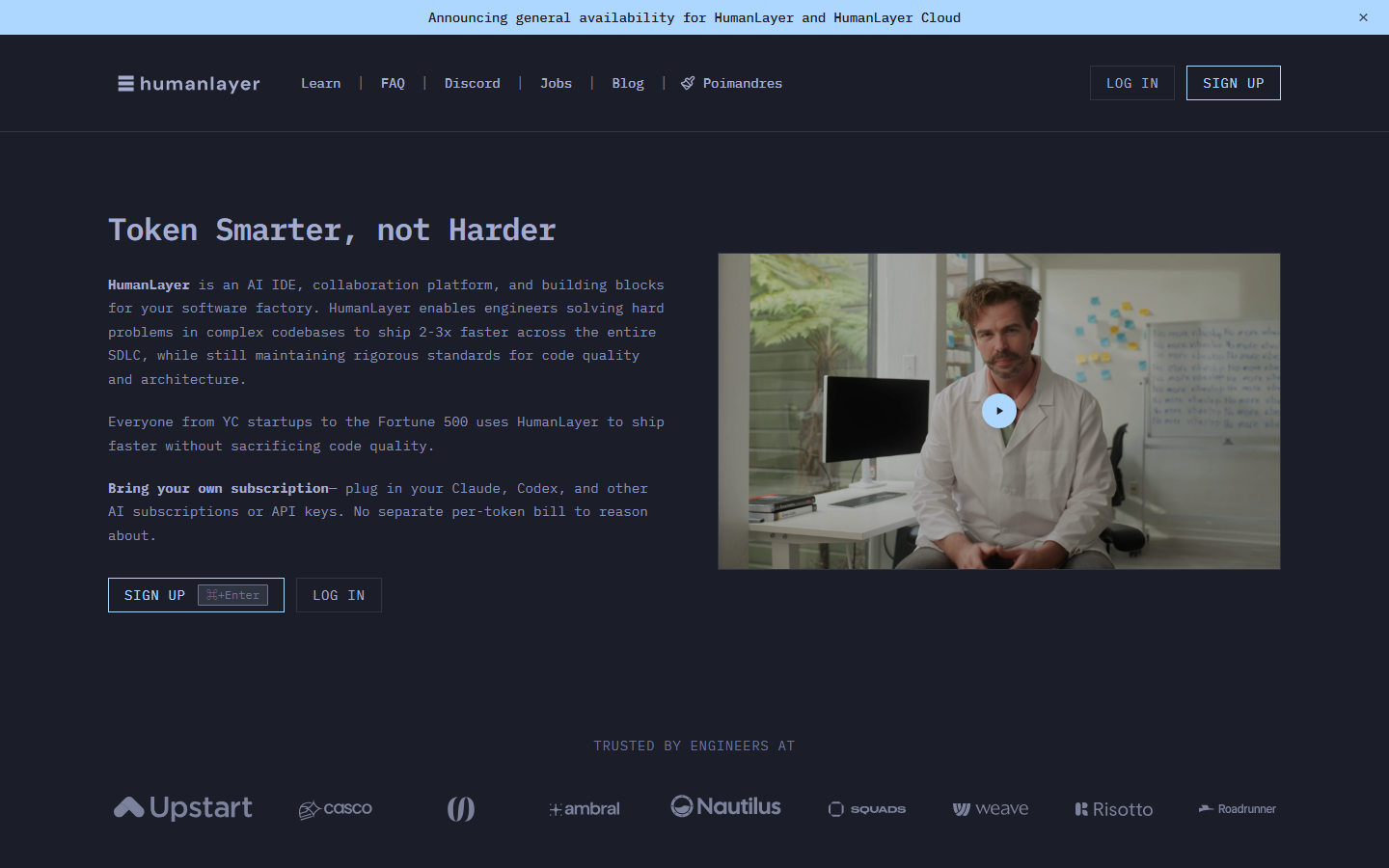
HumanLayer's current public positioning is no longer just a single Agent approval SDK. The homepage of the official website describes it as an AI IDE, collaboration platform and software factory building blocks. The goal is to help engineers use AI coding agents in complex code bases while maintaining code quality and architectural standards. The warehouse README defines CodeLayer as an open source IDE for orchestrating AI coding agents, and explicitly writes it as built on Claude Code, which can be extended from personal notebooks to team use. The core value of the early HumanLayer SDK is still important: fixing human approval on high-risk functions or tool calls themselves, forming a permission gateway before the Agent performs actions.
| Parameters | Current public information |
|---|---|
| Product Main Line | HumanLayer / CodeLayer |
| Official entrance | https://www.humanlayer.dev/ |
| Core positioning | AI Coding IDE, collaboration platform Agent, workload orchestration human-in-the-loop approval layer |
| Early SDK capabilities | require_approval, human_as_tool, human supervision of high-risk function calls |
| Current IDE capabilities | Tasks, agent sessions, artifacts, worktrees, cloud sync, remote agents |
| Supported AI access methods | Comes with Claude, Codex and other subscriptions or API keys |
| Open source warehouse | https://github.com/humanlayer/humanlayer |
| GitHub community size | About 11,018 stars, 925 forks |
| License | README notes that HumanLayer SDK and CodeLayer sources use the Apache 2 License |
| Company Information | YC Fall 2024; Founded 2023; San Francisco; YC page shows team of 3 people |
Positioning change: The boundary of HumanLayer has expanded from "making Agent's high-risk tool calls must undergo human approval" to "letting the engineering team orchestrate and manage AI coding agents". The former solves the problem of permissions and risks, while the latter solves how the software team puts agents such as Claude Code and Codex into tasks, sessions, work trees and team collaboration processes. The two lines do not conflict: the approval layer is suitable for sensitive actions, and the IDE/collaboration layer is suitable for putting these actions into a traceable software delivery system.
User and market recognition
HumanLayer's market signals mainly come from three public channels: official website customer statements, GitHub community data and YC company page. The homepage of the official website states "Everyone from YC startups to the Fortune 500 uses HumanLayer" and also displays the logos of engineering teams such as Upstart, Casco, Osmosis, Ambral, Nautilus, Squads, Weave, Risotto, and Roadrunner; the GitHub repository has approximately 11,018 stars and 925 forks visible on 2026-06-18; the YC page shows that HumanLayer is Active Status Fall 2024 Batch Founder is Dexter Horthy.
Developer Approval: The warehouse scale of more than 10,000 stars shows that HumanLayer has passed the early proof-of-concept stage. For Agent infrastructure, stars do not equate to production deployments, but they do reflect developers' ongoing focus on CodeLayer, Context Engineering, 12 Factor Agents, and human-in-the-loop issues.
Enterprise adoption signals: The official website mentions YC startups and Fortune 500, and the page has a "Trusted by engineers at" customer logo area. Such statements can prove that it is oriented towards team-level engineering processes rather than just serving individual toy projects; however, the number of customers, paid revenue, renewal rates and deployment scale are not disclosed, and these signals cannot be directly inferred as commercial penetration.
Adaptation premise: HumanLayer is more suitable for teams that have already used AI coding agents in real code bases and have begun to encounter problems with multi-session management, work tree isolation, review quality, and permission boundaries. If a team is still in the single-person chat coding stage, its collaboration platform value will be weaker than that of a mature engineering organization.
Cost advantage
The cost advantage of HumanLayer is not to "replace all programming tools for free", but to split the consumption structure of AI coding agents into two layers: HumanLayer is responsible for IDE, collaboration, task and agent orchestration; the underlying model bill can be brought by the team's own Claude, Codex and other subscriptions or API keys. The homepage of the official website clearly states Bring your own subscription and emphasizes that there is no need to understand a separate per-token bill.
C-side/Individual: Individual developers can give priority to the open source warehouse and local desktop orchestration capabilities. The explicit cost is concentrated on the existing Claude, Codex or other model subscription/API fees. If you only need a single prompt or a small script, HumanLayer's task, session, and work tree organization will be more focused; if you have been using Claude Code for a long time, CodeLayer's keyboard-first and multi-session management will more easily offset the learning cost.
Developers/API: The approval capabilities of the early SDK are suitable for embedding control points such as require_approval and human_as_tool into high-risk function calls; currently CodeLayer prefers IDE and agent orchestration. Developer costs mainly include connecting to existing warehouses, configuring Agents, maintaining work trees, managing model credentials, and defining which actions must be confirmed by humans, rather than paying a single API call fee.
Enterprise/Private: Both the official website and README regard teamwork as the core direction, and the YC page also shows that it is recruiting Founding Product Engineers. When enterprises adopt it, explicit costs need to be based on the official real-time page or business communication; implicit costs include SSO/auditing, code permissions, remote agent context, data retention, compliance terms, and internal security reviews. HumanLayer's BYO subscription model can reduce model bill duplication, but it will not eliminate enterprise-level governance costs.
Main functions
The functions of HumanLayer can be broken down into "early SDK approval layer" and "current CodeLayer project collaboration layer". For the user-given Agent manual approval and permission gateway human-in-the-loop direction, early SDK documents are still the core evidence; for currently visible products, the official website and README have focused on the IDE and team collaboration of AI coding agents.
- High-risk tool call approval: legacy SDK documentation explains that HumanLayer uses tools to ensure that high-risk function calls have deterministic human supervision. Even if LLM hallucinations or misjudgments occur, the approval logic is embedded in the function/tool itself.
require_approvalapproval decorator: The document shows the pattern of wrapping function calls before communicating on behalf of users or writing to sensitive systems. It is suitable for scenarios such as sending CRM updates by email, modifying billing information, and operating production databases.human_as_toolHuman input channel: There are autonomous agents for external loops, allowing the Agent to proactively contact one or more people when context, judgment or authorization is needed, instead of just waiting for human initiation in the chat window.- CodeLayer AI Coding IDE: README defines CodeLayer as an open source IDE for orchestrating AI coding agents, and uses Claude Code as one of the basic capabilities.
- Task, session and work tree management: Official website product area description Tasks can combine agent sessions, artifacts, and worktrees into a workspace, which is suitable for team collaboration to track complex development tasks.
- Team and cloud expansion: The official website copy mentions cloud sync, remote agents and HumanLayer Cloud, which are suitable for expansion from local desktop to team and multi-device use.
During function acceptance, "whether approval can truly block high-risk actions" and "whether AI programming collaboration can reduce rework" should be evaluated separately. The former looks at audit links, approval channels and failure fallback; the latter looks at PR quality, context reuse rate, parallel task throughput and code review burden.
Model and version evolution
The version history of HumanLayer is very clear: in the early days, it was the human-in-the-loop SDK, and later the warehouse switched the main line to CodeLayer. The humanlayer.md in the repository clearly indicates that the HumanLayer SDK documentation is being superseded by CodeLayer and states that the SDK has been removed in PR #646; the README places CodeLayer in the current main narrative.
Early days: HumanLayer SDK
Early documents focused on the tool call risks of Agentic Workflows, distinguishing between low-risk reading, public and private data reading, medium and high-risk communication, writing private data, etc., and proposed using HumanLayer on high-risk function calls to ensure human presence. This stage is more like an "Agent permission gateway". The value lies in making approval part of the tool call, rather than relying on prompt words to require the model to wait consciously.
Current: CodeLayer and HumanLayer Cloud
The first screen of the current official website displays "Announcing general availability for HumanLayer and HumanLayer Cloud" and positions the product as AI IDE, collaboration platform and building blocks. The README also states that CodeLayer is an open source IDE for orchestrate AI coding agents. The pro-0.20.0 GitHub release on 2025-12-23 provides CodeLayer Pro DMG; the nightly release on 2026-02-27 shows that the project is still continuing to iterate.
Candidate Verification
When launching a version, you need to distinguish between stable release, nightly release and legacy SDK documents. The production environment is more suitable to be fixed on the stable version or the team's verified build; the nightly version is suitable for following up on new capabilities, but it should not be directly used as the only benchmark for the enterprise development process.
Technical advantages
HumanLayer's technical advantage comes from "putting human control points into the Agent execution system" rather than relying solely on stronger models. For high-risk actions, improving model reasoning capabilities can only reduce the probability of errors, but cannot eliminate the consequences of errors; the approval layer turns human confirmation into hard constraints for function calls, making the Agent more controllable in real business systems.
Mechanism: Approval of the embedded tool itself. Early SDK documentation emphasized HumanLayer baked into the tool/function itself. The effect is that approval does not rely on Agent readme or prompt word commitment, but is enforced by the tool call path; applicable scenarios are operations that cannot be easily rolled back, such as sending external communications, updating customer data, triggering financial actions, modifying production systems, etc.
Mechanism: Humans as Agents can call capabilities. human_as_tool turns human judgment, supplementary information and authorization into callable tools in the Agent workflow. The effect is that the long-term Agent does not have to wait in the chat window for users to actively view it, but can initiate communication through chat, email, SMS and other channels when needed; applicable scenarios are customer onboarding, sales follow-up, exception handling and software task review.
Mechanism: IDE layer organizes context and workload. CodeLayer puts tasks, agent sessions, artifacts, and worktrees into the same workspace. The effect is that multi-agent parallelism in complex code bases is no longer scattered in multiple terminals and chat records; the applicable scenario is software engineering organizations that require parallel exploration, branch isolation, PR collaboration, and team review.
The price of this technical route is increased governance complexity. The deeper HumanLayer goes into the engineering process, the more the team needs to clearly define which actions must be approved, who has the authority to approve, how to handle approval timeouts, and what codes and credentials the remote agent can access.
How to use
The usage entrance of HumanLayer is divided into two categories: current product and legacy SDK. The current product entrance is the official website and cloud login/registration; the legacy SDK documentation can still be used to understand the approval model, but the warehouse has stated that the SDK is being replaced by CodeLayer, and the old SDK should not be regarded as a long-term mainline plan.
| Usage path | Suitable for the crowd | Entrance | Key actions |
|---|---|---|---|
| HumanLayer Cloud / Official website registration | Engineers who want to quickly experience AI Coding IDE and team collaboration | https://cloud.humanlayer.com | Register, connect existing AI subscription or API Key, create tasks and Agent sessions |
| CodeLayer local/open source path | Developers who are familiar with Claude Code and want to orchestrate coding agents locally | https://github.com/humanlayer/humanlayer | Read README, install available builds, configure local repository and model credentials |
| legacy SDK approval model | Developers who are designing Agent permission gateway | https://github.com/humanlayer/humanlayer/blob/main/humanlayer.md | Refer to the control point design of require_approval and human_as_tool |
| Team implementation | Organizations that require multi-member collaboration, remote Agent and audit governance | Official website Sign Up / contact contact@humanlayer.dev | Clarify code permissions, approval policies, model billing and security boundaries |
A reasonable pilot path is: first select a complex but low business risk warehouse task, use HumanLayer/CodeLayer to manage 2 to 3 parallel Agent sessions; then introduce sensitive actions that require manual confirmation, such as initiating PR, triggering deployment, modifying production configuration or outgoing communication; finally, incorporate approval records, failure rollbacks and code quality indicators into the team's routine reviews.
Product Pricing
HumanLayer does not stably disclose the complete price list on its official website. The business structure clearly stated on the official website is to come with AI subscriptions or API keys such as Claude and Codex, and emphasizes that HumanLayer does not create an additional per-token bill that needs to be understood; GitHub release provides CodeLayer Pro DMG; the official website provides cloud sign up/log in; the Terms page explains that HumanLayer can adjust website or product prices at any time. Therefore, the specific costs of enterprise procurement and Pro/Cloud should be subject to the official real-time page or business confirmation results.
| Tier | Current exposure status | Cost description |
|---|---|---|
| Personal/Open Source | Warehouse README annotation CodeLayer and HumanLayer SDK sources use Apache 2 License | Explicit costs mainly come from the built-in model subscription/API Key, and maintenance costs come from local installation and configuration |
| Pro / Desktop release | GitHub latest stable release is CodeLayer Pro 0.20.0, providing macOS DMG | Whether there are charges, licensing terms and support scope are subject to the official real-time page |
| HumanLayer Cloud | The official website has cloud sign up/log in and announces HumanLayer Cloud general availability | Specific packages, seats, remote agents, team collaboration and data terms are not fully disclosed |
| Enterprise/Private | Official website and YC page display for teams and engineering organizations | Requires business confirmation SSO, auditing, remote execution context, data retention, support SLA and compliance terms |
Cost analysis cannot just look at the subscription unit price. The benefits of HumanLayer come from reducing the context loss, repeated exploration and low-quality PR of AI coding agents in complex code bases; true cost acceptance should simultaneously record model expenses, engineer review time PR rollback rate, task completion cycle and security approval burden.
Application scenarios
HumanLayer is suitable for tasks where "the agent can create value but cannot fully delegate authority". It can serve as both an AI programming collaboration platform and a human approval layer before high-risk Agent actions.
- Multi-Agent Development of Complex Code Bases: Split the refactoring, research, test repair, and implementation tasks into multiple agent sessions, and use tasks and worktrees to manage context and products. The focus of acceptance is PR quality, conflict rate, and review time.
- Approval of sensitive operations in production systems: Put deployment, configuration changes, database writing, billing or permission modifications into the approval link. The focus of acceptance is whether the approval truly blocks unauthorized actions and whether the approval records can be traced back.
- Customer Communication and Operation Agent: Let the Agent draft email Slack messages or customer follow-up content, but send it after human confirmation. The focus of acceptance is tone quality, error rate, compliance mark and manual revision ratio.
- Team AI Programming Governance: Upgrade the use of personal Claude Code/Codex to a team-level workflow, unify tasks, sessions, remote agents and collaboration records. The focus of acceptance is multi-person visibility and standardized workflow.
- External loops have autonomous agents: When Agents need to run for a long time and require judgment or authorization from humans in the process, HumanLayer's human_as_tool idea can reduce the risk of "unattended execution".
The unsuitable scenarios are also clear: pure question and answer, low-risk one-off scripts, personal early adopter projects without code collaboration requirements, and generally do not require the introduction of a complete HumanLayer workflow.
Applicable people
The target users of HumanLayer are not all AI tool users, but engineering teams and developers who have integrated AI Agents into real workflows.
- Software Engineering Team Lead: Need to enable multiple engineers and multiple coding agents to collaborate around the same complex warehouse while maintaining architectural standards PR quality and task visibility.
- Platform Engineering and Security Team: It is necessary to define which Agent actions can be automatically executed, which ones must be manually approved, and how to implement approval timeouts, audit records, and credential isolation.
- AI Agent Developer: If you are building an Agent that can send emails, change CRM, trigger deployment, or call internal systems, you need to put approval and human-in-the-loop designs into the tool call path.
- Heavy Claude Code / Codex user: Hope to upgrade the personal multi-terminal and multi-session AI programming method to a task, work tree and team collaboration system.
The boundary condition is: the team needs to be willing to adapt the development process, not just install an editor plugin. If the engineering organization does not have clear habits of code review, permission management, and task splitting, HumanLayer will expose these basic problems and may not immediately improve efficiency in the short term.
Summary and Outlook
The most noteworthy thing about HumanLayer is that it handles "AI Agent delegation" and "human supervision" in the same engineering system. The early HumanLayer SDK solved the problem of manual approval of high-risk function calls. Currently, CodeLayer extends this idea to the IDE, team collaboration and cloud execution environment of AI coding agents. For AI programming in complex code bases, the value of HumanLayer is not to allow models to completely replace engineers, but to allow engineers to gain higher leverage in key decisions, approvals, and architectural quality.
The current limitations also need to be clarified: the official website does not disclose a complete price list; HumanLayer Cloud's enterprise security, data retention, permission details and SLA require business confirmation; the legacy SDK has been replaced by CodeLayer, and the old documents are more suitable as reference for design ideas; the nightly release is updated frequently, and it is not appropriate to blindly follow the latest pre-release build due to production constraints. Before adoption, it is recommended to pilot 1 to 2 real engineering tasks to record PR quality, review time, model cost, approval hit rate and rollback status, and then decide whether to expand to team-level remote Agents and HumanLayer Cloud.
Related tools:  CrewAI,
  LangChain
Version Info
- CodeLayer 0.1.0 Nightly 20260227142452 :The latest pre-release build disclosed by GitHub Releases continues the main line of CodeLayer desktop and Agent orchestration, and is a nightly version rather than a stable version.
- CodeLayer Pro 0.20.0 :GitHub latest stable release public CodeLayer Pro version, provides macOS DMG, and lists Homebrew and manual installation paths in the description.
- HumanLayer SDK Legacy Documentation :The legacy SDK document retained in the warehouse states that the early HumanLayer SDK focused on high-risk function call approval require_approval and human_as_tool; the document also states that the SDK is being replaced by CodeLayer, and there is no official precise release date.
User Reviews