 Intercom AI
Intercom is a customer communication platform for the AI Agent era. Fin AI Agent is natively integrated into the Help Desk and supports billing by outcome ($0.99/resolve). It also provides Copilot manual assistance, work order system, omni-channel messaging, marketing contact and product guidance workflow.
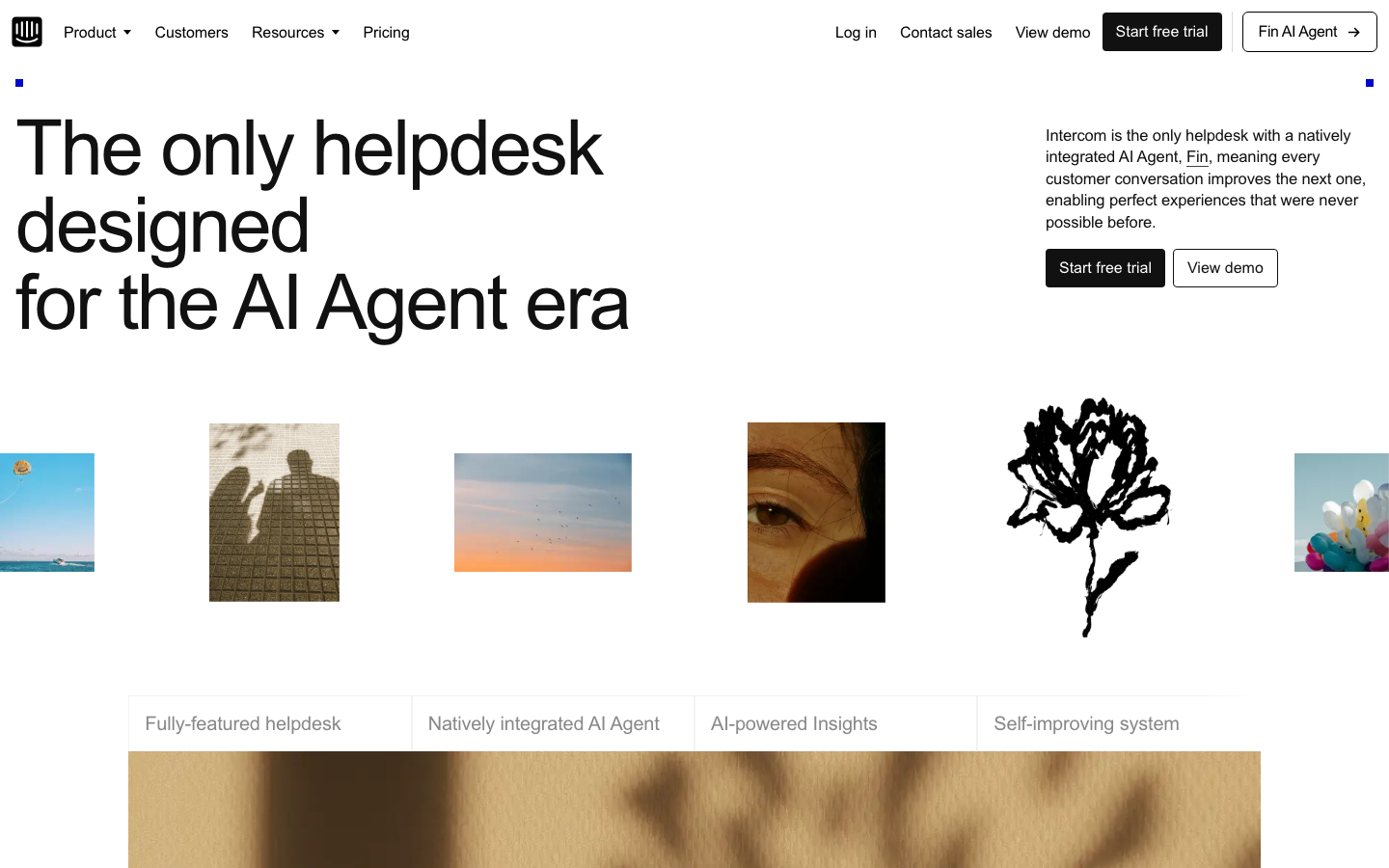
IntercomAI
Core parameters and statistics
Intercom positions itself as a "customer communication platform in the AI Agent era". The core difference is that Fin AI Agent is natively integrated with Help Desk from the bottom (not a plug-in AI plug-in), and adopts a pricing model based on outcome billing. Its product matrix covers three modules: customer service (Inbox), marketing (Engage) and product guidance (Series), and the three share the same customer data plane.
| Projects | Public Information |
|---|---|
| Official positioning | The only helpdesk designed for the AI Agent era |
| AI products | Fin AI Agent (native integration, not plug-in) |
| Product Module | Customer Service Inbox, Marketing Engage, Product News Series |
| Pricing model | Starting from $29/seat/mo + $0.99/outcome (Fin is billed based on the number of solutions) |
| Available plans | Essential, Advanced, Expert, Fin Standalone |
| Integration Ecosystem | 350+ native integrations, open API |
| Free trial | 14 days, no credit card required |
| Customer Cases | Anthropic, Clay, Lightspeed, Rocket Money, Gamma, Synthesia |
| Support channels | Email, Chat, Phone, WhatsApp, In-app, Social |
| Compliance Certification | HIPAA (Expert Plan), SOC2, GDPR |
Fin outcome billing logic: Billing will only occur when the customer confirms that the problem has been resolved, or when the customer stops asking questions after Fin's reply, or when Fin completes a workflow (Procedure). Multiple responses within the same conversation will only be counted once. The higher the AI solution rate, the lower the amortized cost per outcome, forming a positive incentive cycle.
AI and artificial intelligence come from the same source: Fin and human customer service share the same customer record and context history, and carry the complete conversation chain when transferring. This is the essential difference from the "AI + independent Help Desk" architecture such as Tidio and Zendesk Answer Bot - data does not need to be synchronized across systems, so there is no context break problem.
Cross-module collaboration: Users at risk of churn identified in Marketing Engage can directly trigger manual priority follow-up in the customer service Inbox; new functions in Product Series guide data and automatically write back customer portraits, affecting Fin's response priority. The data relationship between these three modules is a moat that is difficult for competing products to copy.
User and market recognition
Intercom's market recognition is based on more than 14 years of brand accumulation in the enterprise customer service field and the quantitative effect endorsement of Fin AI Agent. Its customer structure is dominated by medium and large SaaS, e-commerce and financial technology companies, covering more than 25,000 paying organizations (public data in 2026).
Well-known customer array: Anthropic, Clay, Lightspeed, Rocket Money, Gamma, Synthesia, Robin, [solidcore], etc., spanning AI infrastructure SaaS tools, e-commerce retail and fitness services. These customers are concentrated in the medium and large range with a monthly consultation volume of 500-50,000, which is highly consistent with the economics of the Fin Outcome billing model.
Quantitative effect data (from Intercom official public case):
- Synthesia: The average resolution time after Fin went online dropped from 5 days and 5 hours to 4 hours and 37 minutes, a 96% drop
- Lightspeed: With the assistance of Copilot, the number of daily conversations handled by customer service increased by 31%, and the onboarding time of new customer service was shortened by about 40%.
- [solidcore]: Fin saves hundreds of thousands of dollars in customer service costs every year, and the AI solution rate is stable at more than 45%
- Robin: Fin achieves a 50% AI solution rate, and the number of manual work orders is directly halved.
Industry coverage: Starting from early SaaS customer service, it has now expanded to e-commerce (multi-channel messaging), financial technology (security compliance requirements), medical care (HIPAA support), and education (student consultation automation). Notably, Intercom has the most positive customer feedback in high-frequency, standardized Q&A scenarios (billing, password resets, order status), while under-covering highly personalized consultation scenarios (legal advice, medical diagnosis).
Cost advantage
Intercom's cost structure consists of the three dimensions of "seat fee + Fin outcome pay-as-you-go + add-ons", and has a clear ROI deduction path for medium and large teams. Its core design concept is: the higher the AI solution rate, the lower the amortized cost per outcome, and the marginal cost approaches zero.
C-side/small team starting cost: Essential plan $29/seat/mo + $0.99/outcome, suitable for quick verification of small teams of 1–5 people. All features are available during a 14-day free trial. The Startup plan offers up to 93% discount + 1-year Fin free, which is extremely friendly to early-stage entrepreneurial teams.
Comparison of solutions for medium and large teams:
| Solution | Seat Unit Price | Fin Outcome | Core Differentiation | Suitable for Scale |
|---|---|---|---|---|
| Essential | $29/seat/mo | $0.99/outcome | Basic work order Messenger, knowledge base, pre-built reports | 1–5 people |
| Advanced | $39/seat/mo | $0.99/outcome | Multi-team inbox, workflow automation, polling assignments 20 free Lite seats | 5–50 people |
| Expert | $69/seat/mo | $0.99/outcome | SSO, HIPAA, SLA, multi-brand management 50 free Lite seats | 50–200 people |
| Fin Standalone | No seat fee | $0.99/outcome (minimum 50/month) | Fin AI Agent only, can connect to third-party Help Desk such as Salesforce | Enterprises with existing customer service stacks |
Hidden cost list (must be included in the budget before purchasing):
- Copilot Add-on: $29/agent/mo (unlimited use), includes 10 free Copilot + AI translation credits per agent. The more manual customer service there is, the cost increases linearly.
- Pro add-on: $99/mo (includes 1000 conversation analysis), additional charges are per-use, used for AI quality scoring and topic detection
- Proactive Support Plus: $99/mo (including 500 messages), used for product navigation and proactive push, excess $0.20/mo
- Channel surcharge: WhatsApp/SMS/Phone/Email Campaign is charged additionally based on volume, Email is about $0.001/email, WhatsApp is about $0.005/item
Cost reduction and efficiency improvement deduction (position-level estimates based on public cases):
- Junior Customer Service Specialist: A typical SaaS enterprise's junior customer service handles an average of 40–60 conversations per day. After the introduction of Fin + Copilot, Fin automatically handles repeated inquiries (about 30–50%), and Copilot assists with the remaining responses. The average daily processing volume of the same position can be increased to 100–150, which is equivalent to 2–3 times the human efficiency. Derivation basis: Synthesia solution time dropped by 96%, Lightspeed daily processing volume increased by 31%
- Customer Service Supervisor: Insights automatically covers 100% of conversation quality scores, replacing manual random inspections (usually covering 5–10%), saving about 4–6 hours of quality inspection work per week
- CSM (Customer Success Manager): Proactive Support + Series automatically triggers churn warnings and user guidance, reducing CSM manual troubleshooting time by about 30%
The above data are deductions based on public cases, and actual benefits depend on the completeness of the knowledge base and industry adaptability.
Main functions
-
Fin AI Agent (Core Differentiation): An AI customer service agent natively built into the Help Desk. Based on knowledge base training, it supports Fin Procedures (workflow execution - such as refunds, order modifications, and order inquiries). Applicable tasks: Automatically answer repeated inquiries and perform business operations 7×24, only switching to manual work when uncertain. Expert View: Fin Procedures upgrades AI from "dialogue generator" to "business operation agent", which means that Fin can not only tell customers how to refund, but also directly initiate the refund process, which is something traditional Chatbot cannot do.
-
Copilot human assistance: Each customer service's AI co-pilot automatically pulls historical conversation context, knowledge base answers and drafts responses. Synergy: Copilot and Fin share a knowledge base - Fin automatically answers standard questions, Copilot assists humans in answering complex questions, and the "knowledge gaps" between the two are automatically identified and suggested supplements through Insights analysis. Lightspeed cases show that Copilot increased daily processing volume by 31% and shortened the onboarding time for new customer service to 2–3 days.
-
AI-enhanced Ticketing and Intelligent Work Orders: Convert any conversation into a work order with one click, and AI will automatically classify, prioritize and assign it to the corresponding team. Synergy effect: Work order data writes back customer portraits, affecting Fin's subsequent answer weight; at the same time, work order trend analysis provides trigger conditions for Engage marketing reach.
-
Omnichannel Omni-channel Inbox: Unified workbench for Email, Chat, Phone, WhatsApp, In-app messaging, and social media. Synergy: Channel data is stored in a unified manner, and AI identifies the same customer across channels - when a customer says "My order has not arrived yet" on WhatsApp, Fin can directly reference the context in Web Chat without repeating the description.
-
Marketing Engage and Product Series: Engage triggers automated email/message push based on user behavior; Series embeds guidance messages and feature prompts within the product. Synergy: Users with churn risks identified by Engage are automatically marked, customer service Inbox priority queue display, CSM receives Proactive alerts - the data integration of the three modules shortens the cycle from "risk discovery" to "taking action", from the traditional daily calculation to the minute level.
-
Insights AI Quality Monitoring: 100% coverage of AI scoring for all conversations, automatic detection of topic trends, CSAT changes and quality degradation alerts. Synergy effect: The "knowledge base missing" problem discovered by Insights is pushed to the knowledge base team with one click, and Fin is automatically retrained after supplementation - forming a self-improvement system of "defect discovery → knowledge supplement → Fin improvement → effect verification".
Model and version evolution
Intercom's product iteration is centered on Fin AI Agent and develops along the main line of "deepening of AI capabilities → independent deployment → workflow execution".
2025 Q3: Fin AI Agent released
Fin AI Agent is officially launched. It is an AI customer service agent based on a large language model and adopts the outcome billing model ($0.99/resolve). The initial version only supports automatic text reply based on the knowledge base and supports drag-and-drop knowledge base article management. A basic version of Copilot was launched at the same time, providing simple reply suggestions.
2025 Q4: Copilot upgrade and channel expansion
Copilot upgrades from simple suggestions to an AI-assisted co-pilot with contextual reasoning, supporting automatic drafting of responses, knowledge base retrieval, and historical conversation reference. Added WhatsApp channel integration, multi-language support expanded to 6 languages.
2026 Q1: Fin independent deployment + AI Ticketing
Fin AI Agent is free from the limitations of the Intercom platform and can be deployed as an independent AI layer to third-party Help Desks such as Salesforce and Zendesk, expanding the market for enterprises that already have a customer service stack but want to add AI. AI-enhanced Ticketing was launched at the same time, and conversations were automatically converted into structured work orders and intelligently dispatched. Multilingual Help Center is online.
2026 Q2: Fin Procedures (Workflow Execution)
Fin has gained workflow execution capabilities (Procedures) and can call external system APIs to perform business operations such as refunds, order changes, and inventory inquiries. This is a key node for Intercom to evolve from "conversational AI" to "operational AI Agent". During the same period, Insights was upgraded to 100% conversation coverage.
Follow-up evolution direction (inferred based on the official roadmap)
Fin's Agentic capabilities will continue to expand: from single Procedures to multi-step orchestration (concatenating multiple operations), from passive response to active contact (identifying customer problems before proactively initiating dialogue), and a deeper third-party system API integration map. Intercom’s long-term goal is for Fin to handle 80%+ of customer inquiries, with humans only taking over complex disputes and high-value customers.
Technical advantages
Single Data Plane: Fin shares the same customer records, historical conversations, behavioral data and custom attributes with human agents. While plug-in AI plug-ins (such as Zendesk Answer Bot) require additional layers of data synchronization and context mapping, Intercom’s data plane is naturally unified – meaning zero context is lost on transfer and AI recommended answers are based directly on the current customer’s complete cross-channel interaction history.
Self-improvement is a process: Fin learns from the best responses from human customer service (administrators can mark high-quality responses as training samples), and Copilot feeds back Fin's knowledge to human customer service. Through Insights, the management side obtains one-click repair suggestions for "which knowledge base content is missing" and "which integrations need to be optimized", forming a flywheel effect of "AI assists people → people improve AI → AI better assists people".
Fin Procedures Architecture: Through the workflow engine, the AI Agent not only generates text answers, but also calls external system APIs to perform business operations. Essentially, this is to embed the Agent's workflow capabilities directly into the customer service scenario, without the need to build additional MCP links or maintain independent automation scripts. Procedure supports conditional branch API authentication inheritance, error retry and manual approval nodes (human-in-the-loop is set for irreversible operations such as refunds).
Security and Compliance Architecture: Expert solutions support HIPAA (Healthcare Data Compliance), and all solutions are SOC2 Type II and GDPR certified. Data storage supports AWS US/EU region selection. Permission tiering and manual confirmation points for irreversible operations (refunds, account deletions, data exports) – a requirement for enterprise-level procurement and a key differentiator between Fin and pure AI chatbots.
How to use
Intercom's deployment paths are divided into two types: "native full stack" and "Fin independent deployment", which are suitable for different enterprise starting points.
Path 1: Native Intercom + Fin full stack (recommended)
- Sign up for a 14-day free trial (no credit card required)
- Configure the Help Center knowledge base (supports importing existing FAQs, documents, and help articles)
- Activate Fin AI Agent (automatically trained from the knowledge base, usually effective within 24 hours)
- Add a human customer service team and configure inbox distribution rules
- Set automatic classification and priority rules for work orders (optional AI automatic suggestions)
- Add Copilot/Pro/Proactive Support add-ons as needed
- Integrate existing systems (350+ native integrations for Slack, Salesforce, Jira, Shopify, etc.)
Path 2: Fin independent deployment (for enterprises that already have Help Desk) Enterprises that are already running on Help Desk such as Salesforce and Zendesk can subscribe to Fin separately ($0.99/outcome, minimum 50 outcomes/month) and complete the connection within 1 hour through API or native integration. Fin independently answers questions via Email/Chat/Phone channels, and only transfers back to the original Help Desk for manual processing when needed.
| Entrance | Applicable objects | Core restrictions |
|---|---|---|
| Web management panel | Administrator and customer service | Unlimited, full functionality |
| iOS / Android App | Mobile customer service | Push notifications, basic operations |
| REST API | Developer | API Key required, frequency control restrictions |
| Fin Standalone | Businesses with existing Help Desk | Minimum 50 outcomes/month, AI tier only |
| Embed SDK | Product embedded | Development integration required |
Product Pricing
Intercom's pricing system consists of three levels of nesting: "Plan (determines seat unit price and functional scope)" + "Fin outcomes (pay-as-you-go)" + "Add-ons". Understanding its structure is a prerequisite for evaluating the procurement budget.
Program layer:
| Solution | Seat Price | Fin Outcome Price | Key Functional Boundaries | Suggested Scenarios |
|---|---|---|---|---|
| Essential | $29/seat/mo | $0.99/outcome | Basic work order Messenger, knowledge base, pre-built reports | Start with a small team |
| Advanced | $39/seat/mo | $0.99/outcome | Multiple inboxes, workflow automation, polling 20 free Lite seats | Mid-sized customer service team |
| Expert | $69/seat/mo | $0.99/outcome | SSO, HIPAA, SLA, multi-brand 50 free Lite seats | Regulated industries, large teams |
| Fin Standalone | No seat fee | $0.99/outcome (minimum $49.50/month) | Fin level only, connected to third-party Help Desk | Enterprises that already have a customer service stack |
Add-on Layer:
- Copilot: $29/agent/mo (unlimited use), including 10 free AI translations per agent
- Pro: $99/mo (includes 1000 conversation analysis), $0.10/mo beyond
- Proactive Support Plus: $99/mo (includes 500 messages), $0.20/mo more
- Channel additional: WhatsApp $0.005/SMS $0.01/Phone per minute
Free & Discounted: 14-day fully functional free trial; Startup plan offers up to 93% off + 1 year Fin free; non-profit organizations can apply for discount plans.
Procurement Adaptation Boundary: For teams with a monthly consultation volume of less than 200, the economics of Fin outcome billing are not obvious, and it is recommended to use the Essential solution + pure labor first; teams with a monthly consultation volume of 500–5,000 are Fin’s sweet zone. In theory, 40–50% of consultations can be automated, with the most significant ROI; large teams with a monthly consultation volume of more than 5,000 need to pay attention to the linear growth of Copilot add-on costs, and it is recommended to regularly audit AI The match between resolution rate and outcome consumption.
Application scenarios
-
SaaS enterprise customer support (core scenario of cost reduction and efficiency improvement): Fin AI Agent handles account management, bill inquiries, function usage guidance and other high-frequency repeated consultations (accounting for about 30–50% of work orders), and Copilot assists manual customer service in handling complex technical issues. Position-level deduction: The Synthesia case shows that the resolution time dropped from 5 days to 4 hours, the customer service team changed from "replying one by one" to "only processing complex work orders for Fin upgrades", and the daily work content of junior customer service personnel reversed from 60% repeated answers + 40% complex questions to 20% repeated + 80% high-value processing. Human-computer collaboration boundary: Fin can 100% automate the standard question and answer process; when operations involving account deletion, large refunds, interpretation of legal terms, etc., Fin Procedures must set up manual approval nodes.
-
E-commerce multi-channel customer service (workload peak smoothing scenario): Unify Email, Chat, WhatsApp, and In-app messages into the Intercom inbox, and AI automatically classifies work orders and assigns them according to urgency. Cost reduction deduction: [solidcore] The case shows that Fin saves hundreds of thousands of dollars every year - the number of consultations surges 3-5 times during the big promotion period. Traditional solutions require the addition of temporary customer service or outsourcing, while Fin absorbs the increase at a fixed outcome price, and the marginal cost approaches zero. Boundary of Human-Machine Collaboration: AI handles order inquiries, standard procedures for returns and exchanges; when it comes to dispute arbitration and customer complaint escalation, manual processing is mandatory.
-
Medical/Financial Compliance Customer Service (Regulated Industry Scenario): The HIPAA compliance and SLA guarantee of the Expert solution enable regulated industries to use AI customer service under the premise of compliance. Prerequisites: Requires contact with the area where sales confirmation data resides, the level of audit log detail, and Fin's processing boundaries for PHI (Protected Health Information). Human-machine collaboration boundary: AI cannot independently provide medical advice or financial decisions, and is limited to non-diagnostic scenarios such as account operations, appointment management, and bill inquiries.
-
In-product guidance and customer success (full life cycle scenario): Series embeds new user onboarding guidance in the product, Engage automatically sends behavior-triggered retention emails, and Insights identifies customers whose feature adoption rate has declined and alerts CSM. Cost reduction deduction: It takes about 4–6 hours per week for CSM to manually troubleshoot customer churn signals. After automatic identification by Proactive Support, CSM can directly enter the intervention stage, and the troubleshooting time is reduced by about 70%. Boundary of Human-Machine Collaboration: Churn warnings can be automatically triggered; however, it is recommended that manual CSM take the lead in retaining communications for high-value customers (ARPU > $1000/mo).
Applicable people
-
SaaS and technology company customer service teams (10–100 people): The Advanced/Expert solution's permission management, multi-inbox SLA and work order automation meet the needs of medium-sized customer service operations. Prerequisites: The monthly consultation volume must exceed 500 to reflect the economics of Fin outcome billing; the initial content of the knowledge base must cover at least 80% of common problems, otherwise Fin's initial solution rate may be less than 20%.
-
Medium-to-large enterprises that already have a Help Desk but want to add an AI layer: Use Fin Standalone ($0.99/outcome, no seat fee) to connect AI automatic reply capabilities to existing Salesforce/Zendesk and other systems within 1 hour. Not suitable for boundaries: If the existing Help Desk's work order process is heavily customized (a large number of custom fields, complex approval chains), Fin's independent deployment integration requires additional API development work. It is recommended to verify POC first before purchasing in bulk.
-
Customer service operations leaders and CSM teams in medium and large enterprises: Insights and Pro add-ons provide AI quality monitoring with 100% conversation coverage, which is suitable for management scenarios where customer service quality is quantified into trackable indicators. Prerequisites: It takes 2–4 weeks to build the knowledge base and Fin tuning period. The initial AI solution rate may be 20–30%, and it can reach 40–60% after continuous optimization.
-
Compliance and IT Procurement in Regulated Industries (Healthcare/Financial): HIPAA compliance and SLA assurance for Expert plans are a must. Prerequisite: You must obtain the complete security white paper, data processing agreement (DPA) and SOC2 audit report through enterprise sales, and confirm that the data residence area meets local regulations.
-
Not applicable to the group: Small and micro teams with a monthly consultation volume of less than 200 (Fin's outcome billing economy is not obvious); Fully automated scenarios that require pure AI automatic reply and no manual customer service intervention (Intercom's design premise is "human-machine collaboration" and does not support manual customer service mode); Teams that only need to send marketing emails (MA function is bound to Advanced or above solutions, which is not as economical as a dedicated ESP).
Summary and Outlook
Intercom's industry status and product maturity have made it the "standard" customer communication platform for medium and large enterprises - Fin AI Agent further changes the cost structure of large-scale customer service from "human linear growth" to "AI leverage". Core competitiveness stems from three points: the native integration of Fin and Help Desk (data plane with zero context loss), the incentive mechanism of billing by outcome (the higher the AI solution rate, the lower the cost), and the data connection between the Product-Led mode (product guidance through Series) and the Service-Led mode (customer service through Inbox).
Current limitations: The monthly fee for the full-featured solution (Advanced + Copilot + Pro) is high, and the monthly expenditure for a 200-person team is about $8,000–15,000; Fin’s accuracy is highly dependent on the completeness of the knowledge base, and organizations with weak knowledge bases will have a poor initial experience and may need a 2–4 week knowledge base tuning period; the depth of workflow execution (Procedures) is limited by the openness of third-party APIs, and the integration of non-standard systems requires additional development.
Risk Warning: Although Intercom's per-outcome billing model positively incentivizes high resolution rates, it may also lead the team to pursue "resolution rate numbers" rather than "customer satisfaction" (such as Fin closing conversations prematurely and guiding customers to confirm resolution). It is recommended to monitor the outcome consumption of Fin in conjunction with the CSAT score. In addition, competing products such as Zendesk AI and Freshdesk AI are also rapidly following up on agentic customer service capabilities in 2026, and Intercom’s lead window period is about 6–12 months.
Follow-up observation points: Whether Fin can evolve from "answering known problems" to "actively discovering and solving unknown problems" - the orchestration depth and cross-system integration breadth of Procedures are core indicators; whether Intercom's pricing strategy will adjust the outcome unit price as the cost of AI decreases; and whether its penetration in the small and medium-sized enterprise market will affect the functional boundaries of the Essential solution.
Procurement evaluation suggestions: For teams with a monthly consultation volume of 500+, it is recommended to start with Advanced, first replace 40–50% of customer service volume with Fin to verify the ROI (about 2–3 months), and then evaluate whether to upgrade Expert or expand add-ons; companies that already have a Help Desk are given priority to evaluate Fin Standalone; regulated industries must start with Expert and complete a security review before opening production traffic.
Related tools:  Notion AI, google-workspace
Version Info
- Fin AI Agent + Intercom 2026 Q2 :There is no official precise date yet. Fin AI Agent continues to iterate, introduce Fin Procedures (workflow execution capabilities), and strengthen Copilot and Insights analysis capabilities.
- Fin AI Agent + Intercom 2026 Q1 :There is no official precise date yet. Introducing the independent deployment capability of Fin AI Agent (can be mounted with third-party Help Desk such as Salesforce), and launching AI-powered ticketing.
- Fin AI Agent Launch :There is no official precise date yet. Fin AI Agent is officially released to the market, based on the outcome billing model, and supports knowledge base training and automatic reply.
User Reviews