 Iterable
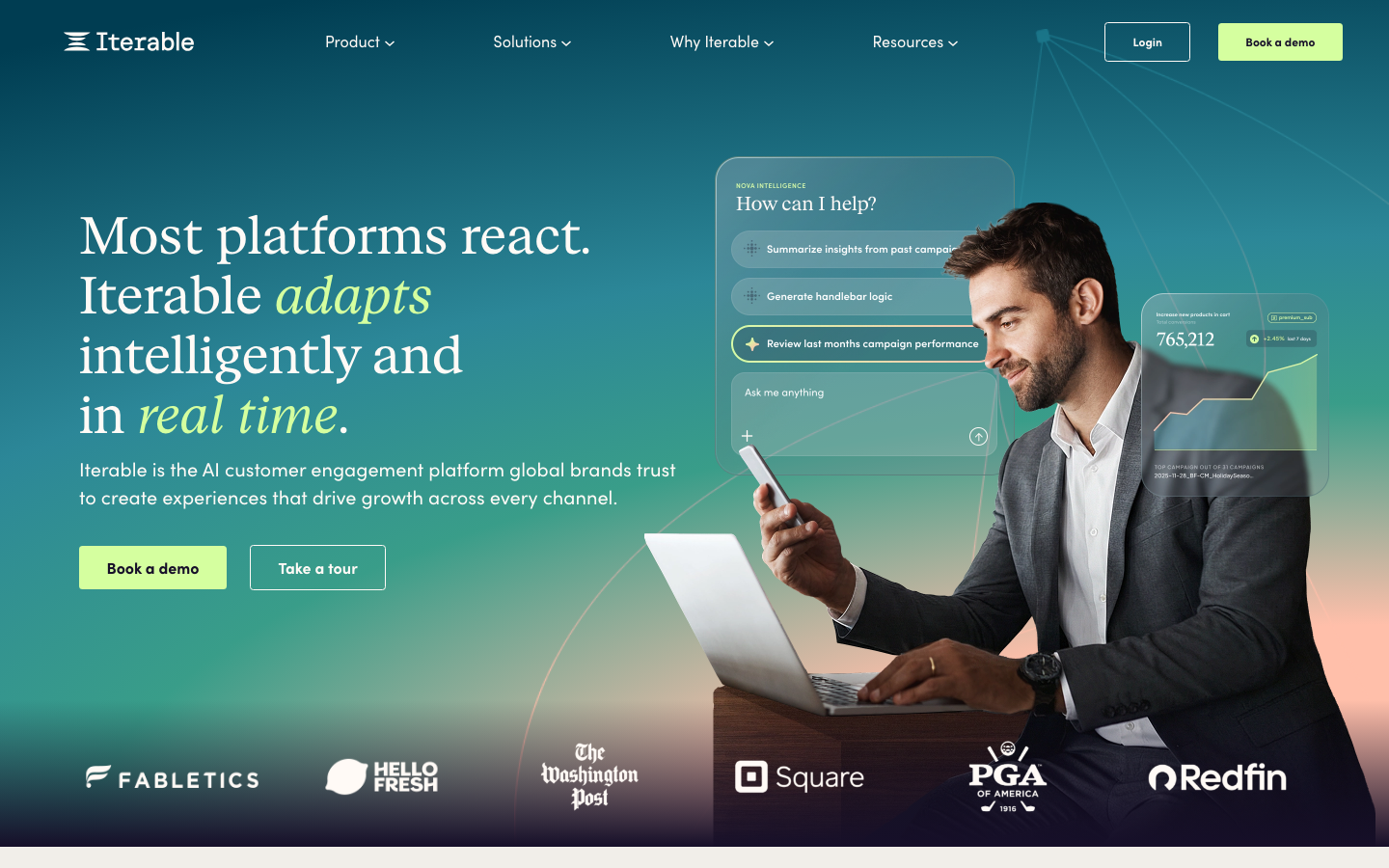
Iterable is a cross-channel marketing platform for user growth teams. It supports omni-channel orchestration of emails, SMS, push notifications, in-app messages and webhooks, and uses data-driven AI capabilities to power personalized marketing.
Iterable
Iterable’s core parameters and statistics
Iterable is positioned as a "cross-channel marketing automation platform for growth teams". The core difference is that it is not a pure email marketing tool, but focuses on "product-oriented consumer Internet companies" (Apps, SaaS, e-commerce platforms, subscription services) as its main customer group, providing omni-channel orchestration capabilities for emails, SMS, push, in-app messages and Webhooks. Its product form is closest to Braze, but it is significantly different from Klaviyo’s e-commerce email in-depth binding strategy.
| Projects | Public Information |
|---|---|
| Official positioning | Cross-channel marketing automation platform for high-growth teams |
| Product Form | SaaS Web + REST API + Mobile SDK (Android / iOS) |
| Channel coverage | Email, SMS, push notification, in-app messaging Webhook, Inbox |
| Core customer group | Consumer Internet companies (App/SaaS/e-commerce/subscription services) |
| Notable Clients | Box, Zillow, Ibotta, Casper, Drizly |
| Number of public integrations | 100+ third-party integrations (including Segment, mParticle, Salesforce, Shopify, etc.) |
| Latest public version | 2026.06 (June 2026 Release) |
| Pricing model | Business subscription system, comprehensive billing based on data volume + message volume + number of channels |
| Public free plan | No public free package, you need to contact sales to get a trial |
Customer group boundary: Iterable's product design is obviously biased towards "digital native companies with high-frequency user interaction". If your business is mainly offline stores, has very few user digital touch points, or only requires one marketing email per month, its cross-channel orchestration capabilities are an over-configuration.
Competitive position: In the cross-channel marketing automation track, Iterable and Braze are highly overlapping in terms of customer groups and functions, but Iterable emphasizes the usage scenarios of the "Growth Team" rather than the "marketing department". This is reflected in the fact that its journey editor is more biased towards the trigger logic of the product operation side (behavioral event driven > time plan driven).
Iterable’s users and market recognition
Gradually build user awareness in the field, and product capabilities are used by content creators and teams to improve work efficiency. Some industry users have incorporated it into their daily workflow. It is recommended to refer to the latest official disclosures for specific user scale and industry adoption rate data.
Cost advantage of Iterable
The cost structure analysis can be divided into three layers: C-side/light users, no public entrance API/no direct billing on the developer side, and business pricing based on usage on the enterprise side.
C-side/Personal Tier: Iterable is not for individual users, and there is no free package or self-service subscription entrance. Individual users or very small teams (such as small apps run by independent developers) cannot register directly and must go through the enterprise sales process. This is in stark contrast to Klaviyo (which offers a free plan up to a certain number of contacts) and Mailchimp (which offers a free tier).
Developer/API Layer: Iterable does not expose a separate API billing scheme. Its REST API and SDK are only available to signed-up enterprise customers. This means that developers cannot conduct technical evaluation through the self-service API during the selection phase, and must first enter the business process to obtain the API key. Similar to Braze, this adds to the upfront business cost of technology selection.
Enterprise/Private Tier: Iterable uses business pricing, and the price is usually based on a combination of the following variables: -Amount of user data (number of contacts, storage capacity of user portraits)
- Message sending volume (billed separately by channel, emails and push usually have different rates)
- Number of channels (the more channels used, the higher the basic fee)
- Additional modules (AI predictive model catalogs, dynamic content, etc. may be billed separately)
The specific price is subject to the official real-time quotation. Before purchasing, it is recommended to clarify the following three points of billing methods: the excess unit price after exceeding the package limit, whether API calls for data import/export are billed, and whether there are additional charges for calls to the AI prediction model.
Total Cost Deduction: Taking a consumer app with 500,000 monthly users as an example, using three channels of email + push + in-app messaging, the annual subscription fee is estimated to be in the tens of thousands to hundreds of thousands of dollars (unofficial data, only based on comparative deductions of Braze's public pricing range for similar products). Compared with building a self-built marketing engine, the explicit cost of acquisition is not low, but the saved development and maintenance team manpower (usually requiring 2-3 back-end + 1 data engineer) can usually cover the subscription cost within 6-12 months.
Main functions of Iterable
Iterable's functional design revolves around "cross-channel user lifecycle management", and its core capabilities can be summarized into six modules:
-
Cross-channel journey editor: A visual workflow canvas that supports the orchestration of multi-step sequences based on user behavior (registration, purchase, app opening, shopping cart abandonment), attributes (region, membership level, preference) and time conditions. Each step can independently select channels (email/push/SMS/in-app messages), and supports branch, delay, waiting and exit conditions. The actual benefit is that the operations team can use one tool to complete complex sequences such as "first send a welcome email after registration → add push notification if not activated for 3 days → trigger SMS if not logged in for 7 days" that used to require the splicing of multiple systems.
-
AI Predictive Models: A collection of built-in multiple predictive models, including Optimal Send Time, Brand Fatigue, Content Recommendations, and Lifecycle Stage Prediction. Expert View: The real value of these models does not lie in the accuracy of a single model, but in the synergy between them - brand fatigue detection can automatically reduce the push frequency of high-reach users, while the optimal sending time model rearranges the contact timing, and then the content recommendation model replaces it with higher-matching materials. The entire adjustment process does not require operators to manually set rules.
-
Dynamic Content (Catalogs): Dynamically pull data from product catalogs, content libraries or real-time APIs, and render personalized content in real time at the moment of sending. For example, the "recommended for you" product list in e-commerce promotion emails and personalized push summaries in news apps. Catalogs supports multiple layers of data sources (static CSV, real-time API, third-party inventory systems), and can load different catalog views based on different branching conditions during the journey. Synergy: When Catalogs is linked with the AI content recommendation model, the process of "model judging user preferences → matching top-N products from the catalog → real-time rendering to email/push" can be achieved without the need to operate manual product selection.
-
User Data Platform (CDP Capability): Unify user portraits, support event tracking, custom attributes, behavior segmentation and real-time user search. Supports importing user data through SDK, API, Segment/mParticle and other data pipelines. Implicit capabilities: Its data platform is not a simple storage layer, but supports "real-time" evaluation of user attributes and events in the journey editor - this means that when a user just completes an action (such as submitting a form), the journey can immediately determine which segment he belongs to and trigger the corresponding next step, instead of waiting for the batch processing window.
-
Experiment and Optimization Engine: Built-in A/B testing and multi-variable testing framework, supporting comparative experiments in email subject lines, push copy, sending time, channel selection and other dimensions. The version recommended by AI can automatically enter the experimental control group. After reaching statistical significance, the system will automatically select the winning version and push it in full. Acceptance Concerns: In actual use, attention needs to be paid to whether the minimum sample size setting and statistical significance threshold of the experiment are adjustable, and whether there is mutual interference between channels in multi-channel experiments (for example, users open emails after learning about activities from push notifications, resulting in falsely high email open rates).
-
Webhook and API channel: Push marketing events (user open, click, conversion, unsubscribe) to downstream systems (CRM, data warehouse, advertising platform) in real time through Webhook to achieve cross-platform action triggering. The difference between this and Zapier-like tools is that Iterable's Webhook is deeply bound to the journey editor and can output events and carry contextual data at any node in the journey.
Iterable model and version evolution
Continuous iterative updates, the latest version introduces performance optimization and new features. Historical version information can be viewed on the official release page. There is no complete public version evolution timeline yet. It is recommended to pay attention to the official announcement to understand the rhythm of feature updates.
Iterable’s technical advantages
Iterable's technical capabilities do not originate from a single model or algorithm, but from the combination of "data real-time + channel orchestration flexibility + AI model layering":
Real-time data architecture: Iterable's user data platform adopts a streaming processing architecture, and the delay from when an event is triggered on the user side to when it can be used as a journey trigger is on the second level. This means that operations teams can trigger instant messages based on real-time signals such as "A user just completed a purchase" or "A user just submitted a return request," rather than relying on hourly or daily batch processing windows. Applicable scenarios: For scenarios with high timeliness requirements (such as anti-fraud notifications, payment confirmations, flash sale reminders), a real-time architecture is strictly needed; but for scenarios such as scheduled newsletters, the additional cost brought by real-time performance may be a waste.
Cross-channel status synchronization: Iterable's journey engine maintains a "user cross-channel contact status", that is, the content and time of the latest messages received by the same user on the four channels of email, push, in-app messaging and SMS are summarized into the same context. This allows the brand fatigue detection model to determine user fatigue based on the frequency of contact across all channels (rather than the frequency of a single channel), avoiding incongruities such as "the frequency of emails has been reduced but push bombing" occurs.
AI model layering strategy: Iterable’s AI capabilities are not a black box model, but layered by tasks:
- The first layer (trigger layer): real-time decision-making based on rules (user behavior → entering the journey → branch judgment)
- The second layer (optimization layer): AI model makes recommendations on sending time, content selection, and frequency (requires historical data accumulation)
- The third layer (prediction layer): forward-looking models such as life cycle stage prediction and churn warning (requiring user behavior sequences with a longer window)
The advantage of this layered design is that newly connected brands can still use the rules engine to run the basic journey first when the data accumulation is insufficient, gradually turn on the AI optimization layer as the amount of data increases, and finally enable the prediction layer. Implementation Tips: When purchasing and evaluating, it is recommended to first confirm whether your current user data level has reached the minimum effective sample requirements of the AI model (usually each segment requires at least thousands of historical interaction records), otherwise the AI function may be "good but not practical".
API-first design: Iterable's core capabilities are exposed through REST API, including user management, event tracking, journey triggering, content rendering and report query. This allows enterprises to directly call Iterable's capabilities in custom front-end or back-end systems without having to force a switch to Iterable's management interface. For mature teams that already have a self-built backend, this means that Iterable can be embedded into the existing system as a "marketing engine" rather than replacing the existing system.
How to use Iterable
Iterable adopts a full business process, and all usage methods require sales contact and account opening first:
| Access method | Applicable stage | Prerequisites | Key actions |
|---|---|---|---|
| Web management background | Daily operation and configuration | Complete business signing, account opening | Journey arrangement, user management, report viewing |
| REST API | Technology integration and data synchronization | Obtain API Key (requires business contract) | User import/event tracking/journey triggering/data export |
| Android + iOS SDK | App-side data collection and push | Integrate SDK into mobile applications | User identity recognition/event reporting/push registration |
| Segment / mParticle integration | Access through data pipeline | Already have a Segment/mParticle account | Configure Iterable as the target output |
Typical access steps:
- Sales docking: Submit the consultation form through the official website, and the sales team will provide a trial situation after assessing the needs. This phase typically takes 1-2 weeks and involves communication of requirements, magnitude assessment and confirmation of contract terms.
- Technical integration: The development team accesses the SDK (mobile terminal) and REST API (server terminal) to complete user identity mapping, event tracking and channel registration. This phase typically takes 2-4 weeks, depending on the compliance of the existing data infrastructure.
- Journey building: The operations team creates the first journey (usually a new user welcome sequence) in the background, and configures trigger conditions, channels and content. It is recommended to start validating the data link from a linear journey through a single channel.
- Grayscale verification: Run through the journey with 5-10% of user traffic to verify data accuracy, channel delivery rate and content rendering correctness.
- Full launch: After passing the verification, it will gradually be expanded to full users, and A/B testing and AI optimization functions will be enabled.
Implementation Tips: In actual projects, the data mapping phase is often the longest and most time-consuming step - the user ID system within the enterprise (cookie ID, device ID, email, phone number, member ID) needs to first complete unified identity resolution in Iterable to achieve cross-channel user association. It is recommended to ask sales to provide technical architect support resources during the business stage.
Product Pricing for Iterable
Iterable does not disclose standard pricing, all plans need to contact the sales team to obtain a quote. Based on the pricing model of similar products in the industry (Braze, Klaviyo, Salesforce Marketing Cloud), it can be deduced that its price structure roughly includes the following dimensions:
| Billing dimensions | Typical billing methods | Description |
|---|---|---|
| Contact base | Billed based on monthly active users or total number of contacts | Usually pricing is based on tiers, the more contacts, the lower the average order price |
| Message sending volume | Billed separately by channel | Email is usually the cheapest and SMS is the most expensive (including operator costs) |
| Number of channels | Platform fees are charged based on the number of enabled channels | The more channels used, the higher the basic fee |
| AI add-on modules | Additional monthly fees | Advanced features such as predictive model catalogs may be billed separately |
| Technical support levels | Basic support is free, advanced support is paid | SLA response time is linked to price |
Free/Trial: Iterable does not have a public free package, but there is a trial environment for evaluation before signing. The specific trial period and functional limitations are subject to sales communication.
Growth Package: For startups and small to mid-sized growth teams, includes core automation capabilities and limited integration support. The official real-time quotation shall prevail.
Enterprise Plan: For larger enterprises, offers customized integrations, dedicated customer success managers, advanced AI models, and private deployment options. The official real-time quotation shall prevail.
True Cost Reminder: In Iterable platforms, excess unit prices that exceed the package limit often affect the total cost more than the basic fee. It is recommended that the following three items be clarified in the contract: the unit price calculation formula after the basic sending volume is exceeded, whether API calls for data import/export occupy the message quota, and whether each prediction call of the AI model is billed separately.
Application scenarios of Iterable
The following four types of scenarios can best take advantage of Iterable's cross-channel orchestration:
-
App user activation and retention: Trigger cross-channel push sequences based on events such as registration, first core behavior (such as first order, first follow), dormancy warning, etc. For example, "If the user does not complete the first purchase on the 3rd day after registration → Push an in-app message with a new customer coupon → If the user still does not purchase on the 7th day, an additional email will be sent." Verification focus: Verify that users in the multi-channel sequence can correctly exit the journey once they complete the goal at any step, so as to prevent converted users from continuing to receive conversion guidance messages.
-
Omni-channel promotions: Simultaneously reach the three channels of email, push, and in-app messages to increase the coverage of major promotions. The advantage of Iterable is that you can set the logic of "not repeatedly reaching the same user through different channels" in the journey - for example, if a user has seen promotional information through in-app messages, no push or email with the same content will be sent to them. Key points of verification: Verify whether the cross-channel deduplication logic can accurately match multiple identities of the same user (email, device ID, mobile phone number).
-
Subscription renewal and churn warning: Automatically trigger a hybrid reminder sequence based on the expiration time (emails sent 7 days before expiration, push notifications 3 days before expiration, and text messages on the same day). At the same time, the AI model triggers the recovery journey in advance when users experience churn signals such as "decreased usage frequency and unused key functions." Implementation Tips: The key to this type of scenario is data timeliness - the user's key behavioral data needs to be returned to Iterable within hours instead of days, otherwise the advance prediction value of the AI churn warning model will be significantly reduced.
-
Automatic classification and migration of user lifecycle: Automatically group users according to RFM (recent consumption time, frequency, amount) or custom rules. Different groups enjoy different reach strategies - highly active users reduce push frequency to avoid fatigue, silent users increase wake-up contacts, and high-value VIP users enter an exclusive maintenance journey. Verification focus: Verify that when a user migrates from one group to another, Iterable can automatically remove them from the original journey and add them to the new journey, instead of causing conflicts due to two journeys running at the same time.
Iterable is suitable for people
-
Growth Team: This is the core target user of Iterable. Growth teams are typically responsible for the full funnel of user acquisition, activation, retention, and referrals and require cross-channel, event-driven automation tools to enable scaled growth experiments. Iterable's journey editor and A/B testing framework directly serve the growth workflow of "quick hypothesis → grayscale verification → full promotion".
-
Product Operations Team: The operational role responsible for the user reach strategy within the app. Iterable's push and in-app messaging capabilities, Catalogs dynamic content, and AI fatigue detection make it more suitable for productized operation scenarios than traditional email marketing tools. Operations teams can independently configure and adjust reach strategies without relying on development.
-
Marketing Event Operation Team: Responsible for the marketing role of big promotions, festival activities and new product launches. Omni-channel simultaneous reach, cross-channel deduplication and real-time activity reporting enable it to outperform single-channel tools during activity-intensive periods.
-
Customer Success and User Operations: Care or early warning processes need to be automatically triggered based on user health (frequency of use, key behaviors, support tickets). Iterable's Webhook capability allows it to be connected with CRM and customer service systems, but this scenario requires the team to have certain automated process design capabilities.
Not applicable to the crowd:
- Small teams that only need to send a monthly newsletter: Mailchimp or SendGrid are much less expensive and complex than Iterable and can be set up on your own without any business contact.
- Scenarios for pure e-commerce sellers that require in-depth Shopify/Shopline SKU-level integration: Klaviyo is deeper than Iterable in e-commerce data integration and product recommendation.
- Teams that require highly customized email template design: Iterable’s email editor capabilities are weaker than Mailchimp and HubSpot in terms of template flexibility and visual editing experience.
Iterable’s human-machine collaboration boundary
As a marketing automation platform, the degree of automation of different sections in Iterable is obviously different:
-
Can be 100% automated: message sending (automatic triggering based on rules and AI), user grouping and migration (automatic execution according to preset rules), version selection for A/B testing (automatic full volume after statistical significance is reached), report generation and exception alerts.
-
Human-in-the-loop required: Key branch logic settings in the journey design phase (operators need to make decisions after understanding user behavior), AI model training data range selection (it needs to confirm which user groups participate in model training), content creation and review of major promotion activities (brand compliance confirmation is required), and Webhook integration configuration with external systems (the development team needs to complete the docking).
-
Strong manual control: Irreversible batch operations (sending in full, deleting user data, changing pricing strategies), compliance approval involving user privacy (unsubscription request processing, data export permissions), abnormal output review of AI models (such as the model recommending obviously inappropriate personalized content).
Recommendation: In the early stages of Iterable's implementation, use "A/B testing to automatically select the winning version" and "automatic user migration" as the first batch of automation pilots, because these have controllable risks and are easy to roll back. For functions such as "automatic frequency reduction based on AI fatigue detection" that affect user experience perception, it is recommended to manually review it in a grayscale environment for 1-2 weeks, and then release the fully automatic execution after confirming that the model output is reasonable.
Summary and Outlook
Iterable's core competitiveness lies in the combination of "cross-channel orchestration flexibility + real-time data architecture + hierarchical AI model", which gives it significant advantages in the user growth and product operation scenarios of consumer Internet companies. It is not the cheapest marketing tool, nor is it the email tool with the richest templates. Rather, it is one of the few platforms that can complete journey orchestration, AI optimization, and experimental evaluation within one system in a segment that requires cross-channel, event-driven, and high real-time data requirements.
Current Limitations and Uncertainties:
- Pricing is completely opaque, all solutions require business contact, and the pre-evaluation cost for small and medium-sized teams is relatively high.
- The flexibility of the email template editor and the richness of the template library are lower than those of Mailchimp and HubSpot.
- The depth of SKU-level data integration in e-commerce scenarios is not as deep as that of Klaviyo (the latter has deeper data pipelines with platforms such as Shopify).
- The actual effect of the AI model is highly dependent on the brand's own data accumulation. New brands or teams with small user base may not be able to feel the improvement of AI functions in the short term.
- The SLA availability commitment and data cross-border compliance certification details have not been officially disclosed. Enterprises need to confirm them separately in the contract before purchasing.
Purchasing and Implementation Suggestions: App-driven consumer brands (SaaS, e-commerce apps, content platforms, subscription services) are recommended to include Iterable in the selection short list and conduct parallel evaluations with Braze. It is recommended to focus on verifying three aspects during the demo stage: whether the flexibility of cross-channel journey orchestration matches the actual triggering logic of the business; the availability of AI fatigue detection and content recommendation under its own data scale; and the complexity of integration with existing data infrastructure through Webhooks. The contract must specify the excess unit price calculation formula, data export permissions, and data migration terms if the contract is not renewed. For teams whose data volume is still in the accumulation stage, it is recommended to start with the "rule engine + single channel" approach. After the data volume reaches the minimum sample requirements of the AI model, they can then gradually activate advanced AI functions to avoid paying unnecessary premiums for AI modules when their own conditions are immature.
Related tools:  Notion AI, google-workspace
How to use Iterable
- Web client: You can use it by visiting the official website and registering an account. Most functions do not require installation.
- API access: Provides RESTful API, developers can obtain the API Key and integrate it into their own applications.
Version Info
- Iterable June 2026 Release :Enhanced AI journey optimization recommendation and workflow visualization panel
- Iterable 2025 Fall :Launching AI-powered outbox timing and content personalization model
- Iterable 2024 Q1 :Introducing Catalogs dynamic content capabilities and webhook channels
User Reviews