 Jira AI
Jira AI is the AI capability implementation of Atlassian Intelligence in the Jira platform. It provides AI Issue summary and creation, natural language JQL query AI automation suggestions and Confluence knowledge Q&A, mainly for enterprise-level software R&D teams.
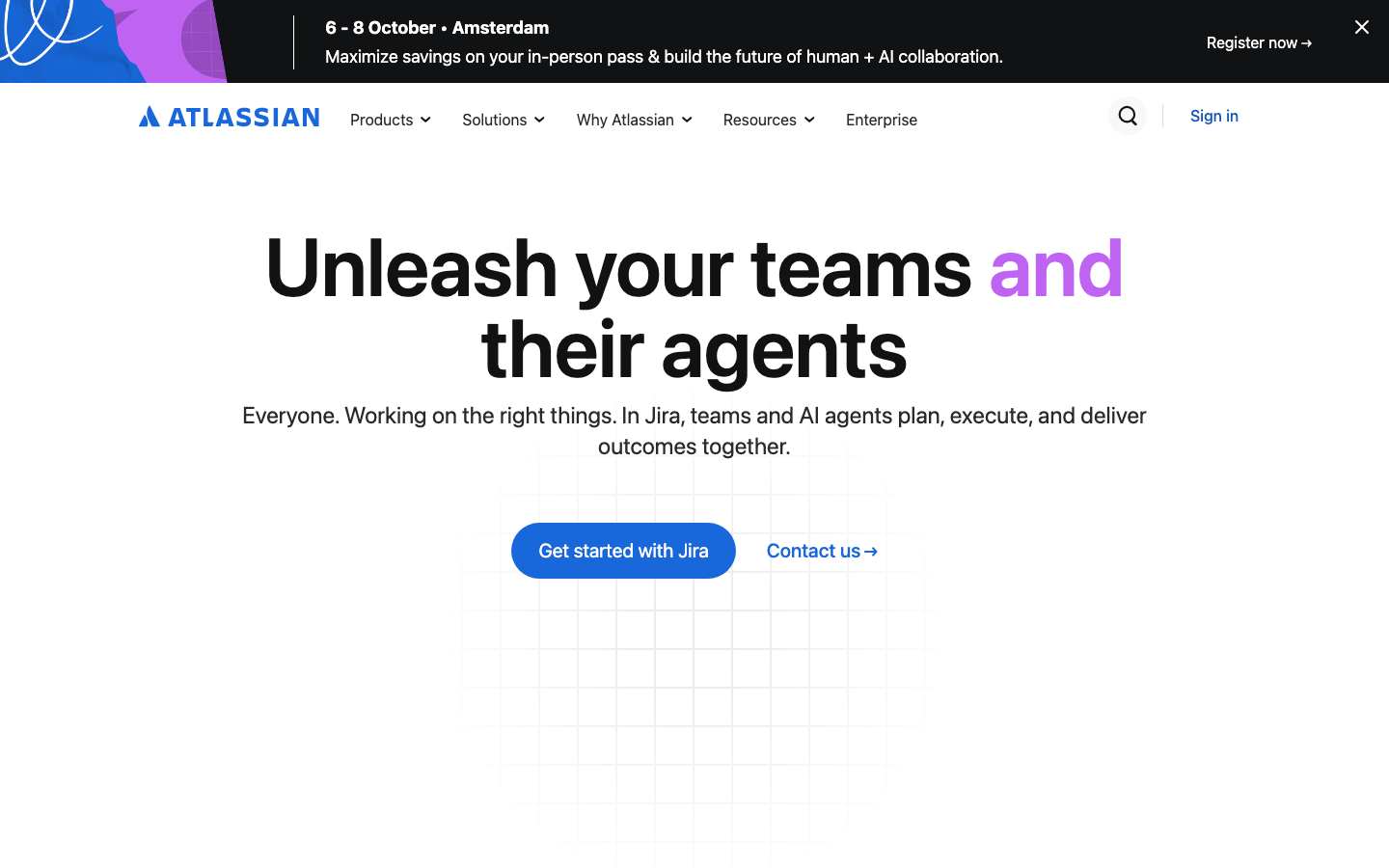
JiraAI
Core parameters and statistics
Jira AI is the implementation of Atlassian Intelligence, Atlassian's unified AI platform, in Jira. Unlike Asana/Monday/Linear’s AI layer, the foundation of Jira AI is Atlassian Intelligence—the same AI platform that powers other Atlassian products like Confluence, Bitbucket, Trello, and more.
| Projects | Public Information |
|---|---|
| Product form | Atlassian Intelligence’s AI functional layer in Jira |
| Core Competencies | AI Issue summary and creation, natural language JQL generation of AI automated suggestions Confluence Q&A |
| Coverage | Jira Software, Jira Service Management, Jira Work Management |
| Underlying model | Atlassian Intelligence (multi-model routing, including GPT-4 and own models) |
| Deployment method | Cloud SaaS (Cloud Enterprise), also supports Data Center self-hosting |
| Pricing model | Atlassian Intelligence add-on (AI add-on) |
| Company size | Atlassian’s annual revenue exceeds $4 billion and its paying customers exceed 250,000 |
| Core Competitive Products | Linear AI, Asana Intelligence, Monday AI |
Point of difference: The biggest feature of Jira AI is "enterprise level" - it is aimed at large organizations that already use Jira and Confluence in depth. AI helps solve "simplification of complex configurations" and "cross-tool knowledge retrieval", rather than lightweight team automation.
User and market recognition
- Customer Size: Atlassian has over 250,000 paying customers, with Jira being its most widely deployed product. From 5-person startups to Fortune 500 companies, Jira covers almost every software team that needs issue tracking.
- Enterprise Penetration: Jira has a very high penetration rate in large enterprises, with Jira instances in many organizations managing tens of thousands of projects and hundreds of thousands of Issues. Atlassian Intelligence's AI functions are launched to these existing customers, and the promotion foundation is solid.
- Market Position: Jira maintains a leader position in the Gartner Magic Quadrant for APM (Application Performance Monitoring) and ALM (Application Lifecycle Management) and is one of the de facto standards for issue tracking worldwide.
- Third-party evaluation: Jira's AI function on G2 scores high in "functional breadth", but is limited by Jira's own historical baggage in "ease of use" and "performance" - complex configuration and slow UI response are common complaints.
Cost advantage
- C-side/Individual: Usually a free version is provided to experience the core functions, and high-frequency use requires a paid package subscription.
- API/Developer: Billed by call volume, suitable for development teams that can be flexibly integrated into their own systems.
- Enterprise/Privatization: Contact the business owner to obtain customized quotation and deployment plan. The specific price is subject to the official real-time pricing page.
Main functions
- AI Issue summary and creation: Automatically generate a structured summary (summary/acceptance criteria/contextual information) based on a long issue description, or directly generate complete issue content through natural language description (such as "Create a Bug Issue where the user failed to log in").
- Natural language JQL generation: Use everyday English to describe query conditions, and AI automatically generates corresponding JQL (Jira Query Language) statements, lowering the threshold for non-technical users to use Jira advanced search.
- AI Automation Rule Suggestion: Analyze the team's management model and project structure, automatically recommend automation rules (such as "Notify the Reporter when the Issue status changes to Done"), reducing manual configuration.
- Confluence Knowledge Q&A: Directly query Confluence documents in Jira to achieve cross-tool retrieval of Issues and knowledge bases. For example, ask "What is our company's deployment process" in Jira, and AI retrieves the answer from Confluence.
- AI Sprint Review Summary: Automatically extract key changes and review points from the completed Issues of the Sprint, and generate a structured Sprint Review Report.
Expert view: The most enterprise-valued scenarios of Jira AI are "natural language JQL generation" and "Confluence knowledge Q&A" - the former lowers the technical threshold for heavy Jira users, and the latter opens up the information islands of Jira and Confluence. These two scenarios only make sense in organizations with deep use of Jira/Confluence, which happens to be Atlassian's core customer base.
Model and version evolution
Continuous iterative updates, the latest version introduces performance optimization and new features. Historical version information can be viewed on the official release page. There is no complete public version evolution timeline yet. It is recommended to pay attention to the official announcement to understand the rhythm of feature updates.
Technical advantages
Atlassian Ecosystem Synergy: The biggest technical advantage of Jira AI is not the AI model itself, but its position in the Atlassian ecosystem - the same AI platform simultaneously provides capabilities for Jira, Confluence, Bitbucket and Trello. This means AI can search across tools between issues and documents, something third-party AI tools cannot do.
Enterprise-grade security and compliance: Atlassian Intelligence promises that customer data will not be used for model training, supports data residency (Data Residency in Cloud Enterprise), encryption and audit logs, and complies with compliance requirements such as SOC 2, GDPR, HIPAA and more. This is critical for large corporate purchasing decisions.
Data Center support: Jira provides a Data Center (self-hosted) deployment option, and Atlassian Intelligence can also deploy a private AI gateway (AI Gateway) in the Data Center to meet the compliance requirements of data not leaving the country. This is a point of difference that neither Asana/Monday/Linear offer.
How to use
| How to use | Applicable people | Features | Cost |
|---|---|---|---|
| Jira Standard + AI additional purchase | Small and medium-sized teams | Basic Issue tracking + AI capabilities | ~$8.15 + AI ~$10/seat/month |
| Jira Premium + AI included/add-on purchase | Growth Team | Premium Roadmap and Sandbox + AI | ~$16.25 + AI optional |
| Jira Enterprise + AI included | Large organizations | Unlimited automation and auditing + AI included | ~$40+/seat/month |
| Data Center + AI Gateway | Organizations with high compliance requirements | Self-hosted + Private AI | Business confirmation required |
Use a typical path: Use AI to generate a complete issue from a natural language description in the issue creation page → Use natural language JQL to query the complex issue list → Query organizational knowledge through Confluence Q&A → Use AI to automatically generate retrospective summaries at the end of the Sprint → Configure automation rules suggested by AI.
Product Pricing
The pricing model is subject to the official real-time page. Usually a freemium or subscription system is used, and basic functions can be used for free. Advanced functions or high-frequency use require paid subscriptions, and users are advised to evaluate the optimal solution based on actual usage.
Application scenarios
Issue management (deduction) in large organizations: 500-person R&D team creates 100+ Issues every day. AI automatic summarization reduces the reading time of long bug reports from 3-5 minutes to 30 seconds; AI natural language JQL query allows non-technical roles (product, operations) to independently find issues, reducing dependence on Jira administrators. However, the additional cost of AI capabilities (approximately $5,000-7,500/month) requires a pre-evaluation of ROI.
Sprint Planning and Review: AI generates a Sprint review summary, which is reduced from about 1 hour/time of manual compilation to about 10 minutes (including verification) automatically generated by AI. For biweekly sprints, the monthly savings is approximately 1.5 hours.
Cross-tool knowledge retrieval: Query Confluence documents directly in Jira, reducing the context switching cost of "viewing issues in Jira, switching to Confluence to check documents, and then switching back to Jira to update issues". Benefits assume that the organization has capitalized its core knowledge in Confluence.
Applicable people
- Medium and large software R&D organizations: For teams that have already used Jira and Confluence in depth, AI's cross-tool search and JQL simplification can help improve efficiency.
- Jira Administrator and Agile Coach: Need to configure automation rules, optimize workflow, and train team roles. AI suggestions can help reduce management burden.
- Jira Service Management users: AI can improve the efficiency of front-line support in work order classification, priority recommendation and knowledge base retrieval in IT service management.
Human-machine collaboration boundary: Issue content generated by AI must be manually reviewed before being published; AI automation rules require administrator confirmation before being enabled; answers to Confluence Q&A must be cross-checked with the original document. All AI operations are subject to Jira's original permissions model.
Dissuade people: Small teams (<10 people) - the cost of AI additional seats is too high, and Linear or Asana is more economical; teams that do not need Jira's complex configuration - Jira's management burden itself may exceed the benefits of AI; cost-sensitive startups.
Summary and Outlook
The core value of Jira AI is not "the smartest AI", but "the AI that best understands Jira configuration" - it helps large organizations lower the threshold for using Jira itself, rather than providing a new way of working. For organizations that are already deeply invested in the Atlassian ecosystem, AI capabilities are a natural extension of the ecosystem’s value.
Not Fitting the Boundary: Small teams and light Jira users don’t fit into Jira AI’s premium model. Organizations that need private deployment can achieve this through Data Center + AI Gateway, but the cost is higher.
Acquisition/Adoption Risk Assessment: Jira AI’s add-on seat billing is the largest acquisition threshold—AI capabilities can run $12,000-$18,000 per year for a 100-person team. It is recommended to apply for an Atlassian Intelligence trial first (usually with a limited AI quota), measure the usage frequency and time savings of the AI function (JQL generated Issue summary Confluence Q&A) in actual use by the team for 2-4 weeks, and then decide whether to purchase in full. If you are already using the Premium/Enterprise plan, it is recommended to confirm whether the AI function is included in the contract.
Related tools:
Version evolution of Jira AI
| Time Window | Major AI Feature Updates |
|---|---|
| 2024 | First release of Atlassian Intelligence, covering Issue summary and simple search |
| 2025-Q3 | Launch of natural language JQL to generate AI automated suggestions AI Issue creation |
| 2025-Q4 | Introducing AI Sprint Review Confluence Q&A Cross-Tool Search |
| 2026-Q1 (current) | Multi-step Issue template generation, cross-project AI search enhancement |
Atlassian Intelligence's AI feature update cadence is approximately quarterly, with important updates typically announced at Team'XX, Atlassian's annual conference.
Version Info
- Atlassian Intelligence for Jira 2026 Q1 release :Deepen the AI Issue creation capability to support multi-step templates, and introduce AI Sprint review summaries and cross-project AI searches.
- Atlassian Intelligence for Jira 2025 Q3 release :Launched AI Issue summary AI automated suggestions and natural language JQL generation.
User Reviews