 Kensho
Kensho is an AI innovation engine owned by S&P Global, providing financial data retrieval and analysis capabilities in the field of AI Office and Efficiency. Its core products include LLM-ready API (providing structured financial data retrieval for large language models), Kensho Extract (PDF to structured data), Kensho Link (entity matching), Kensho Scribe (financial audio transcription) and Kensho NERD (named entity recognition and disambiguation), covering the entire link from data preparation to AI workflow access.
kensho
Core parameters and statistics
Kensho is an AI innovation engine owned by S&P Global. It is officially positioned as "The innovation engine for S&P Global". Its core mission is to open S&P Global's trusted financial data to LLM, Agent and enterprise applications through AI interfaces. It is not an independent tool, but a set of enterprise-level financial intelligence infrastructure consisting of a data preparation layer, a retrieval layer and an AI access layer.
| Projects | Public Information |
|---|---|
| Official Positioning | S&P Global’s AI Innovation Engine |
| Date of establishment | 2013 (Harvard/MIT incubation) |
| Parent Company | S&P Global (acquired 2018) |
| Core product form | LLM-ready API, Extract, Link, Scribe, NERD, Adaptive Retrieval |
| Deployment method | Cloud API, MCP Server, Python SDK |
| Dataset Coverage | S&P Capital IQ Financials, Estimates, Transactions, Transcripts, Company Intelligence, Private Company Financials, Key Developments, Professionals, and more |
| Partners | OpenAI, Anthropic, Google Cloud, AWS, Databricks, Snowflake, LangChain, Cohere |
| Invention patents | 13 items (2018–2025) |
| Office Locations | Cambridge (Harvard Square) + New York City |
| Latest milestone | 2026-06-03 LLM-ready API data set extension |
Product Matrix Logic: Kensho's product line is designed around a clear link - first convert unstructured data (PDF, audio) into structured data through Extract/Scribe, then complete entity matching and knowledge enhancement through Link/NERD, and finally connect the processed data to any LLM or Agent workflow through LLM-ready API and MCP Server.
Data Barrier: Kensho’s core value lies not in the AI algorithm itself, but in its connection to S&P Global’s financial data sets covering tens of millions of listed and unlisted companies. This is a data moat that is difficult for third-party APIs to replicate.
User and market recognition
Kensho's market recognition mainly comes from S&P Global's brand endorsement, ecological cooperation with leading AI manufacturers, and actual implementation cases in the financial industry, rather than public independent user numbers or revenue figures.
Parent Company Endorsement: S&P Global, the world's leading financial data and ratings agency, acquired Kensho as an AI innovation engine in 2018 for approximately US$550 million. This acquisition itself is the market’s highest endorsement of Kensho’s technical strength. Since then, Khensho’s AI capabilities have been embedded in core products such as S&P Capital IQ Pro, S&P Global Energy Core, and S&P Global Marketplace.
Depth of Ecological Cooperation: Kensho has also established cooperation with mainstream AI and cloud vendors such as OpenAI (ChatGPT), Anthropic (Claude), Cohere, Google Cloud, AWS, Databricks, Snowflake, and LangChain. The S&P Global Plugin for Claude Cowork released in February 2026 and the ChatGPT integration launched in March 2026 mark that Kensho has become a key access layer for financial data in the AI ecosystem.
Industry Recognition: Kensho’s leadership helped S&P Global be named to Fortune’s Enterprise AI Maturity Index and Business Insider’s AI Trailblazers list. Its research results are published at top academic conferences such as ACL and DAS all year round, and data sets such as Finance Fundamentals, FIND, SPGISpeech 2.0, and PubTables-v2 are open sourced on Hugging Face, forming a two-way circulation of academic influence and commercial applications.
Cost advantage
- C-side/Individual: Usually a free version is provided to experience the core functions, and high-frequency use requires a paid package subscription.
- API/Developer: Billed by call volume, suitable for development teams that can be flexibly integrated into their own systems.
- Enterprise/Privatization: Contact the business owner to obtain customized quotation and deployment plan. The specific price is subject to the official real-time pricing page.
Main functions
Kensho's capability system revolves around the main line of "converting S&P Global data into AI usable intelligence". The public products can be summarized into two major sections:
Data retrieval layer
- LLM-ready API (deterministic retrieval): Provides API-driven access to structured financial data, supports natural language queries, and returns consistent results every time. LLM is not involved in inference or generation, and the customer has full control over orchestration, tool selection, and execution. This is the core entry point for Kensho’s AI-oriented workflow.
- Adaptive Retrieval (Alpha): Adaptive retrieval for complex open workflows that dynamically routes queries across data sources and automatically assembles results, suitable for in-depth research, multi-step analysis and agent-driven tasks. Currently available in Alpha phase.
Core AI capability layer
- Kensho Extract: Convert unstructured financial PDFs into machine-readable structured data (JSON) with precise processing of text, tables, and charts. This is the bridge between paper financial documents and AI systems.
- Kensho Link: Matches users' tabular company data to S&P Global company IDs and global identifiers, covering more than 70 million public and private company entities. It can still output high-quality matching results even when the input quality is uneven.
- Kensho Scribe: A financial audio transcription service based on deep learning, based on 100,000 hours of S&P Global field data training, supporting AI automatic transcription and manual review (Human-in-the-loop) modes, suitable for financial conference calls, investor presentations and other scenarios.
- Kensho NERD (Named Entity Recognition and Disambiguation): Automatically identifies entities such as companies, people, places, etc. in text and links them to the S&P Global knowledge base, transforming unstructured text into rich business intelligence.
Hidden linkage: These four core capabilities are not isolated products. The typical workflow is: first use Extract to extract structured data in PDF → use Link to match company names to global identifiers → use NERD to identify and link more entities → finally inject the processed data into the Agent or LLM application through the LLM-ready API. Scribe supplements the audio dimension data entry, allowing Kensho to cover three types of information sources: text, table and audio.
Model and version evolution
Continuous iterative updates, the latest version introduces performance optimization and new features. Historical version information can be viewed on the official release page. There is no complete public version evolution timeline yet. It is recommended to pay attention to the official announcement to understand the rhythm of feature updates.
Technical advantages
Kensho's technical advantage comes from the three-layer superposition of "data + AI + financial domain knowledge", rather than the performance of a single model.
Deterministic retrieval vs. generative reasoning: The design philosophy of the LLM-ready API is completely different from general-purpose AI retrieval. It operates in a "deterministic retrieval" mode - always returning the same answer to the same question, without introducing the uncertainty of LLM reasoning or generation. This is critical in financial compliance scenarios: investment banking analysts and auditors need traceable, reproducible data, not LLM's "best guesses." Each answer comes with a link to the original file (S&P Capital IQ Pro), ensuring the output is auditable.
Domain-Specific Model: Trained on 100,000 hours of S&P Global financial audio data, Kensho Scribe is optimized for industry terminology, different accents, and audio quality variations in earnings calls. This is essentially different from the accuracy of general speech recognition services in financial scenarios. Similarly, Kensho Extract's PDF parsing engine is specially optimized for complex layout of financial documents (multi-column tables, headers and footers, annotations).
Full-link architecture: Kensho's products cover the complete link from data extraction → structuring → entity linking → retrieval access. This architecture means financial institutions do not need to stitch data pipelines between multiple vendors, and Kensho provides one-stop data preparation capabilities from raw documents to LLM input.
MCP native support: Kensho is one of the early financial data providers to fully embrace the Model Context Protocol (MCP). Through MCP Server, Kensho can connect to any MCP-compatible application (Claude, ChatGPT, Microsoft Copilot Studio, Amazon Quick Suite, Databricks, etc.), so that the consumption of financial data is no longer limited to self-built applications.
How to use
Kensho uses API as its main delivery form, and also provides two auxiliary entrances: Web UI and MCP access.
| How to use | Applicable products | Entrance | Suitable for people |
|---|---|---|---|
| REST API + Python SDK | LLM-ready API, Extract, Link, Scribe, NERD | docs.kensho.com | Developers, Data Team |
| Web UI | Extract (extract.kensho.com), Link (link.kensho.com), Scribe (scribe.kensho.com), NERD (nerd.kensho.com) | Independent UI for each product | Business analysts, operations team |
| MCP Server | LLM-ready API, Adaptive Retrieval | Configuration via docs.kensho.com | AI users such as Claude/ChatGPT |
| S&P Global Marketplace | LLM-ready API | marketplace.spglobal.com | S&P Global Existing Customers |
Quick Start Guide:
- Register a Kensho account or subscribe to the LLM-ready API through S&P Global Marketplace.
- Obtain authentication credentials (Personal Token or Key Pair).
- Install Python SDK:
pip install kensho-llm-ready-api. - Directly use natural language to query financial data, for example: "Compare the gross margins and EBITDA trends for Amazon, Google, and Meta over the past 5 years".
- Or configure the MCP Server to access Claude/ChatGPT and query directly on the dialog interface.
MCP configuration example (taking Claude as an example): Kensho provides two methods: remote MCP Server and local MCP Server. See docs.kensho.com/llmreadyapi/mcp for configuration details. Kensho also offers the S&P Global Plugin for Claude Cowork, which can be installed directly from the Claude Plugin Market.
Product Pricing
Kensho's pricing model is an enterprise-level API subscription system, and there is no public standard price list.
- Free Trial: The official website provides a free trial entrance. The specific quota, data set availability and functional limitations are not detailed on the public page. Please refer to the services.kensho.com/free-trial real-time page.
- Developer/API Subscription: Pricing for LLM-ready APIs and Core AI APIs is based on dataset coverage and API call volume. Request a quote through S&P Global Marketplace or contact sales.
- Enterprise Subscription: Enterprise-level package pricing, usually including multiple data sets MCP Server concurrent authorization SSO integration, dedicated support and auditing capabilities. Pricing subject to confirmation with S&P Global Account Manager.
- Kensho Labs Customized Solution: Provides customized AI solutions for scenarios that cannot be covered by standardized products. The price depends on the scope and complexity of the project.
Cost Tip: For enterprise-level data APIs like Kensho, you need to confirm the following terms before purchasing - the actual query range of the data set (whether it includes all publicly announced data sets), the upper limit of API calls and the limit on the number of concurrent connections to the MCP Server at the overage rate, whether the data can be used for model fine-tuning or secondary training, and the data retention policy after the contract is terminated.
Application scenarios
Kensho’s implementation scenarios focus on high-value decision-making processes that require credible financial data support:
- Investment Banking and Equity Research: Analysts can quickly pull financial data, transaction history and valuation indicators of comparable companies through the LLM-ready API to build pitch books and research reports. While traditional processes require analysts to manually extract and proofread data from multiple data sources, Kensho compresses this process from hours to minutes, and the results come directly with links to the original files for auditing.
- Earnings Call and Investor Relations: Use Scribe to automatically convert the recording of the earnings call into structured text, combine it with NERD to extract key entities and topics, and then cross-validate the financial data through the LLM-ready API. Suitable for high-frequency batch processing scenarios during the quarterly financial reporting season.
- Asset Management and Portfolio Analysis: Fund managers and researchers use Kensho to obtain historical price trends, industry valuation ranges and stress test data to assist in asset allocation decisions. Adaptive Retrieval (Alpha) is especially valuable in in-depth research and multi-step analysis.
- Enterprise Risk and Compliance: Use Link and NERD to perform entity matching and cleansing of internal data to identify counterparty risk, related transactions and abnormal patterns. A database covering 70 million+ entities dramatically improves the efficiency of the KYC process.
- M&A and Due Diligence: Obtain detailed financial data, industry benchmarks and transaction history of the target company through the LLM-ready API, supporting rapid screening and multi-dimensional analysis before M&A.
Applicable people
Kensho's target user group is mainly professional roles in the financial industry, and it is also expanding to a wider group of AI developers.
- Investment Banker & Equity Analyst: Need to quickly obtain comparable company data, build valuation models, and create pitch decks. Kensho's deterministic retrieval and audit traceability capabilities directly match compliance requirements.
- Quantitative Researchers and Data Scientists: Need high-quality, traceable structured financial data to train models or build analytical pipelines. The Python SDK and REST API make it easy to integrate into existing data science workflows.
- Asset Management and Hedge Fund Professionals: Rely on timely, accurate financial data and market signals to make investment decisions. The full-link capabilities of Scribe + NERD + LLM-ready API cover the entire process from raw audio to structured analysis.
- AI application developers: are building LLM applications or agents in the financial field and need reliable data sources as grounding. Kensho’s MCP native support and multi-platform integration make it the data layer of choice for financial AI applications.
Not suitable for the crowd: Kensho is not suitable for the low-cost experimental needs of individual developers, and its enterprise-level pricing is not friendly to individuals and small teams. There’s also no need for a standalone chat interface – it’s essentially data infrastructure, not a consumer-facing AI chat product. For users who just need general financial data (e.g. stock prices, fundamental indicators), public financial APIs or free sources like Yahoo Finance may be a more suitable option.
Summary and Outlook
The core value of Kensho is that it is the key infrastructure that connects S&P Global’s massive financial data and AI ecosystem. Its irreplaceability comes from three aspects: first, the data barriers posed by S&P Global’s structured financial data sets of tens of millions of companies; second, the full-link product matrix from data extraction, entity matching to LLM retrieval; third, the early and comprehensive embrace of AI open protocols such as MCP. It is not the fastest and cheapest financial data API, but it is currently the enterprise-level financial data solution that is most deeply integrated with the LLM/Agent ecosystem.
Current limitations: Pricing transparency is insufficient, the public page lacks a standard price list, and procurement decisions need to rely on business communication; Adaptive Retrieval is still in the Alpha stage, and production-level availability needs to be verified; core capabilities are highly dependent on the S&P Global ecosystem, and the migration cost after becoming independent from the parent company is extremely high; Chinese support has not been publicly stated, and availability for Chinese financial users needs to be confirmed.
Procurement/Adoption Risk Assessment: The typical adoption path for Kensho is for existing S&P Global customers to pilot the LLM-ready API through the Marketplace to verify dataset coverage and query accuracy before expanding to enterprise-level subscriptions. Before purchasing, you need to confirm with the salesperson the actual available range of the data set, API call volume and concurrency limits, MCP Server authorization terms, and the data retention strategy after the contract is terminated. For non-S&P Global customers, Kensho's evaluation cycle is usually longer, and it is recommended to first use free trials and POC to verify the value of core usage scenarios.
Related tools:  Notion AI, google-workspace
Kensho version evolution
Kensho's core product is a continuously iterative SaaS/API service, and there is no version number system in the traditional sense. The following are publicly available key product milestones:
Early Stage (2013–2024)
Kensho was incubated out of Harvard/MIT in 2013, with an early focus on building natural language financial analytics tools for large financial institutions. After being acquired by S&P Global in 2018, it shifted to building AI infrastructure for the parent company’s data assets. The products at this stage are mainly for internal use within S&P Global, and the API is not publicly available to the public.
LLM-ready API era (2024–present)
- 2024-11-13: S&P Global releases Kensho LLM-ready API (Beta), opening structured financial data to generative AI applications as a natural language interface for the first time.
- 2025-09-15: LLM-ready API extends MCP server access, new dataset support and integration capabilities.
- 2026-01-28: New Private Company Financials and S&P Capital IQ Estimates data sets and enhanced audit traceability.
- 2026-02-24: S&P Global Plugin for Claude Cowork released, bringing financial data skills to AI Agent.
- 2026-03-05: Delivery of S&P Global financial data to a broader user base via ChatGPT.
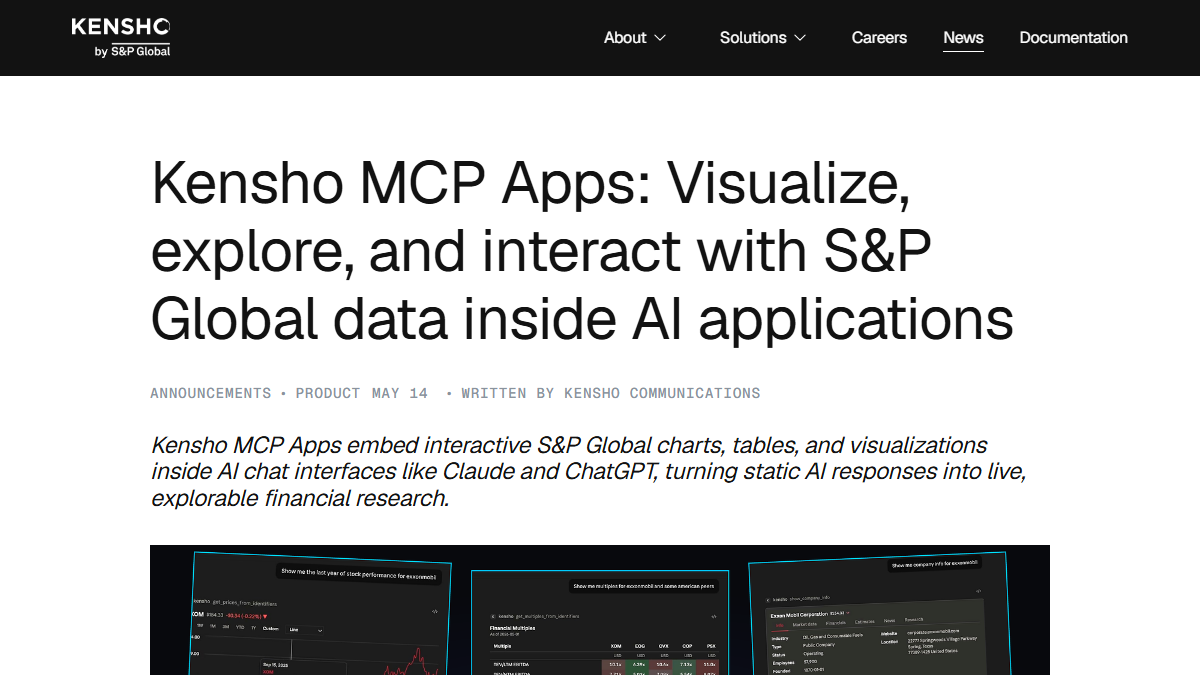
- 2026-05-14: Kensho MCP Apps released, enabling visualization, exploration and interaction of S&P Global data within AI applications.
- 2026-06-03: LLM-ready API adds Key Developments and Professionals datasets, extending global executive data and structured event intelligence.
- 2026-06-11: S&P Global partners with Cohere to expand the AI ecosystem to provide trusted agent workflows for financial institutions.
The characteristics of Kensho's product iteration are: function updates are mainly based on data set expansion, integrated docking and MCP ecological construction, rather than version number upgrades in the traditional sense. Each core API (Extract, Scribe, NERD, Link) maintains its own version independently and iterates at v2/v3 and other levels.
Version Info
- LLM-ready API — Key Developments + Professionals Dataset Extension :The LLM-ready API adds two new data sets, Key Developments (key events) and Professionals (global executive data), to further expand the coverage of AI-driven financial data retrieval.
- Kensho MCP Apps released :Launched Kensho MCP Apps to enable visualization, exploration and interaction of S&P Global data within AI applications.
- S&P Global Plugin for Claude Cowork :Released S&P Global Plugin for Claude Cowork, bringing financial data skills to AI Agent, supporting capabilities such as AI-driven Excel.
- LLM-ready API Beta released :S&P Global releases Kensho LLM-ready API (Beta), making structured financial data accessible through natural language for the first time by generative AI applications.
- LLM-ready API MCP Server extension :LLM-ready API extends MCP server access, new data set support and integration capabilities. There is no official precise date yet.
User Reviews