 Keploy
Free
Keploy
Free
Keploy is an API and integration testing platform for AI programming teams. The core approach is to use eBPF to record real traffic and convert it into regression test mocks and isolation sandboxes that can be played back in CI.
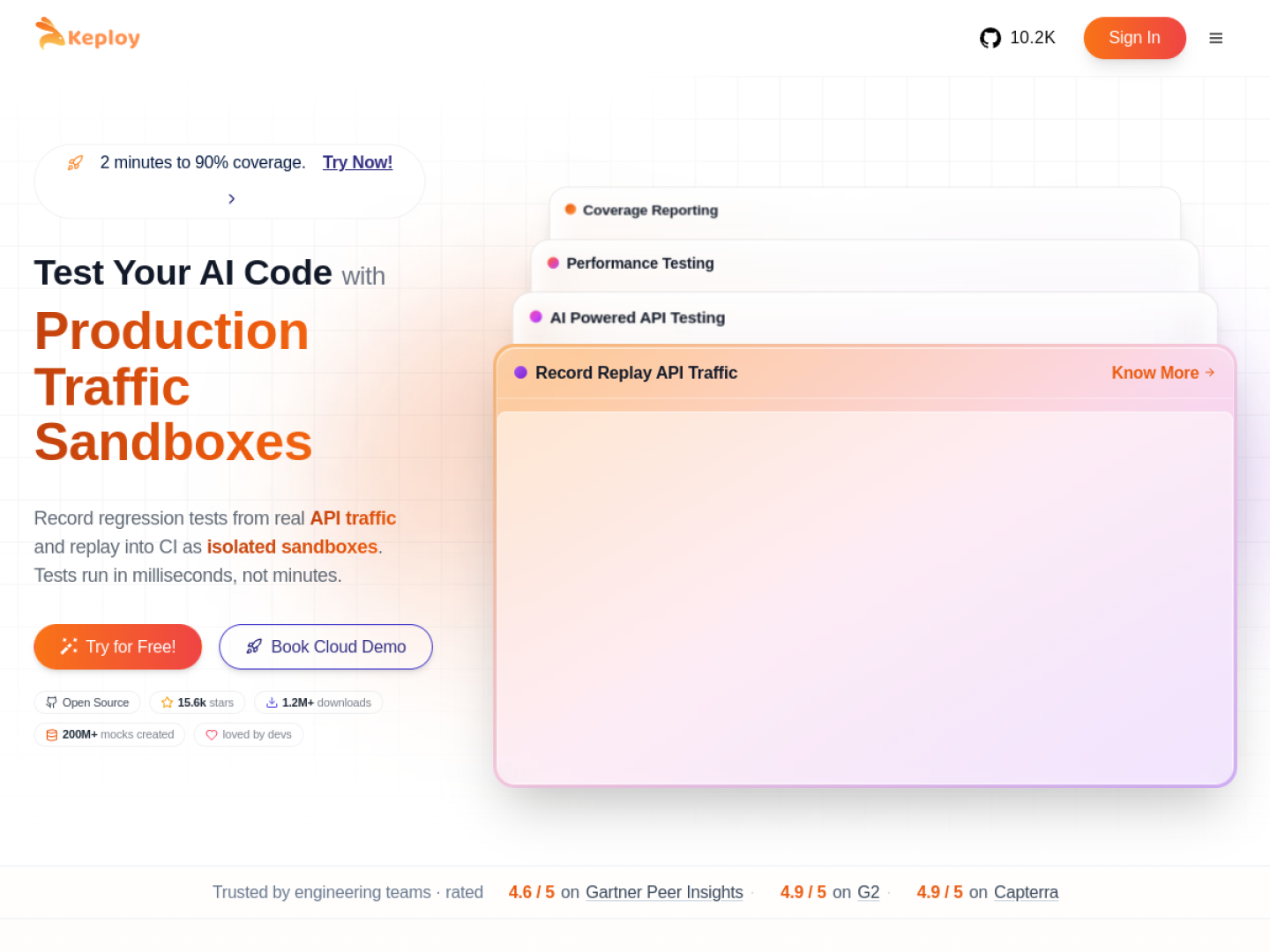
Keploy - In-depth tool analysis
Core parameters and statistics
| Parameters | Current public information |
|---|---|
| Tool Type Determination | Productivity/Business Application |
| Core delivery form | Open source CLI + cloud console + enterprise version capabilities |
| Core technology roadmap | eBPF network layer traffic capture record/replay, Mock Registry, AI-assisted coverage expansion |
| Supported Platforms | Web, CLI, API |
| Public license | OSS core is Apache 2.0 |
| Public ecological signals | GitHub 17.6k stars, 2.2k forks, 127 contributors, 597 Releases |
| Official website public indicators | 1.2M+ downloads, 200M+ mocks created, 15.6k stars |
| Latest verifiable OSS version | v3.5.66, 2026-06-16 |
Brief comment in one sentence: Keploy is not "another test management panel", but directly converts production traffic into regression testing and an API testing platform that relies on sandboxes, focusing on solving the three old problems of slow integration test writing, untrustworthy mocks, and unstable regression coverage.
Tool type determination: Keploy is closer to the productivity/business-side application of rule D, rather than the basic model MCP or simple RAG infrastructure. The reason is straightforward: its main delivery is a test platform for R&D teams to implement record/replay, coverage analysis, team collaboration and corporate governance. When users purchase, they also look at the pricing level CI access, permission SLA and sandbox capabilities, rather than the underlying model interface itself.
Publicity Verification: The official website writes the core selling point as “capture real API traffic with eBPF and replay it in CI as deterministic regression tests, auto-generated mocks, and production-like sandboxes”. This promotion is consistent with the official CLI, GitHub README, and pricing page. It is not simply about applying LLM to the test copy. The real pain point it hits is that the most time-consuming part of API and integration testing is not the assertion itself, but how to stably reconstruct the real dependencies, boundary values, order relationships, and external system behavior.
User and market recognition
Open Source Signal: The GitHub repository disclosed 17.6k stars, 2.2k forks, 127 contributors and 597 releases, indicating that it is not a demonstration project that is released once and then stopped, but an engineered product that continues to be iterated at a high frequency.
Site public indicators: The official website homepage discloses 1.2M+ downloads, 200M+ mocks created, and provides rating entrances for Gartner Peer Insights 4.6/5, G2 4.9/5, and Capterra 4.9/5. It is more appropriate to regard this as a "market adoption clue" rather than an absolute conclusion, because the rating sample size and statistical caliber should still be based on the real-time pages of each platform.
Commercialization signal: The pricing page has been divided into three layers: Playground, Pro, and Enterprise, and SCIM, directory synchronization 99.99% SLA, priority response Kubernetes record-replay, and staging/prod capture have been placed in the enterprise layer. This means that Keploy's goal is not just for use by the open source community, but also for team-level and enterprise-level delivery.
Hidden benefits: For R&D organizations, the real value of Keploy is not to "write fewer test files", but to precipitate the contextual knowledge, dependency behaviors and regression samples that were originally only in the hands of senior back-end and testing students into repeatable assets. After the team is replaced, the returning ability will not be lost along with the people.
Cost advantage
| Cost hierarchy | Current public information | Boundaries to note |
|---|---|---|
| C-side / Personal | OSS core can be self-hosted for a long time; Playground is free, including 30 test suites/month, 100 test runs/month, 5000 integrations/month, 5 AI credits | The free tier is sufficient for trial, but not suitable for high-frequency regression or long-term multi-person collaboration for production-level verification |
| Developer/API | The Pro page is exposed to US$19/user/month + additional usage, and includes US$19 usage credit, contract testing, load testing, collaboration and faster generation capabilities | Additional fees caused by excessive use of AI quota and actual operation scale should still be subject to the official real-time billing page and console |
| Enterprise / Privatization | Enterprise takes business consulting, emphasizing access control SCIM, SOC2/GDPR/HIPAA/ISO readiness, 99.99% SLA, staging/prod capture | There is no public standard price, data residency, support response, and compliance boundary SLA trigger terms must be verified before purchasing |
The Free Truth: Keploy’s free tier is not “unlimited open source + unlimited cloud experience”. The open source core can be self-hosted, but the Cloud Playground clearly caps the monthly test suite, test run, integration run and AI credits, which is suitable for verifying whether the record/replay mechanism matches your service, but not suitable for pressing the entire team's pipeline.
Quantitative deduction for cost reduction and efficiency improvement: For teams that already have API services, database dependencies and third-party interfaces, Keploy is most likely to save the time of "writing integration test templates + setting up mock contexts + maintaining playback data". Taking a medium-sized service that adds 8 to 12 key regression use cases as an example, the traditional approach usually takes half a day to a day to align the recorded data, dependency stubs, and assertions; using the record/replay route, after the pilot matures, the first round of runnable assets can usually be completed within 1 to 2 hours. This is an engineering deduction, not an official commitment.
Hidden costs: If the service call itself contains strong random values, timestamps, order-sensitive arrays, dynamic signatures, or high-noise fields, the team will have to spend time configuring noise filtering, normalize, and templatize rules. Keploy does not have zero management costs, it just shifts the cost from "manually writing templates" to "managing recording quality and playback stability".
Main functions
- Real traffic recording: Capture API calls, database queries and some streaming events through
keploy record -c "<start command>". The core value is not to record, but to avoid having to connect an SDK for each language separately during the recording process. - Deterministic replay test: Use
keploy testto replay recorded assets on CI or locally, allowing the service to rerun requests under isolated dependency conditions. It is suitable for regression verification and interface behavior comparison. - Depends on Mock and Infrastructure Virtualization: Keploy not only records HTTP mocks, but also incorporates MySQL, MongoDB, Postgres, Redis, DynamoDB, Kafka, gRPC, GraphQL and other dependencies into the support matrix to solve the old problem of "single tests can run but integration tests cannot be set up".
- AI coverage expansion: The official focus on AI capabilities is to discover boundary values, missing fields, error types and timing issues based on existing recordings and OpenAPI/Swagger. It belongs to "extended test coverage" rather than replacing the main record/replay link.
- Reporting and risk perception correction: CLI exposes
report,normalize,rerecord,sanitize,templatizeand other commands.normalizehandles high-risk failures conservatively by default, preventing the team from mistaking the real breaking change as the test baseline of the update.
Expert View: Keploy’s feature synergies are strong. Real traffic recording is just the starting point. What really widens the gap is the "recording assets -> dependent mocks -> offline playback -> report diff -> normalize/rerecord modification -> then enter CI". Once this closure is established, the development team does not have to switch back and forth between Postman samples, handwritten integration tests, temporary stub services, and CI reports.
Not suitable for boundaries: If your system is mainly pure front-end interaction, desktop local logic, or the key verification point is complex visual regression rather than API/dependency links, Keploy's advantages will be significantly reduced. It is better at server-side APIs and integration behaviors, not a general quality platform.
Model and version evolution
Version Mainline: The clearest public version context comes from GitHub Releases, not the official website marketing page. The recent releases show that Keploy is still polishing replay, mock diff, database protocol parsing and CLI stability at high frequency.
Recent OSS version nodes
| Version | Date | Public changes |
|---|---|---|
| v3.5.66 | 2026-06-16 | Add Aerospike kind, unify mock mismatch side-by-side diff, fix startup mocks behavior |
| v3.5.65 | 2026-06-12 | Fix the self-termination logic of MySQL replay and Docker daemon starting the race agent |
| v3.5.64 | 2026-06-09 | Incorporate flow body noise into mock matching NoiseConfig |
| v3.5.62 | 2026-06-08 | Added --strict-failure to adopt stricter failure judgment for replay response deviation |
Cloud and commercialization evolution
From OSS to cloud collaboration: The official website FAQ and Pricing have disclosed the Playground, Pro, and Enterprise layers, indicating that the product has developed from a "stand-alone recording tool" to a testing platform with collaborative Spend management Mock Registry, Time Freezing, contract testing, and compliance control.
Boundary Reminder: The internal version number, precise release date and function launch time of the Cloud Console itself have not been fully disclosed. Therefore, the so-called Cloud v1 and v2 names will not be fabricated here. The official public pricing and documentation page shall prevail.
Technical advantages
Mechanism -> Effect -> Scenario 1: eBPF network layer interception: Keploy captures calls at the network layer through eBPF, instead of requiring all business codes to be buried or each language to import the SDK. The direct effect is that it is easier for multi-language teams to have unified access; it is most suitable for microservice API gateway backends and services that rely heavily on external parties.
Mechanism -> Effect -> Scenario 2: record/replay + infra virtualization: It records the real request, dependency return and part of the infrastructure interaction, and then restores the deterministic sandbox during playback. The effect is that the test does not have to rely heavily on external databases, message queues or third-party APIs available online; it is most suitable for teams with unstable CI environments, expensive external dependencies or difficult to reproduce.
Mechanism -> Effect -> Scenario 3: Risk-aware test asset maintenance: normalize, rerecord, report and strict-failure These commands illustrate that Keploy does not assume that the assets will always be stable after recording, but also makes "how to safely update the test baseline" a product capability. The effect is that when the test assets evolve with the service, there is no need to rely on manual visual diff every time.
Mechanism -> Effect -> Scenario 4: AI is only responsible for covering coverage and does not dominate the main process: Officially, AI credits are used for bug detection, self-healing, and coverage gap expansion, rather than completely replacing record/replay. The advantage of this is that it reduces the instability of "relying solely on model guessing and testing" and is more suitable for engineering teams that pursue regression credibility rather than purely generating numbers.
Compliance and Risk: The Enterprise page writes SOC2 / GDPR / HIPAA / ISO readiness, but this type of expression is closer to the "enterprise delivery capability direction" and does not mean that all scenarios automatically meet compliance requirements by default. When recording production traffic, you still need to verify sensitive field desensitization, data retention periods, regional isolation, and audit log policies yourself.
How to use
Get started quickly in 3 minutes: The official installation documents and CLI documents both disclose the shortest path, which is suitable for verifying whether record/replay can run on a local service first.
curl --silent -O -L https://keploy.io/install.sh && source install.sh
keploy login
keploy record -c "go run main.go"
keploy test -c "go run main.go" --delay 10
Typical landing path:
- First use
keploy recordto record a set of real calls on a single API service, and confirm that the generated testcases and mocks can be placed in the local directory. - Use
keploy testto play back and observe whether there are noisy fields, sequence differences or dependency instability issues in the report. - In response to intentional changes, update test assets with
normalizeorrerecordinstead of simply ignoring failures. - When the local environment is stable, connect recording and playback to GitHub, GitLab or Jenkins, and then decide whether to enable cloud collaboration Mock Registry and higher-level AI capabilities.
Human-machine collaboration boundary: Keploy can automate "recording, playback, report generation, and partial correction suggestions", but it cannot fully automate "which changes should be accepted and which changes are actually production regressions." Manual confirmation points are still required when it comes to payments, permissions, compliance interfaces, and high-value customer processes.
Product Pricing
| Packages | Current public prices | Public capability summary |
|---|---|---|
| Open Source | Free self-hosting | Local record/replay, open source core CLI capabilities |
| Playground | Free | 30 suites/month 100 tests/month 5000 integrations/month 5 AI credits, automation CI/CD, schema coverage Dashboard |
| Pro | $19/user/month + additional usage | Includes $19 usage credit, free viewer seats for team collaboration, faster builds, contract testing, load testing, email and chat support |
| Enterprise | Unpublished, consultation required | SCIM, team access control SOC2/GDPR/HIPAA/ISO readiness, 99.99% SLA, Kubernetes and staging/prod capture, dedicated engineering support |
Price Interpretation: The core of Keploy's charging is not "whether there is AI", but whether you need more frequent cloud generation, more detailed collaborative management and enterprise delivery guarantees. For users who just want to verify whether record/replay is suitable for their team, OSS or Playground is enough; for organizations that want to turn test assets into cross-team platform capabilities, the real purchasing point is the Enterprise terms, not the Pro unit price itself.
Standing for the official page: Pro's additional usage, Enterprise contract price AI credit, overage billing viewer seat details and data retention policy are not fully developed in the current publicly captured information. The official real-time page or sales communication should prevail before budgeting.
Application scenarios
- Microservice API Regression: Suitable for back-end teams that frequently change interface orchestration logic, convert production or staging traffic into stable regression samples, and reduce inefficient verification of manual interface points before release.
- Integration testing with heavy dependencies and expensive context: Suitable for systems that rely on databases, message queues, third-party payments, notifications or internal services. Reduce construction costs through mocks and sandboxes.
- Contract and Coverage Governance in CI: Suitable for teams that want to incorporate schema coverage, coverage gap detection and contract diff into the PR process, so that "whether test coverage is sufficient" no longer relies solely on experience.
- Smoke and playback verification before new services go online: Suitable for quickly recording a batch of real requests into the first batch of return assets for smoke test before going online and comparison after changes.
Dimensionality reduction attack scenario: When the team already has real traffic, the interface is stable in capture links such as HTTP/gRPC/GraphQL/database dependency, and the release pace is fast and handwritten integration tests cannot keep up, Keploy's benefits are most obvious.
Applicable people
- Backend and platform engineers: People who need to bring APIs, databases, and external dependencies into the regression process are the easiest to directly see efficiency gains.
- Test development and QA automation team: Teams that need to capitalize on integration testing and converge flaky causes into interpretable reports are suitable to use Keploy as a unified entrance.
- DevOps/CI Leader: People who need to embed record/replay, reporting and team collaboration into the pipeline will pay more attention to viewer seats, SLA, SCIM and operational scale.
- Enterprise R&D Manager: Organizations that have moved from "can it be used" to "how to govern, how to audit, and how to scale" can pay attention to Enterprise's control surface capabilities.
Dissuaded / Inapplicable people: Pure front-end visual regression teams, users of stand-alone scenario scripting tools, prototype projects without stable API boundaries, and organizations that do not allow any real traffic samples to be recorded or the cost of desensitization management is too high, the adoption threshold will be significantly higher.
Summary and Outlook
Keploy's core competitiveness is that it strings real traffic, dependency behavior and regression verification into a project package, instead of just doing the superficial function of "AI generates a few test cases". For API-driven teams, the most valuable part of it is record/replay and infrastructure virtualization, which turns integration testing from a high-manpower, low-coverage, and context-fragile job into an asset that can be run repeatedly in CI.
The current limitations are also very clear: First, the public pricing only fully discloses the free tier and Pro basic entrance, and enterprise contracts and excess usage details still require business confirmation; second, production traffic recording naturally brings data desensitization, auditing, and retention policy requirements; third, high-noise interfaces and complex dynamic responses still require the team to establish normalize, templatize, and manual confirmation rules. Procurement/Adoption Risk Assessment: If the team does not have stable API boundaries, does not have desensitized governance capabilities, or hopes to automatically accept all test changes with zero manual effort, Keploy may quickly amplify the error baseline. A more prudent approach is to first select a service that relies on complex but clear boundaries for pilot testing, verify playback stability, noise management costs, and CI integration effects, and then decide whether to expand to team-level procurement.
Related tools:  GitHub Copilot,
  Cursor
Comparison of competing products
| Comparison dimensions | The tool | Competitor A | Competitor B |
|---|---|---|---|
| Core Differences | — | — | — |
| Price | — | — | — |
| Target User | — | — | -- |
Version Info
- v3.5.66 :The latest OSS CLI version released by GitHub Releases adds Aerospike kind, unified mock mismatch diff, and fixes the behavior of starting mocks within the first 5 test cases.
- v3.5.65 :Fixed the MySQL replay status reading race between Windows and macOS Docker daemon startup, and the self-termination behavior after the agent parent process exits.
- v3.5.62 :Added the --strict-failure flag, which is used to directly determine response deviations as failures during the replay stage instead of downgrading to obsolete.
- v3.4.1 :The CLI version number shown in the official installation document example has no public precise release date and can be regarded as a public installation snapshot in May 2026.
User Reviews