 Khoj
Free
Khoj
Free
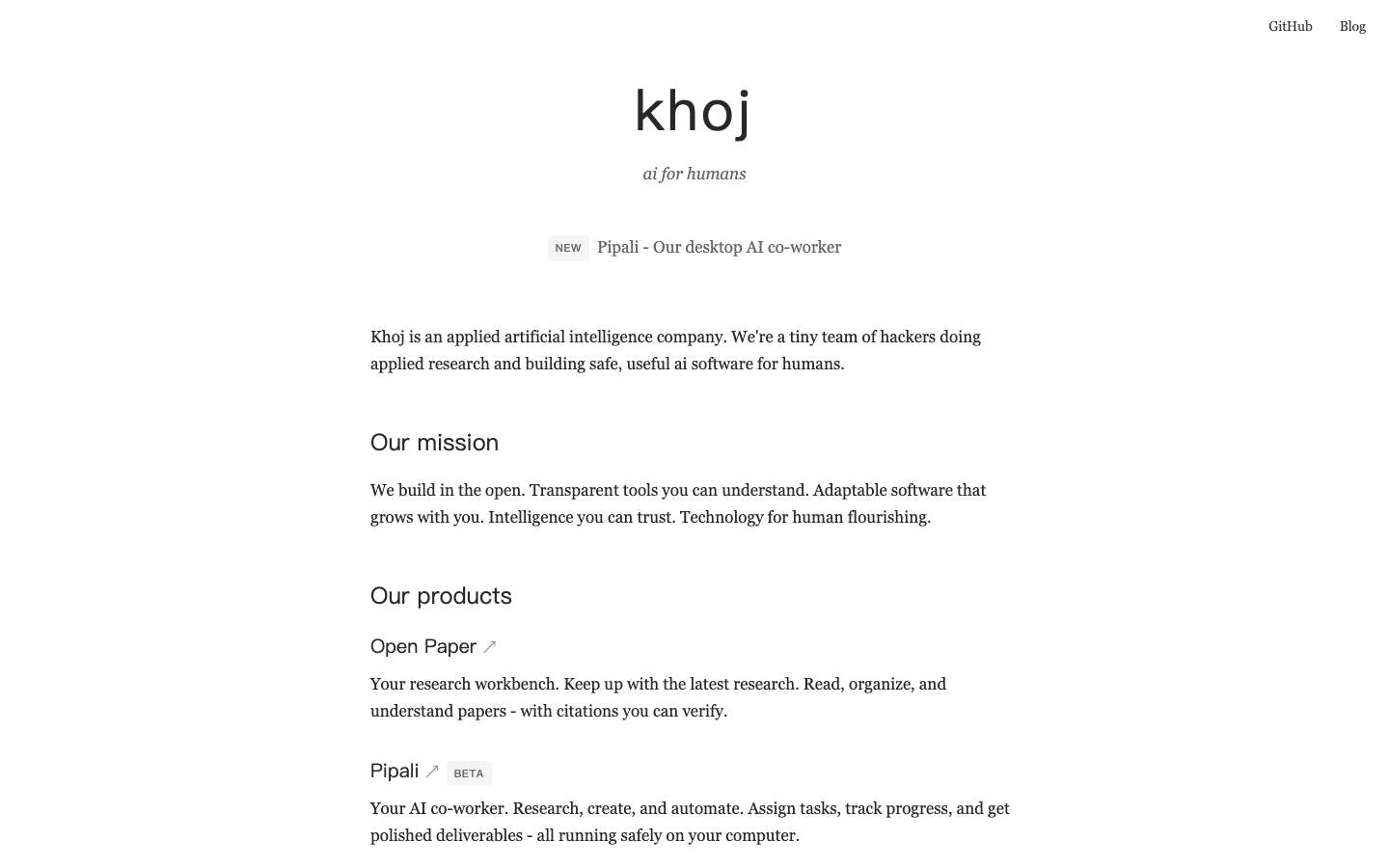
Khoj is an open source personal AI application positioned as the "AI second brain". It can connect your notes, documents and network information, provide semantic search, conversational Q&A, networked research and custom agents, and support the automation of tasks into regularly run research assistants. Khoj provides both a cloud-hosted version and can also be completely self-hosted locally. It supports access to cloud and local large models, and is integrated into portals such as Obsidian, Emacs, desktop and WhatsApp.
Khoj
Core parameters and statistics
Khoj is an open source personal AI application, officially positioned as "your AI second brain". It integrates information scattered in notes, documents and the Internet, provides semantic search, conversational Q&A, networked in-depth research and customizable agents, and can automate research tasks into assistants that run according to plans.
| Projects | Public Information |
|---|---|
| Official positioning | Self-hosted personal AI second brain |
| Deployment form | Cloud hosted version + fully self-hosted (Docker/local) |
| Core capabilities | Semantic search, dialogue Q&A, network research, custom agents |
| Automation | Research tasks can be set to run automatically on a scheduled basis |
| Data source | Personal notes PDF, Markdown, pictures, web pages, etc. |
| Portal integration | Web, desktop Obsidian, Emacs, WhatsApp |
| Model access | Cloud model and local open source model |
| Open Source License | AGPL-3.0 |
| Community size | GitHub about 35,000 stars, 2,200 forks |
| Latest version | v2.0.0-beta.28 (2026-03-26, GitHub Releases) |
Form value: Khoj provides both "out-of-the-box cloud version" and "fully self-hosted version". The former is for individuals who want to use it immediately, and the latter is for users who value privacy and want their data to stay local. The two share the same set of second brain capabilities and can be selected according to privacy needs.
Research Value: Khoj's research model can perform multi-step information retrieval and synthesis across notes and the Internet, extending "finding answers in your own materials" to "combine private knowledge and public networks for in-depth research", and can automate such tasks into scheduled assistants.
Integration value: Khoj does not require users to change their existing habits, but embeds itself into common portals such as Obsidian, Emacs, desktop and WhatsApp, making "asking one's own knowledge base" a natural action in the existing workflow.
User and market recognition
Khoj’s recognition comes from open source community popularity and Y Combinator endorsement. The company has not disclosed revenue and number of paying users.
Community size: The GitHub repository khoj-ai/khoj publicly displays about 35,000 stars and 2,200 forks. It is a highly watched open source project in the direction of "personal AI assistant/second brain". The self-hosting feature makes it especially popular among user groups who value data autonomy.
Background and Positioning: Khoj was developed by a team supported by Y Combinator. In the track of combining personal knowledge management and AI assistants, Khoj forms a difference with "open source + self-hosting + multi-entry integration". It is often compared with various note-taking AI and second brain tools. Its advantages lie in its openness and controllable privacy.
Prerequisites for implementation: The self-hosted version requires certain deployment and operation and maintenance capabilities (Docker or local environment); the final quality of Q&A and research depends on the large model connected and the organization of personal data. If ordinary users do not want to operate and maintain themselves, they can directly use the cloud hosting version.
Cost advantage
- C-side/Individual: Usually a free version is provided to experience the core functions, and high-frequency use requires a paid package subscription.
- API/Developer: Billed by call volume, suitable for development teams that can be flexibly integrated into their own systems.
- Enterprise/Privatization: Contact the business owner to obtain customized quotation and deployment plan. The specific price is subject to the official real-time pricing page.
Main functions
Khoj's capabilities are organized around "turning personal knowledge into conversational, researchable, automatable AI":
- Semantic Search: Perform semantic search on note PDFs, Markdown, pictures, etc. to find information based on meaning rather than keywords.
- Conversation Q&A: Ask questions about personal knowledge base and network information in natural language, and get evidence-based answers.
- In-depth Internet Research: The research mode can perform multi-step information synthesis across private data and public networks.
- Customized Agent: Create an agent with specific knowledge and personality for specific purposes.
- Automation and multiple portals: Set research tasks to run regularly and use them at any time through portals such as Obsidian, Emacs, desktop and WhatsApp.
Model and version evolution
Khoj is in the 2.0 beta iteration stage, and its main focus is on research and automation capabilities.
Mainline release
The latest version v2.0.0-beta.28 (2026-03-26) follows beta.27 (2026-03-25) and beta.26 (2026-03-25). The 2.0 series focuses on research modes, custom agents and automated assistants, and continues to improve multi-entry integration and document indexing.
Version context
From its early focus on semantic search and note-taking Q&A to 2.0's emphasis on "research + automation + intelligence," Khoj's evolution reflects the transformation from a "search-based second brain" to an "active personal AI assistant." For users, 2.0 beta is still being rapidly iterated, and self-hosted users are advised to pay attention to the compatibility of configuration and data indexing when upgrading.
Technical advantages
Khoj's technical advantages can be explained by the chain of "mechanism-effect-scene".
Mechanism: Semantic index + multi-source access. Unify semantic indexing of personal data in multiple formats. The effect is that it can search across documents according to meaning. The applicable scenario is personal knowledge management where data is scattered and keyword retrieval fails.
Mechanism: Self-hosted + Model Neutral. Supports fully on-premises deployment and access to cloud or on-premises models. The effect is that the data is controllable and the cost is adjustable, which is suitable for users who value privacy or have limited network access.
Mechanism: Research Mode + Automation. Encapsulate multi-step research and run it regularly. The effect is to upgrade one-time Q&A to a research assistant with continuous output, which is suitable for users who need to track a certain topic regularly.
How to use
Khoj provides two entrances: cloud and self-hosted:
- Cloud version: Register on the official website and you can directly use Web, desktop and various portal integrations without deployment.
- Self-hosted version: Use Docker or local context deployment according to the official documentation, connect the note directory and documents, and configure the model before use.
- Basic process: Access the data source (notes/PDF/webpage) → Wait for semantic indexing → Ask questions and research on the Web or integrated portal → Create an agent or set up an automated task.
When implementing, you need to pay attention to the organization and indexing quality of the data, as well as the impact of model selection on answers and research depth; self-hosted users also need to plan for deployment and data compatibility during upgrades.
Product Pricing
The pricing model is subject to the official real-time page. Usually a freemium or subscription system is used, and basic functions can be used for free. Advanced functions or high-frequency use require paid subscriptions, and users are advised to evaluate the optimal solution based on actual usage.
Application scenarios
- Personal Knowledge Management: Turn years of notes and documents into a conversational knowledge base. The focus of verification is the hit quality of semantic retrieval.
- Topic Research and Tracking: Use the research mode to conduct in-depth research across data and networks, and automatically track a certain topic at regular intervals. The focus of verification is the traceability of research conclusions.
- Privacy-sensitive local assistant: Completely self-hosted + local model, leaving private data for local processing. The focus of verification is the experience of the local model on the target hardware.
Applicable people
- Knowledge Workers and Researchers: There are a large number of notes and documents that need to be retrieved by meaning and studied in depth.
- Individual users who value privacy: Personal AI assistants who want to be completely self-hosted and data will not be sent out.
- In-depth users of note-taking tools: accustomed to Obsidian, Emacs and other tools, and hope to gain AI capabilities in existing portals.
Not suitable for the boundary: The self-hosted version requires certain operation and maintenance capabilities, and is not suitable for users who are completely unwilling to configure the environment and care about the cloud; as a personal AI application, it does not replace the team-oriented collaborative knowledge base, and multi-person collaboration scenarios need to be evaluated separately.
Summary and Outlook
It provides competitive solutions in its field, and its core value lies in lowering the threshold for AI use in this field.
Current limitations: Some advanced features require paid subscription, and the free version has function or usage restrictions; specific technical details and performance benchmarks have not yet been fully disclosed.
Related tools:  CrewAI,
  LangChain
Comparison of competing products
| Comparison dimensions | Khoj | Competitor A | Competitor B |
|---|---|---|---|
| Core Differences | — | — | — |
| Price | — | — | — |
| Target Users | — | — | — |
Note: The above comparison is based on product public information, and actual differences are based on user experience.
Version Info
- Khoj v2.0.0-beta.28 :The latest 2.0 test version released by GitHub Releases promotes the research model, custom agents and automation capabilities of personal AI second brain, and supports cloud and local model access and multi-entry integration.
- Khoj v2.0.0-beta.27 :2.0 beta version iteration to improve the stability of the research model and agent experience.
- Khoj v2.0.0-beta.26 :2.0 beta version, promoting multi-entry integration and document indexing capabilities.
User Reviews