 Kiro
Free
Kiro
Free
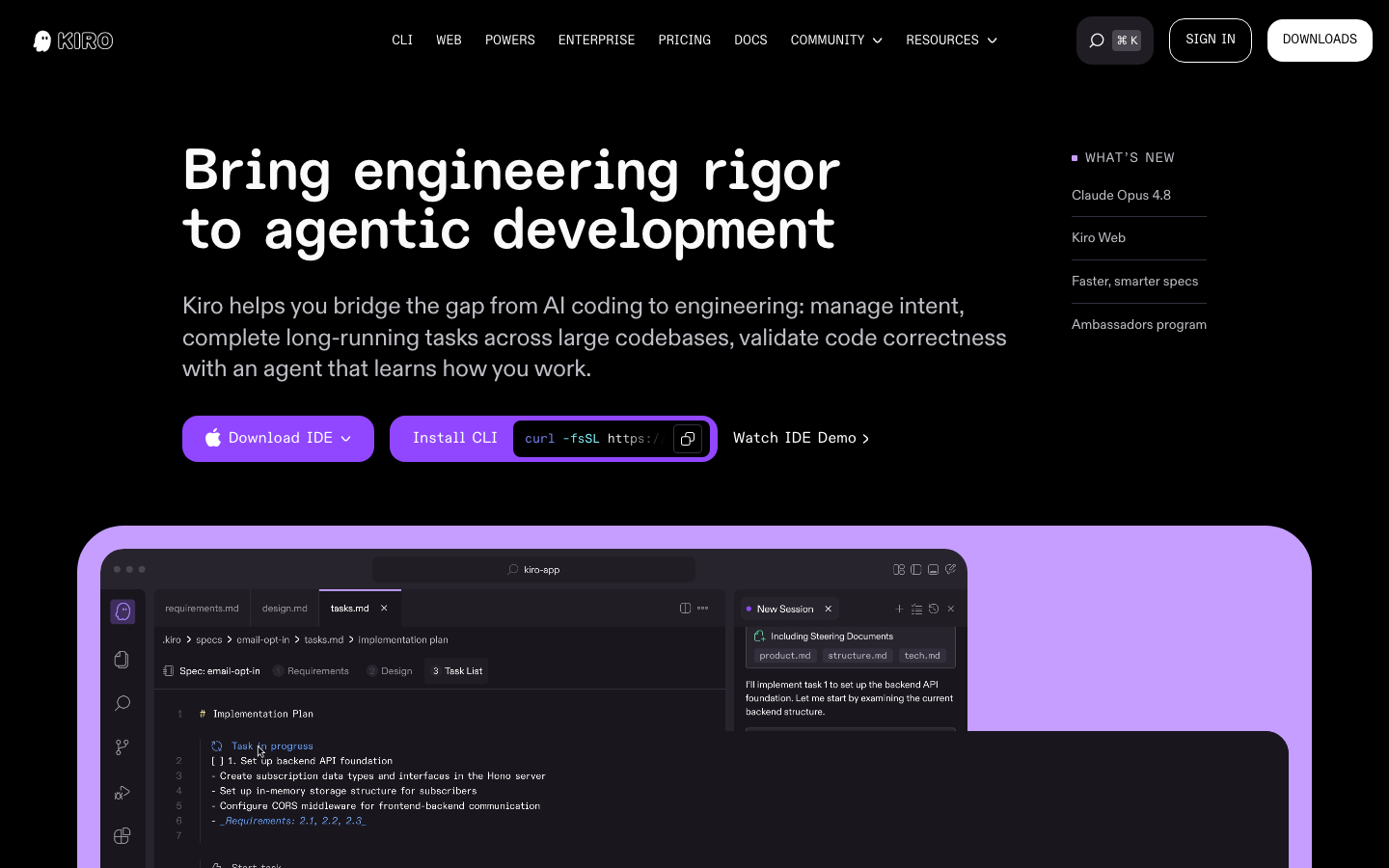
Kiro is an intelligent IDE launched by Amazon (AWS), focusing on "spec-driven development". It goes beyond instant completion and dialogue recoding. Instead, it first converts requirements into structured Spec (requirements, designs, tasks), and then the agent implements them step by step according to the specifications, and automatically performs inspections and tests on save, submit and other events through Hooks. Kiro is built on Code OSS, with the goal of upgrading "atmosphere programming" into a development method that can be trusted and followed by the engineering team.
Kiro
Core parameters and statistics
Kiro is an agent IDE launched by Amazon (AWS). Its official positioning is "Bring engineering rigor to agentic development." It upgrades AI programming from "casual conversation generation" to a structured process of "defining specifications first, and then letting the agent implement them according to the specifications". It is built on Code OSS and provides a familiar editor experience.
| Projects | Public Information |
|---|---|
| Official positioning | Specification-driven intelligent IDE |
| Core mechanism | Spec (requirements/design/task) + Hooks event automation |
| Base | Built on Code OSS, compatible with mainstream editor habits |
| Entry form | Desktop IDE + command line (CLI) |
| Vendor | Amazon Web Services (AWS) |
| Platform support | Windows, macOS, Linux |
Mechanism value: Common AI editors are good at real-time completion and dialogue modification, but they are prone to "deviation" in medium and large tasks and lack traceable basis. Kiro uses Spec to structure requirements, designs, and tasks first, allowing the agent to implement them step by step in a step-by-step manner. The effect is to turn uncontrollable "atmosphere programming" into a reviewable and traceable engineering process.
Deployment value: Kiro is based on Code OSS. The editor interaction and ecosystem are highly familiar to VS Code users, and the migration cost is low. It also provides a CLI to facilitate the integration of agent capabilities into terminals and automated processes.
User and market recognition
Kiro's recognition mainly comes from the differentiation of its "specification-driven" philosophy and the endorsement of AWS.
Differentiation of Concepts: In the context of a large number of AI programming tools focusing on completion and dialogue, Kiro adopts "spec-driven development", emphasizing planning first and implementation later, and traceability of the process. It responds to the team's core concerns about the "uncontrollable and difficult maintenance" of AI-generated code. After its release, it received high attention in the developer community.
Manufacturer Endorsement: As a product launched by AWS, Kiro relies on Amazon’s resources in the cloud and developer ecosystem, and naturally has corporate credibility and long-term investment expectations. Its emergence is also regarded as one of the signs that cloud vendors have officially entered the AI IDE competition.
Prerequisites for implementation: The value of Kiro is more prominent in medium and large projects that require collaboration and maintainability; for one-time scripts or extremely small tasks, specification-driven initial investment seems to be more important. Whether it is suitable depends on the strength of the team's need for "process rigor".
Cost advantage
Kiro's cost advantage does not lie in the unit price of the tool, but in reducing the rework, review, and post-maintenance costs of AI-generated code through specification drive.
For C-side individuals: Kiro provides a free entry level, and individual developers can experience the specification-driven workflow at zero cost.
For developers/teams: Adopt tiered subscription, upgrade based on higher agent usage and collaboration capabilities. Its hidden benefits are: standardization makes AI output more controllable and easier to review, reducing the cycle of "generate-overturn-rewrite", thereby reducing labor rework costs.
For Enterprises: The team-oriented plan provides higher quota and collaborative management capabilities. The cost trade-off point is: compare the subscription fee with the benefits of "improved maintainability of AI code, reduced reviews and rework". The more complex the project and the more collaboration there is, the more obvious the specification-driven returns will be.
Cost Judgment Suggestions: Medium and large engineering teams that emphasize maintainability and collaboration can benefit more from Kiro's process; lightweight, one-time small tasks are easier to use with a general AI editor.
Main functions
Kiro's capabilities revolve around "specification-driven + agent execution":
- Specs specification-driven: Decompose requirements into requirement documents, technical designs and task lists as the basis for intelligent agent implementation.
- Agent Coding: The agent implements tasks step by step according to specifications, and can view and intervene in the process in the editor.
- Hooks Event Automation: Automatically trigger inspections, tests or document updates on save, submit and other events to maintain consistency.
- Code OSS editing experience: Compatible with mainstream editor interaction and expansion habits, with low migration costs.
- CLI Command Line: Brings agent capabilities to the terminal to facilitate scripting and automated integration.
Model and version evolution
Continuous iterative updates, the latest version introduces performance optimization and new features. Historical version information can be viewed on the official release page. There is no complete public version evolution timeline yet. It is recommended to pay attention to the official announcement to understand the rhythm of feature updates.
Technical advantages
Kiro’s technical advantages can be explained by the chain of “mechanism-effect-scene”.
Mechanism: Specification driven (Spec). First structure the requirements into requirements/design/tasks and then implement them. The effect is that AI output is evidence-based, reviewable and traceable, and is suitable for medium and large projects that require maintainability.
Mechanism: Hooks event automation. Automate inspections and tests on critical events. The effect is to build quality assurance into the development process, reduce human omissions, and is suitable for teams that require consistency and specifications.
Mechanism: Code OSS base. Follow the mainstream editor interaction. The effect is that the cost of getting started is low, existing habits and ecology can be reused, and it is suitable for VS Code users who want smooth migration.
How to use
Kiro is for developers, and the typical implementation path is as follows:
- Install client: Download the Kiro client for the corresponding platform (Windows/macOS/Linux) from the official website, or use the CLI.
- Writing Spec: Describe the functions to be done to Kiro, who will generate requirements, design and task lists and confirm them.
- Agent Implementation: Let the agent code step by step according to the task. It can be reviewed and adjusted during the process, and Hooks can be used to automatically run inspections and tests.
When implementing, you need to focus on the granularity and accuracy of Spec, the configuration of Hooks, and the manual review of the generated results. It is recommended to complete the specification-driven process on a medium-scale function before promoting it.
Product Pricing
The pricing model is subject to the official real-time page. Usually a freemium or subscription system is used, and basic functions can be used for free. Advanced functions or high-frequency use require paid subscriptions, and users are advised to evaluate the optimal solution based on actual usage.
Application scenarios
- Medium and large function development: Split complex requirements into Specs and then implement them step by step by agents. The focus of verification is the consistency between output and specifications.
- Team collaborative development: Use specifications and Hooks to unify the quality and specifications of AI output. The focus of verification is review efficiency and maintainability.
- From prototype to maintainable code: Converge the "rapidly generated prototype" into documented and tested engineering code, and the focus of verification is the later maintenance cost.
Applicable people
- Development team that values engineering rigor: Hope that AI-generated code can be reviewed, traceable, and maintainable.
- Developers migrating from VS Code: Want a familiar editing experience coupled with spec-driven agent capabilities.
- AWS Ecosystem Users: Teams that tend to choose AWS system products for cloud and developer tools.
Unsuitable boundaries: One-time scripts, minimal tasks, or scenarios for quickly verifying ideas. Specification-driven initial investment is more important, and it is easier to use a general AI editor. Teams with strong bindings to specific non-AWS tool chains also need to first confirm whether Kiro's integration meets their needs.
Summary and Outlook
Kiro takes "specification-driven development" as its core concept, upgrading AI programming from casual conversations to specifying specs first, and then implementing them in a evidence-based manner by the agent, and uses Hooks to build quality assurance into the process. Based on the familiar experience of Code OSS and the endorsement of AWS, it has become a representative product for cloud vendors to enter the AI IDE track and focus on "engineering rigor."
For teams that implement plans, it is recommended that they first fully run through the "Writing Spec - Agent Implementation - Hooks Verification - Manual Review" on a medium-scale function, and verify the specification granularity and output quality before promoting; before expanding to a team, collaboration management, permissions and corporate compliance requirements need to be verified. The current uncertainties that need to be noted are: the pricing range, underlying model and functional boundaries will continue to be adjusted with the version. The latest official page should prevail before official adoption.
Related tools:  GitHub Copilot,
  Cursor
Comparison of competing products
| Comparison dimensions | Kiro | Competitor A | Competitor B |
|---|---|---|---|
| Core Differences | — | — | — |
| Price | — | — | — |
| Target Users | — | — | — |
Note: The above comparison is based on product public information, and actual differences are based on user experience.
Version Info
- Kiro official version (including CLI) :The official version, which is continuously improved based on the public preview, strengthens specification-driven workflow Hooks automation and team collaboration capabilities, and provides a command line (CLI) entrance. The product adopts a continuous update mode, and there is no unified and precise version date disclosed to the public. It is marked here by node.
- Kiro public preview :Kiro is released as a public preview, introducing core concepts such as specification-driven development (Spec) and Hooks, and is open to developers for experience. There is no official precise date yet, it is approximated according to the public release node.
- Specification-driven workflow (Specs) :Introducing a workflow that decomposes requirements into a three-stage Spec of requirements, design, and tasks, as the core that distinguishes Kiro from ordinary AI editors. There is no official precise date yet, it is approximated according to the public release node.
User Reviews