 Kognitos
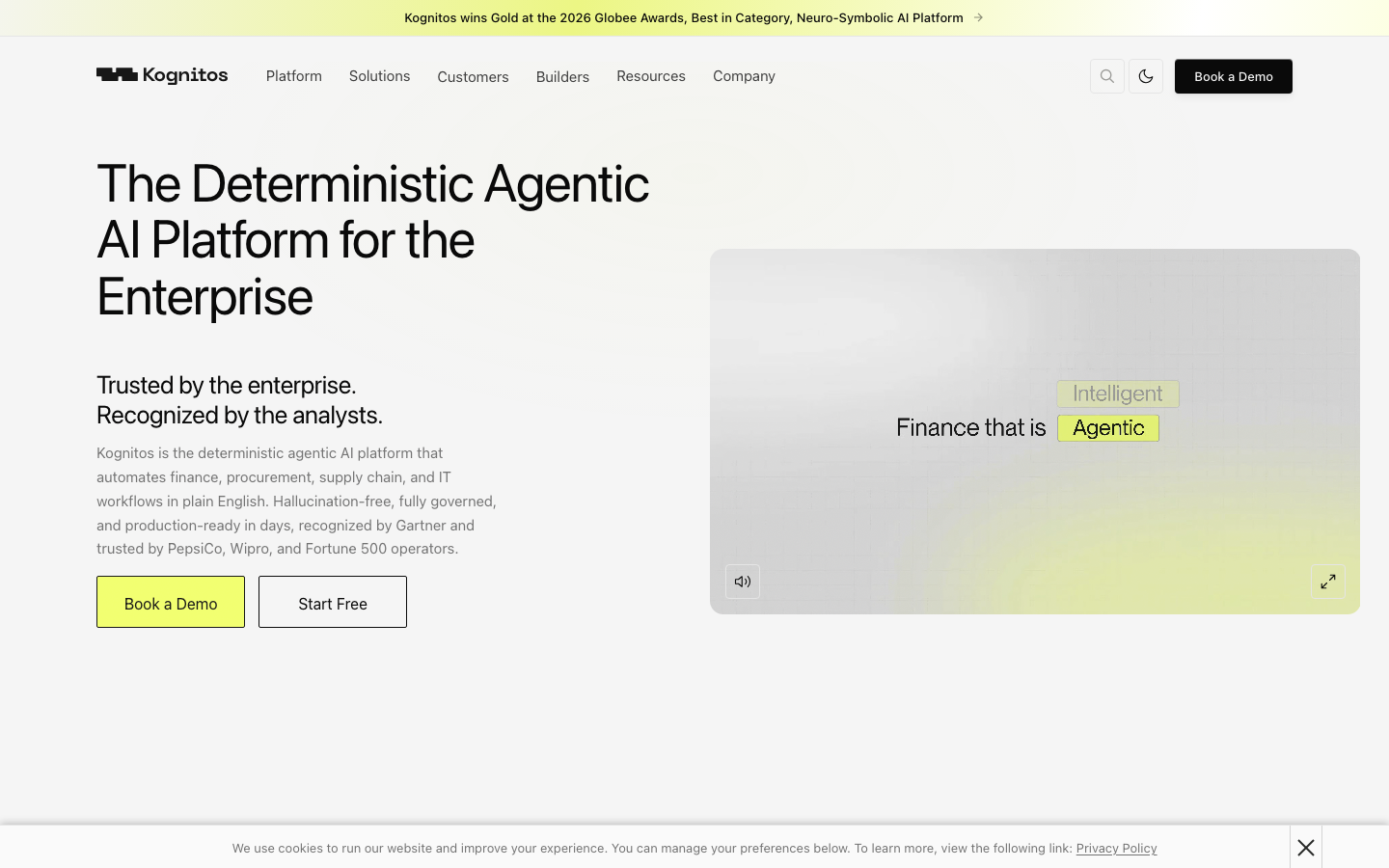
Kognitos allows business personnel to describe processes directly in natural language, and AI automatically converts them into executable automated workflows without writing traditional RPA scripts.
Kognitos
The product positioning and core value of Kognitos is not to simply superimpose an AI dialogue layer on traditional RPA, but to use a "neuro-symbolic architecture" to redesign the division of labor structure of the automation engine - making the LLM responsible for understanding the natural language intentions of business personnel, and the symbolic execution engine responsible for accurately executing business rules. This division of labor gives it a clear differentiated advantage in "zero fault tolerance" scenarios such as financial reconciliation, medical claims, and supply chain compliance.
Core parameters and statistics of Kognitos
Kognitos provides a deterministic agent automation platform for large enterprises. The core difference is that it replaces scripting with natural language and replaces probabilistic output with symbolic execution.
| Projects | Public Information |
|---|---|
| Official positioning | Deterministic Agentic AI platform for enterprises |
| AI capabilities | Natural language process description → Deterministic execution, the official website states zero illusions |
| Core technology | Neurosymbolic AI (Neurosymbolic) + symbolic execution engine |
| Deployment methods | SaaS (cloud hosting), customer VPC, hybrid cloud |
| Integration Ecosystem | 200+ pre-built connectors for SAP, Oracle, Salesforce, NetSuite, ServiceNow, etc. |
| Security Certifications | SOC 2 Type II, HIPAA, GDPR, ISO 27001 |
| Industry Recognition | Gartner Hype Cycle Sample Vendor theCUBE 2026 Innovation Award ISG 2026 Leader HFS Hot Tech 2026 |
| Typical Clients | PepsiCo, Wipro, DISH Network, Ciena, TTX, JBI Interiors |
| Latest version | 2026.1 (2026 Spring) |
| Home | US |
Core Difference: Traditional RPA relies on screen scraping and scripting, and each UI change requires re-maintenance of scripts; Kognitos abstracts business rules into "English as Code" (English as Code), which is deterministically executed by the symbolic execution engine, without guessing or fabricating the results. The official website comparison page shows that its maintenance cost is about 1/12 of traditional RPA.
User and market recognition of Kognitos
The market’s recognition of Kognitos mainly comes from third-party analyst certification and performance cases from corporate customers, rather than public revenue or user numbers (the latter is not officially disclosed).
- Analyst Certification: The official website shows that it has been included as a sample supplier by Gartner 2025 Hype Cycle for AI in ITOps; won theCUBE 2026 Most Innovative AI Product Award; was named Exemplary Leader by ISG 2026 Buyer's Guide for Automation Orchestration; and was listed as a 2026 Hot Tech by HFS Research. The positive identification of four independent analysis institutions shows that its product direction has gained a certain consensus at the industry analysis level, and is not limited to self-promotion by manufacturers.
- Enterprise customers: The customers listed on the official website include PepsiCo, Wipro, DISH Network, Ciena, TTX, JBI Interiors, Century Supply Chain, Norco Industries, EOS Group, etc., Fortune 500-level companies spanning manufacturing, telecommunications, logistics, finance, catering services and other industries. Technology ecosystem partners include AWS, Microsoft Azure, Google Cloud, Oracle, and Salesforce. The endorsement of these five infrastructure layers has reference value for corporate procurement decisions in regulated industries.
- Quantified results: JBI Interiors case study publicly demonstrated elimination of 3,300 hours of manual work per year; Fortune 50 F&B client case study demonstrated annual cost reduction of over $1 million; Century Supply Chain automated 50,000+ bills of lading and carrier bookings per month. These numbers come from the case page of the official website and can be used as a reference for setting acceptance benchmarks before purchasing - but you need to pay attention to the differences between the process complexity in the case and your own business scenarios.
Cost advantage of Kognitos
The cost structure of Kognitos shows typical characteristics of an enterprise-level platform: explicit costs come from subscription contracts, and implicit costs are concentrated in process migration and governance configuration.
C client/Personal: There is currently no free personal version. The official website provides a "Start Free" entrance pointing to application registration (app.us-1.kognitos.com), where you can enter the sandbox to experience the basic process description capabilities of the Builder Agent. However, complete execution and production-bound deployment must be completed through the business demo. Even if individual users or small micro teams have automation needs, they are not suitable for direct adoption at this stage - there are significant pricing thresholds and functional access restrictions.
Developer/API: No independent API access plan or pay-as-you-go billing model is disclosed. Kognitos' Builder Agent and Resolution Agent are delivered as platform-embedded capabilities and do not support developers to call APIs separately outside the platform. If you need to carry out secondary development or embed it into your own system, you need to confirm the available API range and frequency control through the enterprise contract.
Corporate/Private: All options are subject to business confirmation. The official website only provides the Book a Demo entrance, and there is no standard pricing page (visiting /pricing returns 404). Pricing is based on a comprehensive quote based on automation task volume, number of processes, user seats and deployment method (SaaS / VPC / hybrid cloud). Deep integration with large systems such as SAP, Oracle, etc. may involve additional professional services fees.
Hidden Cost Analysis:
- Process migration cost: Migrating from existing RPA (UiPath, Automation Anywhere) to Kognitos requires re-describing the original process logic in natural language instead of directly converting existing scripts - this is a one-time investment in rebuilding process assets.
- Governance configuration costs: The initial configuration of enterprise-level SSO, RBAC, audit policies, and network policies requires the participation of the IT team. Although it is a one-time investment, it involves cross-department coordination time.
- LLM call fee: Although Kognitos uses a neural symbolic architecture to reduce the risk of hallucinations, its natural language understanding layer still relies on LLM. When used in large-scale production, the LLM call fee may become an integral part of the operating cost - the billing method of this part and whether it is included in the enterprise subscription are not clearly stated on the public page and need to be confirmed with the sales team before signing the contract.
Main features of Kognitos
The functional design of Kognitos has obvious "functional synergy" rather than an isolated stack of capabilities:
- Builder Agent: Business personnel describe process steps in everyday English, and Builder Agent automatically converts them into executable "English as code" workflows. No need to draw flowcharts, write scripts, or configure JSON—just describe it like you would explain your job to a new coworker. Implementation value: The right to create processes is transferred from the IT department to the hands of business personnel, shortening the waiting period from the request to the automation go-live.
- Resolution Agent (Exception Handling Agent): When data anomalies, system errors or rule conflicts occur during process execution, the Resolution Agent automatically determines the cause, attempts to repair it, requests approval from the user when necessary, and remembers this processing method for future reuse. The more exceptions are handled, the fewer exceptions are handled, and the system continues to optimize itself. Collaboration with Builder Agent: Builder Agent creation process, Resolution Agent continues to "teach" the system to handle boundary conditions during the execution process. The two form a link of "Create → Execute → Self-heal → Optimize", which is different from the traditional RPA breakpoint link of "Create → Execute → Crash → Wait for IT".
- Deterministic Symbolic Execution Engine: Unlike pure LLM solutions, Kognitos' symbolic execution engine strictly follows business rules and does not guess or fabricate results. Business Journal logs are automatically generated for every operation, and CFOs and auditors can directly review execution records in natural language without the need for technical personnel to translate.
- Browser Automation: For legacy web systems or legacy portals without APIs, Kognitos can drive the browser just like a human would - navigate pages, fill out forms, extract data. Business personnel only need to describe the operation goals in English, and AI will automatically complete the page interaction. Applicable Boundary: Suitable for scenarios where the API is inaccessible, but the ability to adapt to drastic changes in page structure needs to be verified in actual situations.
- 200+ pre-built connectors: covering SAP, Oracle, NetSuite, Salesforce, ServiceNow, Workday, Okta, Slack, GitHub, Microsoft and more
industry system. The connector is implemented as an API-level integration, which is different from the screen capture of traditional RPA. UI changes do not affect the deployed automation process.
- Consumption Dashboard: Displays the number of executions, time consumption, cost and ROI data of each process in real time. Management can visually track the benefits of automation investments without waiting for reports from the IT department. Acceptance Concerns: Update delay granularity of dashboard data, and whether to support filtering by custom dimensions (by department/process/time range).
Kognitos model and version evolution
As a closed-source enterprise-level product, Kognitos version information is not fully recorded on GitHub like open source projects. The following version is synthesized from the official website page and public information:
| Version node | Time | Core changes |
|---|---|---|
| 2026.1 (2026 Spring) | ~2026-03 | Enhance multi-step process understanding and exception handling capabilities; update Consumption Dashboard and execution log visibility |
| 2025.3 (2025 Fall) | ~2025-10 | Introducing cross-application context memory and API integration; expanding the connector ecosystem to 200+ |
| 2025.1 (2025 Spring) | ~2025-03 | Establish the neural symbolic AI architecture baseline; launch the Builder Agent and Resolution Agent dual-agent framework |
The above dates are marked with ~YYYY-MM (there is no official precise release date yet), and the actual release pace is subject to official real-time information. The version naming of Kognitos adopts the "year + serial number" model, and the two release windows of Spring and Fall promote mainline iteration every year.
Differences from typical SaaS: Kognitos does not provide a public changelog or release notes page (as of now), and enterprise customers generally obtain detailed change notes through their customer success manager before upgrading. Procurement contracts should pay attention to version upgrade windows, data migration compatibility and rollback guarantee clauses - this is especially important for companies running critical financial processes.
Technical Advantages of Kognitos
The core technical advantages of Kognitos can be unfolded along a causal chain: neuro-symbolic architecture → deterministic execution → zero illusion → compliant and credible. Each layer corresponds to specific technical mechanisms and business effects.
Neurosymbolic AI: Combines the natural language understanding capabilities of LLM with the deterministic rule execution of symbolic systems. The LLM is responsible for "understanding the intent" - what the user said in English; the symbolic engine is responsible for "executing the rules" - the business rules must run accurately. The two are separated at the architectural level. The output of LLM will not directly enter the execution layer, but will take effect after rule verification by the symbolic engine. This division of labor mechanically blocks the path from which LLM illusions propagate to execution results.
English as Code: Kognitos’ patented technology. The English descriptions of business people are not comments or prompt words, but executable program logic. For example, "If the invoice amount exceeds $10,000, route to the CFO for approval" - this sentence itself is code. The symbolic execution engine runs word-for-word and does nothing beyond the instructions. Technical effect: The "translation loss" between business requirements and technical implementation is eliminated. Business rules are execution logic, and there is no rework caused by "requirements understanding deviation".
Credibility Analysis of Zero Hallucination Architecture: The official website clearly states "Zero hallucinations". From an architectural perspective, this statement is more credible - under the neuro-symbolic architecture, LLM only plays a role in the intention understanding stage (natural language → structured rules), and the actual process execution is completely controlled by the deterministic symbolic engine. Any operation outside the defined rules will be blocked by the engine. However, please note: LLM in the intent understanding stage still has the possibility of misinterpreting user descriptions as wrong rules, so manual review of key rules is still a necessary precautionary measure.
Deployment flexibility: Supports three models: SaaS, customer VPC, and hybrid cloud. Enterprises that are sensitive to data sovereignty (such as banking and medical industries) can run the complete platform within their own infrastructure, and neither training nor execution data leaves the control boundary. The official website Trust Center (trust.kognitos.com) provides more detailed security control instructions.
Security Compliance Matrix: All four certifications, SOC 2 Type II, HIPAA, GDPR, and ISO 27001, have been passed and the certification badge is displayed on the official website. Among enterprise-level AI automation platforms, this is a relatively high level of security endorsement—particularly suitable for process automation scenarios in regulated industries (finance, healthcare, insurance).
How to use Kognitos
The usage path of Kognitos is based on the core design concept of "self-service creation by business personnel + IT governance support", which is essentially different from typical RPA tools that require in-depth participation of RPA developers.
Use the entrance:
| Entrance | Applicable stage | Operation points |
|---|---|---|
| Official website registration (Start Free) | Experience and evaluation | Visit app.us-1.kognitos.com to register an account and enter the sandbox to try out the natural language process description capabilities of Builder Agent |
| Book a Demo | Enterprise Assessment | Book a Demo through the official website. The solution architect will build a sample process according to the business scenario. It is recommended to prepare 1-2 actual business processes for on-site verification |
| Enterprise deployment | Production landing | Determine the deployment mode (SaaS/VPC/hybrid cloud), the IT team cooperates to complete SSO, RBAC, and network policy configuration, and the business team receives Builder Agent operation training |
Typical landing path:
- Pilot Phase (Weeks 1-2): Select 1-2 high-frequency, low-risk financial processes (such as three invoice matching, expense reimbursement approval), use Builder Agent to describe the process in natural language and go online. Acceptance indicators should include process construction time (the target is hours rather than days), execution success rate in the first month, and exception self-healing rate (the proportion of exceptions automatically resolved by the Resolution Agent).
- Contrast Phase (Weeks 3-4): Run in parallel with traditional RPA or manual processes that are still running, and compare execution efficiency, exception handling time, and manual intervention rate. Core comparison indicators: single transaction processing time dropped from X to Y, abnormality reporting rate dropped, and audit log completeness difference.
- Expansion phase (starting from the 5th week): After confirming that the pilot reaches the standards, it will gradually be integrated into the processes of more departments such as supply chain HR and IT. Utilize the historical exception handling experience accumulated by Resolution Agent to reduce the cold start cost of new processes.
Key acceptance points (must be tested before purchasing):
- Are the connectors to core ERP (SAP/Oracle) stable on the currently used version?
- API-less legacy systems existing internally, actual coverage and reliability of browser automation
- Whether the exception handling strategy meets financial compliance requirements (who has approval authority, which fields are retained for audit information, and retention period)
Product Pricing for Kognitos
Kognitos uses an enterprise quotation system and does not have a public standard pricing list (/pricing page returns 404). The following information is synthesized from the entrances and industry practices that can be confirmed on the official website:
Free Tier: The official website provides a "Start Free" registration entrance, which allows you to enter the application sandbox to experience basic functions. However, the complete process creation and production execution must be enabled through the business process.
Enterprise pricing structure: Based on annual contracts, billing dimensions may include automation task volume, number of processes, user seats, and deployment mode. No specific figures appear in the public information on the official website, and all plans need to obtain quotations through Book a Demo.
Only pricing signal: The official website comparison page claims that Kognitos "costs 12x less to maintain" (maintenance cost is 1/12 of traditional RPA), but this is a maintenance cost ratio relative to traditional RPA, not an absolute pricing number.
Estimated cost items involved in corporate procurement:
- Platform subscription fee: annual contract basis, priced based on the number of processes or task volume
- LLM calling fee: or included in subscription, subject to contract confirmation
- Professional services fees: process migration, initial integration, training (if applicable)
- Infrastructure fees: computing and storage resources in privatized deployment scenarios
Procurement Suggestion: Before obtaining a formal quotation, first complete end-to-end verification on 1-2 self-owned processes through the official demo; then request a customized quotation based on the actual number of processes. The contract should clearly include SLA (execution success rate and availability commitment), data storage location and sovereignty clauses, version upgrade window period and rollback guarantee, data migration and process export support when exiting.
Application scenarios of Kognitos
Kognitos' implementation scenarios focus on "clear business rules, cross-system, document-intensive" background processes. The following four scenarios are supported by customer cases on the official website:
- Accounts Payable (AP) Automation: Automatic extraction of supplier invoices → PO three order matching → Difference marking and approval routing → ERP posting. JBI Interiors case shows elimination of 3,300 hours of manual work per year through AP automation. Verification focus: OCR accuracy for multi-currency and multi-format invoices, flexible configuration of three-item matching rules (including partial matching, conditional passing and other boundary conditions).
- Supply chain data synchronization: Supplier invoice → ERP warehousing confirmation → Procurement system status update → Carrier booking. Century Supply Chain case shows processing 50,000+ documents per month. Key points of verification: Data docking method with the carrier system (API direct connection/browser automation), automatic processing and manual intervention strategy for abnormal waybills (address mismatch, cargo shortage).
- Financial Monthly Statement and Reconciliation: Extract data from ERP, bank, and subsidiary systems → Account reconciliation → Difference analysis → Report generation and approval submission. Key points of verification: Depth of data extraction from SAP/Oracle (whether GL level of detail is supported), and conflict resolution strategies when exceptions occur in multiple data sources at the same time.
- HR onboarding and permission activation: Enter new employee information → Create corporate email → Activate system permissions → Configure Okta/Active Directory → Send welcome email and equipment application. Key points of verification: depth of integration with HRIS (Workday, etc.), audit traceability of permission configuration (who granted what permissions at what time).
- Medical claims processing: Submission of medical claims application → Information extraction and coding verification → Insurance qualification verification → Compensation calculation and notification. Verification focus: Implementation of HIPAA compliance in actual implementation (patient data desensitization, access control configuration, compliance retention of audit logs).
Applicable groups of Kognitos
Kognitos’ multi-role coverage strategy serves four categories of people and has clear boundaries for adaptation groups:
- Finance and Accounting Team: Kognitos’ most direct value group. High-frequency repetitive processes such as AP reconciliation, monthly settlements, and expense audits directly benefit from natural language creation. Prerequisite: The team already has a clear business process document or SOP - if the process itself is chaotic and the rules are vague, it will be difficult for AI to automatically orchestrate it. It is recommended to complete the standardization of key processes before introduction.
- Supply Chain and Operations Team: In scenarios involving multi-system data synchronization and exception tracking, Kognitos' cross-application orchestration capabilities and Resolution Agent's automatic exception handling can significantly reduce operational burdens. Prerequisites: The upstream and downstream systems (ERP, WMS, TMS) of the supply chain already have basic API or Web access capabilities; for purely paper- or email-driven processes, digital infrastructure needs to be completed first.
- IT & Automation Leader: The decision-maker responsible for evaluating and introducing automation platforms. Kognitos’ zero-illusion architecture and SOC 2/HIPAA certification lower the compliance approval threshold, but require IT teams to complete infrastructure configuration such as SSO, RBAC, network policies, etc. in the initial phase. Prerequisite: The organization has a preliminary awareness of automated governance, rather than just pursuing a single point of efficiency improvement - the value of platform tools lies in unified governance, rather than replacing one-time scripts.
- Compliance & Audit Team: Kognitos’ Business Journal records every action in natural language, allowing auditors to review execution records without a technical background. This is a hidden value point for compliance teams in regulated industries (finance, healthcare, insurance). Acceptance concerns: Whether the Business Journal’s export format (whether it supports CSV/PDF batch export) and log retention policy (configurable retention period) meet industry regulatory requirements.
Not suitable for crowds and scenes:
- Users who only need personal-level script automation are more suitable for lightweight solutions such as Python script Zapier - Kognitos's enterprise-level pricing and deployment complexity far exceed such needs
- Organizations where processes are not yet standardized and do not even have written SOPs - automation tools will only accelerate confusion rather than solve management problems
- Teams that rely entirely on open source solutions and cannot afford the cost of enterprise-level subscriptions - Kognitos is a closed-source commercial product with no community version or open source branch
- Rare scenarios that have extremely high requirements for multi-round complex decision-making chains with extremely long contexts. It is necessary to confirm the context boundary and rule conflict resolution capabilities of the neural symbolic engine with the official before purchasing.
Summary and Outlook of Kognitos
Kognitos has taken a differentiated technical path in the direction of "replacing RPA scripts with natural language" - it does not simply add a layer of AI dialogue on top of traditional RPA, but uses a neuro-symbolic architecture to redesign the division of labor of the automation engine: LLM is responsible for understanding intentions, and the symbolic engine is responsible for precise execution. This division of labor structure has clear practicality in "cannot make mistakes" scenarios such as finance, medical care, and compliance. It is also the fundamental reason why it has been recognized by many analysts such as Gartner, ISG, and HFS.
Current Limitations and Uncertainties:
- The product is a closed-source enterprise-level solution with opaque pricing, making it difficult for small and medium-sized teams to independently evaluate procurement thresholds and cost expectations.
- Ultra-complex, multi-round cross-dependent processes may still require manual debugging in actual operation. Performance in extreme scenarios depends on the context window and rule conflict resolution capabilities of the neural symbolic engine.
- The official website does not disclose the API independent access solution, which imposes restrictions on development teams who want to embed Kognitos into their own systems.
- Version iteration information is opaque (no public changelog). Enterprise customers rely on customer success managers to obtain change instructions. Version upgrade and rollback terms should be clearly stated in the procurement contract.
Procurement/Adoption Risk Assessment: Before an enterprise introduces Kognitos, it is recommended to complete end-to-end verification on 1-2 actual processes through the official demo, focusing on testing: ① the stability of the connector with the core ERP (SAP/Oracle) on the current version; ② the actual coverage and reliability of browser automation of the old internal API-less system; ③ whether the exception handling strategy meets the internal compliance audit requirements (approval chain, audit fields, retention period). Contract terms should focus on data storage location/sovereignty terms, version upgrade window period and SLA, data migration and process export support when exiting. For medium-sized enterprises with an annual automation volume of less than 100,000 transactions, it is recommended to first confirm the minimum consumption commitment and overage billing method to avoid cost overruns caused by deviations between actual usage and contract estimates.
Related tools:  CrewAI,
  LangChain
Detailed comparison between Kognitos and traditional RPA
| Comparison Dimensions | Kognitos | Traditional RPA (UiPath / Automation Anywhere) |
|---|---|---|
| Process creation method | Natural language description (English as code), business personnel self-service | Drag-and-drop flowchart + script writing, RPA developer required |
| Execution engine | Symbolic execution engine (deterministic, zero illusions) | Screen scraping + API scripting (probabilistically dependent UI element positioning) |
| UI change response | API level integration, does not rely on UI elements, changes have no impact | Screen capture scripts become invalid with UI changes and require manual maintenance and updates |
| Exception handling | Resolution Agent automatic processing + experience memory reuse | Usually error reporting and interruption, waiting for IT troubleshooting and repair |
| Maintenance cost comparison | The official website claims that it is about 1/12 of traditional RPA | High (script maintenance + UI adaptation + exception troubleshooting) |
| Compliance audit | Natural language Business Journal, which can be reviewed by non-technical personnel | Most logs are in technical format and require translation to be understood |
| Deployment flexibility | SaaS / VPC / hybrid cloud | Typically requires on-premises or virtual desktop infrastructure |
| Security Certification | SOC 2 / HIPAA / GDPR / ISO 27001 | Varies widely among manufacturers |
| Getting Started | Within a few days (business personnel self-help) | A few weeks to a few months (training + development required) |
| Typical Maintenance Team | Business People + IT Governance | RPA Development Team |
This comparison table combines public information from the official website and industry public information. The core difference is "who has the authority to create and maintain the automation": Kognitos hands it back to the business people, whereas traditional RPA requires ongoing investment from a professional development team.
Version Info
- Kognitos 2026 Spring :There is no official precise date yet. Enhance multi-step process understanding and exception handling capabilities.
- Kognitos 2025 Fall :There is no official precise date yet. Introducing cross-application context memory and API integration.
User Reviews