 Komo AI
Free
Komo AI
Free
Komo AI is an AI-powered search engine tool.
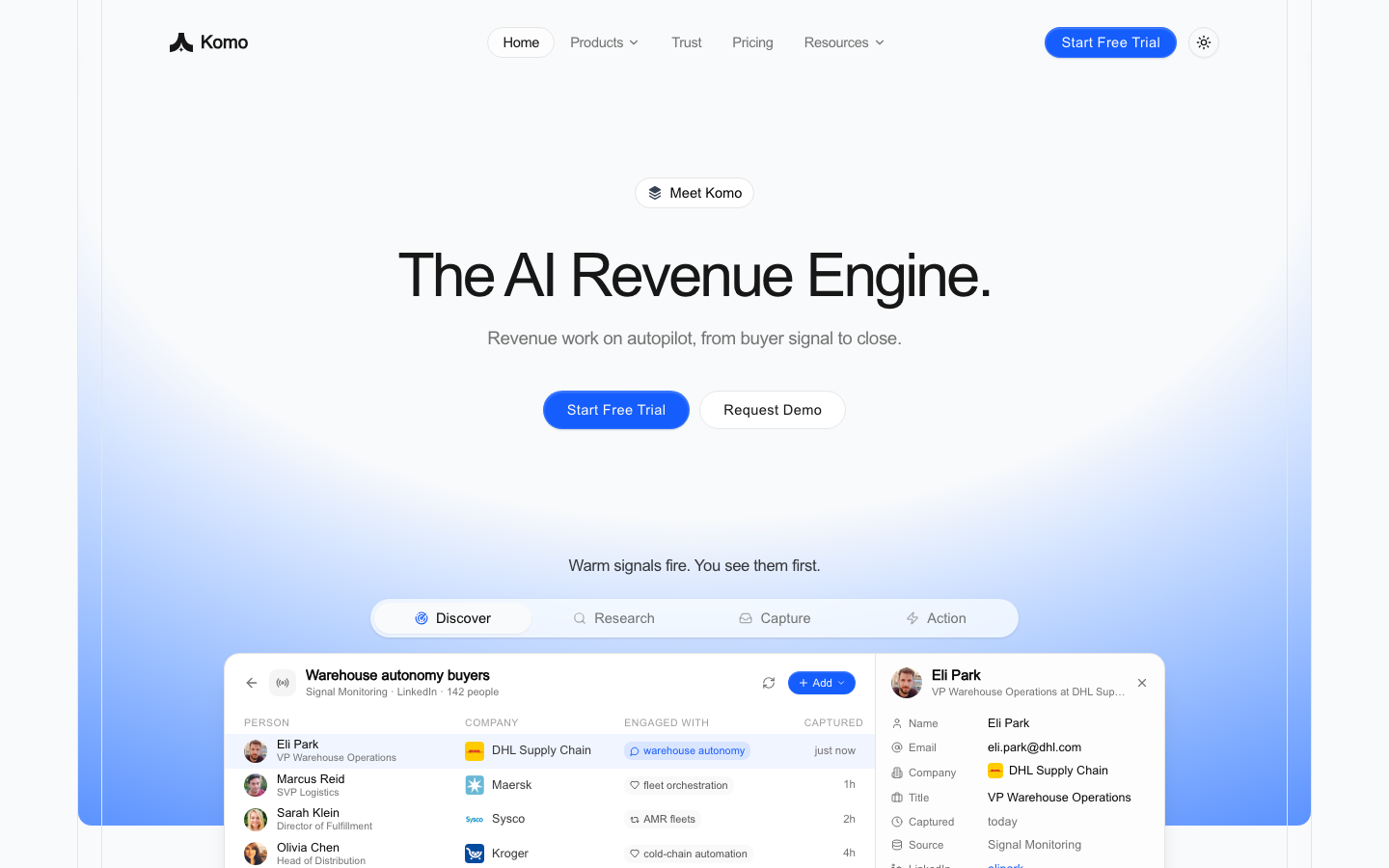
KomoAI
Core parameters and statistics of Komo AI
Komo AI is an AI search engine and research platform (Type D - productivity/business application) with privacy first and no ad tracking as its core concepts. It provides three interaction modes of search, dialogue, and exploration through generative AI, and uses a "three-column" interface to simultaneously present AI summary answers, community discussion threads, and selected web page sources, which is different from the blue link list of traditional search engines. It is positioned as a "privacy-protecting AI research assistant" - using AI to accelerate information acquisition and in-depth research without collecting user behavior data.
| Projects | Public Information |
|---|---|
| Product positioning | Privacy-first AI search engine and research platform |
| Core capabilities | AI search, dialogue Q&A, topic exploration, community discussion, multi-model integration |
| Product form | Web (iOS / Android mobile) |
| Business Model | Freemium (Free + Subscription-Based Paid) |
| Attribution | US (development team is located in New Zealand) |
| Established | 2022 |
| Average monthly visits | ~58.6K (2026 data) |
| Domain Rating | DR 54 (Ahrefs) |
| Supported Platforms | Web, iOS, Android |
| Supported languages | Multi-language (including en-US, etc.) |
Brief review in one sentence: Komo AI is not another clone of Perplexity, but through the combination of "three-column answers + community manual correction layer + free switching of multiple models", it has found its own differentiated position in the AI search track - suitable for in-depth researchers who are sensitive to privacy and need to cross-verify the accuracy of information.
Users and market recognition of Komo AI
Traffic and user scale: According to statistics from NavTools.ai, Komo AI has an average monthly visits of approximately 58.6K, a bounce rate of 41.75%, an average visit duration of 22 seconds, and 1.83 pages viewed per visit. The main sources of traffic are natural search (35.35%) and direct access (31.82%), followed by generative AI channels (14.19%) and referral traffic (12.68%). The top five regions are the United States (19.64%), Ecuador (8.24%), India (6.47%), Brazil (5.74%) and Turkey (5.55%).
Market Positioning and Competition Landscape: The AI search engine track in which Komo AI operates is highly competitive - Perplexity AI (valued at over US$3 billion) is the current market leader, and there are also many competing products such as You.com, Kagi, Genspark, Exa, and Nano Search (360). The core differentiation of Komo AI lies in three dimensions: first, the privacy commitment of no advertising and no tracking (actual verification can be confirmed through the privacy policy); second, the community discussion layer as a manual correction and supplementary mechanism for AI answers; third, free switching of multiple models (DeepSeek, OpenAI, Claude, Gemini, Llama, etc.). These differences have a certain reputation among the developer community and user groups with strong privacy awareness, but the overall brand awareness and user scale are still far lower than those of leading competitors.
Industry Benchmarking: Compared with Perplexity Pro ($20/month), Komo AI’s Basic plan ($15/month) is slightly cheaper, but there is still a certain gap in index coverage, answer quality, and response speed. Compared to Kagi (starting at $10/month), Komo AI offers a free tier with a lower barrier to entry. Overall, Komo AI is in the ecological niche of "cost-effective alternatives" and has not yet formed an independent market moat.
Cost Advantages of Komo AI
Komo AI adopts the Freemium model, and the cost structure is broken down as follows:
C-side/individual users: The free package provides basic AI search, conversation and community summary functions, but the number of daily queries is limited. Suitable for light users. Paid packages are divided into Basic ($15/month or $12/month annual payment) and Premium ($30/month or $24/month annual payment), with the latter offering higher query limits, more AI model choices, and advanced research tools.
API/Developer: Business plan ($200/mo) includes API access, file uploads, third-party integrations (Notion, Google Drive, Zendesk), and scheduling tools. There is no public independent API pricing, and developers need to obtain interface capabilities through the Business plan.
Business/Team: The Business plan offers 4,000 structured search credits, team collaboration tools, and early enterprise features. However, there is no public privatization deployment plan. If enterprises require private deployment, they need business communication - there is currently no relevant supporting information disclosed.
Price comparison: Mainstream AI search engines
| Products | Free Package | Paid Starting Price | Core Differentiation |
|---|---|---|---|
| Komo AI | Limited queries + basic search | $12/month (Basic annually) | Community discussion layer + multi-model switching + no tracking |
| Perplexity AI | Limited query + basic search | $20/month (Pro) | Wide index coverage + high answer quality + mature ecosystem |
| Kagi | No free tier | $10/mo (starter) | No ads + Custom sorting + Universal Summarizer |
| You.com | Limited queries | $14.99/month (Pro) | Multimodal + code interpreter + app integration |
| Genspark | Limited query | Unpublished | AI Agent driver + personalized summary |
Key Points of Cost Analysis:
- Real limitations of the free package: Free users may encounter queues during peak periods, and the number of daily queries is strictly limited - if it is used as the main search engine, the vast majority of users will trigger payment requirements within 1-2 weeks.
- Annual payment vs monthly payment: Basic annual payment discount is about 20% ($144/year), Premium annual payment discount is about 20% ($288/year), annual payment is locked but no automatic renewal special terms are disclosed.
- Hidden Cost: The multi-model switching function seems rich, but the number and types of models available in the Free/Basic package are limited, and Premium unlocks the complete model library - users pay for "option" rather than "result quality".
Key features of Komo AI
-
AI Intelligent Search (Search Mode): Based on generative AI, it conducts semantic understanding of web page indexes and directly returns summary answers containing quoted sources instead of traditional link lists. Use value: Transform the search from "filtering links" to "verifying answers", especially suitable for quickly obtaining factual information.
-
Conversational Q&A (Chat mode): Supports multiple rounds of dialogue, and users can continue to ask questions without losing the context. The model can adjust the answer direction based on previous questions. Use Value: Replace scattered single searches, suitable for exploratory research and concept learning.
-
In-depth topic exploration (Explore mode): Based on the topics input by the user, automatically discover related topics, community discussions and trend dynamics, forming a knowledge graph-based information network. Use Value: Core capabilities in market research, competitive product analysis and trend tracking scenarios.
-
Three-column results panel: The same query is displayed simultaneously: ① AI-generated direct answers (including citation annotations); ② Community discussion threads (users can add context and corrections); ③ Selected web source lists. Use value: Provide the convenience of rapid cross-validation in the context of doubtful AI credibility.
-
Free switching of multiple AI models: Built-in DeepSeek, OpenAI GPT, Anthropic Claude, Google Gemini, Meta Llama and other models, users can freely select the answer engine in the settings. Use value: Different models have their own advantages in different types of queries - for example, DeepSeek is good at logical deduction, Claude is good at long text understanding, and Gemini is good at multi-modality - users can flexibly choose according to the type of task.
-
Source citations and fact-checking: Each AI answer comes with a clickable source link and is assisted by AI fact-checking tools. Use value: Information tracing is urgently needed in academic research and professional writing.
-
Mind Map Visualization: Search results can be visually presented in the form of mind maps to help users understand the relationship structure between concepts. Use Value: Structured information sorting on complex topics (such as technical architecture, policies and regulations).
-
Third-party tool integration: Supports access to external knowledge bases such as Notion, Google Drive, Zendesk, etc. to achieve cross-platform information retrieval. Use value: Enterprise users can use Komo AI as a query front-end for internal knowledge bases to uniformly search multiple data sources.
[Expert View]: The most differentiated feature of Komo AI's feature set is not the AI search itself (almost all competing products have it), but the synergistic effect of "community discussion layer + multi-model switching" - the community layer provides a manual error correction loop for pure AI output, and multi-model switching allows users to compare the answering styles of different AIs without jumping between different search engines. This "All-in-One Research Station" design concept is closer to the real workflow of researchers than Perplexity's "Pure AI Answer Machine" route.
Komo AI model and version evolution
Since its founding by Komo Technologies (New Zealand) in 2022, Komo AI has experienced the following key version nodes:
Early stage (2022-2023)
- August 2022: The company is founded and begins developing a privacy-first AI search engine prototype.
- 2023: The product will be publicly launched. The initial version provides basic AI search and conversation functions, with "no advertising and no tracking" as the core selling point. Early adoption grew primarily through word-of-mouth among developer communities and privacy-aware groups.
Function expansion period (2024)
- Three-column interface release: The three-column layout that introduces AI answers + community discussions + web page sources has become the iconic interaction design of the product.
- Explore mode is online: Adds topic exploration capabilities, supports trend discovery and related content recommendations.
- Mobile application release: iOS and Android versions are online, covering mobile search scenarios.
Maturity period (2025-2026)
- Multi-model architecture integration: Access multiple mainstream large models such as DeepSeek, OpenAI, Claude, Gemini, Llama, etc. Users can freely select the answer engine in the settings.
- Business Plan with Enterprise Features: Introducing the $200/month Business plan, which includes API access, 4,000 structured searches, file uploads, and third-party integrations.
- Mind Mapping and Fact Checking Tool: Adds mind map visualization of search results, as well as AI-driven automatic fact checking.
- Current version: The latest iteration is mainly about incremental function updates. The official version number has not been disclosed. The real-time function status of the product site shall prevail.
Version context summary: The evolution path of Komo AI is clearly divided into three stages - from "MVP for private search" to "three-column research interface" to "multi-model research platform". This path reflects the change in product positioning from "a private search engine that replaces Google" to "an integrated workbench for AI researchers."
Technical advantages of Komo AI
Mechanism → Effect → Applicable Scenarios:
-
Multi-model routing architecture: Komo AI does not rely on a single LLM, but maintains a model routing layer in the backend. After the user selects a model, the query is routed to the API endpoint of the corresponding model, and the returned results are structured by Komo's front-end rendering layer (adding citation sources, community context, etc.). Effectiveness: Users can compare the answering style and accuracy of different models in a single search without having to open ChatGPT, Claude and Gemini separately. Applicable scenarios: Research tasks that require multi-source cross-validation (such as literature review, competitive product analysis).
-
Three-column information architecture: Display the AI-generated answer UGC community content and the original web page source side by side, forming a triple information flow of "AI initial judgment → community correction → source verification". Effect: Significantly reduces the risk of information misjudgment caused by AI illusion - the community discussion layer acts as an artificial fact checker. Applicable scenarios: Inquiries involving high factual accuracy requirements (such as medical information, legal terms, technical parameters).
-
Privacy Zero Tracking Architecture: Komo AI does not collect user search behavior data, does not place ads, and does not create user portraits. The data is only used for processing the current query and will not be persisted after the query is completed. Effect: The business model of search engines monetizing behavioral data is fundamentally eliminated, and users do not need to choose between "search quality" and "privacy protection". Applicable scenarios: Scenarios with compliance requirements for data privacy (such as lawyers, journalists, medical researchers).
-
Community discussion response: Users can add comments, correct errors, and add context below the AI answers. These community contributions continue to improve the quality of answers to this query. Effect: Introducing a "crowdsource correction" mechanism for AI search, the quality of answers to popular queries will continue to improve as community participation increases. Applicable scenarios: Technical, academic and other subject areas with high community participation.
How to use Komo AI
Entrance and Platform:
| Entrance | Address/How to obtain | Description |
|---|---|---|
| Web side | https://komo.ai | The most complete functional experience, supporting all modes |
| iOS App | App Store Search "Komo AI" | Mobile search and conversation |
| Android App | Search "Komo AI" on Google Play | Mobile search and conversation |
Typical steps:
- Access the web: Open https://komo.ai in your browser and start basic search without registration.
- Select interaction mode: Switch between Search (precise search), Chat (dialogue question and answer), and Explore (theme exploration) according to the task type.
- Enter natural language query: Enter the question directly in the search box or chat box (supports Chinese, English and other languages).
- Interpret the three-column results: Read the AI summary answers in the left column, view community discussions and error corrections in the middle column, and browse the source web links in the right column.
- Switch AI model: If you are not satisfied with the current answer, you can switch to a different underlying model in the settings to regenerate.
- Registration/Paid Unlock Quota: After the free user query quota is used up, you need to register and choose the Basic / Premium / Business plan to continue using it.
Key points to get started: For research-type in-depth queries, it is recommended to first use the Explore mode to discover topics, then use the Search mode to obtain specific answers, and finally use the Chat mode to conduct multiple rounds of questioning - this three-step process of "discovery → acquisition → deep digging" can maximize the multi-mode synergy advantage of Komo AI.
Product Pricing for Komo AI
Komo AI provides a four-level pricing system (based on the information disclosed and public information on aipapas.com, and the real-time page of the official website as the final basis):
| Plan | Monthly Price | Annual Price | Core Benefits |
|---|---|---|---|
| Free | $0 | $0 | Basic AI search, conversation explore mode, limited number of daily queries |
| Basic | $15/month | $12/month ($144/year) | AI chat/search access 30 times/day Research Mode query, limited AI model selection |
| Premium | $30/month | $24/month ($288/year) | Higher query limit, all AI models, structured search, advanced research tools |
| Business | $200/month | Discounted annual payment | 4,000 structured searches, file upload API access, third-party integrations, team collaboration |
Pricing Strategy Observation:
- The core difference between Basic and Premium is "Number of Research Mode queries" and "AI model access scope", not function type. The value of upgrading from free to Basic lies in the increase in quota, while the value of upgrading from Basic to Premium lies in model selection and advanced search capabilities.
- The pricing of the Business plan ($200/month) is a big jump compared to the Premium ($30/month), but it includes API integration and 4,000 structured search credits - this tier is clearly aimed at small teams with automation needs, rather than individual researchers.
- The annual payment discount is about 20%, which is at a medium level among similar SaaS. It is neither an overly aggressive lock-in strategy nor a significant price advantage.
Komo AI application scenarios
-
Academic Research and Literature Review: The researcher enters the research topic, uses the Explore mode to discover relevant literature and related topics, uses the Search mode to obtain the AI summary of the specific paper abstract, and then compares the answers of different LLMs to the same question through multi-model switching. ——Value: From the "article-by-article reading and screening" of traditional search to "AI preliminary screening + manual verification", the literature research stage can be shortened by 40-60%.
-
Market and Competitive Product Intelligence Analysis: Enter competing product names or industry keywords, use the Explore mode to track the latest developments, community discussions and trend changes, and use multi-model switching to analyze information from different perspectives (technical, commercial, user evaluation). ——Value: Get structured intelligence summaries with one query, replacing scattered searches on multiple platforms (Google, social media, industry reports).
-
Content Creation and Topic Planning: Content creators enter the topic direction, use Chat mode to brainstorm, use Explore mode to discover popular discussion angles and user pain points, and use Search mode to verify factual data. ——Value: From "topic selection based on experience" to "topic selection assisted by data + community signals", reducing the risk of misjudgment of content direction.
-
Developer Technology Survey: Developers enter the technology stack name or question (such as "React Server Components vs Next.js App Router"), get comparative answers to multiple AI models, and view practical experience and technical disputes in community discussions. ——Value: Technology selection decision-making has changed from "reading official documents + browsing blogs" to "AI summary + cross-validation of community experience".
-
Unified search of enterprise knowledge base: Through the integration of Notion, Google Drive, and Zendesk, employees can use Komo AI as a unified entrance to search for internal enterprise documents, customer work orders, and knowledge bases. ——Value: Reduce the time cost of cross-platform switching and improve information retrieval efficiency.
Dimensionality reduction attack scenario: Multi-model comparative study is the most unique application method of Komo AI - compare DeepSeek, GPT, Claude, and Gemini's answers to the same question within one screen, and use community discussions to verify the accuracy of each model's answer. This is not possible on both Perplexity and Kagi.
Human-machine collaboration boundary:
- 100% Automable: Factual information retrieval, simple concept queries, news summaries, trend discovery.
- Human confirmation required: Research conclusions involving professional judgment (medical diagnostic recommendations, interpretation of legal provisions), high-impact business decisions (investment analysis, strategy formulation), complex queries that require inference of in-depth domain knowledge - although multiple models provide different perspectives, the final judgment still relies on human professional experience.
Applicable groups of Komo AI
-
Academic researchers and students: need to efficiently search and organize multi-source literature, and have strict requirements on the sources of citations in answers. Komo AI’s three-column interface and multi-model comparison are particularly suitable for quick scanning in the early stages of a literature review. Prerequisite: Basic English search ability is required (although multiple languages are supported, the index coverage of English content is the most complete).
-
Privacy-conscious daily search users: Dissatisfied with Google/Bing’s behavior tracking and data collection models, and hope to obtain privacy protection without sacrificing search quality. Komo AI’s zero-trace architecture directly addresses this need. Unfit Boundary: If the real-time and complete requirements of search results are extremely high (such as real-time stock quotes, rolling updates of emergencies), the index size of Komo AI may not be enough.
-
Content creators and new media operators: need to quickly obtain inspiration for topic selection, track hot trends, and verify factual data. The Explore mode and community discussion layer provide "crowd intelligence information" that traditional search engines cannot directly present. Not suitable for boundaries: Search scenarios that require a large amount of high-quality copyrighted images or video materials - Komo AI mainly focuses on text content.
-
Market research positions for small and medium-sized enterprises: Need to do competitive product research and industry trend analysis, but do not have the budget to purchase professional market intelligence tools (such as CB Insights, Similarweb paid version). Komo AI’s Basic/Premium plans ($12-24/month) offer a cost-effective alternative. Prerequisite: The research scope is limited to the information available on public web pages and cannot replace first-hand research and paid databases.
-
Developers and technical decision-makers: In the scenarios of technology selection research, framework comparison and bug troubleshooting, the multi-model switching capability allows you to quickly obtain suggestions from different perspectives, and the community discussion layer supplements practical pitfall experience. Not fitting boundaries: Searches involving private code bases or internal technical documentation - Komo AI's third-party integration currently only supports common tools such as Notion and Google Drive, and does not support self-hosted knowledge bases.
Summary of unsuitable groups: High-frequency traders who have extremely high requirements for real-time search results, SEO professionals who need to deeply customize search rankings, and enterprise analysis teams that rely on paid commercial databases (such as Bloomberg Terminal, LexisNexis) - in these scenarios, Komo AI's index scale and professional data coverage are not enough to meet the needs.
Summary and Outlook of Komo AI
Komo AI has chosen a differentiated path in the AI search engine track - it does not pursue the maximization of index size (that is Google's battlefield), nor does it blindly copy Perplexity's pure AI answer model. Instead, it builds an information workbench for in-depth researchers through the combination of "privacy zero tracking + community correction layer + multi-model switching". Its core competitiveness lies in its response strategy to the "AI credibility dilemma": since users do not trust a single output of AI, it provides community error correction and multi-model comparison mechanisms to assist verification.
Current Main Limitations:
- Limited Index Coverage: On long-tail queries and very new content, the quality and completeness of the returned results are significantly inferior to those of Google or Perplexity.
- Insufficient community participation: The current average monthly visits of 58.6K means that the community discussion layer is in a "frame but no content" state for most queries, and the value of human flesh correction has not yet been fully realized - this is a typical cold start problem.
- Low brand awareness: Compared with Perplexity (which has annual revenue of tens of millions of dollars), Komo AI is still a niche tool and has low visibility among ordinary users.
- Mobile experience needs to be optimized: The three-column interface has an excellent experience on a large screen, but the information density and interaction logic on the mobile phone need to be further adapted.
- Enterprise functions are still shallow: Although the Business plan provides a $200/month tier, compared with enterprise search products such as Glean, there is still a clear gap in terms of permission management, SSO, and audit logs.
Follow-up observation points:
- Whether the cold start of community discussion can be broken through incentive mechanisms or cooperation with content platforms such as Reddit/Zhihu.
- Will multi-model switching become an industry standard? If all search tools start supporting multi-models, this differentiation advantage of Komo AI will be eroded.
- Whether AI Agent functions will be introduced on the basis of privacy protection (such as automating information collection tasks), evolving from a "search tool" to a "research assistant".
Procurement and Adoption Risk Assessment: For individual users, Komo AI’s free plan is worth a try, especially researchers who are privacy-sensitive or need to compare multiple models - you can experience core differentiated features at zero cost. For team/enterprise users, it is recommended to pilot the Business plan on a small scale (3-5 people) first, focusing on verifying: ① the search accuracy of third-party integrations (Notion, Google Drive) on actual enterprise data; ② whether the 4,000 structured search quota meets the team's monthly needs; ③ whether the stability and response delay of the API meet production bound standards. Before the "human correction layer" of the community has become sufficiently active, it is not appropriate to use Komo AI as the only research or search tool. It is recommended to use it in conjunction with Perplexity or Kagi to complement it.
Related tools: perplexity, you-com
Version Info
- Komo AI :There is no official precise date yet.
- Komo AI :There is no official precise date yet.
User Reviews