 Kubeflow
Free
Kubeflow
Free
Kubeflow is Google's open source MLOps platform running on Kubernetes, covering the entire process of data preparation, model training, tuning and inference deployment.
Kubeflow
Kubeflow’s core parameters and statistics
Kubeflow is not a single application, but a collection of Kubernetes native components - each sub-project evolves independently and is assembled into a complete platform through a unified Kubeflow Community Distribution (KCD). This "building block" architecture determines that the boundaries of its capabilities depend on which components you assemble, rather than a certain version number telling everything.
| Projects | Public Information |
|---|---|
| Official positioning | AI platform tool base layer on Kubernetes |
| Core sub-projects (sorted by GitHub Stars) | Kubeflow Pipelines (4.2k ★), Spark Operator (3.1k ★), Kubeflow Trainer/Training Operator (2.2k ★), Katib AutoML (1.7k ★), Kubeflow Hub/Model Registry (176 ★), Notebooks (74 ★), Central Dashboard (16 ★) |
| Infrastructure dependencies | Kubernetes 1.25+ (required) |
| Open Source License | Apache 2.0 |
| CNCF Maturity | Incubating Projects (Incubating) |
| Place of Residence | United States (US) |
| Cross-project GitHub Stars | 33.1k+ (including all sub-projects) |
| Contributors across projects | 3,000+ |
| PyPI cumulative downloads | 258 million+ |
| Number of GitHub releases | 94 times (main repository) |
| Target Users | Enterprise ML/Platform teams with Kubernetes foundation |
| Deployment method | Self-hosted (supports bare K8s, GKE, EKS, AKS, etc.) |
Core Difference: The difference of Kubeflow lies in "mapping ML workflows into Kubernetes native resources" - each training task is a K8s Job, each inference endpoint is a K8s Service, each experimental parameter is managed through ConfigMap/CRD, and monitoring and logs directly reuse K8s ecological tools such as Prometheus and Fluentd.
User and market recognition of Kubeflow
Kubeflow is the MLOps open source project with the widest coverage in the Kubernetes ecosystem. Its market recognition is reflected in the three dimensions of community activity, enterprise adoption and cloud vendor integration.
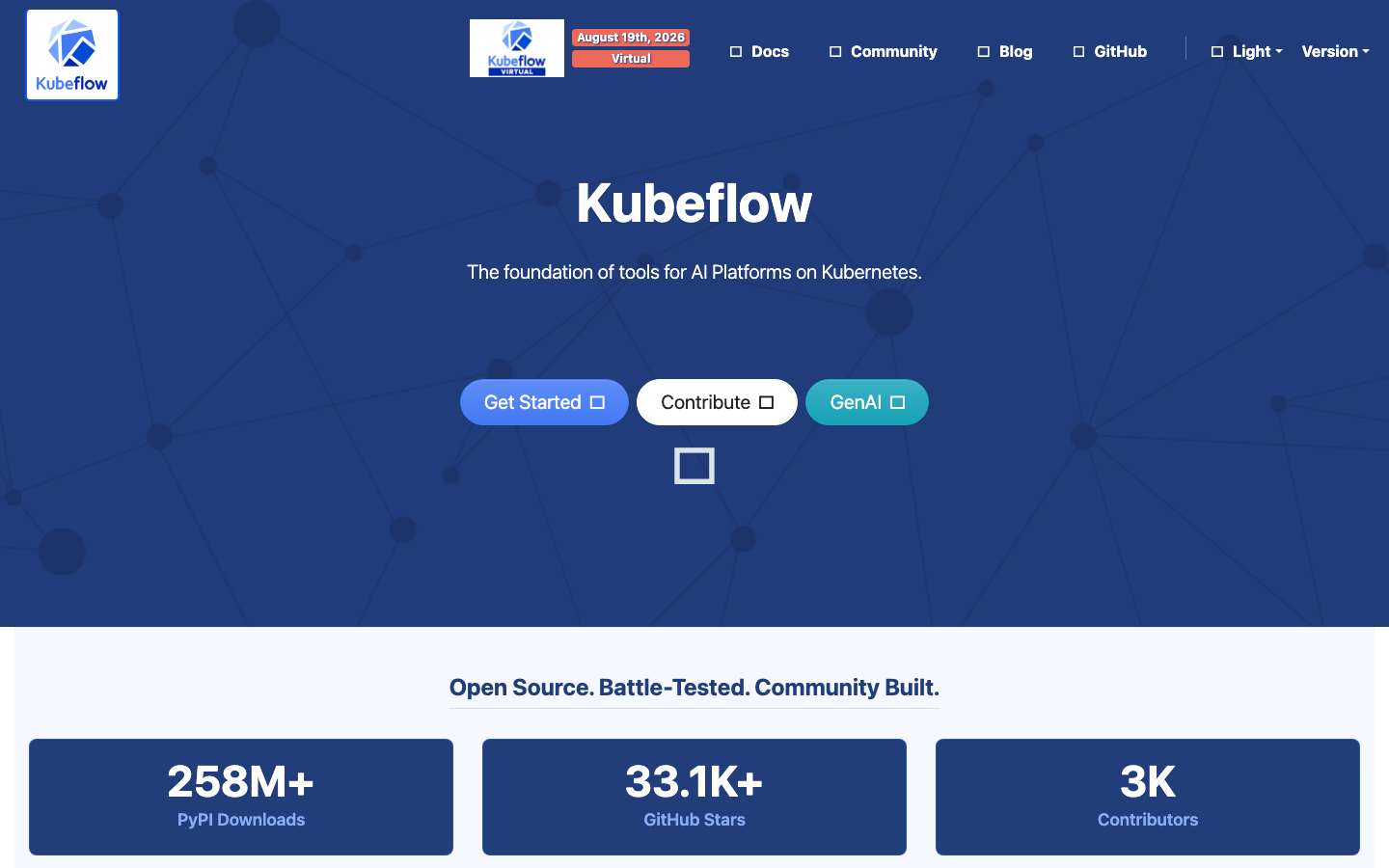
Community size: As of mid-2026, the total number of Kubeflow cross-project stars on GitHub exceeds 33.1k, and the number of contributors exceeds 3,000. The main repository has 15.8k Stars, 2.7k Forks, and the Pipelines sub-project has 4.2k Stars, indicating that the community not only pays attention to the concept of Kubeflow, but also goes deeper into the use and contribution of specific components. PyPI has been downloaded 258 million times in total, reflecting the depth of its SDK’s penetration into the Python ecosystem.
Enterprise Adoption: Trusted customers displayed on Kubeflow’s official website include leading cloud vendors such as AWS, Oracle, and Red Hat. The adopting companies listed in the GitHub ADOPTERS.md file cover finance, technology, manufacturing, telecommunications and other industries. The underlying part of Google Cloud's Vertex AI draws on the design concept of Kubeflow; AWS provides a SageMaker hybrid deployment solution based on Kubeflow; Azure's MLOps capability is also deeply integrated with Kubeflow Pipelines.
CNCF ecological position: As a CNCF incubation-level project, Kubeflow has passed TOC’s maturity assessment but has not yet entered the graduation stage. This means that its API stability and governance maturity have reached CNCF standards, but the independent version cadence of some sub-projects may lead to higher overall deployment complexity.
Industry evaluation reference: In third-party MLOps platform comparisons, Kubeflow is generally ahead of MLflow (lack of K8s native integration) and SageMaker (closed source lock) in the dimensions of "open source" and "K8s nativeness", but lags behind managed services in "out-of-the-box usability". MLOps reports from analysts such as Gartner often list Kubeflow as a representative reference implementation of open source MLOps.
Cost advantage of Kubeflow
Kubeflow's cost structure consists of three levels: "open source zero license fee + infrastructure borne by yourself + operation and maintenance manpower investment", which is essentially different from the cost model of a hosted SaaS MLOps platform.
C-side/Individual Users: Kubeflow does not have a SaaS version for independent data scientists. Individual users need to build their own Kubernetes environment (Minikube, Kind or free quota from cloud vendors) to experience Kubeflow. In Minikube mode, a single node can run some components, but full functionality requires a multi-node cluster. For individual learners, the time cost (2-8 hours for context building) is much higher than the sign-up-and-use model of SaaS tools.
Developers/API users: Kubeflow provides Python SDK (kfp) for Pipeline programming. The SDK itself is free, but executing Pipeline requires a backend K8s cluster. Developers can use Google Cloud's Vertex AI Pipelines (compatible with Kubeflow Pipelines SDK) to run workflows on a pay-as-you-go basis without building a self-built cluster. This is currently the most economical Kubeflow developer portal. Billing is based on the number of executions and computing resources. The cost of a single experiment ranges from a few yuan to several hundred yuan.
Enterprise/Private Deployments: This is the primary cost scenario for Kubeflow. The costs are broken down as follows:
| Cost Item | Estimate Range | Description |
|---|---|---|
| Platform License | 0 yuan | Apache 2.0 open source, no licensing fees |
| K8s cluster (production level) | 3,000-30,000 yuan/month | 3-10 nodes, Evian manufacturer and configuration floating |
| GPU computing power | 5-50 yuan/card/hour | A100/H100 on-demand price, reserved instances can be reduced to 30-50% |
| Operation and maintenance manpower | 0.5-2 people/year | The cost of operation and maintenance personnel combined with K8s + ML is higher than that of pure K8s operation and maintenance |
| Storage and network | 500-5,000 yuan/month | PVC storage, model product storage, cross-regional traffic |
Cost Comparison Deduction: Taking a 10-person ML team with an average of 200 hours of GPU training per month as an example, the annual TCO of self-built Kubeflow is about 300,000-800,000 yuan (including operation and maintenance manpower sharing), while the annual fee for a managed MLOps platform of the same scale is about 500,000-1.5 million yuan. The advantages of Kubeflow are even more obvious at scale - after the number of nodes exceeds 20, the marginal cost is only 40-60% of the hosting solution. However, the initial build cycle (2-4 weeks) and operation and maintenance complexity are hidden costs. The team needs at least one engineer who is familiar with K8s and can troubleshoot Kubeflow component compatibility issues.
Main functions of Kubeflow
Kubeflow's functionality consists of a set of independent sub-projects, each focusing on a section of the ML lifecycle. The following are the core functional components and their synergy relationships:
-
Kubeflow Pipelines (KFP): Visual DAG workflow engine, pipeline of serial data preprocessing → training → evaluation → deployment. Expert view: The real value of KFP is not only "drawing a flow chart", but it allows the Pipeline to be defined as a Python DSL (kfp SDK), and the compiler generates IR (Intermediate Representation) YAML to achieve contextual decoupling of pipeline definition and execution. This means that the same Pipeline definition can be seamlessly migrated between local K8s, GKE, and EKS, solving the core pain point of inconsistency between ML development and production.
-
Katib automated hyperparameter search and NAS: The AutoML engine based on Kubernetes CRD supports three search algorithms: Grid Search, Random Search, and Bayesian Optimization, as well as the Early Stopping strategy. Hidden linkage: Katib can directly call Kubeflow Pipelines as the experiment execution engine, and each hyperparameter combination is executed as a Pipeline Run - this means that the results of the hyperparameter search automatically carry the complete experimental link (data version, code version, indicator), without manual association.
-
Kubeflow Trainer (Training Operator): Distributed training operator, natively supports PyTorch, TensorFlow, MPI, XGBoost, MXNet and other frameworks. Extended LLM fine-tuning support for HuggingFace, DeepSpeed, Megatron, MLX, JAX in version 1.9. Engineering Perspective: The core abstractions of Training Operator are CRDs such as
PyTorchJobandTFJob, which encapsulate the deployment logic of distributed training topology (Worker/PS/Chief) into K8s resource definitions. Users only need to specify the number of copies and mirrors to start distributed training, without the need to hand-write complex K8s StatefulSet and Service configurations. -
KServe (Inference Service): An independently evolved high-performance model inference platform that supports automatic deployment of TensorFlow, PyTorch, ONNX, Scikit-learn, XGBoost and other formats. Provides production-level capabilities such as elastic scaling (based on Knative), A/B testing, canary release, and request logs. Collaborative value: After KServe is linked with Kubeflow Pipelines, the CI/CD closure of "automatic triggering of inference service update upon completion of training" can be achieved - the last step of the Pipeline calls the KServe API to update the inference endpoint to achieve end-to-end automation.
-
Kubeflow Notebooks: A hosting service that runs Jupyter Notebook in a K8s cluster, supporting multi-tenant isolated GPU acceleration and custom mirroring. Each Notebook instance is an independent K8s Pod, and users can choose different images (PyTorch, TensorFlow, R language, etc.) and resource specifications. Implementation Tips: The linkage between Notebooks, Katib and Pipelines is a high-frequency path - after users complete data exploration and prototype experiments in Notebooks, they can export the code as a Pipeline component with one click, and then submit it as a scheduled training task.
-
Kubeflow Hub (Model Registry): Model metadata management center, which stores model version, source Pipeline Run, evaluation indicators, deployment status and other information. It bridges the tracking gap between experiments (Pipelines + Katib) and production (KServe), allowing platform teams to clearly see "which model version of which experiment is currently being served in production."
-
Central Dashboard: Unified management console that integrates the Web UI of all sub-projects. Provides RBAC permission management, multi-tenant namespace isolation, and cluster resource monitoring portals. For platform administrators, Dashboard is the core entrance for daily operation and maintenance.
Synergy between functions: The components of Kubeflow are not isolated functions, but form a complete link of "Notebook experiment → Pipeline orchestration training → Katib hyperparameter optimization → Hub model registration → KServe inference deployment → Prometheus monitoring feedback". A typical closed scenario: the data scientist debugs the model in Notebook, and when satisfied, encapsulates the code into a Pipeline component, searches for the best hyperparameters through Katib, and the best model is automatically registered to the Hub. The Hub triggers KServe to update the inference endpoint, and the latency and throughput indicators of the inference service are collected by Prometheus and displayed in the Dashboard.
Kubeflow model and version evolution
As a collection of projects, Kubeflow's version number system has evolved from "unified release" to "sub-project independent release + community release". The current version number of the main repository (such as 1.9) corresponds to the version of Kubeflow Community Distribution (KCD), not the version of a certain sub-project.
Early stage: unified release (2018-2021)
- Kubeflow 0.1 (2018-03): The first open source version, basic functionality is limited to running TensorFlow Jobs on K8s. At that time, the project was positioned as "TensorFlow on Kubernetes".
- Kubeflow 0.2 (2018-06): Introduced Jupyter Notebook support, extended to the PyTorch framework.
- Kubeflow 1.0 (2020-03): Milestone release marking API stability commitment. Contains preview versions of Pipelines, Katib, Notebooks, and KFServing. CNCF was accepted as an incubation project in the same year.
- Kubeflow 1.1-1.3 (2020-2021): Focus on multi-tenant RBAC, Istio integration and enterprise-level functional improvements.
Component decoupling and independent evolution (2021-2024)
- Kubeflow 1.4-1.5 (2021-2022): KFServing evolves into an independent project KServe to accelerate the independent release cycle. Training Operator is split from the main repository. Pipelines v2 begins technology preview.
- Kubeflow 1.6-1.7 (2022-2024): Pipelines v2 GA, introducing IR intermediate representation and more flexible component definition. Katib adds Neural Architecture Search support. Community Distribution (KCD) has officially become the recommended deployment method.
- Kubeflow 1.8 (~2025-06, no official precise date yet): Improved Pipeline’s observability and GPU scheduling strategy. Trainer adds native support for HuggingFace Accelerate.
Latest phase: LLM and GenAI support (2025-present)
- Kubeflow 1.9 (~2026-03, no official precise date yet): Focus on enhancing LLM training workload support - Kubeflow Trainer adds distributed training support for DeepSpeed, Megatron, MLX, and JAX; Katib adds LLM hyperparameter search templates (LoRA rank search, etc.); KServe enhances the deployment experience of LLM inference frameworks such as vLLM and TGI.
Subproject independent version status
| Subprojects | Standalone versions | GitHub Stars | Description |
|---|---|---|---|
| Kubeflow Pipelines | v2.x (standalone) | 4.2k ★ | KFP v2 is the current mainline, IR YAML driver |
| KServe | v0.13+ (standalone) | 3.9k ★ (standalone repository) | Split from Kubeflow main repository |
| Katib | v0.16+ (independent) | 1.7k ★ | Continuous iteration, decoupled from Kubeflow version |
| Spark Operator | v1.x (standalone) | 3.1k ★ | For Spark on K8s workloads |
| Training Operator | v1.7+ (standalone) | 2.2k ★ | Covers Trainer and MPI Job |
Version Compatibility Tip: The sub-project version integrated by Kubeflow 1.9 KCD may not be the latest version of each sub-project. During actual deployment, it is recommended to check the release notes of each sub-project separately to confirm the version compatibility matrix. The official document provides a compatibility table, but there is an update lag. The full link should be verified in the test environment before production deployment.
Technical advantages of Kubeflow
Kubeflow's technical advantages are rooted in its deep adaptation to Kubernetes' native resource model, rather than building another abstract layer on top of K8s.
Kubernetes CRD-driven architectural design: Each core capability of Kubeflow is defined by a Custom Resource Definition (CRD). Taking the Training Operator as an example, the PyTorchJob CRD defines the desired state of distributed training (number of Workers, PS, mirrors, resource quotas). Kubeflow's Controller monitors CRD changes and reconciles them to the actual state. The advantage of this design is that the kubectl and GitOps processes that users are already familiar with can be used directly for ML workload management without having to learn an additional platform CLI. kubectl apply -f pytorchjob.yaml will start distributed training.
Component-level assembly: Kubeflow does not force full deployment. The platform team can choose to deploy only Pipelines + KServe, or only Katib + Trainer, or even develop Kubeflow Notebooks independently as a team development environment. This flexibility comes from the fact that each sub-project is an independent combination of Controller + CRD + Web UI, and components communicate through standard K8s Service and ConfigMap, without any hard dependencies.
Pipeline IR (Intermediate Representation): The IR mechanism introduced by KFP v2 is a key innovation in technology. It compiles the Pipeline definition into an intermediate representation YAML that is independent of the specific running context, and then interprets and executes it on the target cluster by the execution engine (Dag Runner). This means that the same Pipeline definition can be transplanted between test clusters, production clusters, and even K8s services of different cloud vendors, solving the classic problem of ML workflow "it can run when it is developed but cannot run when it is produced".
Natural integration with K8s ecological tools: Because Kubeflow's resource model is a standard K8s resource, the entire K8s ecosystem can be reused at zero cost: Prometheus collects monitoring indicators for training and inference; EFK/Loki collects Pod logs; Argo CD implements GitOps synchronization defined by Pipeline; Velero backs up CRD and PVC data. In contrast, non-K8s-native MLOps platforms need to implement or integrate these infrastructure capabilities themselves.
GPU scheduling and resource isolation: Kubeflow uses Kubernetes' node resource management and extended schedulers such as Volcano/Scheduler to achieve fine-grained allocation and isolation of GPU resources. Katib's concurrent experiments can limit the GPU upper limit of each experiment through K8s ResourceQuota to prevent a certain set of hyperparameter searches from exhausting cluster computing power. In a multi-tenant scenario, resource isolation and quota management between teams are achieved through K8s Namespace + RBAC.
LLM training adaptation capability: In version 1.9, Kubeflow Trainer can orchestrate hundreds of cards of LLM distributed training on K8s by integrating the launcher scripts of DeepSpeed and Megatron. The core idea is to encapsulate DeepSpeed's deepspeed startup command as the entrypoint of K8s Job, and use the Training Operator's CRD to manage the Worker-PS topology to achieve elastic scheduling and fault recovery of training tasks.
How to use Kubeflow
The deployment path of Kubeflow varies depending on the team size and scenarios. From stand-alone learning to production-level multi-cluster deployment, the following are the most commonly used methods:
| Deployment method | Applicable scenarios | Complexity | Typical time-consuming |
|---|---|---|---|
| Kubeflow Community Distribution (KCD) | Production-level full-featured deployment | Medium-High | 1-3 days |
| Cloud vendor hosting Distribution (GKE/EKS/AKS) | Deep cloud integration context | Medium | 2-8 hours |
| Kind/Minikube local deployment | Personal learning and prototype verification | Low | 30 minutes-2 hours |
| Subproject independent deployment (e.g. Pipelines only) | Lightweight requirements | Low-medium | 1-4 hours |
KCD Rapid Deployment (Recommended for Production):
Kubeflow Community Distribution is currently the officially recommended production deployment method. The general steps are as follows:
- Prepare the Kubernetes cluster (1.25+) and ensure there are sufficient CPU/GPU resources and storage classes.
- Download the KCD manifest for your target K8s version from the official Kubeflow GitHub Release page.
- Install the KCD manifest:
kubectl apply -k https://github.com/kubeflow/kcd/...(for specific paths, please refer to the official documentation). - Configure Ingress/Gateway (KCD uses Istio as the north-south traffic gateway by default).
- Access the Web UI through the Central Dashboard's NodePort or LoadBalancer address.
- Create a Notebook instance or submit the first Pipeline through the
kfpSDK.
Quick example of submitting Pipelines using kfp SDK:
# Install SDK: pip install kfp
importkfp
from kfp import dsl

@dsl.component
def train_op(epochs: int, lr: float) -> str:
    import json
    # Training logic is executed here
    metrics = {"accuracy": 0.95, "loss": 0.05}
    return json.dumps(metrics)

@dsl.pipeline(name="training-pipeline")
def training_pipeline(epochs: int = 10, lr: float = 0.001):
    train_task = train_op(epochs=epochs, lr=lr)

# Compile and submit
kfp_client = kfp.Client(host="<YOUR_KUBEFLOW_HOST>")
run = kfp_client.create_run_from_pipeline_func(
    training_pipeline,
    arguments={"epochs": 20, "lr": 0.0001},
    experiment_name="my-experiment"
)
Verify deployment: After the deployment is completed, confirm the status of each component through Dashboard. Use kubectl get pods -n kubeflow to check whether the core Pod is Running; run a sample Pipeline through the "Pipeline" menu of the Dashboard to verify the end-to-end link.
Operation and Maintenance Points: Kubeflow's component logs are checked through kubectl logs or collected to a centralized log platform; if Pipeline execution fails, first check the Pod event (kubectl describe pod) and KFP's Workflow CRD status (kubectl get workflow).
Kubeflow product pricing
Kubeflow itself is 100% open source and free infrastructure software, but "free" is limited to the software license level. The actual implementation cost consists of the following three levels:
C client/individual users: Kubeflow does not have a SaaS version for individuals. For personal learning, you can build a minimal deployment through Minikube or free quota from cloud vendors. The monthly cost of a typical single-node Minikube deployment is about US$0-30 (depending on the cloud vendor's free quota policy), but maintaining a stable and available Kubeflow environment requires a certain amount of K8s operating experience - this is an implicit "time cost" for independent developers.
Developer/API call level: kfp SDK and kfctl CLI are completely free. But each Pipeline execution consumes K8s cluster resources. Three economic options: (1) Local Minikube runs small-scale experiments with zero cost but limited computing power; (2) Use Google Cloud Vertex AI Pipelines (compatible with KFP SDK), which is billed based on the number of executions and resources. The single cost of small-scale experiments is about 5-50 yuan; (3) Self-built small clusters (3 nodes) run development workloads, and the monthly infrastructure cost is about 2,000-5,000 yuan.
Enterprise/Private Deployments: There is zero software licensing fee, but based on cluster size and GPU usage, the annual TCO is estimated as follows:
| Enterprise size | Cluster size | Monthly infrastructure cost (estimated) | Operation and maintenance manpower (years) | Annual TCO range (estimated) |
|---|---|---|---|---|
| Small team (5-10 people) | 3-5 nodes, 1-4 card GPU | 8,000-20,000 yuan | 0.5 people | 150,000-400,000 yuan |
| Medium-sized team (20-50 people) | 10-20 nodes, 8-32 card GPU | 30,000-100,000 yuan | 1 person | 500,000-1.5 million yuan |
| Large organization (100+ people) | 50+ nodes, 100+ card GPU | 150,000-500,000 yuan | 2+ people | 2-8 million yuan |
Hidden Cost Tip: The above estimate does not include the GPU cost of model training itself (usually billed based on actual usage during training tasks and not included in the platform infrastructure). In addition, upgrading Kubeflow components requires downtime or rolling migration, and each major version upgrade may require 1-4 weeks of engineering time for compatibility testing and data migration. It is recommended to reserve a 20% operations buffer in your budget.
Kubeflow application scenarios
Kubeflow's capabilities cover the entire ML life cycle from experimental management to production inference. The following four scenarios have been verified at scale:
-
Enterprise-level ML pipeline platform: Host the entire process of data preprocessing, feature engineering, model training, evaluation, and deployment on K8s. Suitable for teams that need to eliminate the difference between "development with PyTorch runthrough and production with manual reconfiguration". Cost reduction and efficiency improvement: In the traditional model, ML engineers need to manually operate 8-12 steps for each model iteration (data extraction, format conversion, training script parameter configuration, deployment configuration, etc.). After switching to Kubeflow Pipeline, it is reduced to "submit a Pipeline Run", and the single iteration time is shortened from 2-4 hours to 30-60 minutes (deduction value, the actual improvement varies depending on the complexity of the team process). Implementation Tips: Pipeline's component granularity design directly affects the reuse rate - it is recommended to encapsulate common steps such as "data verification", "feature calculation" and "model evaluation" into standard components and use them as a common component library for the team.
-
Multi-team model service platform: Multi-team isolation is achieved through K8s Namespace + RBAC. The training tasks of each team run in an independent namespace and share the inference service gateway. Suitable for medium to large organizations with multiple algorithm teams. Human-computer collaboration boundary (Rule D mandatory): Resource configuration changes for model training (such as the number of GPUs, storage expansion) should be capped through K8s ResourceQuota instead of manual approval; however, a manual confirmation point must be set in the last step of model release (stream switching from Staging to Production) to prevent insufficiently verified models from being directly exposed to online traffic.
-
LLM fine-tuning and deployment: Use Kubeflow Trainer's support for DeepSpeed and LoRA to orchestrate distributed fine-tuning tasks for large language models on K8s. KServe works with vLLM or TGI to implement high-throughput inference deployment of LLM. Cost reduction and efficiency improvement: The fine-tuning task based on LoRA automatically searches for the best rank and learning rate combination through Katib, reducing the manual parameter adjustment time from 1-2 days to 2-4 hours (deduction value). At the same time, the configuration and indicators of each experiment are automatically recorded, avoiding the common engineering problem of "forgetting to record what parameters have been changed".
-
AutoML and hyperparameter automation: Katib supports running dozens of sets of hyperparameter experiments at the same time, automatically eliminating inefficient combinations. It is suitable for scenarios that require a lot of trial and error, such as feature engineering exploration, model architecture selection, and training strategy optimization. Implementation Tips: The number of concurrent experiments in Katib is limited by cluster resources. It is recommended to set the resource quota limit for CPU/GPU to prevent a single group of experiments from occupying too many resources and causing other experiments to starve to death. The Early Stopping policy can significantly reduce invalid attempts - it is recommended to enable the Median Stop policy first.
Not suitable for scenarios: Kubeflow is not suitable for the following scenarios - independent data scientists who do not need K8s infrastructure (a laptop is enough to run experiments); lightweight inference businesses that require an end-to-end delay of less than 10 minutes from code submission to model online; projects that deeply bind native services of specific cloud vendors (in this case, managed services such as Vertex AI and SageMaker are more recommended for a better integration experience).
Applicable groups of Kubeflow
Kubeflow is targeted at teams and organizations, not individual developers. The following four types of roles are the core user groups:
-
ML Engineer/Algorithm Engineer: Encapsulate the training code into Pipeline components, use Katib to automate hyperparameter search, and deploy model inference endpoints through KServe. Prerequisites: Basic Docker containerization skills (packaging training scripts into images) and Python programming skills are required. The kfp SDK is designed to be user-friendly for PyTorch/TensorFlow, but there is usually a 1-2 day learning curve the first time you convert a local training script into a Pipeline component.
-
ML Platform Engineer/DevOps Engineer: Responsible for the deployment, upgrade, monitoring and troubleshooting of Kubeflow clusters. You need to master both K8s operation and maintenance and ML workload characteristics - such as understanding GPU shared scheduling strategies, being familiar with Prometheus monitoring training indicators, and being able to troubleshoot distributed training communication failures of PyTorchJob, etc. This type of role is a key human investment for the implementation of Kubeflow. At least one person in the team is required to ensure the stability of the production environment.
-
Data Scientist/Researcher: Run interactive development scenarios in the cluster with Kubeflow Notebooks, leveraging cluster GPU resources to accelerate experiments. Not suitable for boundaries: Data scientists who have high expectations for "out-of-the-box" may be frustrated during the bounded configuration stage - Kubeflow does not provide pre-installed images with all dependencies, and users need to build their own or choose community images. It is recommended that platform engineers prepare standardized images in advance.
-
AI Technical Manager/Platform Decision Maker: Evaluate the suitability of Kubeflow as the team's ML infrastructure. Three prerequisites need to be focused on: (1) The team already has or plans to build K8s infrastructure; (2) There is at least one K8s operation and maintenance engineer to support; (3) The size and workload complexity of the ML team have reached a level where "manual management is already difficult" (usually an algorithm team of more than 5 people or a monthly training time of more than 500 GPU hours). Not suitable for the boundary: For algorithm teams with less than 3 people or organizations that already have stable hosting MLOps solutions, it is not recommended to migrate to Kubeflow - the input-output ratio is uneconomical.
Summary and Outlook
Kubeflow is the most complete open source MLOps platform in the Kubernetes ecosystem - it deeply binds ML workflows to container orchestration, and is suitable for enterprise teams that already have K8s infrastructure and require end-to-end MLOps capabilities.
Core Advantages: Kubeflow's componentized architecture allows "you get what you use" without introducing unnecessary complexity by installing all components; zero-cost integration with the K8s ecosystem (Prometheus, Istio, Argo CD, etc.) allows the platform team to leverage existing technology stacks; the community scale of 3,000+ contributors and 33k+ Stars ensures long-term ecological vitality. Version 1.9’s expanded support for LLM training workloads keeps it relevant in the GenAI era.
Current main limitations: (1) High installation and operation and maintenance complexity - the full deployment of KCD involves 10+ Controllers, CRDs and Web UIs, and version compatibility management between components requires dedicated maintenance; (2) Steep learning curve - users need to master both the ML framework (PyTorch/TensorFlow) and K8s Operational skills, cross-fertilization talents of the two skills are scarce in the market; (3) Chinese documentation and community resources are relatively limited, and domestic technology blogs and case sharing are still dominated by hosted MLOps platforms; (4) There is a generation gap between UI experience and commercial MLOps products (such as Vertex AI, SageMaker), and some operations still need to return to the command line.
Follow-up observation points: (1) The competitive situation between Kubeflow and Ray ecology - Ray is rapidly penetrating on the "lighter" route of AI training and reasoning. Can Kubeflow reduce the operation and maintenance threshold while maintaining the native advantages of K8s; (2) CNCF graduation progress - from Incubating to Graduated needs to prove the governance maturity and adoption breadth of the project; (3) LLM workload support depth - whether it can be used in DeepSpeed/Megatron Based on the integration, it further provides high-level capabilities such as LoRA fine-tuning template RLHF workflow; (4) KCD version release rhythm - whether the time difference from sub-project release to KCD integration can be shortened.
Purchase and Adoption Risk Assessment: (1) For enterprises with existing K8s teams and growing ML workloads, Kubeflow is an open source option worth evaluating - it is recommended to pilot non-critical processes (offline training, model evaluation) for 1-2 months to confirm that the team can independently troubleshoot daily faults before expanding to production inference scenarios. (2) Kubeflow major version upgrades may involve CRD migration and API changes. Before upgrading the production environment, full-link regression testing must be completed in the pre-release environment, and the rollback plan must be written into the upgrade SOP. (3) For strong compliance industries, Kubeflow’s RBAC and audit log functions have met basic requirements, but fine-grained data lineage tracking and model version auditing still need to be expanded on their own. (4) For small and medium-sized teams or organizations without K8s foundation, it is recommended to first evaluate managed MLOps services (Vertex AI, SageMaker) or lightweight alternatives (MLflow + Ray), and then consider migrating to Kubeflow after the infrastructure matures.
Related tools:  Hugging Face, replicate
Version Info
- Kubeflow 1.9 :There is no official precise date yet. Enhanced support for LLM training workloads and platform stability.
- Kubeflow 1.8 :There is no official precise date yet. Introducing an improved Pipeline experience and optimizations for GPU scheduling.
User Reviews