 Lambda Labs
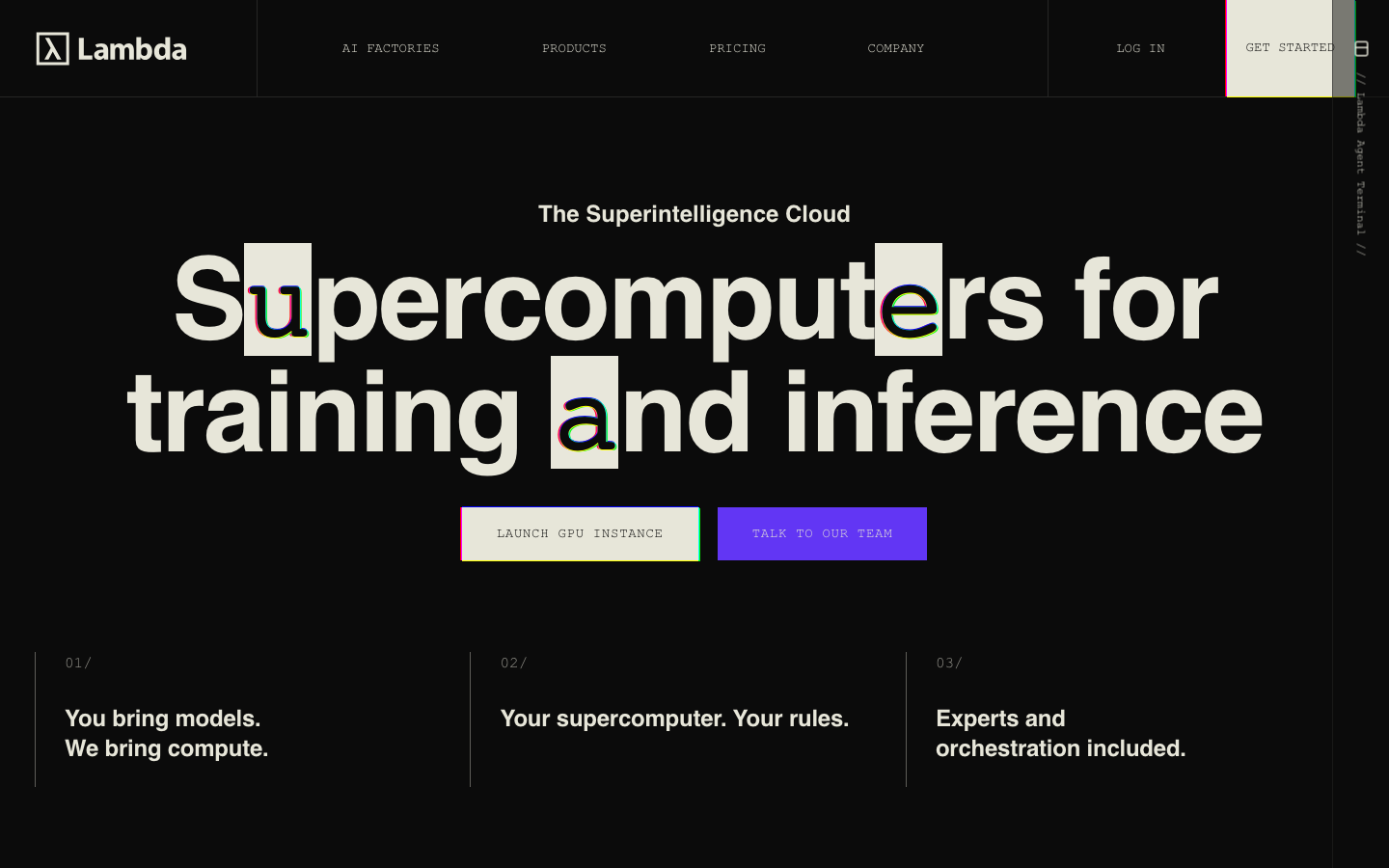
Lambda Labs provides NVIDIA GPU cloud rental and private-brand deep learning workstations, covering high-performance AI infrastructure from single-card training to H100 clusters.
LambdaLabs
Core parameters and statistics of Lambda Labs
Lambda Labs (the brand will be simplified to Lambda from 2025, and the domain name will be migrated to lambda.ai) is one of the few infrastructure providers that covers cloud GPU rental, self-branded AI workstations and ultra-large-scale AI factories. Its GPU cloud directly benchmarks AWS EC2 GPU instances and the Azure ND series, but is more thorough in the specialization of AI workloads - it does not do general computing and only serves AI training and inference.
| Projects | Public Information |
|---|---|
| Official Positioning | AI Infrastructure Provider (The Superintelligence Cloud) |
| Core Business | GPU Cloud Instance 1-Click Cluster, Super Cluster AI Factory, Deep Learning Workstation |
| GPU models (latest) | NVIDIA VR200 NVL72, GB300 NVL72, HGX B300, HGX B200, H100 SXM, A100 SXM |
| GPU models (previous generation) | NVIDIA A100 SXM (80GB/40GB), Tesla V100 |
| Deployment form | Cloud (self-service + hosting) + local hardware |
| Core Product Line | GPU Instances, 1-Click Clusters™, Superclusters, AI Factories, Lambda Stack |
| Target customer groups | Cutting-edge AI laboratories, hyperscalers, enterprises, governments, research institutions, start-up teams |
| Partners | NVIDIA (Exemplar Cloud + 7x Partner of the Year), Supermicro, Dell |
| Security Certification | SOC 2 Type II |
| Financing scale | Cumulative equity financing exceeds $1.5B (TWG Global, USIT, etc.) |
| Key customer cases | Microsoft (billion-dollar multi-year contracts), Kodiak Robotics (autonomous driving), Hudson River Trading (quantitative trading) |
Architecture positioning: Lambda does not build a SaaS platform layer, but directly provides bare metal-level GPU computing power, connected to ML frameworks such as PyTorch/TensorFlow, and connected to the self-developed Lambda Stack (pre-installed with underlying libraries such as CUDA, cuDNN, NCCL). This means that users get performance close to local hardware, but without the burden of data center operation and maintenance.
User and market recognition of Lambda Labs
Lambda’s market recognition is mainly reflected in three levels:
Customer lineup: The world's most cutting-edge AI organizations directly use Lambda infrastructure, including hyperscaler (Microsoft's multi-billion-dollar multi-year contract), cutting-edge AI laboratories (hundred-billion parameter-level basic model training), regulated industry enterprises (finance, autonomous driving, etc.) and government agencies. Kodiak Robotics uses Lambda to train its self-driving system "Kodiak Driver", and 28 unmanned trucks are already running commercial freight on public roads; Hudson River Trading turned to Lambda after its own data center computing power peaked. These cases verify Lambda’s competitiveness in terms of computing power flexibility and reliability.
Industry Evaluation: Lambda submitted Llama 3.1 8B training results based on NVIDIA GB300 NVL72 in MLPerf Training v6.0 (June 2026). The performance improved by 18.7% compared to its previous round, and it also achieved the fastest MoE training results on HGX B200. Lambda is also the first cloud service provider to release STAC-AI™ LANG6 audit results on NVIDIA HGX B200, specifically providing third-party verifiable data on AI inference performance in financial services scenarios.
NVIDIA Niche: Lambda is an NVIDIA Exemplar Cloud Partner (certified October 2025) and has received the NVIDIA Partner of the Year award for seven consecutive years. This certification means Lambda has an advantage not available to other small GPU cloud vendors in terms of shipping priority, engineering support and early access to NVIDIA’s latest GPUs.
Analyst and media recognition: Lambda has raised more than $1.5B in cumulative financing from investors, including TWG Global and USIT, reflecting institutional capital’s recognition of its technical route and business model. The multi-billion-dollar, multi-year contract reached with Microsoft in November 2025 is one of the most iconic commercial collaborations in the GPU cloud industry.
Lambda Labs’ Cost Advantage
Lambda's cost structure advantage comes from three layers: hardware supply chain, architecture specialization, and zero hidden fee strategy.
GPU cloud instance price comparison by hour
| GPU model | Video memory | vCPU | Memory | SSD | Lambda price ($/GPU·h) |
|---|---|---|---|---|---|
| NVIDIA B200 SXM6 | 180 GB | 208 | 2900 GiB | 22 TiB | $6.69 |
| NVIDIA H100 SXM | 80 GB | 208 | 1800 GiB | 22 TiB | $3.99 |
| NVIDIA A100 SXM (80GB) | 80 GB | 240 | 1800 GiB | 19.5 TiB | $2.79 |
| NVIDIA A100 SXM (40GB) | 40 GB | 124 | 1800 GiB | 5.8 TiB | $1.99 |
| NVIDIA Tesla V100 | 16 GB | 88 | 448 GiB | 5.8 TiB | $0.79 |
1-Click cluster price comparison
| Configuration | Lease | Number of GPUs | Price ($/GPU·h) |
|---|---|---|---|
| NVIDIA HGX B200 | 2 weeks – 1 year | 16 | $9.86 |
| NVIDIA HGX B200 | 2 weeks – 1 year | 64 | $9.36 |
| NVIDIA HGX B200 | 2 weeks – 1 year | 256+ | $8.87 |
| NVIDIA HGX B200 | 1 year+ | 16+ | Business Confirmation |
Cost Structure Breakdown:
- No egress fees: Lambda explicitly states that there are no egress fees, which is rare in GPU clouds. GPU instances of AWS, Azure, and GCP usually charge $0.05-$0.12/GB for outbound traffic. For training scenarios that require frequent export of checkpoints (often hundreds of GB), this is a considerable hidden cost.
- Billing by Minute: Instances are billed by the minute, with no minimum consumption, suitable for experimental training and short-cycle inference loads.
- Reservation and Volume Discount: The unit price of 1-Click cluster decreases by about 5-10% when the number of GPUs increases (16→64→256+), and lower prices are available for long-term leases (1 year+), but business confirmation is required.
- Comparison with AWS: The on-demand price of AWS p5.48xlarge (8× H100) is about $24.96/GPU·h (need to be converted into the total instance price/8). Lambda's H100 single card is $3.99/GPU·h, which has obvious price advantages in on-demand scenarios. However, it should be noted that Lambda does not include the managed databases, load balancing, and object storage buckets of standard cloud vendors. It is only pure computing power.
Three-tier cost analysis:
- C client/individual researcher: Rent a single card instance by the hour, with a minimum of $0.79/h (V100) to start experiments, no prepayment. For individuals trying small-scale fine-tuning or inference verification, the cost of entry is significantly less than purchasing hardware.
- Developer/Team: On-demand instances are suitable for elastic expansion; 1-Click clusters are suitable for project teams with clear training cycles. The 16-card B200 cluster is about $9.86/GPU·h, which is about 47% higher than the on-demand instances, but what you get is a dedicated cluster connected by InfiniBand.
- Enterprise/Large Scale Training: Superclusters require business confirmation pricing, ranging from 4,000 to 165,000+ GPUs, including managed operation and maintenance services (Kubernetes/Slurm). Enterprise long-term contracts can get significantly lower prices than on-demand, but there are no public bids. Microsoft's multi-billion-dollar contract is the lower limit for reference - based on this magnitude, the unit price should be in the range of $2-3/GPU·h or even lower.
Key features of Lambda Labs
Lambda's product line is built around four levels of GPU computing power consumption, from a single card to a cluster of 100,000 cards, covering the full life cycle of AI workloads.
1. GPU cloud instances (Instances)
Self-service, first-come, first-served, on-demand GPU instances in single to 8-card configurations. Core experience points:
- Out-of-the-box: Lambda Stack (PyTorch, TensorFlow, CUDA, cuDNN, NCCL) is pre-installed. Users do not need to manually install drivers and ML frameworks. Training can start as soon as the instance is started.
- Real-time Observability: Built-in Dashboard and API to monitor GPU utilization, memory, network performance, and supports Prometheus/Grafana integration.
- Persistent Storage: Data set checkpoints and outputs remain mounted between sessions. Up and down expansion does not require re-uploading data, and no outbound traffic charges are incurred.
- Multi-entry management: Supports three methods of creating/stopping/restarting instances via UI, Cloud API, and CLI, making it easy to integrate into CI/CD or orchestration scripts.
Typical workflow: The researcher uploads the data set → selects the H100 instance → enters training within 5 minutes → uses the API to monitor the loss curve → saves the checkpoint after completion → destroys the instance. The entire process requires no manual intervention in operation and maintenance.
2. 1-Click Clusters™
For teams that have gone beyond single-machine training and require distributed training. Self-service booking, InfiniBand interconnected clusters of 16-2,000+ GPUs:
- Network interconnection: Quantum-2 InfiniBand network + SHARP acceleration, reducing communication bottlenecks in distributed training.
- Managed Orchestration: Optional managed Kubernetes or Slurm orchestration with support for S3-compatible object storage.
- Flexible lease period: starting from 2 weeks, up to 1 year; supports POC border quick verification.
- Price Transparency: B200 cluster $8.87-$9.86 per GPU hour, inversely related to GPU count and lease term.
3. Superclusters
Dedicated single-tenant clusters for cutting-edge model training, ranging from 4,000-165,000+ GPUs, are Lambda’s most high-end product lines:
- Shared No Architecture: Single tenant, physical isolation, hardware-level security.
- Liquid cooling high density: Integrated liquid cooling and high-density power supply to increase the density of computing power per watt.
- Expert Collaborative Engineering: Lambda team participates in cluster design and workload tuning.
- Complete Observability: Prometheus + OpenTelemetry + Grafana, or connect to the customer's own monitoring system.
- 24/7 Support: Dedicated team of experts respond 24/7.
4. AI Factories (AI Factory)
Modular AI data center for gigawatt-level computing power needs:
- Modular expansion: 5-75MW distributed sites to 75MW+ campus, supporting modular power supply and liquid cooling hot-swap upgrades.
- NVIDIA Deep Integration: One of the first deployment platforms for the latest GPU architectures (VR200 NVL72, GB300 NVL72, HGX B300).
- Network architecture: NVLink domain (in-node GPU direct connection) + lossless InfiniBand + RoCE (Converged Ethernet RDMA), supporting hybrid cloud expansion.
5. Auxiliary products and tools
- Lambda Stack: Deep learning software stack, pre-installed with PyTorch, TensorFlow, CUDA, cuDNN, NCCL and the latest NVIDIA driver, supporting Ubuntu 22.04/24.04. Not only is it pre-installed in the cloud, it can also be installed manually on a local workstation.
- Managed Kubernetes/Slurm: Lambda is responsible for control plane operation and maintenance, automatic node recovery and monitoring. Users only need to submit containerized workloads or Slurm jobs.
- Workspaces (newly released in June 2026): Helps teams organize cloud resources, control access permissions, and isolate development/staging/production environments in shared GPU environments.
- Bare Metal Instances (newly released in May 2026): Provides complete hardware control (BIOS, kernel parameters) while maintaining API-driven automation capabilities.
- GPU Benchmarks and LLM Index: Public GPU performance benchmark data and LLM inference performance index to assist selection decisions.
[Functional Synergies]: Lambda’s product line is more than just GPU rentals of varying sizes. The real synergy is that the same Lambda Stack software stack runs through the cloud instance 1-Click cluster and local workstation, which means that the code debugged by users on a single card can be migrated to large-scale cluster operation without adaptation. Workspaces and Cloud API further open up the resource management link from personal experimentation to team collaboration to production deployment.
Lambda Labs model and version evolution
As an infrastructure service provider, Lambda's "version evolution" is reflected in hardware generation updates, product line expansion and service milestones.
| Time | Milestone | Description |
|---|---|---|
| 2012 | Company Founded | Founded in San Francisco by ML engineers Stephen Balaban and Michael Balaban |
| ~2022 | GPU Cloud goes online | Starts providing cloud GPU instance rental services |
| ~2024-06 | Hyperplane cluster released | High-bandwidth InfiniBand cluster for large model training |
| 2025-08 | $1B Senior Secured Credit Facility | Expanding AI Factory Infrastructure Capabilities |
| 2025-10 | NVIDIA Exemplar Cloud Certification | One of the first cloud service providers to obtain this certification |
| 2025-10 | Appointment of Stacey Finerman as VP of Investor Relations | Strengthening capital operation capabilities |
| 2025-11 | Microsoft’s multi-billion dollar contract | Deploying tens of thousands of NVIDIA GPUs for Microsoft’s AI infrastructure |
| 2025-11 | Completed $1.5B+ equity financing | Investors are TWG Global, USIT |
| 2026-05 | Bare Metal instance released | Cloud instance providing complete hardware control |
| 2026-05 | HGX B200 STAC-AI LANG6 Audit | The first cloud provider to release auditable performance data in financial AI scenarios |
| 2026-06 | Workspaces feature release | Multi-boundary resource isolation and access control |
| 2026-06 | MLPerf Training v6.0 best results | GB300 NVL72 training results leading |
| 2026-06 | Domain name migrated to lambda.ai | Brand simplified from Lambda Labs to Lambda |
| 2026-07 | VR200 NVL72 deployment | Rack-scale systems with Rubin GPU launched |
Evolutionary logic: Lambda’s version history reflects the hardware driver characteristics of the GPU cloud industry—each major version jump corresponds to the iteration of the NVIDIA GPU architecture (H100 → B200 → GB300 → VR200). At the same time, Lambda has evolved from pure IaaS to managed PaaS (Kubernetes/Slurm managed Workspaces, Bare Metal) at the software layer, indicating that it is transforming from simple computing power leasing to an "AI infrastructure as a service" platform.
Lambda Labs’ technical advantages
1. Specialized architecture
Lambda is a pure AI cloud and does not do general computing business. This means that its data center design is completely optimized around AI workloads - everything from power density to liquid cooling to network topology does not need to be compatible with traditional enterprise IT needs. The direct advantages this brings are higher computing power density per watt and more stable GPU utilization.
Mechanism: AI dedicated data centers can omit the redundant UPS ratio and low-density power supply design of traditional computer rooms, and allocate more power budget to GPU computing nodes. Lambda's AI Factories adopt a modular 5-75MW design and support liquid cooling and hot-swapping to reduce heat dissipation losses.
Effect: At the same GPU scale, Lambda's PUE (energy usage efficiency) is better than that of general-purpose cloud GPU instances transformed from traditional data centers. Although the actual measured data has not been made public, the theoretical efficiency gain of the dedicated architecture is in the 15-25% range.
2. NVIDIA gives priority to supply and engineering cooperation
Lambda is an NVIDIA Exemplar Cloud partner and has been awarded NVIDIA Partner of the Year for seven consecutive years. This means that Lambda has higher priority and larger volume discounts than small and medium-sized GPU cloud vendors in the supply allocation of the latest GPUs (B200, GB300, VR200).
Effect: Lambda is able to provision cloud instances within weeks of new GPUs being released, whereas smaller vendors may have to wait months. This is a significant time advantage for teams that need to use the latest architecture for benchmarking or model adaptation as soon as possible.
3. Deep optimization of network architecture
Lambda deploys three network solutions simultaneously in the supercluster:
- NVLink domain: direct GPU connection within node/cabinet, used for model parallel training and communication-intensive collectives, eliminating PCIe bottlenecks.
- InfiniBand with SHARP: Lossless and low-latency network between cabinets, supporting RDMA and adaptive routing. SHARP aggregates reduction operations at the network level to reduce node CPU load.
- RoCE v2: RDMA integrated with Ethernet, supporting hybrid cloud and multi-cloud expansion scenarios.
Applicable scenarios: NVLink domain is essential for single-machine multi-card training (such as tensor parallelism); InfiniBand is essential for cross-node data parallelism and pipeline parallelism; RoCE provides a low-cost option for elastic hybrid cloud scenarios.
4. Lambda Stack consistency
Lambda Stack is the "software glue" that connects all products - cloud instances are pre-installed, local workstations can be installed manually, and clusters are managed in a unified manner. This means that "configuration drift" between the development context and the production context is minimized.
Hidden cost reduction: Consistency reduces the debugging time of "local run-through and cloud error reporting". For training projects that rely on a large number of underlying libraries (such as specific versions of CUDA, Transformer Engine), this can save days to weeks of context adaptation work.
Lambda Labs usage entrance
Lambda provides multi-layer usage entrances, covering C-side to enterprise-level requirements:
| Entrance | Applicable objects | Typical operation paths |
|---|---|---|
| Web Dashboard (lambda.ai) | All users | Register account → Select instance/cluster → Start with one click → Connect via browser SSH |
| Cloud API (docs.lambda.ai) | Developer/DevOps | API Key acquisition → Script automation to create/stop/restart instances → Integrated CI/CD |
| CLI Tools | Developers | Install Lambda CLI → lambda instance launch --type h100 --count 4 and other commands |
| Managed Kubernetes | Platform Team | Submit K8s resource definition → Lambda manages control plane and hardware → User operations via kubectl |
| Hosted Slurm | HPC team | sbatch job submission → Lambda management scheduler and nodes → User-insensitive hardware operation and maintenance |
| Business docking | Enterprise/Government | Contact sales team → POC context verification → Long-term contract signing → Dedicated cluster deployment |
Typical usage steps (on-demand instance):
- Visit lambda.ai, register an account and complete payment method settings.
- Select the GPU model (such as H100 SXM), configuration (1×/2×/4×/8×), and storage capacity in the Dashboard.
- After the instance is created, obtain the SSH connection information; Lambda Stack is pre-installed, directly use
nvidia-smito confirm the GPU status. - Upload the data set and start the training script. Monitor GPU utilization, memory, and network in real time through Dashboard or API.
- After the training is completed, download the checkpoint and destroy the instance to stop billing. Persistent storage retains data, and the same volume can be mounted to the next instance.
Typical scenarios for API automation:
# Lambda Cloud API - Create instance (Python example, need to replace API Key)
import requests

API_KEY = "<YOUR_API_KEY>"
HEADERS = {"Authorization": f"Bearer {API_KEY}", "Content-Type": "application/json"}

# Start 2× H100 instances
payload = {
    "region": "us-east-1",
    "instance_type": "gpu_h100_80gb_2x",
    "name": "training-run-1",
    "ssh_key_names": ["my-key"]
}
resp = requests.post("https://api.lambda.ai/v1/instances", headers=HEADERS, json=payload)
print(resp.json())
Lambda Labs Product Pricing
Lambda's pricing system can be divided into three tiers based on product lines:
On-demand instances (self-service)
Billed by hour by GPU model, billed by minute, no minimum consumption, no outbound traffic charges:
| GPU model | Current price ($/GPU·h) |
|---|---|
| NVIDIA B200 SXM6 (180GB) | $6.69 |
| NVIDIA H100 SXM (80GB) | $3.99 |
| NVIDIA A100 SXM (80GB) | $2.79 |
| NVIDIA A100 SXM (40GB) | $1.99 |
| NVIDIA Tesla V100 (16GB) | $0.79 |
1-Click Cluster (semi-managed)
Dedicated clusters with InfiniBand interconnect, price is inversely related to GPU count and lease term:
| GPU model | GPU quantity | Lease period | Price ($/GPU·h) |
|---|---|---|---|
| HGX B200 | 16 | 2 weeks – 1 year | $9.86 |
| HGX B200 | 64 | 2 weeks – 1 year | $9.36 |
| HGX B200 | 256+ | 2 weeks–1 year | $8.87 |
| HGX B200 | 16+ | 1 year+ | Business Confirmation |
Superclusters and AI Factories (Enterprise)
There is no public price, please contact the commercial team. Pricing elements include:
- Number of GPUs (4,000-165,000+)
- Lease period (months to years)
- Managed service scope (whether Kubernetes/Slurm operation and maintenance is included)
- Network and storage architecture complexity
C-side/individual researchers: The V100 instance has an extremely low entry cost of $0.79/h and can be used for prototype verification and small-scale fine-tuning. Note that V100 does not support FP8/BF16. For modern model training, it is not cost-effective. It is recommended to use at least A100.
Team/Developer: On-demand H100 instance $3.99/GPU·h suitable for flexible experiments; 16-card B200 1-Click cluster $9.86/GPU·h suitable for team projects with clear cycles.
Enterprise level: Large-scale training requires commercial contracts. Taking Microsoft's multi-billion-dollar contract as the reference lower limit, it is speculated that the unit price of large-scale long-term contracts is far lower than the public price. It is recommended to pay attention to the terms in the contract regarding GPU model upgrades, maintenance window SLA compensation, and expiration renewal pricing protection.
Application scenarios of Lambda Labs
Full process training of large language model
From single-node SFT/RLHF fine-tuning (using 1-8× H100 instances) to multi-node pre-training (using 256+ GPU 1-Click clusters or Superclusters), Lambda's InfiniBand interconnect and Lambda Stack consistent context eliminate the need for code to adapt across contexts.
Engineering considerations: Selecting 8× H100 instances for single-node training can meet most fine-tuning needs (Llama 3 70B full-parameter fine-tuning requires approximately 8× H100 and 80GB of video memory). Pre-training a 100B+ parameter model requires Superclusters-level 1,000+ GPU clusters. Lambda's performance on MLPerf shows that its network topology has good support for both model parallelism and data parallelism.
Elastic inference deployment
Compared with H100, B200 instances have a claimed performance improvement of 15× in inference scenarios (thanks to larger video memory and FP4 support), and are suitable for inference services with high throughput and low latency requirements. Lambda instances are billed by the minute and can be quickly expanded during traffic peaks and reduced during troughs. Together with the Cloud API, automatic elastic scaling can be achieved.
Autonomous driving model training
The case of Kodiak Robotics demonstrates the application of Lambda in end-to-end autonomous driving model training: it needs to continuously process massive amounts of road mining data, run large-scale reinforcement learning simulations, and replay verification after each model update. Lambda supports the entire process on a single-tenant cluster, and data security is guaranteed through SOC 2 and physical isolation.
Financial AI reasoning and backtesting
Hudson River Trading selects Lambda to scale its quantitative R&D infrastructure, and STAC-AI LANG6 audit results provide a comparable benchmark of NLP inference performance for financial scenarios. The key value of Lambda in the financial industry is that - single-tenant physical isolation meets compliance requirements, while managed Kubernetes reduces IT operation and maintenance burdens.
Academic Research and Teaching
University laboratories can use the V100 instance at $0.79/h for teaching experiments, and the A100 instance at $2.79/h to run master's/doctoral level training projects. Lambda does not require long-term contracts, is billed by the hour, and is suitable for scientific research procurement processes based on project and budget approval systems.
Lambda Labs Applicable Groups
- Researcher at the Frontier AI Lab: 1,000+ GPU clusters are needed to train basic models, and there is a strong need for InfiniBand interconnection and managed operation and maintenance. Lambda’s Superclusters provide physically isolated dedicated environments to avoid competing with other teams for computing power.
- Technical Director of an AI Startup Company: Before purchasing GPU hardware, use on-demand instances to verify the product direction and training process, and then commit to large-scale training budget after confirming convergence. 1-Click clusters offer better unit pricing than on-demand for mid-scale training.
- Enterprise AI Platform Team: Responsible for internal model training and inference infrastructure construction. Lambda's managed Kubernetes/Slurm reduces platform teams' investment in hardware operations, while SOC 2 certification reduces compliance audit costs.
- University professors and graduate students: have limited budget but need A100/H100 level computing power to publish top conference papers. Lambda's hourly billing model allows flexible control of expenditures during the project cycle, and V100 instances are used as entry options to significantly reduce trial and error costs.
- Quantitative funds and financial technology companies: have strict requirements for single-tenant isolation, compliance audits, and low-latency networks. Lambda’s STAC-AI audit and physical isolation architecture is more suitable for financial scenarios than general-purpose clouds.
Not suitable for crowds and scenes:
- Enterprises that need "Family Bucket" cloud services: Lambda only provides GPU computing power and does not provide standard cloud services such as object storage (needs to be connected to S3 separately), managed database CDN, DNS, etc. Teams that need a complete cloud ecosystem should choose AWS/Azure/GCP.
- Budget-conscious individual enthusiasts: The $0.79/h V100 is still more expensive than purchasing a second-hand RTX 3090 yourself, and the V100 lacks BF16/FP8 support. If you're just trying out a small Stable Diffusion inference or Keras introductory tutorial, Colab Free Edition or JarvisLabs are more economical options.
- Non-NVIDIA ecosystem users: Lambda is entirely based on NVIDIA GPUs and does not support AMD ROCm or Intel oneAPI. If the workflow relies on AMD GPU, a detour is required.
Summary and Outlook of Lambda Labs
Lambda's positioning in the GPU cloud market can be summarized as: not a general cloud, only AI computing power. This focus enables it to form differentiated competitiveness in NVIDIA's deep AI workload optimization and contextual consistency in the supply chain, but it also clearly lags behind AWS/Azure/GCP in terms of service breadth.
Current Limitations and Uncertainties:
- Data centers are concentrated in North America, Asia-Pacific and Europe, with insufficient coverage, and there are regional blind spots for scenarios that require low-latency global inference deployment.
- The market competition in the GPU cloud continues to intensify. Competing products such as CoreWeave, RunPod, and Vast.ai have their own price elasticity strategies. Lambda’s B200 $6.69/GPU·h is not the absolute lowest.
- As a privately held company, Lambda does not disclose detailed financial data, customer retention rates, or actual utilization of its hyperscale clusters. Investors are required to conduct business due diligence.
- The domain name has been moved to lambda.ai, but the original lambdalabs.com still retains the jump. Search and bookmarks need to be updated simultaneously.
Procurement/Adoption Risk Assessment:
- Pilot path: It is recommended to start with an on-demand H100 instance, using $3.99/GPU·h to verify the training process and network performance, and confirm whether the InfiniBand performance of the cluster meets expectations. The test period is recommended to be 2-4 weeks, focusing on the difference between the actual training throughput (tokens/sec) and the theoretical peak.
- Extended Conditions: Evaluate the need to switch to 1-Click Clusters or Reserved Instances when monthly spend on On-Demand Instances exceeds $10,000-20,000. 1-Click clusters at $8.87-$9.86/GPU·h, while more expensive than on-demand at $3.99, include dedicated InfiniBand networking and managed orchestration, potentially lower overall TCO for multi-node training.
- Enterprise verification items before signing: ① GPU model upgrade terms - whether the next generation GPU (such as Rubin) can be smoothly migrated when it is launched during the contract period; ② Maintenance window and SLA compensation standard; ③ Data evacuate plan - complete and safe migration of data from the single-tenant cluster after the contract is terminated; ④ Cross-validation of the actual throughput and cost per token of Lambda and CoreWeave on the same training tasks.
Related tools:  Hugging Face, replicate
Version Info
- Lambda GPU Cloud updates :Continuously iterative cloud service with no fixed version number.
- Lambda Hyperplane cluster release :There is no official precise date yet.
User Reviews