 LangDB
Free
LangDB
Free
LangDB is the AI Gateway for AI agents and LLM application teams, providing OpenAI-Compatible API, unified access to 250+ models, real-time tracing, cost control guardrails, SSO/SAML and enterprise private deployment options.
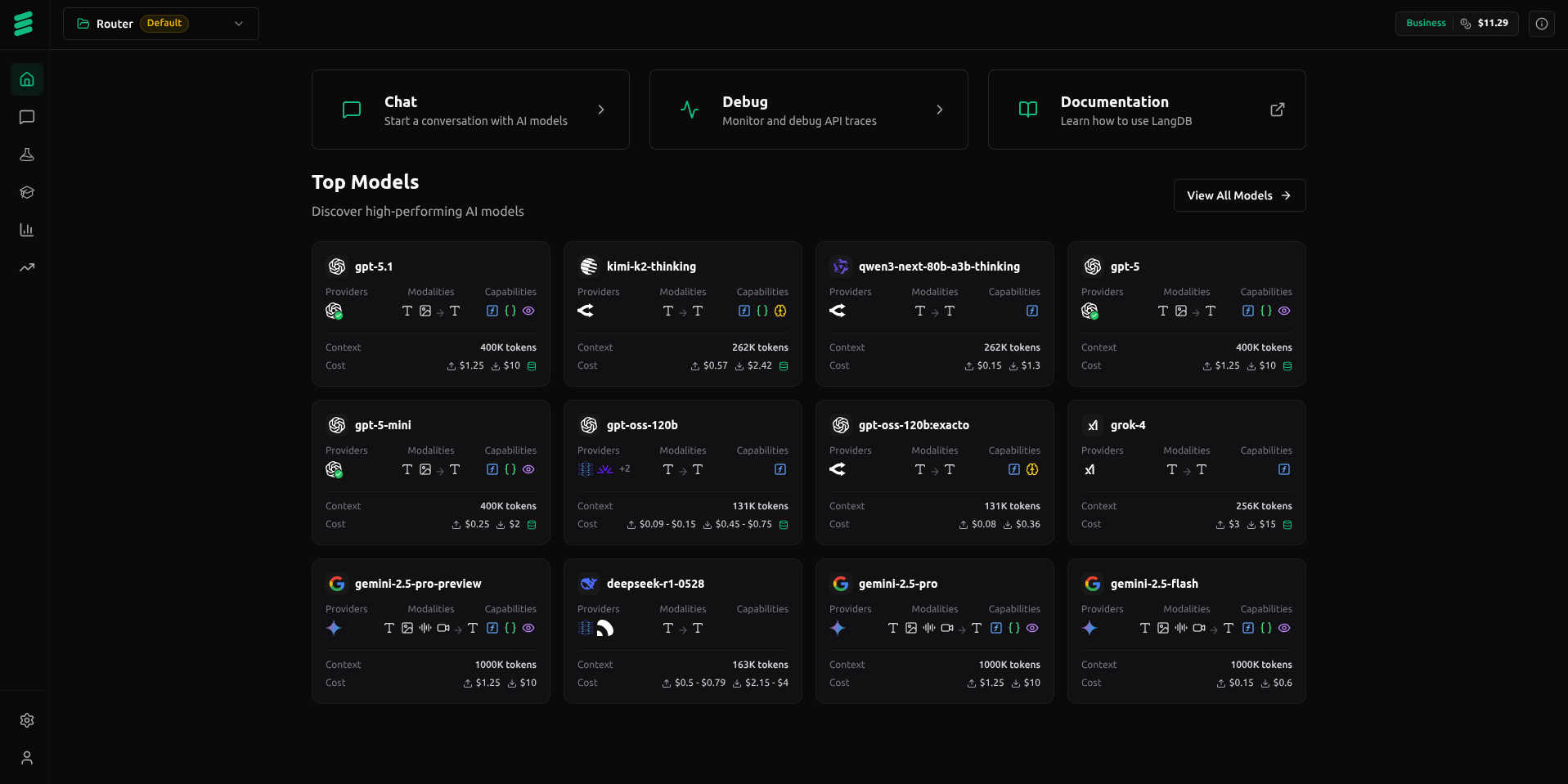
LangDB - In-depth tool analysis
Core parameters and statistics
| Parameters | Current public information |
|---|---|
| Product positioning | Enterprise-level AI Gateway and AI Agent observable platform |
| Core entrance | Web console OpenAI-Compatible API, https://api.langdb.ai in document examples |
| Key Capabilities | Unified access to 250+ LLM models, real-time tracing/debugging, LLM analytics, cost control guardrails, SSO/SAML, private deployment |
| Technical roadmap | The official website clearly emphasizes that AI Gateway is fully built in Rust, oriented towards performance and large-scale governance |
| Integration method | OpenAI SDK base_url replaces Project ID header, LangChain, Google ADK, OpenAI and other frameworks for observable access |
| Open source form | The official website shows that the observability stack has been open sourced as vLLora; the official open code organization provides AI Gateway, samples, Python SDK and other projects |
| Company public information | LinkedIn company page shows headquarters Singapore, company size 11-50 people, establishment date 2022 |
| Capital endorsement | Official website About and homepage display Sequoia Capital, Gradient Ventures, January Capital |
Positioning judgment: LangDB is more suitable to be classified as ai-agents rather than ai-model-training. It does not use training basic models or fine-tuning platforms as the main entrance, but provides gateways, observations, governance and cost control for Agents, LLM applications and multi-model call chains. For users of this project, it solves the problem of "how to route, track, debug, control and manage multiple models and Agent workflows after they are online."
Boundary Note: LangDB can connect and manage multi-model traffic, but it is not equivalent to model vendors, nor does it replace the business-side Agent orchestration framework. If the team only needs a single chatbot or a simple call to a model API, the governance value of LangDB will be lower than its access and operation and maintenance costs.
User and market recognition
Enterprise-level signal: The official website positions the product title as "The Fastest Enterprise AI Gateway", and the price page divides the packages into four levels: Free, Professional, Business, and Enterprise, and provides SSO/SAML, private Slack channels, white glove onboarding, Private VPC deployment, Enterprise Support, and Uptime SLA in the Business and Enterprise profiles, indicating that its target customers are not just individual developers, but cover growing teams and large enterprises.
Ecological Approval: The official public code organization shows that LangDB AI Gateway provides a unified LLM interface in the OpenAI API format, and emphasizes that it can be integrated with frameworks such as LangChain, Vercel AI SDK, and CrewAI. The AI SDK community provider page also describes LangDB as a high-performance enterprise AI gateway that supports access to multiple LLMs, tracing, cost optimization and dynamic routing with a few changes.
Company Credibility: The LinkedIn company page shows that LangDB is headquartered in Singapore, the industry is Technology, Information and Internet, and the scale is 11-50 people; the investors displayed on the official website include Sequoia Capital, Gradient Ventures and January Capital. This information cannot directly prove the maturity of the product, but it can show that LangDB is not an anonymous tool station, but an enterprise-level product endorsed by a public company identity and capital.
Cost advantage
| Tier | Public price and quota | Cost meaning |
|---|---|---|
| C-side/individual | Free: $0/month, 1 Project, 2k logs/month, 7-day data retention, tracing/debugging, Google Workspace | Suitable for verifying access methods, observation links and model routing, not suitable for long-term storage of large-scale traces |
| Developer/API | Professional: $49/month, annual payment -20%, 2 Projects, 20k logs/month, BYO LLM keys, project level cost control, basic guardrails, 30-day data retention, 10 Virtual Models, CSV export | Extend cost control and log retention to individual developers or small teams, the key value is "bring your own model key + project level cost control" |
| Enterprise/privatization | Business: $199/month, annual payment -20%, 200k logs/month, SSO/SAML, dynamic cost control, 90-day retention; Enterprise: Custom, Private VPC deployment, Private ClickHouse cloud, OpenTelemetry Endpoint, Unlimited retention | Enterprise profile extends the cost from a single model call to identity, auditing, data retention, private network and SLA, the actual contract is subject to the official real-time page |
Cost structure: LangDB’s explicit costs come from platform packages and model credits; implicit costs come from accessing the SDK, configuring provider keys, establishing projects and guardrail, and integrating tracing data into the team’s existing monitoring process. Its cost advantage is not in "replacing all model bills", but in unifying different models, projects, teams and traces into one governance plane, reducing management losses caused by multi-vendor bills and decentralized debugging links.
Applicable prerequisites: When the team has switched models between multiple providers, needs to track the Agent call chain, or wants to set budget and routing strategies for the project, LangDB's Professional/Business file can more easily reflect the value. If you only make low-frequency prototype calls, the Free file is sufficient for verification, and the paid file has limited benefits.
Main functions
- Unified model access: The official website shows that LangDB can access and manage 250+ LLM models. Through a unified API, the team can manage the requests, costs and performance of different providers under the same entrance.
- Agent tracing and debugging: The product page emphasizes real-time monitoring, tracing, analysis and optimization, which can be used to observe multi-step calls, abnormal nodes and delay sources in the Agent workflow.
- LLM analytics: The Advanced LLM Analytics module on the official website is used to view LLM performance, usage and effectiveness. It is suitable for switching model selection from intuition to observable data on latency, cost and quality.
- Cost and Budget Control: The price page displays that Professional provides Project level Cost Control, and Business provides Dynamic Cost Control, which is suitable for configuring budgets and alarms by project workspace or team.
- Guardrails & Governance: Professional includes Basic Guardrails, Business extends to LLM + Partner Guardrails, and Enterprise also offers enterprise support and private deployment options suitable for adding security and compliance perimeters to sensitive scenarios.
- Enterprise Identity and Data Retention: Business offers Role based access, SSO + SAML and 90-day data retention, while Enterprise offers Private VPC, Private ClickHouse cloud, Unlimited data retention and OpenTelemetry Endpoint for organizations that require auditing and integration with their own monitoring.
Acceptance focus: Function acceptance should not just focus on "whether the model can be adjusted." It should also verify whether the trace covers key Agent steps, whether the project-level budget can limit abnormal calls, whether the model routing retains interpretable records, and whether the log retention period meets the team's audit requirements.
Model and version evolution
| Node | Public form | Major changes |
|---|---|---|
| open-source-ai-gateway | The open source Enterprise AI Gateway presented by the official open code organization | Built in Rust, providing OpenAI API format unified interface routing, load balancing, failover, analytics, cost tracking and self-hosted options |
| vllora-open-source-observability | The open source observability stack displayed on the official website homepage | Opens tracing, analysis, and optimization capabilities into a locally runable observation stack for frameworks such as LangChain, Google ADK, and OpenAI |
| managed-ai-gateway-2026-q2 | The hosting platform shown on the official website and price page | Formed Free/Professional/Business/Enterprise package, covering 250+ models, logs quota, retention, guardrails, SSO/SAML, Private VPC and OpenTelemetry Endpoint |
Version context: The evolution of LangDB is not a traditional desktop software version upgrade, but an overlay of capabilities from open source AI Gateway, open source observability stack, to hosted enterprise platform. For procurement and implementation, the key is not to remember a certain version number, but to distinguish the extent to which "self-hosted gateway capabilities", "hosted console capabilities" and "enterprise governance capabilities" are covered.
Current Limitations: The official website does not disclose the complete changelog, precise release date and itemized launch time of all cloud functions. The version field in the document is therefore recorded as a public milestone, and the description "no official precise release date is available yet" is retained.
Technical advantages
Rust gateway mechanism: The official website emphasizes that LangDB is an AI gateway fully built in Rust. Mechanically, Rust is more suitable for building high-concurrency, low-overhead network services; in effect, it is easier to maintain stable delay and reliable forwarding when model requests pass through the unified gateway; applicable scenarios are enterprise multiple models calling Agent batch requests and production environments that require unified failover.
OpenAI-Compatible API: The documentation example uses OpenAI SDK and calls LangDB by replacing base_url with https://api.langdb.ai and adding x-project-id header. Mechanically, this reduces the migration cost from directly calling the model vendor to managing through the gateway; in effect, the team can access tracing, cost and routing capabilities without significantly changing the business code; the applicable scenario is the application of the existing OpenAI SDK call chain.
Unified observation and cost control: LangDB puts providers, models, projects, logs and costs into the same control plane. Mechanically, requests first enter the gateway and then to the model provider, and logs and cost data are collected at the gateway layer. In effect, teams can view consumption and delays by project. Applicable scenarios are when multiple teams share model quotas, need to troubleshoot abnormal Agent calls, or prevent overspending on a single project.
How to use
Entry path: For lightweight trial, just enter the Free plan from the official website; for developer access, you can use the OpenAI SDK according to the document examples, point the API base URL to LangDB, and pass in the LangDB token and Project ID; for enterprise access, you usually need to confirm the provider key, SSO/SAML, data retention, private deployment, and OpenTelemetry docking boundaries.
Typical steps: The first step is to create a project and configure the model provider or unified credits; the second step is to point the existing OpenAI SDK calls to the LangDB API; the third step is to view the Chat, Debug, Documentation and Top Models entrances on the console; the fourth step is to set up cost control guardrails and data retention by project; the fifth step is to connect the real Agent workflow to tracing and observe the delay, cost and error of each call node.
Implementation rhythm: In the pilot phase, it is recommended to select an existing Agent or RAG application first, and record the difference in delay and cost trace integrity between calling the provider directly and through LangDB; after passing the application, multi-model routing and budget control can be expanded to more projects.
Product Pricing
Package structure: The price page shows four levels: Free, Professional, Business, and Enterprise. Free is free and includes 250+ models, 1 Project, 2k logs/month and 7-day retention; Professional is $49/month, -20% annual payment, includes 2 Projects, 20k logs/month, BYO LLM keys, project level cost control and basic guardrails; Business is $199/month, -20% annual payment, includes Unlimited Projects, 200k logs/month, SSO/SAML, dynamic cost control, and 90-day retention; Enterprise is Custom, which includes Private VPC deployment, Private ClickHouse cloud, Unlimited retention, custom models and fine-tuning, OpenTelemetry Endpoint, Enterprise Support, and Uptime SLA.
Model credits: The pricing page also provides instructions for Unified Model Credits, which cover supported providers with a balance and track usage, cost, and latency at the team and project dimensions. The actual model call cost will be affected by the selected provider, model, input and output token, cache and routing strategy, and is ultimately subject to the official real-time page and account bill.
Procurement Boundary: Professional is more like a governance entrance for individual developers and small teams; Business begins to cover organizational identity, permissions, retention cycles and dynamic fee control; Enterprise's value is mainly in private networks, private ClickHouse, unlimited data retention SLA and enterprise support.
Application scenarios
- Multi-model gateway governance: When teams use OpenAI, Anthropic, Google, open source hosted models, or niche providers simultaneously, they can manage model selection, cost, latency, and provider keys through a unified LangDB portal.
- AI Agent debugging: When tool call failure, loop calls, or cost exceptions occur in a multi-step Agent workflow, LangDB's tracing/debugging can help locate which step, model, or provider is causing the problem.
- LLM Cost Control: Establish budgets, alarms and dynamic routing by project workspace or team, suitable for R&D teams to advance "model calling costs" from month-end bills to runtime management.
- Enterprise Observability Integration: Enterprise’s OpenTelemetry Endpoint, Private ClickHouse cloud, and Private VPC are suitable for integrating AI request logs into existing monitoring, auditing, and data platforms.
Unsuitable scenarios: Single-player low-frequency demos, completely offline model training, applications that only require a fixed model and have no tracking/cost control requirements do not necessarily need to introduce a gateway layer such as LangDB.
Applicable people
- AI application developer: Already have the OpenAI SDK call chain and hope to obtain the model routing trace and cost view with minor changes.
- Agent Platform Team: It is necessary to observe the multi-step Agent execution process under LangChain, Google ADK, OpenAI and other frameworks, and conduct a unified analysis of errors, delays and costs.
- Engineering Management and Platform Engineering Team: It is necessary to unify the management of AI use by different projects, teams and providers, and reduce operation and maintenance risks through SSO/SAML, RBAC, retention cycles and budget strategies.
- Enterprise Security & Compliance Team: Organizations focused on private deployments, data retention OpenTelemetry, auditing, and SLAs are better suited to evaluate Business or Enterprise profiles.
Prerequisites: The team must at least have a stable LLM application or Agent workflow, a manageable provider key, and the engineering conditions to be willing to call the model to the unified access gateway. If the current application is still in the prompt draft stage, it will be easier to complete the prototype with a Free file or direct provider call.
Summary and Outlook
Core Value: The advantage of LangDB is to upgrade LLM calls from "dispersed API requests" to "observable, controllable, and manageable AI traffic layer." 250+ models have unified access to Rust gateway OpenAI-Compatible API, Agent tracing, guardrails and enterprise private deployment options, which constitute its main competitiveness for production-level AI applications.
Current limitations and uncertainties: The official website does not disclose the complete company registration entity, founder, precise release date of all product nodes, itemized prices of credits for each model, and details of Enterprise contract terms; some functions such as custom models and fine-tuning, Private VPC, and OpenTelemetry Endpoint need to confirm the available scope with business or enterprise support. The number of models in the public information also has different page calibers such as 250+, 150+, 350+, etc. This article mainly focuses on the 250+ currently displayed on the official website homepage and documents.
Implementation Suggestions: During the pilot, it is advisable to select an Agent or multi-model application with real traffic, and compare the trace integrity rate, average delay, failure location time, project cost and budget alert effect between the direct connection provider and after connecting to LangDB on a 2-4 week cycle; before expanding to Business or Enterprise, SSO/SAML, data retention, private deployment OpenTelemetry, SLA and model credit billing terms should be verified.
Related tools:  CrewAI,
  LangChain
Comparison of competing products
| Comparison dimensions | The tool | Competitor A | Competitor B |
|---|---|---|---|
| Core Differences | — | — | — |
| Price | — | — | — |
| Target User | — | — | -- |
Version Info
- Managed AI Gateway and Agent Observability :The managed AI Gateway currently displayed on the LangDB official website and price page includes unified access to AI Agent tracing/debugging for 250+ models, project-level cost control guardrails, SSO/SAML, private VPC and OpenTelemetry Endpoint; there is no official precise release date yet.
- vLLora Open-source Observability Stack :The homepage of the official website shows that LangDB has open sourced the observability stack as vLLora, which is used to run tracing, analysis and optimization capabilities locally, and is oriented to LangChain, Google ADK, OpenAI and other frameworks; there is no official official release date yet.
- Open-source Enterprise AI Gateway :Official organization page introduction LangDB AI Gateway is an open source enterprise AI Gateway built in Rust. It provides a unified LLM interface analytics, cost tracking, rate limiting, routing, failover and self-hosted options in the OpenAI API format; there is no official precise release date yet.
User Reviews