 Langflow
Free
Langflow
Free
Langflow is an AI tool used to embed AI capabilities into actual business tasks and improve delivery efficiency.
langflow
Langflow’s core parameters and statistics
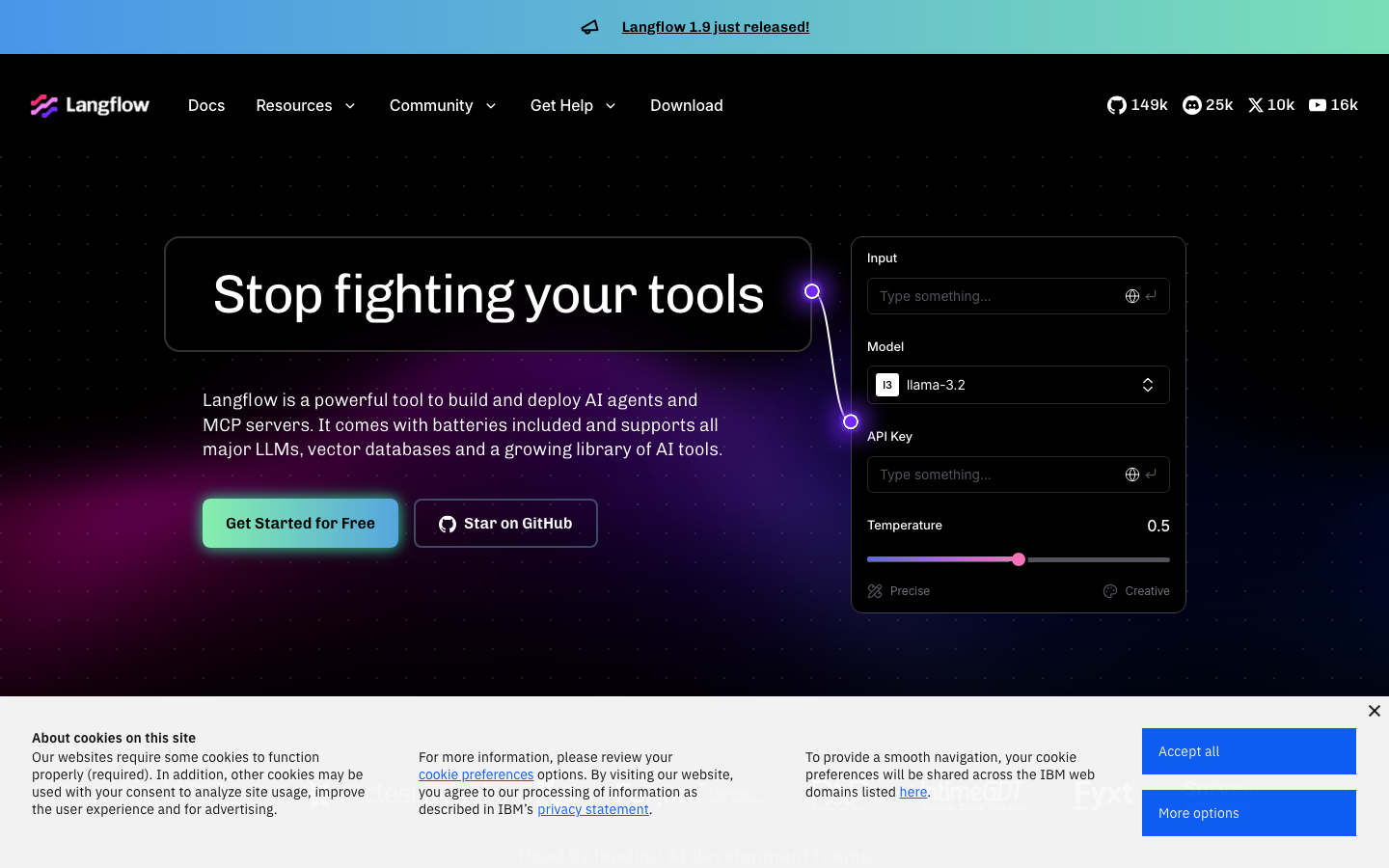
Langflow is an open source low-code AI workflow building platform, with its core positioning as Low-code AI builder for agentic and RAG applications. Compared with similar tools such as Flowise, Dify, n8n, etc., the most significant difference of Langflow is its first-class citizen support for MCP server deployment and multi-agent orchestration, as well as a fully visual drag-and-drop build experience.
| Projects | Public Information |
|---|---|
| Product Name | Langflow |
| Official entrance | https://www.langflow.org/ |
| GitHub repository | https://github.com/langflow-ai/langflow |
| GitHub Stars | 152k |
| GitHub Forks | 9.6k |
| Number of contributors | 382 |
| Open Source License | MIT |
| Technology stack | Python 64.7% + TypeScript 23.4% + JavaScript 11.3% |
| Python version requirements | 3.10–3.14 |
| Latest stable version | v1.10.2 (~2026-07-04) |
| Cumulative number of Releases | 300+ |
| Supported Platforms | Web, API, Desktop (Windows/macOS), Docker |
| Supported languages | en-US |
| Home | US |
| Community size | Discord 25k members / X 10k followers / YouTube 16k subscriptions |
Brief review in one sentence: Langflow is not another AI chat interface, but a visual orchestration platform that reduces the dimensionality of multi-agent workflows from "handwritten glue code" to "drag and drop connections". It is especially suitable for engineering teams that need to package RAG, Agent, and MCP services into API delivery.
Publicity Verification: The official claim is "Drag. Drop. Deploy." - Drag and drop build, one-click deployment as API or MCP server, this promise is true. GitHub 152k Stars, 300+ Release, and 382 contributors verify the activity and engineering maturity of the product. Compared with Flowise and Dify, Langflow has advantages in native MCP support and Python code-level customizability.
Langflow’s users and market recognition
Community and Developer Adoption: Langflow has received 152k Stars and 9.6k Forks on GitHub, ranking among the top echelons of similar low-code AI tools. 300+ Releases and 382 contributors indicate that the project maintains a continuous high-speed iteration rhythm. In terms of community channels, Discord has gathered 25k members, the X platform has 10k followers, and the YouTube channel has 16k subscriptions, forming a relatively active user ecosystem.
Enterprise Customer Cases: The official page shows usage feedback from three typical customers:
- BetterUp (Studios Director): "Langflow allows us to quickly implement complex product ideas through a visual process that anyone can understand."
- WinWeb (Sr. Software Engineer): "Langflow has completely changed the way we develop RAG applications, allowing us to focus more on creativity rather than complexity."
- Athena Intelligence (CEO): "Langflow completely changes the way we iterate and deploy AI workflows."
Industry Benchmarking: In the low-code AI workflow track, Langflow is in direct competition with Flowise (GitHub ~35k Stars), Dify (~55k Stars), and n8n (~55k Stars). Langflow’s core differentiators are:
| Compare dimensions | Langflow | Flowise | Dify | n8n |
|---|---|---|---|---|
| Visual construction | Drag-and-drop connection + real-time playground | Drag-and-drop connection | Process canvas | Node arrangement |
| MCP server deployment | Native support | Not supported | Not supported | Partially supported |
| Multi-agent orchestration | First-class citizen support | Basic support | Agent nodes | None |
| Python code-level customization | Editable Python source code for each component | Limited | Limited | Limited |
| Observability integration | LangSmith/LangFuse native integration | Third party | Built-in monitoring | None |
| Deployment method | OSS/Cloud/Docker/Desktop | OSS/Cloud | OSS/Cloud | OSS/Cloud |
| Open Source License | MIT | MIT | Apache 2.0 | Sustainable Use License |
Langflow’s cost advantage
Langflow adopts the OSS core free + Cloud value-added services model, and the cost structure is different at three levels:
C-side/individual user
- OSS self-deployment: completely free (MIT license), without any functional restrictions. Users only need to bear the server cost (the minimum configuration is 2C4G to run).
- Desktop version: Free to download and use, all dependencies are packaged, no need to manage Python context.
- Cloud Free Edition: Officially provides free Cloud quota, suitable for rapid prototype verification.
Developer/API layer
- OSS self-deployment: Zero API call fees, all calculations are completed within self-controlled territory.
- Cloud Paid Edition: Billed based on resource usage (subject to the official real-time pricing page), the precise unit price is not disclosed on the public page.
- Hidden costs: The operation and maintenance costs of self-deployment solutions (Docker management, version upgrades, data backup) need to be taken into consideration.
Enterprise / Privatization Layer
- Enterprise Cloud: Provides SLA guarantee RBAC, audit log SSO and other enterprise features, the price needs to be confirmed by business.
- Self-deployed enterprise version: It can be fully privatized and deployed, and the data will not leave the network. It is suitable for compliance-sensitive industries such as finance and medical care.
- Procurement Suggestion: Enterprise contract terms (SLA, data boundaries, upgrade strategy, support response time) need to be verified through business communication before purchasing, and are not fully disclosed on the public page.
| Cost items | OSS self-deployment | Cloud free version | Cloud enterprise version |
|---|---|---|---|
| Software license fee | 0 (MIT) | 0 (limited) | Volume/year subscription |
| Server cost | User borne | Included in free quota | Included in subscription |
| Operation and maintenance manpower | Team maintenance required | Platform hosting | Platform hosting |
| SLA Guarantee | None | None | Yes |
| Data sovereignty | Full control | Platform hosting | Optional privatization |
Langflow’s main features
Langflow's core capabilities revolve around the complete link of "visual construction → instant testing → deployment as API/MCP". There are significant synergies between functions:
-
Visual Workflow Builder: Based on React Flow's drag-and-drop canvas, users drag LLM, Vector Store, Agent, Tool and other nodes from the component panel and define the data flow through connections. Synergy effect: Each component on the canvas can be double-clicked to open the Python source code editor for in-depth customization, achieving seamless switching of "visualization + code-level control" and solving the typical pain point of "easy to use but uncontrollable" in low-code platforms.
-
Interactive Playground: After the workflow is built, open the playground directly next to the canvas for conversational testing, supporting step-by-step debugging. Synergy effect: Playground not only tests the final output, but can also view the context transfer and variable status of intermediate steps, which greatly reduces the debugging cost of RAG and Agent links - this requires repeated print/log in the traditional development model.
-
Multi-agent Orchestration: Natively supports Multi-agent architecture. Multiple Agents can be connected in a workflow, and each Agent can access different Tools and Memory. Synergy effect: Agents share context through Conversation Management, realizing the division of labor model of "main agent dismantling tasks → sub-agent special execution → result summary", eliminating the need to hand-write complex Agent coordination logic.
-
One-click deployment as API/MCP server: Any workflow can be exported as a REST API endpoint or MCP server with one click. Synergy: This means that non-engineering teams can build AI logic through drag and drop, and then the engineering team directly calls APIs or integrates into existing applications through the MCP protocol - this is Langflow's killer feature that distinguishes it from pure low-code tools.
-
Observability Integration: Natively integrates observability platforms such as LangSmith and LangFuse to provide Trace and Span level monitoring. Synergy: The same tracking mechanism is used from playground debugging to monitoring after production deployment, eliminating the "observability gap" between development context and production context.
Expert perspective: The core logic of Langflow functional design is not "more and more", but the integration of the four phases of "build-test-deployment-monitor". The real value does not lie in how powerful a single function is, but in the zero-friction transition from one stage to the next - you can test it after dragging the process, deploy it into an API after testing, and see Trace in LangFuse after deployment. This end-to-end coherent experience is the essential reason why it stands out among many low-code AI tools.
Tool open list
As an Agent/MCP/automation platform, Langflow's Tool behaviors exposed to large models include:
| Tool name | Function description | Typical applications |
|---|---|---|
create_component |
Create a custom component | Encapsulate private API as a draggable node |
connect_flows |
Connect sub-workflows | Implement workflow nesting and reuse |
run_workflow |
Execute the complete workflow | Trigger the production pipeline |
export_api |
Export to REST API | Deploy workflow to production environment |
deploy_mcp |
Deploy as MCP server | Expose tools to MCP clients |
test_playground |
Testing in Playground | Interactive debugging and verification |
monitor_traces |
Monitor Trace links | Production-bound performance diagnosis |
Architecture link
User input/upstream application
      |
      v
+-------------------------------------------------+
| Langflow Visual Canvas |
| +----------+ +----------+ +----------+ |
| | Agent | --> RAG | --> LLM | |
| | node | | node | | node | |
| +----------+ +----------+ +----------+ |
| |
| v v v |
| +----------------------------------------+ |
| | Playground debugging layer | |
| +----------------------------------------+ |

+---------------------+--------------------------+
                       |
         +-------------+-------------+
         v v
+-----------------+ +-----------------+
| REST API Endpoint | | MCP Server |
| (FastAPI) | | (MCP Protocol) |

+--------+--------+ +--------+--------+
         | |
         v v
  External application/front-end MCP client/Agent framework
Control flow: The user drags and drops the configuration at the layer level → the Langflow engine parses the DAG → executes the node logic in sequence → the output is deployed after verification by the playground.
Data reflow: Production API call → Trace data → LangSmith/LangFuse → Feedback to canvas iteration.
Langflow model and version evolution
Langflow has 300+ Releases, and its iteration speed is second to none among similar tools. From the initial version to the v1.10 mainline, it has experienced the evolution from "simple LLM chain orchestration" to "full-featured Agent/MCP platform".
Current mainline: v1.10.x (~2026-05 to present)
| Version | Release Date | Key Changes |
|---|---|---|
| v1.10.2 | ~2026-07-04 | Security fixes, release process optimization |
| v1.10.0 | ~2026-05 | ToolGuard Component Protection Strategy Playwright Test Coverage LFX Version Alignment |
| v1.10.0-rc | ~2026-04 | Enterprise RBAC basic Authorization Guards and monitoring framework enhancements |
Historical key versions
| Version | Release Date | Key Changes |
|---|---|---|
| v1.9.x | ~2026-02 | Composio component upgrade Voice Mode experimental feature |
| v1.8.x | ~2025-11 | MCP Server natively supports Workflow as API officially released |
| v1.7.x | ~2025-08 | Python Code Structured Tool, Observability (LangFuse) integration |
| v1.6.x | ~2025-05 | Multi-agent orchestration engine Conversation Management |
| v1.5.x | ~2025-02 | Component Market Playground Step by Step Implementation |
| v1.0.x | ~2024-09 | The first public stable version, visual builder, basic API export |
| Initial release | ~2023 | Experimental LLM link orchestration tool |
Version management suggestions
Langflow uses semantic versioning (SemVer) and follows the major.minor.patch specification. For production users, it is recommended to lock the minor version number (such as 1.10.x) and return to key workflows before upgrading. Follow the Breaking Changes tag in GitHub Release Notes, especially component API signature changes and database migrations.
Langflow’s technical advantages
Mechanism analysis: Why is Langflow faster, more stable, and more controllable among its peers?
Engine architecture: Langflow’s underlying engine implements DAG (Directed Graph) scheduling based on the Python asynchronous framework. Each workflow node is an independent execution unit, and data is transferred between nodes through input/output ports. The engine automatically detects node dependencies and executes parallel independent nodes in topological order - this means that multiple independent LLM calls or API requests can be automatically processed in parallel by the engine without the need for users to manually configure concurrency policies.
Unified abstraction of the visualization layer and the code layer: Langflow's core technical decision is to have each visual component correspond to a Python class. Users can directly edit the build method of the class by double-clicking the node, which means that "drag and drop" and "programming" ultimately use the same set of abstractions. Comparing Flowise's JSON configuration and Dify's YAML definition, Langflow's Python-level customizability gives it a stronger escape capability when encountering platform boundary scenarios - functions that cannot be completed by dragging can be solved by writing a piece of Python.
MCP native support: Langflow is the first low-code platform to implement MCP (Model Context Protocol) server deployment as a first-class feature. Workflows can be exposed as MCP Server through the deploy_mcp behavior, which means that the AI logic built by Langflow can be seamlessly connected to any client that supports the MCP protocol (such as Claude Desktop, Cursor, VS Code's MCP extension, etc.). In the current era of rapid expansion of the MCP ecosystem, this capability constitutes a significant niche advantage.
Observability Architecture: Langflow outputs Trace data through the OpenTelemetry standard and can be connected to mainstream observation platforms such as LangSmith, LangFuse, and Grafana. The complete link of each workflow execution (including LLM call time and token consumption, sub-agent call API external access) is recorded as a structured Span. This is crucial for problem location and cost auditing in production contexts.
Engineering Pitfall Guide
Based on community usage feedback and engineering practice, the following three types of problems and their solutions are commonly encountered in actual implementation of Langflow:
1. The dead loop is controlled by Token inflation
- Problem: In the Agent workflow, LLM may iterate infinitely in the cycle of "tool call→result return→call again", resulting in out-of-control Token consumption and sudden increase in API fees.
- Solution: Set a hard upper limit of
max_iterationsin the Agent node (default recommendation is 10-15 times); set a global timeout for the workflow (timeoutparameter); enable repeated action detection - if the Agent executes the same Tool three times in a row and passes in similar parameters, it will automatically interrupt. In the Cloud version, there is also usage budget control on the platform side.
2. Excessive workflow complexity and context overload
- Problem: In large-scale RAG workflows or deep Agent orchestration, intermediate variables (document blocks, conversation history Tool return results) continue to accumulate, and eventually the LLM context window or Langflow engine memory is overwhelmed.
- Solution: Use Top-K truncation and Score Threshold filtering in the Vector Store node; enable the dialog window sliding strategy in the Agent node (only retaining the most recent N rounds of conversations); use the Map-Reduce mode for long documents - first process them in chunks and then merge the results instead of stuffing them into LLM at once; use Langflow's Sub-flow mechanism to disassemble large workflows into nested sub-workflows, and each sub-flow manages the context independently.
3. Security and ultra vires governance
- Issue: Langflow workflow may call external APIs (such as sending emails, writing to databases, calling third-party services). Once triggered by malicious users or unauthorized operations, it may lead to data leakage or business losses.
- Solution: Use the ToolGuard component protection strategy introduced in v1.10 to set a confirmation point (Confirmation Step) for sensitive operations; enable Read-only Mode in the self-deployment context and divide the workflow into "executable" and "requires manual approval"; restrict the deployment and editing permissions of specific users through RBAC (v1.10 Enterprise Edition); enforce Human-in-the-loop for irreversible operations (delete, pay, publish) Confirm.
How to use Langflow
Langflow provides multiple startup methods, and users can choose the most appropriate entry according to the scenario:
Quick start comparison
| Startup method | Applicable scenarios | Commands/operations |
|---|---|---|
| pip installation startup | Developer local development | uv pip install langflow -U && uv run langflow run |
| Docker startup | Server deployment / CI context | docker run -p 7860:7860 langflowai/langflow:latest |
| Desktop client | Quick experience for non-technical users | Download the installation package from the official website |
| Cloud registration | Online use without operation and maintenance | Register a free account on the official website |
| Run from source | Contribute code / Custom build | make run_cli (from the repository root directory) |
Typical usage steps
- Installation Startup: Choose any of the above methods to start Langflow, and access
http://127.0.0.1:7860with the browser. - Build workflow: Drag the required LLM, Vector Store, Agent, Tool and other nodes from the left component panel to the canvas, and connect the input and output ports through wires.
- Configuration Node: Double-click the node to enter the configuration panel - fill in the API Key, select the model, set Prompt Template and other parameters. For in-depth customization, click the "Code" tab to directly edit the Python source code of the component.
- Playground Test: Click the Playground button above the canvas to conduct interactive testing in the side chat window. Supports step-by-step execution and views the intermediate variables of each step.
- Deployment online: Click the "Export" button and choose to export as REST API or MCP server. The API endpoint supports standard RESTful calls, and the MCP server can be discovered and called by any MCP client.
- Monitoring and Iteration: Configure LangSmith or LangFuse integration to track workflow execution in the production environment, and optimize prompt and node configuration based on Trace data.
MCP mount configuration example (claude_desktop_config.json)
{
  "mcpServers": {
    "langflow-workflow": {
      "command": "npx",
      "args": [
        "-y",
        "@langflow/mcp-server",
        "--url", "http://localhost:7860",
        "--flow", "<your-flow-id>"
      ]
    }
  }
}
Note: The above configuration is based on the standard exposure mode of Langflow MCP Server. If there are changes to the official warehouse API, please refer to the README and documentation at
https://github.com/langflow-ai/langflow.
Product Pricing for Langflow
The pricing model is subject to the official real-time page. Usually a freemium or subscription system is adopted, basic functions can be used for free, and advanced functions or high-frequency use require payment.
Langflow application scenarios
Scenario 1: Rapid construction and deployment of RAG applications (dimensionality reduction attack scenario)
Task type: Enterprise knowledge base Q&A, intelligent document retrieval, customer service knowledge assistance. Actual income:
- Deduction: Traditional RAG development involves document parsing → chunking → Embedding → Vector Store → Retriever → LLM generation link, and the engineering team takes 2-3 weeks to complete the MVP. Using Langflow, drag and drop to connect Document Loader + Text Splitter + Embedding + Vector Store + LLM nodes, shortened from 2-3 weeks to 2-3 hours.
- Engineering value: Each section in the RAG link has an independent visualization node. Parameter adjustment (chunk size, overlap, top-k, temperature) does not require code changes, and the effect can be verified in the playground immediately.
Scenario 2: Multi-agent collaboration system
Task Type: Complex task dismantling and allocation, cross-system data integration, automated report generation. Actual income:
- Deduction: Build a "market research agent system" - plan the agent to dismantle the research problem → search for the agent and call SerpAPI/Tavily → analyze the agent to extract key information → write the agent to generate a report. Create a Master Agent and three sub-Agents in Langflow, and share the research context through Conversation Memory. Goed from 5 days of hand coding coordination logic to 1 day of drag and drop configuration.
- Engineering Value: The communication protocol and context transfer between Agents are automatically managed by the Langflow engine, and developers only need to define the Tool list and Prompt Template of each Agent.
Scenario 3: MCP service factory
Task Type: Expose internal APIs and data sources as MCP tools for consumption by AI clients. Actual income:
- Deduction: Enterprises need to expose internal CRM queries, order queries, inventory checks and other capabilities to Claude Desktop or custom AI applications. Create a Tool component for each API in Langflow → combine into MCP workflow → deploy as MCP Server. Exposure time per service reduced from 2 days (handwritten MCP Server) to 2 hours.
- Engineering Value: The life cycle of MCP Server (startup, authentication, authentication, current limiting, monitoring) is managed uniformly by Langflow's deployment infrastructure.
Scenario 4: Automated data processing pipeline (dimensionality reduction attack scenario)
Task type: document classification and extraction, data cleaning and conversion, batch content generation. Actual income:
- Deduction: The new media team needs to process 100+ industry articles every day, classify and label them and generate summary weekly reports. Langflow workflow concatenates LLM Classifier + Summary Generator + Format Converter to perform automation via Python Code node. Operation staff reduced from 4 hours of manual processing to 30 minutes of review and acceptance per day.
- Engineering value: Workflow can be exported as API and called by automation platforms such as Zapier/Make/n8n to build cross-system AI automation links.
Unsuitable Scenario (Guidelines for Dissuading Resignation)
- Customer-facing applications that require highly customized UI: Langflow's runtime interface is a basic chat UI, which is not suitable for direct use as a customer-facing product interface. It is recommended to only use Langflow as the back-end API engine, and use React/Vue to develop the front-end independently.
- Ultra-low latency (<200ms) for production inference: End-to-end latency is higher than calling the LLM API directly due to the workflow engine's DAG scheduling overhead. For high-concurrency and low-latency scenarios, please use the native inference framework.
- Workflows requiring deep model fine-tuning: Langflow is an inference layer orchestration tool and does not provide model training/fine-tuning capabilities.
Applicable groups of Langflow
Adapt to the crowd
- AI application developers: Need to quickly build and iterate RAG/Agent prototypes. Langflow's visual construction + Playground debugging shortens the MVP cycle from weeks to days. Prototypes can be smoothly transitioned to production via export API or MCP Server.
- Solution Architect: Need to design AI workflows for enterprises. Langflow's componentization and visualization features make it an ideal PoC tool - architects can build a demonstrable end-to-end process within 1 day to speed up solution review.
- DevOps/Automation Engineer: Need to embed AI capabilities into existing CI/CD or automated pipelines. Langflow's API export and Docker deployment are naturally compatible with existing infrastructure.
- Non-technical product manager/project manager: Hope to understand and participate in AI workflow design through visual means. Langflow's drag-and-drop interface allows non-engineering roles to build and adjust process logic.
Not applicable to the crowd
- Production teams pursuing ultimate inference performance: Langflow's DAG scheduling will introduce additional delays and is not suitable for real-time inference scenarios with millisecond response.
- Product teams who need end-to-end customer UI: Langflow provides a workflow engine and basic chat UI, not a complete application framework for end customers.
- Small teams with extremely budget-sensitive: If only simple LLM calls are needed, using the OpenAI/Claude API directly is cheaper than deploying and maintaining Langflow.
Boundary of human-machine collaboration
In the Langflow workflow, the following section recommends setting up a human-in-the-loop confirmation point:
| Sectional | Recommended degree of automation | Description |
|---|---|---|
| Content generation (copywriting/summary/translation) | 100% automated | Manual review after LLM output |
| Data classification and labeling | 100% automation | Fully automatic after the accuracy reaches the standard |
| Email/Message Draft | 80% automation + manual confirmation | Automatically generated + manual confirmation before sending |
| Database write operation | Must be manually confirmed | Use ToolGuard to set the confirmation point |
| Payment/Order Operation | Must be manually confirmed | Irreversible operations are fully manual |
| External API calls (publish/delete) | Must be manually confirmed | Read-only operations can be automatic, write operations require approval |
Summary and Outlook of Langflow
Core Competency: Langflow's core competitiveness does not lie in the depth of a single function, but in the zero-friction experience of the complete link of "build → test → deploy → monitor". It integrates the life cycle management of AI workflow from "multi-tool splicing" to "same platform ownership", lowers the threshold of AI engineering through visual drag and drop, and retains the ability to escape through Python customization.
Current Limitations:
- Cloud version pricing is not transparent enough, and enterprises need business communication before purchasing
- Runtime latency is higher than direct API calls, not suitable for ultra-low latency scenarios
- The customer's UI-oriented capabilities are weak and need to be used with a front-end framework
- Reference architecture and best practice documentation for large-scale production deployments are still being developed
Ecological and technical direction: The rise of the MCP protocol is an important opportunity for Langflow - as a low-code platform that natively supports MCP Server, Langflow is expected to become the first choice for "non-engineering teams to contribute tools to the MCP ecosystem." Directions worthy of attention in the future include: the establishment of the MCP Marketplace, more fine-grained RBAC and audit capabilities, and the launch of Serverless runtime.
Procurement/Adoption Risk Assessment:
- Vendor lock-in risk: Medium - Workflow format is Langflow private DAG definition, but can be exported to Python code to reduce migration costs.
- Version upgrade risk: Low - 300+ Release management experience and semantic versioning strategy reduce the probability of destructive upgrades.
- Community Sustainability: Low - 152k Stars, 382 Contributors The MIT protocol ensures the long-term health of the project.
- Security Compliance: The data sovereignty of the OSS version is fully controlled, and the enterprise version needs to verify the SOC2/GDPR certification status (not disclosed).
It is recommended to adopt a "pilot first" strategy: a small team uses the OSS version to build a PoC within 1-2 weeks, verify the business value and performance baseline of the workflow, and then evaluate the Cloud Enterprise Edition or self-deployed production solution after confirming that it is feasible.
Related tools:  CrewAI,
  LangChain
How to use Langflow
- Web client: You can use it by visiting the official website and registering an account. Most functions do not require installation.
- API Access: Provides RESTful API, developers can obtain the API Key and integrate it into their own applications.
Version Info
- Langflow Web Latest :The official page does not disclose the semantic version number. It is recorded in the current public form and there is no official precise date yet.
- Langflow Public Milestone :The official has not disclosed the precise historical release date, and established a minimum version context based on public product milestones.
User Reviews