 LangMagic
Free
LangMagic
Free
LangMagic is an AI transcoding and translation tool.
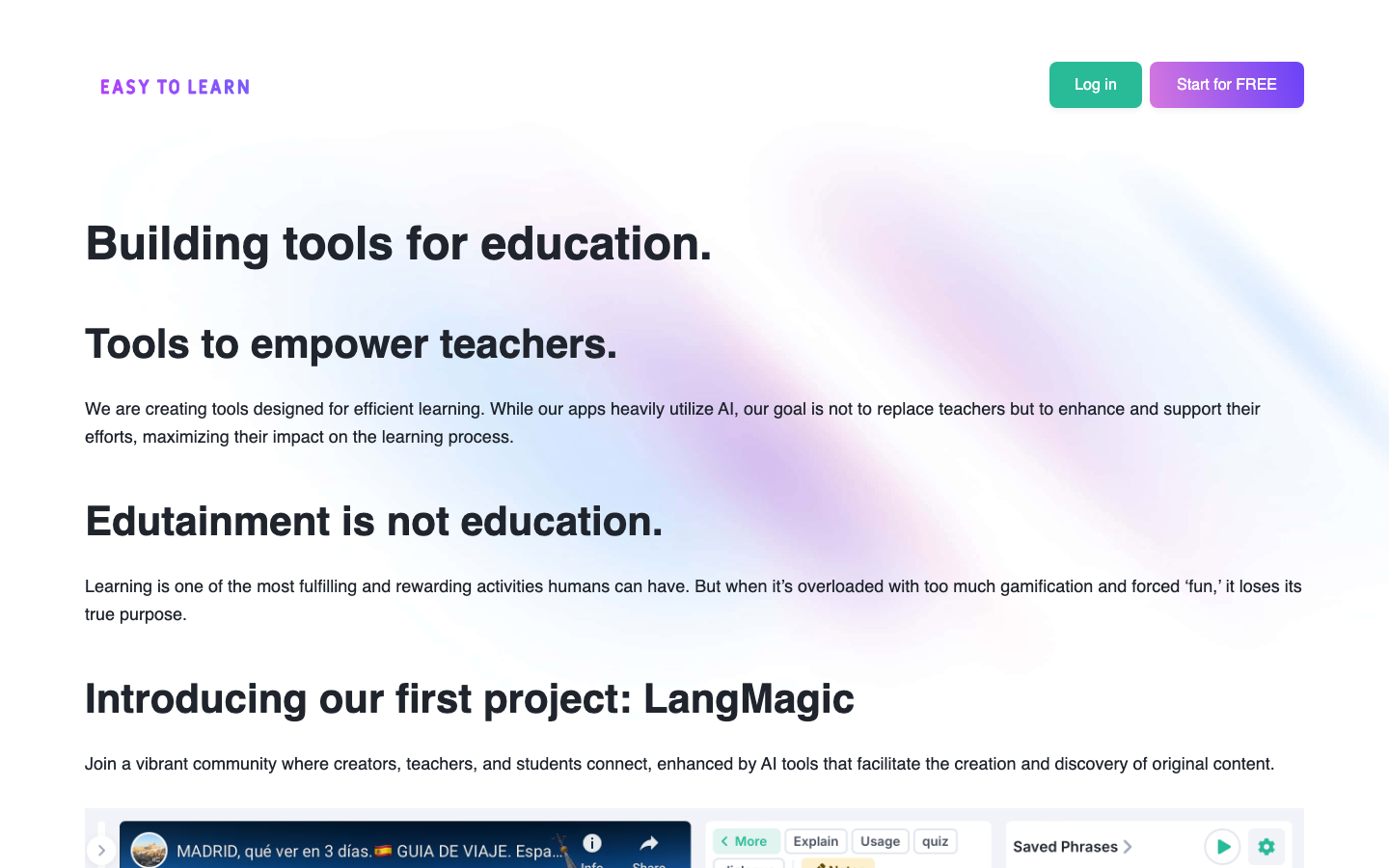
LangMagic
LangMagic’s core parameters and statistics
LangMagic is an AI language translation and localization learning platform (Type D - productivity/business application) developed by the EasyToLearn team. The core logic is to allow users to learn foreign languages through native language materials (videos, articles, audio) + AI translation annotations, instead of traditional rote learning or pure gamification.
| Projects | Public Information |
|---|---|
| Product Positioning | AI Language Translation and Localization Learning Platform |
| Core capabilities | AI translation, content analysis, adaptive learning, pronunciation assessment, grammar correction |
| Product Form | Web / Chrome Extension / Telegram Bot |
| Business Model | Freemium |
| Home | US |
| Parent Company | EasyToLearn |
| First public | About 2024-03 (based on X account registration time) |
| Latest version | 1.0 |
| Supported Platforms | Web, Chrome Extension, Telegram Bot |
| Target languages | English, Spanish, French and other languages (subject to actual platform support) |
Brief review in one sentence: LangMagic is not an independent translator, nor is it a Duolingo-style gamified check-in tool - it takes the "AI translation + native content input" route: using AI to turn YouTube videos and web articles into learning materials with translation annotations, allowing language acquisition to occur in a real context.
Publicity Verification: The official X account description is "Your FREE Language Tutor — Learn Languages with Native Content", which is consistent with the actual product form. Unlike most "AI conversation practice speaking" tools on the market, the core difference of LangMagic is that it is "content-driven" - it does not allow users to chat with AI, but to learn through AI translation and analysis of real content. However, the actual experience after registration requires logging in, and the completeness of functions is subject to the product itself.
Users and market recognition of LangMagic
LangMagic is at the crossroads of AI language learning and translation assistance. Its direct competitors include mature platforms such as Duolingo AI, Babbel, Speak, and ELSA Speak, as well as "content input" tools such as Memrise and LingQ with AI translation as their core selling point.
Market positioning difference: LangMagic is closer to LingQ's "content library + translation annotation" model, but introduces more AI automation capabilities (automatic translation, adaptive difficulty AI pronunciation assessment). Compared with Duolingo's gamification system, LangMagic's learning path emphasizes the "Comprehensible Input" theory - users acquire language by reading and listening to real content of interest, rather than through manually written graded exercises.
Community and word-of-mouth: As of 2026-07, the X account @langmagic_app has about 7 followers and 14 followers, and the number of public interactions is small, indicating that the project is still in the early customer acquisition stage. There are no public GitHub repository Crunchbase financing records or enterprise customer cases. The team size is about 8 people (based on the public information of easytolearn.io), led by CEO Vladimir Yakimenko, including development, project management, translation and other roles.
Trust Tip: Core indicators such as user volume, payment conversion rate, and retention rate are not public. It is recommended to obtain them through in-product experience or direct contact with the team before purchasing or in-depth use.
LangMagic’s cost advantage
LangMagic adopts a freemium pricing strategy with a three-tier cost structure as follows:
| Tier | Fee Model | Key Benefits | Restrictions |
|---|---|---|---|
| C-side / Personal - Free version | $0 | Basic translation, limited content library, daily learning quota | The number of daily translations and content visits are limited (subject to the actual product strategy) |
| C-side/Personal - Paid version | Undisclosed (subject to pricing page) | Unlimited translation, AI pronunciation assessment of all content libraries, advanced grammar analysis | Presumed monthly/annual subscription, the specific price needs to be logged in to view |
| API / Developer | Unpublished | — | Unpublished independent API |
| Corporate / Privatization | Undisclosed | — | Unpublished corporate plan |
- C-side/Individual: The free version provides basic translation and limited content access, suitable for experience and light learners. The paid version unlocks all content and AI functions, and the price is comparable to mainstream language learning applications ($8-15/month range), but the specific number is subject to the actual display in the product.
- API/Developer: The independent API has not been disclosed. It is speculated that the translation and content parsing interface may be opened in the future.
- Enterprise / Privatization: Undisclosed enterprise plan, does not rule out providing customized versions for language schools or educational institutions.
[The truth about free]: The core limitations of the free version are likely to be "daily translation/content visits" and "feature set tailoring" - free users may only be able to use limited video/article materials, and cannot use advanced features such as AI pronunciation assessment. Compared with human language teachers ($20-50/hour), AI-driven translation learning solutions have obvious marginal cost advantages in long-term use, but learners need to adapt to the "self-study-based AI-assisted" model, which lacks instant feedback and social pressure from real teachers.
LangMagic’s main features
- AI multi-lingual translation and annotation: Users upload or select any foreign language content (YouTube videos, web article PDFs), and AI automatically recognizes the language and generates sentence-by-sentence translations, vocabulary annotations, and grammar explanations. Applicable tasks: Get instant understanding assistance when reading foreign language news and watching foreign language videos, switching from "interrupting reading by looking up the dictionary" to "AI seamless annotation".
- Native content learning library: The platform has a built-in real-language material library (videos, articles, podcast scripts) graded by difficulty and theme, covering news, technology, culture, life and other scenarios. Applicable tasks: Find learning content that matches your interests and is moderately difficult, and avoid the two extremes of "the teaching material is boring" and "the real content is too difficult".
- AI pronunciation assessment and correction: The user reads the sentences in the material, and AI scores and points out specific pronunciation problems from dimensions such as intonation, intonation, and rhythm. Applicable tasks: Improve oral pronunciation and visualize the oral problem of "feeling good about yourself but not being understood by native speakers".
- Adaptive difficulty and personalized path: AI tracks the user's reading/listening performance (comprehension rate, new word rate, number of rereadings), and dynamically adjusts the difficulty and type of recommended content. Applicable tasks: No need to manually select levels - the system automatically pushes challenge content that is "slightly higher than the current level" to avoid staying in the comfort zone for a long time.
- Chrome extension immersive translation: After installing the Chrome extension, you can trigger AI sentence-by-sentence translation and vocabulary explanation with one click when browsing any foreign language webpage, turning daily web browsing into a language learning scenario. Applicable tasks: Integrate daily information acquisition (browsing Reddit, reading TechCrunch) and learning to solve the pain point of "no time to learn a language".
[Expert View]: The most valuable thing about LangMagic is not the translation accuracy itself, but the linkage of "translation + learning" - traditional translation tools (Google Translate, DeepL) just translate and leave, and users are done after reading the translation, and there is no "learning". The difference of LangMagic is that each sentence translation comes with vocabulary extraction, grammatical explanation and entry to the learning list, turning one-time translation needs into reusable learning assets. This link of "translation is input, input is learning" is the essential difference between it and pure translation tools.
LangMagic model and version evolution
As an early project launched in 2024, LangMagic has less public version information. The following is the minimum milestones that can be confirmed from public channels:
| Time node | Event | Description |
|---|---|---|
| ~2024-03 | X account @langmagic_app registration | Starting point of project public signal |
| ~2024 | easytolearn.io is online | The parent company’s brand website is online, publishing team information and product blogs |
| ~2025-2026 | Chrome extension & Telegram Bot released | Expanded product form, from Web to multi-device coverage |
| ~2026-07 | Current version 1.0 | Subject to product public information, no more detailed version number is available |
Evolution Trend: Inferred from the content of the parent company's blog (all centered around language learning methodology) and the pace of product iteration, LangMagic's evolution direction is "content source expansion + AI capability deepening" - from the early limited corpus to the more open arbitrary URL content parsing expansion, and from basic translation to in-depth annotation with contextual grammar. However, the specific version number and update log shall be subject to the product or official channels.
LangMagic’s technical advantages
Superposition of translation engine + LLM semantic understanding: LangMagic's translation link is not a single machine translation model, but a dual-layer structure of "statistical translation + large language model semantic understanding". The first layer quickly generates sentence-by-sentence translations, and the second layer uses LLM to analyze the context to generate vocabulary annotations, synonym substitutions, and grammatical explanations. This architecture is more economical than pure LLM translation (the first layer handles most requests) and more flexible than pure statistical translation (the second layer handles ambiguities and context-dependent scenarios).
Adaptive content grading mechanism: The platform automatically marks the difficulty level of each piece of content (based on vocabulary frequency, sentence complexity, speaking speed and other dimensions), and combines the user's historical interaction data (understanding rate, new word rate, length of stay) to build a dynamic ability portrait. The recommendation algorithm matches user portraits with content difficulty, pushes materials with "i+1" difficulty (slightly higher than the current level), and maintains the flow channel. Compared with manual grading on traditional platforms, this has finer granularity and faster updates.
Multi-modal input support: Supports three input forms: text, audio, and video. AI uniformly extracts learnable language units (vocabularies, phrases, sentence patterns), and cross-indexes between different modes. When the same vocabulary appears in video subtitles and articles, the system can display it in association to enhance memory. The technical difficulty of multi-modal alignment lies in the synchronization of the timestamp accuracy of speech recognition and the translation results. The implementation effect of LangMagic needs to be verified in the specific content.
How to use LangMagic
LangMagic provides three entrances to suit different usage habits:
| Entrance | Access path | Core purpose | Applicable scenarios |
|---|---|---|---|
| Web Application | app.langmagic.com → Register/Login → Select language → Start learning | Complete learning experience, including content library, translation annotations, and learning tracking | Main learning scenario, suitable for users with fixed learning time |
| Chrome extension | Chrome Web Store installation → Click the extension icon when browsing any web page | Immersive web translation + vocabulary learning | Embedded learning in daily web browsing, suitable for "fragmentation + high frequency" scenarios |
| Telegram Bot | Search and bind through Telegram | Lightweight translation and study reminder | Suitable for users who are accustomed to IM interaction and use fragmented time |
Typical usage steps (Web):
- Visit app.langmagic.com and log in with your Google account.
- Select the target language and current level (beginner/intermediate/advanced).
- Select videos or articles of interest from the content library, or paste any URL to import external content.
- AI automatically generates translations, sentence-by-sentence annotations and highlighted vocabulary, allowing you to learn while reading/watching.
- Save new words to your personal vocabulary library, and the system will push review reminders regularly.
- Use the pronunciation assessment function to practice reading sentences and get AI scores and suggestions.
First time configuration estimate: Registration + level test takes about 5-8 minutes; getting familiar with the product interface and core functions takes about 15 minutes; a more stable learning rhythm can be achieved after forming daily usage habits (15-30 minutes a day).
Product Pricing for LangMagic
The pricing information of LangMagic is not fully disclosed on the public page. The following is the fragmented information that is available:
- Free version: Provides basic translation functions, limited content library access and daily learning quota limit. Suitable for trial and light learning needs.
- Paid version: The specific price can only be viewed after logging into the product. It is speculated that the monthly fee is in the range of $8-15, which is comparable to the pricing level of mainstream language learning applications. The paid version is expected to unlock unlimited translation, complete content library AI pronunciation assessment, advanced grammar analysis and other functions.
- Payment Cycle: It is not disclosed whether monthly/annual payment options are supported and whether there are discounts.
Comparison of pricing of mainstream language learning platforms (based on public information in 2026):
| Platform | Free version | Paid monthly fee (approx.) | Core differences |
|---|---|---|---|
| LangMagic | Limited quota | Undisclosed (estimated $8-15) | AI translation + native content learning |
| Duolingo | With ads + limited lives | $12.99 (Super) | Gamification |
| Babbel | Limited courses | $12.95 | Structured course system |
| LingQ | Limited content | $11.99 | Content library + translation annotations |
| ELSA Speak | Limited functionality | $11.99 | AI pronunciation assessment |
The above comparison is public information in the industry, and the actual pricing of LangMagic is subject to the in-product display.
Application scenarios of LangMagic
- Foreign language video/film and television learning: When users watch YouTube foreign language videos, LangMagic's AI translation displays subtitle translations and vocabulary annotations sentence by sentence. Deduction: From "80% of people don't understand when watching raw meat videos" → "Use AI translation to understand + learn authentic expressions in videos", especially suitable for learners who use film and television content to learn languages. Key points of verification: translation delay, multilingual coverage (whether Japanese, Korean and other minor languages are supported).
- Web reading and information intake: Get instant translation and new word tagging when browsing English news (TechCrunch, The Guardian) or Reddit through the Chrome extension. Deduction: From "copy and paste new words into the dictionary when you encounter them" → "get the translation directly on the current page + automatically add to the learning list" to reduce context interruption. Verification focus: Extended compatibility with SPA pages (single page applications) and dynamically loaded content.
- Test preparation and vocabulary accumulation: For those preparing for language exams such as TOEFL, IELTS and DELE, LangMagic's content library can be used as supplementary reading/listening materials, combined with AI annotations to quickly accumulate high-frequency academic vocabulary. Deduction: from "memorizing test questions + memorizing vocabulary books" to "naturally contacting test vocabulary in real academic content" to improve the sense of language. Key points to check: Whether special preparation content classification and word frequency analysis are provided.
- Localized language training for corporate overseas teams: For foreign trade, cross-border e-commerce, and overseas operations teams that need to quickly improve their target market language skills, LangMagic can provide customized translation learning for industry content (emails, product copywriting, customer service conversations). Deduction: From "relying on translation software to communicate bluntly" → "learning authentic business expressions through industry-specific content". Key points to verify: Whether B-end pricing and team account management functions are supported.
Quantification of cost reduction and efficiency improvement (deduction):
- Writing a foreign language weekly report for new media operations: From manual translation + sentence-by-sentence verification, about 2 hours → AI translation + annotation learning, self-writing in about 45 minutes, reducing translation rework time by about 60%.
- Junior programmers read English technical documents: From fragmented reading of word-by-word dictionary lookup (about 90 minutes to understand 1 document) → AI sentence-by-sentence translation + vocabulary annotation assistance (about 35 minutes), improving reading efficiency by about 60%.
- Language test preparers do reading exercises: From the manual process of "word search-recording-reciting" → AI automatically extracts new words + spaced review push, the memorization of the outline can reduce about 70% of repeated labor.
The above is a reasonable deduction based on product positioning, unofficial commitment data.
Applicable groups of LangMagic
- Language self-learners and lifelong learners: People who already have a certain motivation for learning and do not need gamified rewards to maintain their habits. LangMagic provides "tools" rather than "coaches" and is suitable for learners with strong self-motivation. Not suitable for learning styles that rely on external supervision and social competition.
- Foreign language content consumers (video/reading enthusiasts): People who like to watch foreign language YouTube, read foreign language news, and watch foreign language dramas. LangMagic combines "consuming content" and "learning language" into one, with extremely low marginal learning costs. It is not suitable for traditional users who are not interested in original audio content and only rely on textbooks to learn.
- Language test preparers: Test preparation users who need a lot of real-world contextual input to improve their reading and listening. LangMagic’s content library and AI annotations can be used as supplementary training tools in addition to question brushing. It is not suitable for short-term test preparation scenarios where you only rely on test skills to suddenly improve your scores (test-taking skills still require manual training).
- Overseas operations and cross-border workers: professionals who need to use foreign languages for work communication, writing emails and product copywriting. In a team scenario, you need to pay attention to whether it supports account management and progress tracking. It is not suitable for legal/medical and other professional scenarios that require extremely high language accuracy (AI translation may have terminological deviations).
Does not fit boundaries:
- Learners with zero foundation and insufficient self-motivation: LangMagic's core model is "AI-assisted self-study", which requires users to actively select content and persist in learning. If users need a fixed curriculum, class atmosphere and teacher supervision, LangMagic is not the right choice.
- Professional scenarios that require extremely high translation accuracy: For translation of professional scenarios such as legal contracts, medical reports, and technical specifications, the accuracy of AI translation + annotation is not enough to replace professional manual translation. It is recommended to use professional translation tools or manual services.
- Users who need systematic test-taking training: LangMagic does not provide test-taking services such as explanation of test techniques, simulated scoring, essay correction, etc., and is not suitable for learners whose only goal is to "increase scores in the short term".
- Enterprise-level large-scale deployment: Before the enterprise solution and management functions are disclosed, it is not recommended that enterprises directly conduct team procurement. It is recommended to verify the effect through the personal version first.
Summary and Outlook of LangMagic
LangMagic enters the language learning market with a combination of "AI translation + native content input", forming a differentiated positioning with Duolingo's gamification approach and Babbel's structured courses. Its core assumption is that the most effective language acquisition occurs in "comprehensible real input", and the role of AI is to lower the threshold of understanding and accelerate vocabulary absorption. This route is theoretically sound (based on Krashen's input hypothesis), but the quality of execution depends on translation accuracy, content coverage, and the maturity of the recommendation algorithm.
Current Limitations and Uncertainties:
- The product is still in its early stages (X account registered in 2024-03, low interaction volume), user scale and market verification are insufficient, and core indicators such as paid conversion rate and retention rate are not disclosed.
- Pricing information is not transparent. The specific functional boundaries and prices of the paid version need to be viewed after logging in, which increases the evaluation cost for potential users.
- There is a lack of public benchmark testing on the performance of translation quality in unpopular languages and long and difficult sentences, and there is no comparison data with professional translation tools such as Google Translate and DeepL.
- The accuracy of AI pronunciation assessment has not been verified against traditional speech assessment tools such as ELSA Speak.
- The team size is limited (about 8 people), and there may be bottlenecks in product iteration speed and customer support capabilities.
Procurement/Adoption Risk Assessment:
- Individual users: The free version has a low threshold and is worth a try - if the user has a habit of consuming foreign language content, the incremental value of LangMagic is very obvious; if the user needs a systematic course, it is recommended to choose Babbel or LingQ as the main tool.
- Team/Educational Institution: It is recommended to conduct a small-scale pilot of 5-10 people for 1-2 months, focusing on verifying: ① the accuracy of AI translation in industry-specific terminology; ② team account management (if a school or enterprise requires multi-user management, confirm whether this function is supported); ③ the possibility of integration with existing LMS (learning management system). Before obtaining the above confirmation, it is not recommended to purchase it as a core teaching platform.
- Development Team: If you consider secondary development based on LangMagic's translation capabilities, you need to confirm whether the API is publicly available. As of 2026-07, no public API documentation or SDK has been found, and it is recommended to contact the EasyToLearn team directly to confirm the possibility of technical cooperation.
Related tools:  GitHub Copilot,
  Cursor
Version Info
- LangMagic :There is no official precise date yet.
- LangMagic :There is no official precise date yet.
User Reviews