 LangSmith
Free
LangSmith
Free
LangSmith is an LLMOps platform launched by LangChain, Inc., covering tracing, monitoring, online/offline evaluation, datasets, annotation queues, prompt hub, playground, deployment, Fleet and Sandboxes of Agent/LLM applications. It is suitable for advancing AI applications from prototype debugging to production observation and version management.
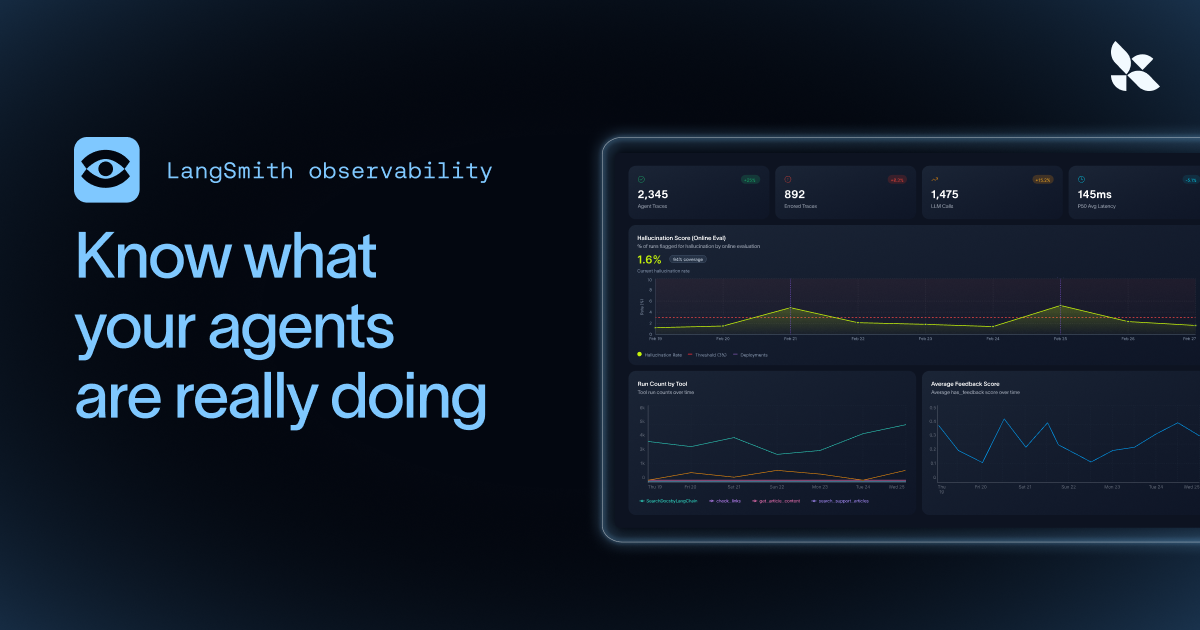
LangSmith
Core parameters and statistics
| Projects | Public Information |
|---|---|
| Product Positioning | AI Agent and LLM observability, evaluation, deployment platform |
| Official website | https://www.langchain.com/langsmith |
| Application portal | https://smith.langchain.com |
| Core modules | Observability, Evaluation, Deployment, Engine, Fleet, Sandboxes, Prompt Hub, Playground |
| SDK and access | Python, TypeScript, Go, Java SDK; supports OpenTelemetry access |
| Deployment forms | Cloud, Hybrid, Self-hosted; Enterprise supports running in customer Kubernetes clusters |
| Cloud Data Region | smith.langchain.com managed data is stored in GCP us-central-1 |
| Paid tiers | Developer, Plus, Enterprise |
| Free credits | Developer plan includes 5k base traces/month and 50 Fleet runs/month |
| Latest public updates | LangSmith Cloud changelog from 2026-06-08 to 2026-06-12 |
Product Boundary: LangSmith is not a large model training platform, nor is it responsible for replacing the inference APIs of model vendors such as OpenAI, Anthropic, and Google. Its core position is in the AI application layer, establishing engineering controls around input, output, tool calls, context, latency, cost, evaluation results, and deployment running status.
Access meaning: LangSmith is the smoothest for LangChain/LangGraph users, but it does not only serve the LangChain ecosystem. The official product page clearly states that any agent stack can be accessed through Python, TypeScript, Go, Java SDK or OpenTelemetry, which makes it more like a team-level LLMOps platform rather than a debugging panel for a single framework.
User and market recognition
Enterprise Adoption Signal: LangSmith product page displays customer logos such as Klarna, Vanta, Clay, Rippling, Lyft, Gong, Harvey, Abridge, Cloudflare, Bristol Myers Squibb, Workday, Cisco, Mercor, Nvidia, etc., and presents its production-level positioning with "Helping top teams ship great agents". This information illustrates that LangSmith’s target customers already cover SaaS, medical, sales, cloud services and large enterprise technology teams.
Ecological position: LangSmith, LangChain and LangGraph form a combination of "development framework - agent orchestration - observation, evaluation and deployment". For teams that use LangGraph to build long-link agents, LangSmith can handle trace, dataset, experiment, deployment, and alert results, reducing the cost of switching between log platforms, table evaluation, and manual playback.
Undisclosed items: LangChain, Inc. does not disclose LangSmith’s number of unique paying customers, revenue, renewal rates, or penetration rates in various industries on the product page. The relevant business scale can only be based on official subsequent disclosures, and cannot be inferred from customer logos or the popularity of the open source ecosystem as a definite figure.
Cost advantage
C-side/individual developer: The Developer plan is $0/seat/month and includes 5k base traces/month 1 seat, 50 Fleet runs/month tracing, online/offline evals, Prompt Hub, Playground, Canvas, annotation queues, monitoring and alerting. For personal or early PoC, you can set up the core links first without purchasing an enterprise package first.
Developer/API Team: Plus plan is $39/seat/month and includes 10k base traces/month 1 dev-sized agent deployment, up to 3 workspaces, email support, 500 Fleet runs/month, and access to Engine and Sandboxes. For small teams, explicit costs come from seats, trace excess Fleet runs, deployment runs, and deployment uptime; implicit costs come from SDK access, sensitive field desensitization, evaluation data set maintenance, and alarm rule management.
Enterprise/privatized scenario: Enterprise is custom pricing, covering hybrid/self-hosted, data does not leave VPC, custom SSO/RBAC, support SLA, team training, architecture guidance, customized seats/workspaces, and Fleet, Engine, and Sandboxes packages. The total enterprise cost is not only the subscription price, but also includes cloud resource Kubernetes operation and maintenance, auditing, permission model and cross-team rollout costs.
Main functions
- Tracing: Observe the Agent execution process step by step and locate nodes that affect latency, cost and response quality. For multiple rounds of conversations and tool invocation scenarios, trace can break down "why the model answered this way" into replayable engineering evidence.
- Monitoring and dashboards: Summarize production traces into real-time indicators, alarms and quality monitoring panels, suitable for continuous observation of sudden cost increases, delay jitter, quality degradation and abnormal tool calls.
- Online/offline evaluation: offline eval uses curated datasets to compare prompts, models, and retrieval strategies before publishing; online eval runs safety, format, quality, and LLM-as-judge rules on production traces, and can use sampling to control costs.
- Datasets and experiments: Reflow online failed samples into data sets, and compare different versions in the same experiment table. In June 2026, the changelog has added experimental progress bars and categorical feedback derived percentages to facilitate scanning of pass/fail results.
- Annotation queues and feedback: supports manual feedback queue inline annotation, user feedback SDK and presigned feedback URL, which is suitable for precipitating manual quality inspection results into reusable evaluation assets.
- Prompt Hub, Playground and Canvas: Support prompt debugging, version collaboration and automatic improvement process, reducing the risk of regression caused by direct online modification of prompt.
- Deployment: Provides a deployment runtime for Agent workload, covering durable execution, real-time streaming, and horizontal scaling, and can trigger deployment from GitHub or Studio.
- Engine, Fleet, Sandboxes: Engine is used to automatically discover recurring issues in traces and diagnose root causes; Fleet allows multiple roles in the company to use agents; Sandboxes is used to safely run agent-generated code and supports agent rules to connect to cloud services.
Model and version evolution
Mainline version of LangSmith
2026-06-08 to 2026-06-12 Cloud update: LangSmith Cloud changelog records Engine project-level spend display, experiment table progress bar Dashboards v2 bar/line charts, Deployment triggers Google ADK agents from Studio to deploy Sandboxes AWS authentication proxy and Dockerfile snapshot and other updates. This illustrates that LangSmith's recent focus has expanded from pure observability to deployment, sandboxing and cost governance.
2026-06-01 to 2026-06-05 Cloud update: The same changelog shows that the run rule webhook payload adds capabilities such as trace deep link, per-workspace Engine spend GA, Engine webhook secret rotation, Sandbox GCP auth proxy, and experiment table derivation percentage to strengthen automation, cost transparency, and cross-cloud sandbox access.
LangSmith’s Historical Milestones
2024-02-15 GA: The official LangChain blog announced that LangSmith is generally available, positioned as a production-level platform for LLM application development, monitoring, testing and evaluation. The GA node means that the product moves from beta trials to a more stable commercialization stage.
2023-07-18 Public Beta: LangChain official blog announced LangSmith, proposing to use a unified platform to help developers debug, test, evaluate and monitor LLM applications. This node established the direction of LangSmith as the core product of the LangChain business platform.
Technical advantages
Asynchronous tracing mechanism: Product page description LangSmith SDK uses async callback handler to send traces to distributed collector, so it will not block the application main process. The advantage of the mechanism is that the application can continuously report traces in the production environment without having to wait for the observation platform to respond synchronously for each LLM call; applicable scenarios are high-concurrency customer service agent backends and internal knowledge Q&A.
OpenTelemetry and multi-SDK access: The official page provides Python, TypeScript, Go, Java SDK and OpenTelemetry paths. Mechanically, the team can reuse existing observability specifications and incorporate LLM trace into a larger engineering monitoring system; the effect is to reduce cross-language service access costs, and is suitable for polyglot backend and microservice scenarios.
Evaluation and observation data come from the same source: LangSmith puts production traces, datasets, experiments, online evals and annotation queues on the same platform. Mechanically, online failure samples can be directly turned into regression test data; the effect is that prompt, model and retrieval adjustments have reproducible benchmarks, which is suitable for Agent product teams with frequent iterations.
Deployment runtime is related to observation: Deployment uses the execution model of assistants, threads, and runs, and is connected to the failure detection of Engine. Mechanically, the running status of the agent after deployment can be directly analyzed by trace and engine; the effect is from "looking at the log after going online" to "locating the failure mode based on trace evidence after going online", which is suitable for multi-version and multi-agent production environments.
How to use
| Usage path | Entrance | Typical steps | Adaptation scenarios |
|---|---|---|---|
| Cloud quick access | https://smith.langchain.com | Register an account -> Create workspace/project -> Get API key -> Configure SDK/contextual variables in the application -> View traces and dashboards | Personal PoC, small team |
| Evaluation workflow | LangSmith Evaluation docs | Create dataset -> Configure evaluator -> Run offline experiment -> Reflow failed samples -> Set up online evaluator | Pre-release quality gate control and online quality monitoring |
| Deployment | LangSmith Deployment docs/Studio | Connect to GitHub or use CLI -> Create agent deployment -> Configure threads/runs -> Observe traces and Engine issues | LangGraph/Agent production deployment |
| Self-hosted / Hybrid | Platform setup docs | Confirm Enterprise plan -> Prepare Kubernetes, PostgreSQL, Redis and other infrastructure -> Configure control plane and data plane -> Connect to SSO/RBAC | Data does not leave VPC, strong compliance organization |
Minimum implementation steps: First select a high-value link, such as customer service Q&A, sales assistant or internal knowledge base agent; connect tracing to establish four basic indicators of latency, cost, error, and quality; then create a dataset from real failure traces, use offline eval to verify and repair; finally, connect online eval and alert to the release process.
Product Pricing
| Plan | Public price | Including quota and capabilities | Typical positioning |
|---|---|---|---|
| Developer | $0 / seat / month, then pay as you go | 5k base traces/month 50 Fleet runs/month 1 seat, tracing, evals, Prompt Hub, Playground, Canvas, annotation queues, monitoring, alerts | Personal and early verification |
| Plus | $39/seat/month, then pay as you go | 10k base traces/month 1 dev-sized agent deployment, 500 Fleet runs/month, up to 3 workspaces, Email support, Engine, Sandboxes | Teams building and deploying agents |
| Enterprise | Custom pricing | Hybrid/self-hosted, custom SSO/RBAC, Support SLA, architecture guidance custom seats/workspaces, Fleet/Engine/Sandboxes packages | Security, compliance, privatization and large-scale teams |
Usage Item Boundary: The pricing page also lists billing dimensions such as custom deployment runs, deployment uptime, Fleet runs, Engine, Sandboxes, and trace events. LLM usage is billed separately by model vendors and is not included in LangSmith prices. Before formal purchasing, you need to refer to the official real-time pricing page and contract terms.
Application scenarios
- Production Agent Observable: When multi-step Agents experience high delays, high costs, or incorrect tool calls, LangSmith trace can play back the input, output, and intermediate states step by step, helping the engineering team locate whether there is a problem with retrieval prompts, tools, or model selection.
- Pre-release evaluation access: The product team organizes real problems, boundary samples, and failure samples into a dataset, and uses offline eval to compare the old and new prompts, models, and RAG strategies to avoid the regression of "good local demonstration effect, but overall online deterioration."
- Online quality monitoring: Monitor security, format, factuality, cost and delay through online eval, dashboards and alerts. It is suitable for setting continuous quality thresholds for high-risk scenarios such as customer service, medical documents, and legal Q&A.
- Agent deployment collaboration: The R&D team uses LangSmith Deployment to host long-running Agents, and forms a post-deployment problem location link through real-time streaming, horizontal scaling, threads/runs models and Engine.
- Internal Agent Distribution: Fleet is suitable for handing over agents as company-level capabilities to different business roles, while allowing the engineering team to retain tracking, permissions, usage and quality management capabilities.
Applicable people
- AI Application R&D Team: It is necessary to turn the prototype into an online service and continuously observe trace, quality, cost and delay. The prerequisite is that you are willing to connect the SDK or OpenTelemetry in your application.
- LLMOps/Platform Engineering Team: It is necessary to provide unified tracing, evaluation, prompt, dataset and deployment infrastructure for multiple business lines to avoid building scattered tools for each business line.
- Product and Quality Team: It is necessary to use reproducible datasets, annotation queues, experiment results and online eval to participate in AI function acceptance, rather than relying solely on subjective experience.
- Enterprise Security & Compliance Team: Requires hybrid/self-hosted, SSO/RBAC, data residency and auditing capabilities. This group should prioritize confirming Enterprise terms, data areas, log retention, and access control details.
Not suitable for the boundary: Projects that only do one-time demos, have no continuous online plans, have no evaluation samples, and do not require team collaboration may not be able to reflect the full value of LangSmith in the short term. For very lightweight, very low-cost personal scripts, it may be simpler to use model provider logs or local structured logs directly.
Summary and Outlook
The core value of LangSmith is to put debugging evidence, production observations, measurement data, human feedback and deployment operation status of LLM/Agent applications in the same engineering platform. It is especially suitable for AI teams that have entered the production or quasi-production stage, because the problem for such teams is often no longer "whether the model can be called", but "whether the quality is stable, whether the cost is controllable, whether the failure is reproducible, and whether it can be rolled back after going online."
There are currently four main categories of limitations and uncertainties: first, Enterprise, hybrid/self-hosted, SLA and advanced security terms require business confirmation; second, the Cloud data area is exposed as GCP us-central-1, and cross-regional or local compliance requirements require verification of the deployment plan; third, modules such as Fleet, Engine, Sandboxes, Deployment are still iterating rapidly, and changelogs need to be consulted before upgrading; fourth, LLM inference fees are independently charged by the model supplier, LangSmith It can only help observation and governance, but cannot eliminate the underlying model cost.
The implementation suggestion is to start piloting with 1-2 key AI links, and quantify trace coverage, online failure recurrence rate, evaluation pass rate, average delay and unit request cost; when these indicators can stably enter the release process, then expand to multi-project, multi-workspace and enterprise-level deployment. Pricing pages, data retention trace event limits SSO/RBAC, deployment zone SLAs, and self-hosted upgrade strategies should be reviewed before making a formal purchase.
Related tools:  GitHub Copilot,
  Cursor
Version Info
- LangSmith Cloud June 8-12, 2026 update :The updates announced by LangSmith Cloud changelog on June 8-12, 2026 cover Engine project-level spend display, experimental progress bar Dashboards v2 chart Deployment triggers Google ADK agents deployment from Studio and Sandboxes AWS certified agent and other capabilities.
- LangSmith Cloud June 1-5, 2026 update :LangSmith Cloud changelog announces updates to run rule webhook trace deep link, workspace Engine spend GA, Sandbox GCP auth proxy, experiment table derivation percentage, etc.
- Generally Available :The official LangChain blog announced LangSmith GA, emphasizing its capabilities in the development, monitoring, testing and evaluation of LLM applications.
- LangSmith Public Beta :The official LangChain blog announced LangSmith, positioned as a unified platform to help developers debug, test, evaluate and monitor LLM applications.
User Reviews