 Langtail
Free
Langtail
Free
Langtail is a prompt management and LLMOps platform for AI product teams. It uses playgrounds, tests, deployments, logs, and metrics to advance prompts from experiments to production.
Langtail tool text
Core parameters and statistics
| Parameters | Current public information | Description |
|---|---|---|
| Official positioning | Prompt management for product teams / LLMOps platform | The homepage of the official website emphasizes "Build, test, and deploy AI prompts collaboratively", and the official document further defines it as an LLMOps platform oriented to the AI application life cycle. |
| Core objects | Workspace, Project, Prompt, Prompt version, Deployment, Log, Metric, Test | Concept system covers everything from prompt writing to production monitoring, rather than a single point Prompt editor. |
| Main entrance | Web console, deployment API, OpenAI Proxy, SDK | Document Index lists the deployment API, Proxy, SDK, Assistants and Threads interfaces. |
| Target users | Product teams, engineering teams QA/AI testing teams | Both the official title and the Langtail 1.0 blog regard "product teams testing AI applications" as the core group. |
| Public deployment form | Cloud SaaS; Enterprise supports self hosting | Pricing page lists Self hosting in the Enterprise file. |
| Free Tier | Free, $0/month + VAT | Includes unlimited users, 2 prompts or assistants, 1,000 logs/month, 30 days data retention. |
Langtail is closer to a "cue word production system" than a "cue word inspiration library." It puts Prompt templates, variables, tool calls, model parameters, test assertions, deployment context and online logs into the same workbench. It is suitable for teams that have embedded LLM functions into products and need to reduce regression risks and online communication costs.
User and market recognition
- Public customer signals: Both the official website and the public beta blog cited Deepnote's case feedback. Deepnote engineer Ondřej Romancov commented that Langtail simplified the development and testing of Deepnote AI. Such signals suggest that Langtail’s early adopters are concentrated among B2B software teams that already have AI product capabilities.
- Product Release Timeline: Official About page records first beta release in October 2023, funding obtained in January 2024, Product Hunt launch in April 2024; this gives a minimal market validation path from internal testing to public beta.
- Public list signal: Product Hunt related public page records Langtail Public Beta entered the daily list on April 25, 2024; this type of ranking is only suitable as a launch popularity signal and is not equivalent to long-term retention or revenue data.
- Undisclosed Boundary: The official website does not disclose the number of active customers ARR, retention rate, list of available regions or number of enterprise contracts, so these dimensions cannot be written to determine the scale. A more valuable judgment on the procurement side is to first see whether the existing AI functions have entered production and whether the team really needs testing and deployment management.
Cost advantage
- C client/individual: The Free file can be used to start small projects with $0/month + VAT, which is suitable for verifying 1-2 Prompts or Assistants; but the free tier only has 1,000 logs/month and 30 days retention, which is not suitable for carrying serious production monitoring.
- Developer/API: Pro profile is publicly available for $99/month + VAT, 1 user, 20 prompts or assistants, unlimited logs, 90 days retention. Its cost advantage is not that "model calls are cheaper", but that it reduces the engineering time of manually pasting test samples and repeatedly changing the code to deploy prompts.
- Enterprise/Private: Team profile is open to the public for $499/month + VAT, 10 users, unlimited prompts or assistants, 1 year retention, Radars & Alerts and dedicated support; Enterprise is Custom, including AI Firewall, self hosting and custom retention. Enterprise costs need to be assessed together with subscription fees, model vendor billing, log retention, compliance reviews and integration effort.
| Plan level | Official public price | Key limitations/capabilities | Suitable stage |
|---|---|---|---|
| Free | $0/month + VAT | Unlimited users; 2 prompts or assistants; 1,000 logs/month; 30 days retention | Personal verification, small-scale PoC |
| Pro | $99/month + VAT | 1 user; 20 prompts or assistants; unlimited logs; 90 days retention | Independent developer or one-person AI product lead |
| Team | $499/month + VAT | 10 users; unlimited prompts; 1 year retention; Radars & Alerts; dedicated support | Multi-person product/engineering/QA collaboration |
| Enterprise | Custom | Unlimited users; custom retention; AI Firewall; dedicated support; self hosting | Large organizations, compliance or private deployments |
Main functions
- Playground collaborative writing: Playground supports templates, variables, tools, model parameters, versions, sharing and deployment portals. The significance of the product is to allow product, engineering and prompt leaders to discuss the output on the same interface, instead of having prompts scattered in code, documents and chat logs.
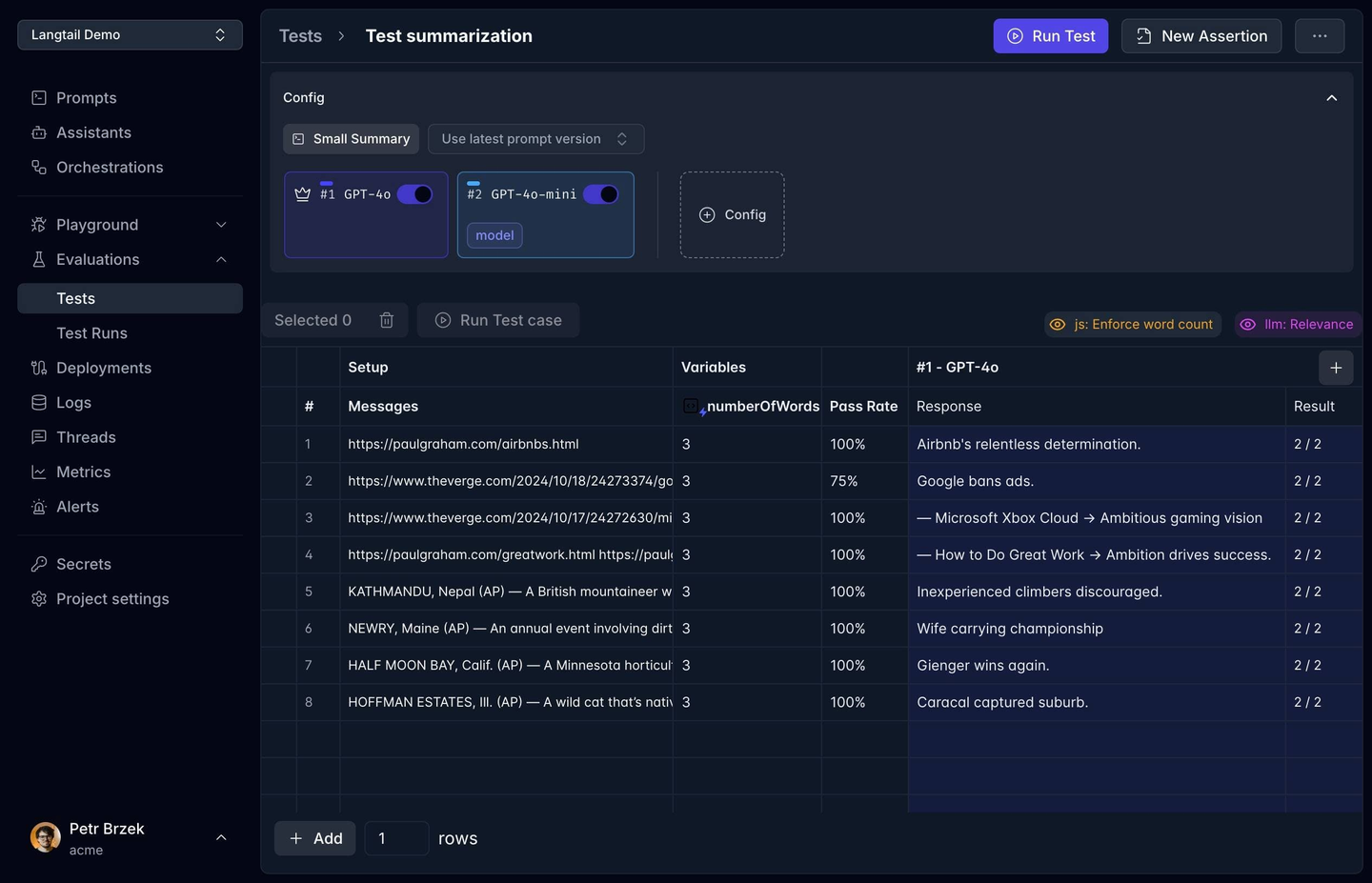
- Tests and assertions: Tests consist of cases and assertions, and assertion types include text assertions, JavaScript assertions and LLM assertions. Text assertions are suitable for deterministic formats, JavaScript is suitable for structured rules, and LLM assertions are suitable for natural language standards and classification evaluation.
- Deployment API: Deployments can publish Prompt as API endpoint and support context, version and rollback. It reduces the frequency of "republishing the application when changing the prompt", but only if the team is willing to hand over the prompt life cycle to platform hosting.
- Logs and Metrics: Each deployment call or OpenAI Proxy request will generate a log. Metrics can view activities, delays, and costs from the prompt or project dimensions. For production AI applications, this is closer to a business troubleshooting perspective than just looking at model vendor bills.
- Assistants and Threads: The document index lists Assistants, Threads and thread messages API, indicating that Langtail not only manages a single Prompt, but also covers conversational applications with longer contexts.
- AI Firewall and Alerts: The official website and pricing page display AI Firewall, Radars & Alerts, which are used for security output, abnormal behavior and operational alarm management of higher-risk teams.
Model and version evolution
| Time | Version/Milestone | Official Public Changes | Product Meaning |
|---|---|---|---|
| 2023-10 | First testing version | About page records the release of the first testing version at Prague AI meetup | The starting point of the product comes from AI application debugging and evaluation problems, rather than general model training. |
| 2024-04-25 | Public Beta | Official blog Public collaboration workspace Playground, Prompt deployment, log analysis, testing OpenAI and Azure OpenAI support | Langtail enters the public availability stage from internal testing. |
| 2024-10-29 | Langtail 1.0 | Official blog releases spreadsheet-like testing interface, test configurations, Hosted Code Tools, Assistants | The product focus has obviously shifted to AI application testing and QA workflow. |
| 2025-02-14 | Test Improvements and Infrastructure Updates | Updated logging test configuration pass rate display, tool call focus repair o1 series reasoning effort processing, etc. | Iterations focus on test experience, model compatibility, and operational detail stability. |
Langtail's "version" is not an installation package number for traditional desktop software, but a functional milestone for the cloud platform. For adopters, it is more important to pay attention to which model providers, assertion types, log dimensions, and deployment modes it supports, because these capabilities will directly affect regression testing and fault location after the AI function goes online.
Technical advantages
- Mechanism: Prompt version and deployment context decoupling application code. The effect is that Prompt adjustments can be transferred through Langtail's deployment version, instead of triggering application code release every time; applicable scenarios are product functions with frequent Prompt iterations such as customer service robots, content generation, search Q&A, etc.
- Mechanism: Test case tabulation + multiple assertion types. The effect is that product QA and engineering can check the output around the same batch of cases, instead of manually testing several samples each; applicable scenarios are AI functions that require continuous regression in output format, compliance wording, classification results, and summary quality.
- Mechanisms: Logging requests, supplier responses, cost and latency metrics. The effect is that online problems can be returned from the specific log to the playground recurrence context; the applicable scenario is troubleshooting when output deviations, cost abnormalities, or delay fluctuations occur in the production environment.
- Mechanism: OpenAI-compatible and SDK/API entrance. The effect is that teams can introduce Langtail next to existing model calling links instead of completely rewriting the AI application architecture; the applicable scenario is teams that are already using OpenAI, Azure OpenAI, or compatible providers.
- Mechanism: Enterprise self hosting and AI Firewall. The effect is that organizations that are more sensitive to data retention, output security, and deployment boundaries have stronger room for negotiation; applicable scenarios are scenarios with high audit requirements such as finance, medical care, and internal corporate knowledge bases.
How to use
- Account and Project: Create a workspace/project after entering the sign-up or app console from the official website, and split an AI function into prompts, variables, model parameters and test data.
- Prompt writing: Configure system/user/assistant templates, variables and model parameters in the Playground, and add tools to simulate function calls or external API behavior if necessary.
- Test verification: Add cases in Tests and set text, JavaScript or LLM assertions for output; when the model, parameters or prompts are changed, use the same batch of cases to compare the pass rate and failure samples.
- Deployment and online: Publish the confirmed Prompt version to preview, staging or production environments through Deployments, and then call it from business applications using API key or SDK.
- Online monitoring: Check the Logs and Metrics after going online, pay attention to the call volume, delay, cost and abnormal output; when encountering problems, bring the specific logs back to the playground to reproduce, and then decide whether to adjust the prompt or roll back the version.
The prerequisite for using Langtail is that the team already has clear AI application tasks, sample input and output standards. If you only write prompt words temporarily or do one-time content creation, its testing, deployment and monitoring system will appear to be too heavy.
Product Pricing
Langtail operates on a SaaS subscription + enterprise commerce pricing structure. The public price covers Free, Pro, and Team. The custom price of Enterprise is subject to the official real-time page and business communication. The public pricing does not indicate whether the model call fee is resold by Langtail or borne entirely by the user's own provider key, so the official budget should account for platform subscriptions, model token costs, log retention, and privatization implementation separately.
| Cost dimensions | Free/Pro/Team visible information | Enterprise visible information | Budget concerns |
|---|---|---|---|
| User seats | Free unlimited users; Pro 1 user; Team 10 users | Unlimited users | The division between Team and Enterprise mainly depends on seats, retention, support and compliance requirements. |
| Prompt/Assistant Quantity | Free 2; Pro 20; Team unlimited | Unlimited | Multiple business lines or multiple contexts will exceed the Free/Pro limit faster. |
| Logs and retention | Free 1,000 logs/month, 30 days; Pro unlimited logs, 90 days; Team 1 year | Custom retention | Production monitoring usually requires longer retention and more detailed auditing. |
| Advanced Governance | Team includes Radars & Alerts | Enterprise includes AI Firewall, self hosting | Security, alerting and privatization are the main additions to the enterprise profile. |
Application scenarios
- AI Functional Regression Test: It is suitable to precipitate output behaviors such as summary, classification, customer service Q&A, and content generation into a test set, and observe the impact of model upgrade prompt changes and parameter changes on the pass rate.
- Prompt from experiment to production deployment: suitable for teams whose Prompt changes frequently but has a slow pace of business application release. Use deployment endpoints and contextual aliases to reduce the dependence of Prompt iterations on code release.
- Online LLM Cost and Quality Monitoring: Suitable for teams that need to view call, delay, cost and response details by pressing prompt/project, and use logs to feed back online failure samples to testing and prompt improvements.
- Cross-functional Prompt collaboration: Suitable for product, engineering, and operation QA to participate in the output of AI products defined by standards, extracting prompt words and acceptance criteria from the code warehouse to a collaborative interface.
- High-risk output governance: Suitable for scenarios that are sensitive to wrong answers, prompt injection, unauthorized output or unsafe output, combined with AI Firewall, Alerts and test assertions for dual governance before and after going online.
Applicable people
- AI Product Manager: It is necessary to convert user scenarios, output standards and launch risks into testable Prompt versions, rather than relying solely on human experience judgment.
- Engineering Team: Prompt management, deployment, logging and SDK/API calls need to be incorporated into the engineering process, while avoiding re-releasing business applications every time Prompt is adjusted.
- QA and Evaluation Team: Need to use tabulated cases, assertions, pass rates, and failure records to test AI applications instead of manually tracking results with ordinary spreadsheets.
- RevOps/Operational AI Team: Need to observe real user input, output quality, cost and delay, and feed back online samples to Prompt and test sets.
The boundaries of incompatibility are also clear: teams without stable AI functionality, no sample input, no output acceptance criteria, and no production call volume should not introduce the complete LLMOps platform prematurely. Purely personal prompt word collection, one-time writing, model training and data annotation are not Langtail’s main battlefields.
Summary and Outlook
The core value of Langtail is to upgrade prompts from "strings in code" to collaborative, testable, deployable, and monitorable product assets. It is suitable for teams that have entered the productization stage of AI functions, especially those organizations that are beginning to feel pressure on model upgrade prompt regression, online costs, error output, and cross-team collaboration.
There are three main current limitations: first, the complete list of customer scale, revenue SLA, available regions, and model suppliers has not been made public; second, Enterprise's private AI Firewall and custom retention require business confirmation; third, the value of the platform relies on the team's ability to maintain high-quality test sets and clear acceptance criteria. A more prudent approach when implementing is to select a high-frequency AI function for 2-4 weeks as a pilot, use the pass rate, online failure recurrence rate Prompt release time, average delay and model cost changes to conduct quantitative acceptance, and then decide whether to expand to more business lines.
Version Info
- Test Improvements and Infrastructure Updates :The official update log records test results, display pass rate according to configuration, Playground tool call focus fix, o1-preview/o1-mini reasoning effort processing and other improvements.
- Langtail 1.0 :The official blog released Langtail 1.0, focusing on adding spreadsheet-like test interface Test Configurations, Hosted Code Tools and Assistants.
- Public Beta :The official blog releases Langtail public beta, public collaborative workspace Playground, Prompt deployment, log analysis, testing and OpenAI/Azure OpenAI support.
User Reviews