 Leadfeeder
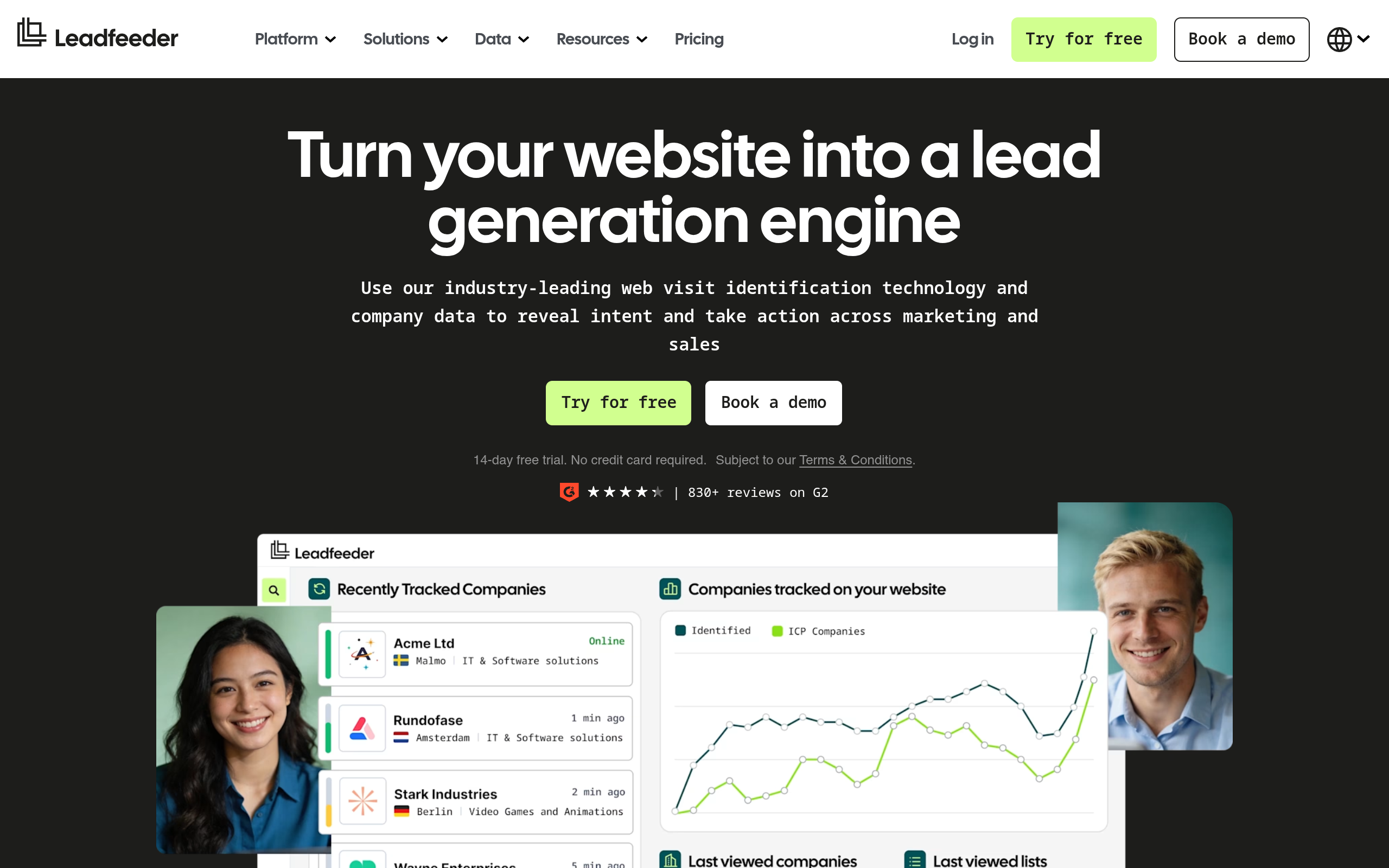
Leadfeeder identifies anonymous visitors to corporate websites and matches them to corresponding company information, helping B2B sales teams convert website traffic into follow-up leads.
Leadfeeder
Tool type determination: Leadfeeder belongs to [Productivity/Business-side Application] - B2B sales intelligence and website visitor identification tool, and its main delivery form is SaaS end-to-end application. The following will perform a directional in-depth analysis (Rule D) according to this type, covering the quantification of cost reduction and efficiency improvement and the boundary of human-machine collaboration.
Core parameters and statistics of Leadfeeder
| Parameter items | Public information |
|---|---|
| Product Positioning | Website Anonymous Visitor Identification and B2B Sales Lead Generation Platform |
| Deployment method | SaaS cloud (global multi-region nodes) |
| Data Sources | Google Analytics Integration + Self-Deployed Tracking Pixel + JS Tags |
| Identification scope | Company name, industry classification, employee size, geographical location, access page path, return visit frequency |
| Identify the link | Visitor IP → Reverse DNS/ISP data → Company database match → LinkedIn contact supplement |
| CRM Integration | Salesforce, HubSpot, Pipedrive, Zoho CRM, Microsoft Dynamics |
| Integration method | Native connector + REST API + Zapier/Webhook bridging |
| Compliance Certification | GDPR, CCPA, SOC 2 (subject to the current certification page of the official website) |
| Browser Compatible | Compatible with all major browsers through JS tags |
| Data retention | Historical visitor data is retained for different lengths of time according to package levels (Basic 12 months, Premium 24 months, Enterprise customized) |
Interpretation of Core Parameters: Leadfeeder's identification link relies on the two legs of "IP reverse matching + company database cross-validation". The first leg determines whether company-level information can be identified - affected by VPN, proxy, shared IP, usually the identification coverage is between 30%-60% (varying depending on the website traffic source structure). The second leg determines whether company information can be extended to personal contacts - through LinkedIn public profile matching, but this section only has a probability of hits, and there is no guarantee that specific contacts can be found for every company. This means that there is a clear conversion funnel between "identified companies" and "acquired contacts", and teams should use "identified companies" rather than "total visitors" as the ROI baseline denominator when evaluating.
Realistic boundaries of recognition quality: The recognition rate is higher when visitors come from corporate fixed IPs (such as headquarters and branch dedicated lines); visitors from mobile networks, residential broadband or public Wi-Fi are extremely difficult to match to the company. Therefore, the identification value of B2B scenarios targeting large enterprise customers (usually accessed from the office network) is significantly higher than scenarios targeting small and medium-sized enterprises or C-side users.
Leadfeeder’s users and market recognition
Leadfeeder’s market recognition mainly comes from the B2B marketing and sales technology ecosystem rather than public revenue data (the latter is not fully disclosed).
Market positioning: Leadfeeder belongs to the subcategory of "Web Visitor Identification", which belongs to the upstream section of "Intent Data/Intent Data" in the B2B MarTech ecosystem. Direct benchmarking tools include Albacross, Clearbit Reveal, and similar modules from 6sense and Demandbase. Compared with the latter two, Leadfeeder focuses more on the lightweight relationship of "identification + notification" without doing complete advertising delivery or account-level AI programming.
Enterprise customer coverage: Leadfeeder’s official website and case page publicly display that its customers cover multiple B2B industries such as SaaS, professional services, manufacturing, education and training, etc. Typical customers include remote office, enterprise software and human resources service providers. Although the precise number of customers or ARR has not been disclosed, its case library covers the European and North American markets, indicating that its cross-border deployment capabilities have been verified.
Ecological integration: Leadfeeder’s native integration with mainstream CRM (Salesforce, HubSpot), marketing automation (Marketo, HubSpot) and analysis tools (Google Analytics 4) makes it cheaper to embed in teams with existing MarTech stacks, which is also its core advantage compared to pure independent tools.
Industry Recognition: Leadfeeder has long been at the forefront of the "Website Visitor Identification" category of third-party evaluation platforms such as G2. User reviews focus on aspects such as "fast CRM installation, smooth synchronization, and direct help for ABM strategies"; shortcomings focus on "limitations of IP identification coverage" and "high price jumps after exceeding package limits."
Cost Advantages of Leadfeeder
Leadfeeder's cost structure needs to be evaluated from two dimensions: "direct subscription cost" and "implicit opportunity cost", and split into three levels: individual/team, developer integration, and enterprise level.
C-side/small team level:
- The Basic package starts at $199/month, suitable for websites with less than 5,000 monthly visitors, and includes basic visitor identification and monthly summary reports.
- The explicit subscription cost is about $2,388 per year, but after discounting based on the "number of identifiable companies", the CPL (cost per lead) is usually between $3-$15, which is significantly lower than traditional advertising ($50-$200) and outbound purchase lists ($20-$100), provided that the website has a certain base of B2B natural traffic.
- Hidden costs: It takes marketers about 1-2 hours per week to filter and organize the Leadfeeder output to convert it into sales follow-up leads.
Developer/API integration levels:
- The public pricing page does not provide separate API-only packages; API access is included in the Enterprise package and requires business confirmation.
- For internal developer teams, automatic synchronization can be achieved based on webhooks and CRM native connectors without the need for additional API subscriptions. This reduces dependence on the engineering team, but limits the flexibility for custom data cleaning and third-party system integration.
- When bridging with iPaaS platforms such as Zapier/Make, the execution costs of these platforms need to be added, and the annual cost increase is about $600-$1,200.
Enterprise level:
- The pricing of the Enterprise package is not disclosed and needs to be confirmed by booking a business demonstration. Annual contracts for typical enterprise deployments often include: tiered pricing based on traffic size, CRM integration configuration, dedicated CSM and custom data retention policies.
- Enterprise-level hidden costs are concentrated in three places: first, internal configuration and training (approximately 2-4 weeks learning curve for the marketing department); second, interface management with the existing MarTech stack (such as no double writing and no conflict of identification data); third, the team needs to establish a standardized SOP of "visitor identification → lead scoring → sales follow-up", otherwise the identification data will accumulate as noise instead of signal.
- Compared with the self-built solution (self-built IP identification + company database maintenance), the annual fee of Leadfeeder (Enterprise is about $10,000-$50,000 based on traffic) is significantly lower than the cost of data procurement, infrastructure and labor maintenance required by self-built (estimated annual $50,000+), but it is not cost-effective for websites with extremely low traffic (average monthly <1,000 visitors).
Cost Comparison: Leadfeeder vs Alternatives
| Plan | Starting Cost | Total Annual Cost (Estimated) | Conditions | Main Limitations |
|---|---|---|---|---|
| Leadfeeder Basic | $199/month | ~$2,388/year | Monthly traffic below 5,000, light team | Lead scoring needs to be upgraded to Premium |
| Leadfeeder Premium | $299/month | ~$3,588/year | Teams who need real-time notifications and quality scoring | No API, no custom retention |
| Leadfeeder Enterprise | Business confirmation | $10,000-$50,000+/year | Large-scale, multi-site, deep CRM integration required | Business contract lock-in period 1-3 years |
| Albacross | ~$159/month | ~$1,908/year | Pure identification needs, no contact supplement | Contact supplement is weaker than Leadfeeder |
| Clearbit Reveal | Business Confirmation | $15,000+/year | Direct data of the contact email address needs to be supplemented | The price is high, and the threshold is high for a small team |
| Self-built solution | $20,000+ initial investment | $50,000+/year | Large-scale data compliance and custom processing | Requires full-time data engineer maintenance |
Main functions of Leadfeeder
The core of Leadfeeder's capabilities lies in "turning the website from one-way display into a two-way signal source", and it is formed through five functional modules:
-
Anonymous Visitor Company Level Identification: Core Competencies. Match anonymous traffic to company name, industry, size and geography via IP database. Different from the traditional form to leave money, it captures the silent traffic that "comes but leaves no trace". Acceptance focus: Identification coverage rate - B2B customer traffic usually 30%-60% can be matched to the company; if personal email/mobile network dominates the website traffic, the identification rate will be significantly lower.
-
Complete browsing behavior review: Record the complete access path of each company within the specified time window - including access pages (product page, pricing page, case page, job search page), length of stay, frequency of return visits, and access period. Cross-functional collaboration: Behavior records are not only information display, but also provide a "weight basis" for subsequent clue scoring. For example, "visits to the pricing page have a higher weight than visits to the blog page" and "the signal strength of three return visits within a week is higher than a single visit" - this linkage between the rule engine and behavioral data constitutes the key difference between Leadfeeder and pure log analysis tools.
-
AI Lead Quality Scoring (2026 Spring Release): The newly introduced AI scoring capability replaces manual rule weighting and automatically trains scoring models based on historical conversion data. A combination of actions (such as downloading the white paper + visiting the pricing page + three return visits) is automatically marked as "high intent," while simply visiting the blog homepage remains a "low score." Hidden linkage: The scoring result is not just a column of numbers in the list, it also drives CRM synchronization priority (high-scoring leads create tasks first), feed notification thresholds (only high-scoring triggers real-time reminders) and report filtering. This means that one model output affects three downstream actions at the same time - this is a key node for Leadfeeder to upgrade from "information display" to "action-driven".
-
CRM two-way synchronization: Identified visitor data automatically creates or updates lead/contact records in CRM, with complete browsing behavior summary, and duplicate detection prevents the same company from creating multiple duplicate leads. Synergy: Synchronization is not just a "one-way write" - when a sales rep updates a lead status in the CRM (e.g. "Contacted, Converted, Invalid"), Leadfeeder learns that feedback in reverse and adjusts future scoring and notification strategies for visitors from the same source type.
-
Customized feed and real-time notification: Users can create watch lists (such as Top 100 target customers, key renewal customers), and when company employees in the list visit the website again, real-time push notifications will be sent via email or Slack. Product Logic: This is not a simple "who is coming" broadcast, but a priority screening of "who is worth following now". Combined with the scoring mechanism, the feed can be sorted by "high-scoring leads that have not been followed up > follow-up leads > low-scoring leads" to help sales representatives focus on the window period with the highest conversion probability.
-
LinkedIn Contact Matching (2025 Fall Release): Attempts to match public LinkedIn profiles from company information, presenting a list of possible contacts (position, department LinkedIn links). Boundary Tip: This function is probabilistic matching rather than private crawling. The hit rate is affected by the company size and the completeness of the LinkedIn public profile. Large and medium-sized enterprises have a higher hit rate, while small and micro enterprises often cannot match personal contacts.
Leadfeeder model and version evolution
Leadfeeder's product iterations mainly focus on the two main lines of "recognition accuracy improvement" and "downstream action enhancement". The following is based on the public release instructions and functional milestones:
Mainline release
- 2026 Spring Release (2026-S1, ~2026-03): The latest version currently verifiable. The core change is the introduction of AI-driven lead quality scoring, which upgrades the scoring model from manual rules to a machine learning model based on historical conversion data. At the same time, it enhances the richness of company information (write back data from CRM to supplement company description, industry tags) and deeper CRM integration (supports two-way synchronization and feedback). This version marks the transition of Leadfeeder from "data collection layer" to "intelligent decision-making layer".
- 2025 Fall Release (2025-S2, ~2025-09): Introducing LinkedIn contact matching, enhanced visitor behavior analytics (cross-session behavior merging), and custom report generators. The core breakthrough of this version is to expand from "knowing which company is coming" to "who you may talk to", significantly shortening the link from identification to contact.
- 2025 Spring Release (2025-S1, ~2025-03): Releases deep integration with GA4 (replacing the old Universal Analytics integration), launches custom feed and real-time notification functions, and supports Slack/email push. After this version, Leadfeeder changes from a "passive query tool" to an "active notification tool".
- 2024 Annual Update (~2024-Q3): Enhanced CRM integration matrix (new Pipedrive, Zoho CRM native connector), launched API access (Enterprise) and public REST API documentation. The complete data export capabilities make it suitable for embedding in medium and large MarTech stacks.
- 2023-2024 Early Iteration: Leadfeeder is continuously maintained under the framework of Dealfront (after merging with Echobot), with the core focus on increasing the frequency of IP database updates (upgrading from monthly updates to weekly updates), optimizing European traffic identification accuracy (solving the problem of reduced IP availability due to GDPR downregulation), and multi-site management panels.
Version evolution features
Leadfeeder's version number system does not adopt semantic (SemVer) standards, but is marked by year + quarter (S1/S2), combined with product name + seasonal description (such as "Spring Release"). This naming method shows that its product evolution is driven by feature releases rather than patch fixes. For users, paying attention to the Feature Releases twice a year can obtain major capability changes without having to track intermediate fix versions.
Technical Debt and Migration Considerations
After Leadfeeder merged with Germany's Echobot to form Dealfront in 2022, the independent brand and interface of Leadfeeder were maintained at the product level, but the underlying data infrastructure (company database IP mapping engine) was integrated. Versions after the 2025 Fall Release all run on a unified data infrastructure, which means that early (pre-2023) user configurations and custom rules may need to be revalidated under the new version.
Technical advantages of Leadfeeder
Leadfeeder's technical advantage comes from the in-depth optimization of the vertical scenario of B2B visitor identification, rather than the leadership of the underlying AI model or infrastructure. The following is a breakdown of its "mechanism → effect → applicable scenario" causal chain from four levels:
IP reverse matching company-level database: Leadfeeder's core technology asset is a global IP → company mapping database, which is maintained and updated through three channels - regular synchronization of ISP/ASN data, the European enterprise IP library integrated after the Echobot merger, and desensitized feedback of customer website traffic data. Effectiveness: Compared to solutions using pure open source IP geolocation libraries (such as MaxMind GeoLite), Leadfeeder has about 20-40 percentage points higher company-level matching accuracy, especially in the European market (due to Echobot's local data accumulation). Applicable scenarios: For enterprise customers, especially the European and North American B2B markets, the recognition quality is significantly better than the general IP library.
GA4 native integration vs universal tag scheme: Leadfeeder supports both Google Analytics 4 native integration (through Google Analytics’ data export API) and self-deployed JavaScript tags. Mechanism: The GA4 integrated mode does not require the installation of additional JS tags on the website, but uses the existing GA4 data flow of the website for analysis; the self-deployment mode captures more granular page-level behavior through first-party cookies. Effectiveness: GA4 mode reduces the intrusion into the website technology stack (the IT team only needs to authorize data access), and is suitable for medium and large enterprises that are sensitive to third-party scripts or have GA4 widely deployed. The self-deployment mode is suitable for scenarios that require more accurate behavior tracking. Applicable scenarios: The more complex the existing MarTech stack, the more priority should be given to GA4 integration mode to reduce implementation friction.
Behaviour signal → closed mechanism of scoring rules: Leadfeeder’s AI scoring model (2026 Spring Release) is a supervised learning based on user-side conversion data. Mechanism: The team needs to first mark the visitor historical data of "converted customers" in the CRM, so that the model can learn which behavior combinations (page combinations, visit frequency, dwell time, etc.) are most relevant to conversions. Effect: The model can begin to output differentiated scores two weeks after it goes online, and the scores will continue to be optimized as more conversion data is input. Applicable scenarios: B2B websites with 50+ historical conversion records can benefit substantially from AI scoring; below this number, manual rule scoring may be more suitable.
Design trade-offs for CRM two-way synchronization: Leadfeeder does not make a generalized data lake, but uses CRM as the "final state system". Mechanism: After all identification data is temporarily stored within Leadfeeder, it is written to the Lead/Opportunity object of CRM according to rules, and all subsequent follow-up actions are completed in CRM. Leadfeeder itself doesn’t offer a follow-up interface, email templates, or task management—it’s focused on RF and synchronization. Effectiveness: This single-point focus design makes Leadfeeder low-cost to implement (only requires CRM integration configuration), but the price is that for teams not using mainstream CRM (or stages that are not using CRM), the value of Leadfeeder's output will be significantly attenuated. Applicable scenarios: Teams that have deployed Salesforce/HubSpot and are running standards.
Data retention and compliance architecture: Leadfeeder supports custom data retention policies (Enterprise), and visitor data can be automatically expired and deleted according to the time window stipulated in the contract. Coupled with GDPR's "right to be forgotten" request processing interface and CCPA's Opt-Out mechanism, it has a foundation for deployment in data compliance-sensitive industries.
How to use Leadfeeder
The deployment and use of Leadfeeder is divided into three stages: installation and configuration → daily operation and maintenance → sales follow-up. The following is a three-level entrance description:
Tier 1: Lightweight deployment (GA4 integration mode)
Suitable for teams with existing GA4 deployments, zero intrusion:
- Register a Leadfeeder account and select "Google Analytics Integration" as the data source.
- Authorize Google Analytics data access (read-only permission) and select the GA4 data flow that needs to be analyzed.
- The system automatically looks back at the visitor data of the last 30 days and starts generating a visitor identification report.
- Configure the CRM connection (Salesforce / HubSpot / Pipedrive, etc.) and set automatic synchronization rules.
- Set the following account list and notification rules as needed.
There is no need to modify the website code, and it usually takes 30-60 minutes from registration to generating the first report. Note: The data sampling of the GA4 free version may affect the integrity of visitor identification for small websites. It is recommended that the Premium package be used first for traffic level inspection.
Level 2: Standard deployment (self-deployment JS tag mode)
Suitable for scenarios requiring higher data accuracy or no GA:
- Generate tracking pixel/JS tag code snippet in Leadfeeder.
- Embed the code snippet into the website or at the bottom of the page (no development required if using GTM).
- Wait for 24-48 hours to accumulate the basic data volume before performing identification analysis.
- The subsequent steps are the same as for the first layer.
This mode can obtain more detailed page-level behavioral data than GA4 integration, but it increases the page load burden by about 20KB and needs to be accompanied by an update to the privacy policy (informing website visitors of the purpose of first-party tracking).
Tier 3: Enterprise-level deployment (multi-site + deep CRM integration)
For businesses managing multiple sites or a matrix of brands:
- Activate the multi-site management panel through the Enterprise plan.
- Configure the data source independently for each site (you can choose GA4 integration or JS tags for each site separately).
- Configure a global following account list (to track the target company’s network activities across sites).
- Enable two-way CRM synchronization (Leadfeeder reads conversion status from CRM and reversely optimizes the scoring model).
- Set role permissions (who can view data from which sites, who can configure rules).
Bridge to iPaaS platform: Leadfeeder supports Webhook output, which can push visitor identification data to automation platforms such as Zapier / Make (formerly Integromat) in real time. Typical configuration: Leadfeeder identifies visitors from the target company → Webhook notifies Slack → automatically creates a CRM Task → triggers email reminders for sales representatives. Total response time for this link is typically within 2-5 minutes.
Human-machine collaboration boundary (mandatory by rule D):
- 100% automatable: visitor identification, company information enrichment, behavior record summary, lead initial scoring creation, CRM lead synchronization, notification push. These sections run without human intervention.
- Manual confirmation points must be set: lead scoring adjustment (AI scoring model requires manual verification of the accuracy of historical conversion marks), addition and deletion of attention account lists (to prevent the sales team from missing high-value targets or over-notifying), and judging the timing of first contact for high-value customers (system notifications are only signals. Whether to contact, when to contact, and with what content still depends on the judgment and experience of the sales representative). Processing involving customer data deletion requests (GDPR Right to Erasure) must also be confirmed by the compliance officer before execution.
Product Pricing for Leadfeeder
Leadfeeder adopts a package pricing model tiered by website traffic size, and all pricing is for monthly active website traffic (number of unique IPs) rather than user seats.
| Package | Monthly payment price | Annual payment discount | Adapted to monthly traffic | Core differences |
|---|---|---|---|---|
| Basic | $199/month | About $167/month (paid annually) | Under 5,000 unique IPs | Basic company identification + monthly reporting + 1 user |
| Premium | $299/month | About $250/month (paid annually) | Under 10,000 unique IPs | Includes AI lead scoring + real-time feed + real-time notifications + 3 users |
| Growth | $499/month | Subject to official website | Below 25,000 unique IPs | Includes custom reports + enhanced CRM synchronization + 10 users |
| Enterprise | Business Confirmed | Business Confirmed | Any or Very Large | Multisite Management + API Access + Custom Data Retention + Dedicated CSM |
Business Implications of the Pricing Structure: Leadfeeder's pricing is directly linked to website traffic, which means that as the traffic to the company's official website increases (such as a surge in traffic during a marketing campaign), the monthly fee will increase accordingly. Teams need to take seasonal fluctuations in traffic into account when planning budgets, rather than just estimating daily traffic. At the same time, overage after exceeding the package traffic limit is usually charged per thousand IPs ($20-$50/thousand times). This hidden cost may reach 30%-50% of the basic package fee.
Free quota: The Leadfeeder public page does not provide a permanent free plan, but does provide a 14-day free trial (requires binding a credit card). The trial period includes all the features of the Premium package. After the trial period expires, you will automatically fall back to Basic or upgrade by choice. It is recommended to complete the recognition rate and CRM synchronization verification 3-5 days before the end of the trial in order to decide whether to renew.
Transaction Currency and Settlement: Settlement is denominated in US dollars (USD) by default. European businesses can invoice in Euros (EUR) by contacting sales. Enterprise plans usually require annual payment, and Basic and Premium support monthly/annual payment switching.
Additional cost items: Pay-as-you-go billing that exceeds the traffic limit, multi-site additional charges (except Enterprise usually only supports single site), professional services (such as custom data integration, training) require additional quotation. API access is only included in the Enterprise plan, and there is no separate API subscription channel.
Application scenarios of Leadfeeder
Leadfeeder's typical implementation scenario focuses on the core value of "converting anonymous visitors into followable sales signals" rather than generalized marketing analysis.
Traffic monetization of the B2B marketing department: When the marketing team discovers that "three employees of a target company visited the product page, case page and pricing page multiple times within a week", this signal (with a summary of the visited pages) can be pushed directly to the sales representative in the corresponding region through CRM synchronization. Cost reduction and efficiency improvement: Under the traditional model, the marketing team needs 1-2 man-days/week to manually screen website analysis reports, match company information, and organize lead lists. After the introduction of Leadfeeder, this work was reduced to 0.5-1 man-day/month (reviewing the quality and exceptions of automatically generated leads), and the efficiency increased by about 80%-90%. Acceptance Indicator: The average delay from "website visitor identification to lead storage" does not exceed 24 hours; the market side measures the effect by "new number of follow-up companies" per month rather than "total number of identifications".
Proactive monitoring of ABM accounts: Import 100-200 key accounts from the annual Target Account List into a Leadfeeder watchlist to receive real-time notifications when their employees visit the website. The marketing team can collaboratively push targeted content based on this (for example, the target company just visited the case page → deliver similar case ads to its AD account that day). Cost reduction and efficiency increase deduction: The ABM team has traditionally relied on third-party intent data (such as Bombora / G2 Buyer Intent) to obtain account activity signals. The annual fee for a single data source is between $10,000-$50,000 and the signal delay is about 1-2 weeks. Leadfeeder provides "first-hand intent signals" - users actively visit your website, rather than intentions inferred by a third party, and the signal is close to real-time. Key points of human-machine collaboration: Notifications are automatically triggered, but content matching (what ads to push, what words to use to contact) requires manual decision-making and is not suitable for complete automation, especially when facing large strategic customers.
Conversion attribution for content marketing: After the team publishes a white paper, research report or webinar, Leadfeeder can quantify "how many target company IPs visited the download page or registration page". Cost reduction and efficiency increase deduction: The marketing team has traditionally tracked content performance through UTM + GA, but the data granularity of GA is limited to "how many people visited the download page" - it cannot tell the team "which companies they are from". Leadfeeder bridges the gap from "traffic metrics" to "account-level coverage." Implementation plan: Generate a content marketing account coverage report based on Leadfeeder data every quarter, and cross-analyze it with the transaction data in the CRM to identify the difference in conversions of different content types for companies in different industries/sizes.
Active outbound call warm-up by sales representatives: Sales representatives check the priority lead list guided by Leadfeeder every day, and filter out accounts that have "visitor activities from the target company in the past 3 days and are rated in a high segment" as priority outbound call targets for the day. Hidden benefits: This move not only shortens the first contact distance - the traditional cold call requires a 30-second opening introduction, but the leadfeeder-driven follow-up can directly use "I noticed that colleagues from your company have recently reviewed our XX plan" as an icebreaker - it also changes the work rhythm of the sales representative, from "random outbound calls" to "signal-driven outbound calls", and the conversion rate is usually increased by 2-3 times.
Renewal Signal of Customer Success Department: Employees of currently signed customers intensively visit the website (such as technical support page, knowledge base, upgrade introduction page) again, which may be a precursor signal for renewal, upgrade or complaint. Customer success teams can add them to a watchlist to proactively intervene before customers reach out.
Applicable groups of Leadfeeder
The service value of Leadfeeder varies by role. The following describes the degree of fitness and preconditions hierarchically by role, and gives a clear [unsuitable boundary]:
-
B2B Market Operations Leader: the core target users. Responsible for website traffic acquisition and lead conversion, using Leadfeeder to quantify the account-level coverage effect of marketing activities. Most suitable: Teams with mature GA4 deployment and CRM systems, and market operations personnel with basic data analysis capabilities. Not suitable for boundaries: B2B marketing teams that target brand exposure rather than lead acquisition; scenarios where website traffic is less than 1,000 unique visitors per month and mainly comes from mobile terminals - identification coverage and ROI will be low.
-
B2B Sales Development Representative (SDR): Direct beneficiary of Leadfeeder. SDR obtains a daily push of high-intent visitor lists, replacing random dialing. Best for: Sales reps with good CRM habits and the ability to write feedback by lead status. Not Fitting the Boundary: Teams that never use a CRM or rely on Excel to manage leads; sales scenarios that require a lot of personal contact information (phone number, email) rather than company-level signals - Leadfeeder does not provide full personal contact details.
-
ABM and Customer Marketing Manager: Use Leadfeeder as the "signal input layer" of the ABM technology stack, working with platforms such as 6sense / Demandbase. Best for: Medium to large enterprises with a clear Target Account List and tiered strategy. Misfit Boundaries: Teams whose ABM strategies are still in the "unified messaging coverage" rather than "account-level personalization" phase - where Leadfeeder's account-level signals instead add noise that doesn't equal action.
-
Information Technology and MarTech Operations: Responsible for the installation, integration and data governance of Leadfeeder. Best for: IT team members with CRM integration experience and GA4 data permissions. Not suitable for the boundary: A closed network boundary with extremely limited infrastructure (cannot embed JS tags in the website, no GA4 access).
-
Founder of B2B SaaS in the early stage: Suitable for verifying the early product-market fit stage, understanding who is visiting the official website and which categories of visitors are closest to paid conversions. Best for: Early-stage SaaS with 5,000+ monthly traffic, where the founder is directly responsible for sales. Not suitable for boundaries: Very early projects with only prototypes or demo pages - the number of visitors at this time is too small, and the signal density of Leadfeeder is not enough to drive decisions.
Summary and Outlook of Leadfeeder
Leadfeeder's core competency lies in its clear positioning of "transforming B2B websites from a one-way display of content into a real-time intent signal source." Unlike ZoomInfo's generalized contact database, Leadfeeder only tracks "who actively comes to your website" - which means that the signals it provides are naturally filtered with purchase intent, rather than a broad-net list purchase. Unlike 6sense’s full-stack ABM platform, Leadfeeder only does the identification and notification layer and does not get involved in ad delivery and AI orchestration, which means that its integration cost in the MarTech stack is lower, but it cannot drive an end-to-end ABM strategy alone.
Current Limitations and Uncertainties:
- The upper limit of IP identification coverage (30%-60%) is the inherent ceiling of this category's technical path - the company information of VPN, mobile network, and residential broadband users cannot be recovered.
- After merging with Echobot in 2022, product brands and interfaces will remain independent, but the unification of the underlying data infrastructure has not yet been fully completed, and there are cases where some European company data is inconsistent between the dual platforms.
- The effectiveness of AI lead scoring is highly dependent on the quality and quantity of historical conversion data in the CRM - accounts with less than 50 conversion records have limited significance in enabling AI scoring.
- LinkedIn contact matching is subject to changes in LinkedIn's privacy policy, and match rates have been trending downward since 2025.
- For the Asian market (especially China, Japan and South Korea), the coverage depth of the company's database is weaker than that of the European and American markets, and the recognition accuracy may drop significantly.
Future evolution direction (speculation based on product route):
- Refining from "company-level identification" to "department-level identification" - Visitor attribution to certain departments/geographic locations within large enterprises will increase the level of ABM refinement.
- Stronger AI prediction layer - the current score is based on historical conversions, and in the future it may be extended to "predict which type of visitor is most likely to convert to MQL within 30 days".
- More open ecological connection - currently only the Enterprise package provides APIs, and may be decentralized to lower-level packages in the future to broaden the developer ecosystem.
Procurement/Adoption Risk Assessment: B2B enterprises with monthly traffic of more than 5,000 unique IPs and Salesforce or HubSpot deployed can initiate a 14-day free trial assessment. Focus on validating three key metrics over a two-week period: actual number of identifiable companies (not official estimates), accuracy and latency of CRM sync, and actual conversion rate of push leads by sales reps. Before confirming the annual budget, it is recommended to ask sales to provide "pay-as-you-go billing details after traffic exceeds the limit" and "compliance terms for data retention and deletion" to avoid unexpected cost increases during the contract period. For teams in the European market, Albacross can be evaluated as a comparison option at the same time; for large enterprises with ABM as the core strategy, it is recommended to use Leadfeeder as the signal input layer to cooperate with 6sense / Demandbase, rather than replace the latter.
Procurement/Adoption Risk Assessment (continued): From a risk perspective, there are a few points to focus on - contract lock-in period (Enterprise typically requires 1-3 years, with penalties for early termination), data migration costs (historical visitor data cannot be migrated after replacing identification tools), and vulnerability of identification quality to VPN/proxy traffic (in industries where remote working is widespread, visitors may access from home networks rather than office IPs, leading to omissions). If the team finds that the recognition rate is lower than 20% during the trial period, it should decisively postpone the purchase and troubleshoot the traffic structure problems instead of forcing the deployment.
Related tools:  Notion AI, google-workspace
Version Info
- Leadfeeder 2026 Spring Release :Adds AI-driven lead quality scoring, enhanced company information richness, and deeper CRM integration.
- Leadfeeder 2025 Fall Release :Introducing LinkedIn matching, enhanced visitor behavior analytics, and custom reporting.
User Reviews