 LegalRobot
Free
LegalRobot
Free
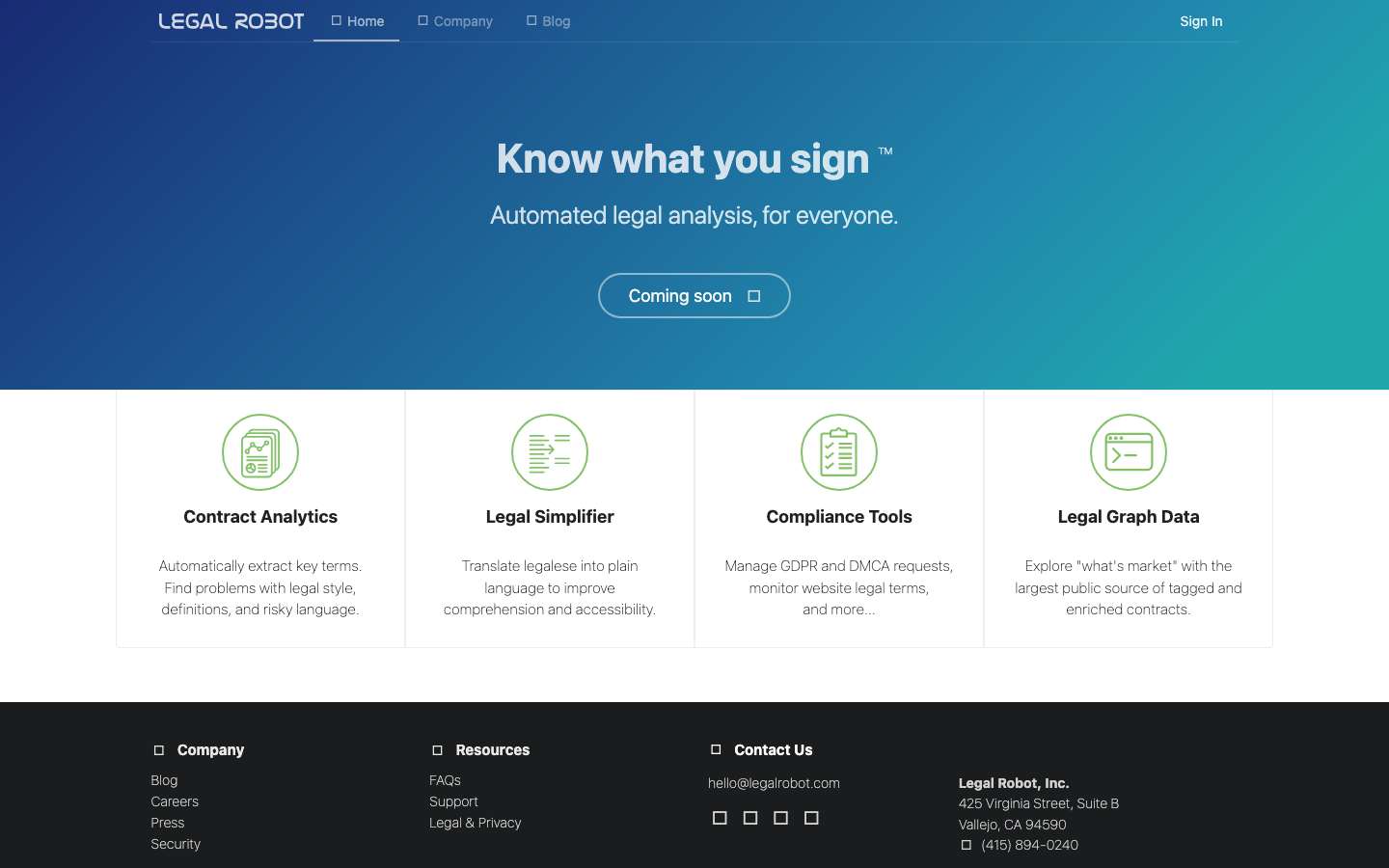
LegalRobot is an AI legal assistant platform for small and medium-sized enterprises and individuals, with the slogan "Know what you sign". It provides three core capabilities: contract analysis, legal simplification and compliance tools. Its unique feature is the establishment of a public legal graph database (Legal Graph Data) to help users understand "what the standard terms of similar contracts in the market look like."
LegalRobot
Core parameters and statistics
LegalRobot's legal technology route is significantly different from other legal AI tools: it extends the target users from lawyers to "everyone who signs a contract." Its unique selling point (USP) is "legal simplification" - using AI to translate complex legal provisions into everyday language that ordinary people can understand.
| Projects | Public Information |
|---|---|
| Official positioning | Automated legal analysis, for everyone |
| Headquarters | Vallejo, California |
| Core products | Contract analysis, legal simplification, and compliance tools Legal Graph |
| Target users | Small and medium-sized enterprises, individuals, entrepreneurs |
| Business Model | Free + Paid Subscription |
| Unique capabilities | Legal Graph Data (public contract terms benchmark database) |
| Compliance Coverage | GDPR, DMCA, and More |
| Support Platform | Web, API |
Differentiation from competing products: Unlike Kira Systems (for large law firms and M&A transactions) and Luminance (for corporate legal departments), LegalRobot is positioned as "legal AI for the public" - the founders clearly designed the product to "can understand contracts without a lawyer."
User and market recognition
LegalRobot’s user base is mainly small and medium-sized business owners, entrepreneurs and freelancers, rather than top law firms.
User Feedback: LegalRobot is well-known in the legal tech community, and its Legal Graph database in particular is recognized among researchers and the contract analytics community.
Market positioning: LegalRobot gave up the large law firm market with high unit prices and chose to serve long-tail SMB and individual users. This strategy makes its market larger but less valuable per user. Its main competitors are public-facing legal services platforms such as Rocket Lawyer and LegalZoom, not Kira or Luminance.
Community Asset: LegalRobot has built what may be the largest public contract terms database (Legal Graph), containing annotated and structured contract data sets. This has reference value for legal AI research and contract analysis tool development.
Cost advantage
- C-side/Individual: Usually a free version is provided to experience the core functions, and high-frequency use requires a paid package subscription.
- API/Developer: Billed by call volume, suitable for development teams that can be flexibly integrated into their own systems.
- Enterprise/Privatized: Contact the business owner for customized quotation and deployment plan. The specific price is subject to the official real-time pricing page.
Main functions
LegalRobot's functions are designed around "helping ordinary people understand and manage legal documents":
- Contract Analytics: Upload contract documents, and AI will automatically identify and extract key clauses (compensation clauses, confidentiality clauses, termination clauses, governing law, etc.), mark problematic legal terms, define conflicts and risk clauses. Unlike Kira Systems' in-depth clause extraction, LegalRobot's analysis is more focused on "discovering possible issues in the contract" rather than "extracting all structured data in the contract."
- Legal Simplifier: "Translate" complex legal terms into easy-to-understand everyday language. For example, interpret the "Indemnification" clause as "If something goes wrong because you use this service, you need to compensate the other party for the related losses." This feature is especially valuable to non-legal professionals.
- Compliance Tools: Manage GDPR Data Subject Access Requests (DSAR) and DMCA takedown requests, monitor changes to website legal terms (Privacy Policy, Terms of Service). This is more practical for small and medium-sized enterprises that do not have full-time legal affairs.
- Legal Graph Data: LegalRobot's featured asset - an open database of legal terms that allows users to search "What is the confidentiality period of a typical NDA in the market?" or "What is the compensation cap ratio in a standard SaaS contract?" This database provides a market benchmark reference for in-house legal teams when negotiating contracts.
- Risk Score: Provides an overall risk score for the contract to help users with non-legal backgrounds quickly judge the risk level of the contract.
Model and version evolution
Continuous iterative updates, the latest version introduces performance optimization and new features. Historical version information can be viewed on the official release page. There is no complete public version evolution timeline yet. It is recommended to pay attention to the official announcement to understand the rhythm of feature updates.
Technical advantages
Natural language legal simplification: LegalRobot has unique accumulation in NLP for legal text simplification. Its model can decompose long and highly complex legal clauses into simple subject-predicate-object structures, greatly improving readability while retaining legal meaning. This capability is extremely useful for non-legal users.
The Network Effect of Legal Graph Data: LegalRobot’s Legal Graph database is its unique competitive edge in the legal AI market – it is not a private training dataset, but a benchmark database of contract terms that users can publicly query. Every contract analyzed on the platform will contribute a data record to the database as long as the user agrees to be anonymized, forming a network effect.
Multi-dimensional analysis framework: LegalRobot's contract analysis is not limited to clause extraction, but also includes legal style evaluation (legal style, such as excessive use of passive voice, vague wording), definition density analysis, cross-reference consistency check, etc. This reflects its review perspective on contract quality rather than just being a clause extractor.
How to use
| How to use | Applicable scenarios |
|---|---|
| LegalRobot Web Platform | Directly upload documents or enter contract text for analysis |
| API calls | Batch processing or integration into own systems |
| Legal Graph Query | Query market benchmark data on contract terms |
Typical usage steps (individual/small and medium-sized enterprise use):
- Register a LegalRobot account (free tier).
- Upload the contracts that need to be reviewed (such as service agreement NDA, lease contract).
- Select the analysis mode (quick scan or in-depth analysis), and AI will automatically generate a contract analysis report.
- View key clause extraction, risk annotation and legal simplified explanations.
- If necessary, use Legal Graph to query market standards for terms in contracts of the same type.
- Export analysis reports for contract negotiation.
Product Pricing
LegalRobot’s pricing is based on a free + paid subscription model:
- FREE VERSION: Limited contract analysis times, basic clause extraction and legal simplification features. The specific free quota is subject to the latest information on the official website.
- Pro (Monthly/Yearly Subscription): Unlimited contract analysis, in-depth risk scoring Legal Graph data access and more detailed compliance tools. Pricing.
- API access: billed based on contract analysis volume, suitable for enterprises that need to integrate legal analysis capabilities in batches.
Application scenarios
- Contract review for entrepreneurs and SME owners: Core scenarios. When entrepreneurs receive an investment term sheet (Term Sheet) or supplier contract, use LegalRobot to quickly understand the risks and implications of key terms and avoid signing terms that are not beneficial to them. Benefits: Obtain a preliminary contract risk assessment before hiring a lawyer and reduce the cost of outside legal consultation.
- Service Agreement Management for Freelancers: When freelancers (designers, developers, consultants) receive service contracts from clients, use LegalRobot to identify key terms such as limitations of liability, confidentiality obligations, and ownership of intellectual property rights. Benefits: Protect your own rights and interests and avoid unreasonable liabilities due to "signing a standard contract".
- Small Business GDPR and Privacy Compliance: Small SaaS businesses without legal staff use LegalRobot's compliance tools to manage user privacy requests and monitor privacy policy updates. Benefit: Maintain base level of compliance at lower cost.
- Market benchmark research on legal clauses: Corporate legal counsel uses LegalGraph to query the specific expressions and negotiation scope of typical clauses in similar contracts in the same industry and before negotiations. Benefits: Get data to back up your negotiations and avoid accepting terms that are well below market standards.
Applicable people
- Entrepreneurs and small and medium-sized business owners: LegalRobot’s most valuable user group. Quickly understand key contract terms and risks without a legal background.
- Freelancers and independent workers: Groups who need to protect their contractual rights but do not have the budget for a lawyer.
- Nonprofits and Startup Teams: Organizations with limited budgets but in need of basic legal compliance capabilities.
Not suitable for boundaries: LegalRobot is not suitable for professional legal research or complex M&A due diligence of large law firms - the depth and accuracy of its analysis cannot meet the requirements of AmLaw 100 law firms; it does not support complex legal strategy analysis and court document drafting; although the legal simplification function is approachable, the simplified expression may lose accuracy in legal disputes; the coverage of its Legal Graph data (mainly US law) limits international use.
Summary and Outlook
LegalRobot fills an overlooked gap in the legal AI market – contract understanding tools for non-legal professionals. Its "Legal Simplified" and Legal Graph database are its differentiators, giving non-lawyer users access to basic contract review capabilities.
Current limitations: The depth of product functions is limited and not suitable for complex legal scenarios; the user base and brand awareness are far lower than those of law firm-oriented tools such as Clio and Casetext; the scale and quality of Legal Graph data depend on the user base, and the current limited user scale may limit the data network effect; the product iteration rhythm and stability are not transparent (the official website focuses on "Coming soon" rather than available functions).
Purchase & Adoption Risk Assessment: LegalRobot’s free tier is a low-risk entry option for SMB owners and individuals who want to quickly understand contracts. However, if legally binding contract review and negotiable recommendations are required, it is still recommended to use the AI output as a reference and ultimately rely on the opinions of a practicing attorney. Enterprises need to confirm the privacy terms of data processing before purchasing, especially whether the uploaded contract text will be used for training the Legal Graph database.
Version evolution of LegalRobot
| Milestone | Time | Description |
|---|---|---|
| LegalRobot founded | Undisclosed time | Headquartered in Vallejo, California |
| Release of contract analysis tool | Undisclosed | Initial contract basic analysis function launched |
| LegalGraph released | ~2022 | Public contract terms database, differentiated core |
| Compliance Tools Expansion | ~2023 | Added GDPR and DMCA Compliance Management |
| Continuous iteration | So far | Continue to improve the AI analysis engine and database coverage |
Business process integration and ROI analysis
As a productivity tool for businesses or professional positions, LegalRobot’s true value depends on its depth of integration with existing workflows and quantifiable efficiency improvements. The following is a systematic analysis from three core dimensions.
System integration and data interoperability The ability to interoperate with existing business systems is a key prerequisite for productivity tools to be integrated into workflows. It is recommended to focus on evaluating the following integration dimensions: the openness and documentation quality of the RESTful/GraphQL API (whether a complete API reference and SDK examples are provided), the support scope of Webhook event notifications (which business event types are supported for automatic push), the number and depth of pre-built integrations with common collaboration SaaS tools (WeChat Enterprise, DingTalk, Feishu, Slack, Notion, Jira, etc.), and enterprise-level identity authentication support (SSO/SAML/OAuth and LDAP/AD directory integration). Products that lack integration capabilities are easily isolated into information islands, which in turn increases the cognitive cost and operational friction for teams to switch between different tools.
Efficiency Quantification and ROI Estimation Methodology Before purchasing decisions, it is recommended to quantify the input-output ratio through a structured method: Step 1, choose 3-5 Standardized tasks that are frequently repeated and time-consuming in each team are used as test samples; in the second step, the average time consumption of a single task before and after tool intervention, first-time pass rate or error rate, and the number of links requiring manual intervention are recorded under controlled conditions; in the third step, the saved manpower time is converted according to the comprehensive cost of the position (salary, benefits, management sharing), and soft benefits (increased employee satisfaction, standardization of work quality, and improvement in response speed to core business) are superimposed to obtain a comprehensive ROI estimate. It is recommended to continue tracking ROI trends on a monthly basis, as the value of a tool usually increases over time as team proficiency increases and workflows are optimized.
Phase-based implementation strategy and risk control It is recommended to adopt a three-stage implementation path of "pilot verification-gradual promotion-continuous optimization". In the pilot stage (1-2 weeks), a single team or a single business scenario is selected for small-scale verification. The core goal is to verify technical feasibility and user acceptance, and establish preliminary usage specifications and success standards; in the promotion stage (2-4 weeks), after the pilot verification is passed, the coverage is gradually expanded, and standardized activation processes and training materials are developed; in the optimization stage (continuous), the workflow configuration is continuously adjusted based on actual usage data and user feedback, and more high-value application scenarios are explored. Clear quantitative key result indicators should be set at each stage to avoid blindly expanding the scope of use without data support.
Version Info
- Legal Robot 2026 Release :Continuous improvements to the contract analysis engine and legal simplification capabilities, expanding Legal Graph data coverage. There is no official precise date yet.
- LegalRobot 2.0 :Introducing Legal Graph data capabilities and an improved contract analysis engine. There is no official precise date yet.
User Reviews