 LibreChat
Free
LibreChat
Free
LibreChat is an open source AI chat assistant for developers, teams and enterprises, unifying OpenAI, Anthropic, Google, Azure, AWS Bedrock and more compatible endpoints into the same interface, while providing AI Agent, MCP, code interpreter Artifacts, multi-user authentication and self-hosting capabilities. The core value is not to "re-create a chat box", but to converge decentralized model access, permission management and tool access into an auditable and scalable internal AI portal.
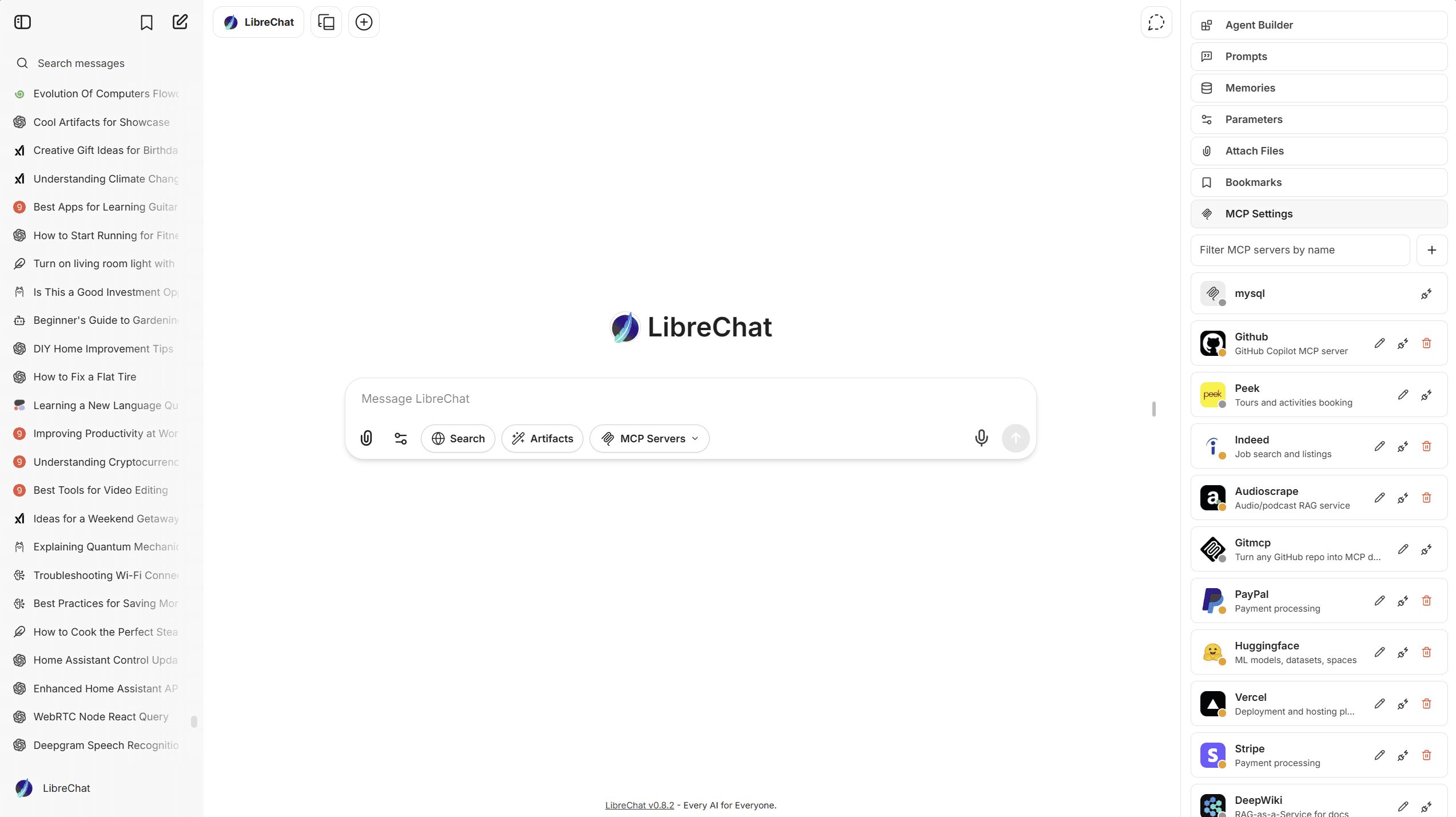
LibreChat
Core parameters and statistics
| Parameters | Official verifiable information |
|---|---|
| Product positioning | Free, open-source AI platform / self-hosted AI chat platform |
| Open Source License | MIT License |
| Multi-model support | OpenAI, Anthropic, Google, Azure, AWS Bedrock and more compatible endpoints |
| Core Extensions | Agents, MCP, Code Interpreter, Artifacts, Web Search, Memory |
| Enterprise capabilities | OAuth2, SAML, LDAP, two-factor authentication Moderation, Admin Panel |
| Market Signals | 40.2k GitHub stars, 8.2k forks, 373 contributors, 41M Docker pulls |
| Multilingual interface | 30+ languages |
| Current document mainline | Docs annotation v0.8.x (latest) |
A brief comment: LibreChat is not "another ChatGPT clone site", but an open source AI portal that packages multiple models, tool calls, permissions management and self-hosted deployment into a unified entrance.
Publicity Verification: The official describes it as a unified, customizable interface, which is basically true. The real pain point it hits is not that "chat looks better", but that enterprises or development teams don't want to switch back and forth between OpenAI, Anthropic, Google, intranet models and a bunch of independent tools, nor do they want to spread permissions, auditing and deployment logic into multiple SaaS.
User and market recognition
The homepage of the official website directly lists 40.2k GitHub stars, 41M Docker pulls, and 373 contributors. The About page states that it has grown from a "single developer project" to an open source infrastructure maintained by hundreds of contributors and adopted by thousands of organizations. The customer wall on the homepage publicly displays the logos of Shopify, Daimler Truck, Boston University, ClickHouse, Stripe and other organizations, indicating that its audience has expanded from individual users to team and enterprise internal platform scenarios.
This type of market recognition has two meanings. First, LibreChat is no longer an experimental warehouse, and the community activity and version rhythm are fast enough. Second, the reason for its adoption is not the model capability itself, but the combination of “unified frontend + controllable backend”. For many teams, gathering access habits that were originally scattered among 4 to 6 model portals into an internal portal is an improvement in organizational efficiency.
Cost advantage
| Cost layers | LibreChat's exposure | What cost items to really look at |
|---|---|---|
| Personal/C-side | The official website clearly states Open Source & Free, No subscriptions, no restrictions | There is no subscription fee, but you still have to prepare the model Key and run it yourself |
| Developer/Team | Free self-hosting, Docker and various cloud deployment templates available | Server, storage, logs, authentication, upgrade and maintenance are the responsibility of the team themselves |
| Enterprise | The official emphasizes enterprise ready, but does not disclose the standard SaaS price | SSO, compliance audit, operation and maintenance manpower, strategic governance, and online change process are the big ones |
The truth about free: LibreChat’s “free” only means that the software license is free, but it does not mean that the total cost of ownership is zero. You still have to pay the underlying model calling fee, deployment resource fee, observability cost, and maintenance overhead caused by version upgrades.
Hidden benefits/costs: If each person in the team originally saves a set of model addresses, prompt words, and tool configurations, LibreChat can converge "a private workbench for each person" into a "standard front desk shared by the team." Judging from the process deduction, opening an AI workbench for new members can often be reduced from half a day to a day of bulk configuration to 10 to 20 minutes of unified access and permission allocation. This is not an official commitment, but a typical organizational benefit after platformization.
Main functions
- Unified entry for multiple models: Switch between OpenAI, Anthropic, Google, Azure, AWS Bedrock and OpenAI-compatible endpoints in the same interface to prevent the team from spreading their model usage habits to multiple products.
- Agents + Skills + Subagents: Not only can you chat, but you can also encapsulate reusable instructions, resources and permissions into Skills, and then let the main Agent coordinate the Agent to complete the division of labor.
- MCP Tool Access: Connect external tools, data sources and services to the conversation flow through the Model Context Protocol, without having to re-create a plug-in integration layer each time.
- Code Interpreter and Artifacts: Support safe sandbox execution of code and generate React, HTML, Mermaid and other products in chat, suitable for turning "answers" into "deliverables".
- Enterprise Authentication and Authority Management: OAuth2, SAML, LDAP, two-factor authentication Moderation, and Admin Panel appear together, indicating that it is not designed to only serve a single user.
- Search Memory, RAG and file capabilities: Supports message search, persistent memory, file upload OCR, Web Search, RAG API, and advances the chat workbench to the knowledge entry layer.
Expert view: The synergy of these functions is not that it has "multiple functions", but that it puts model routing, tool access, permission system and workflow interaction in one shell. The actual value is to reduce context migration and no longer have the split link of "chat in A, file analysis in B, code execution in C, and permission approval in D".
Model and version evolution
LibreChat's evolution rhythm is quite engineering, and the main version line continues to advance around three things: more model access, deeper Agent/MCP capabilities, and stronger enterprise operability and maintainability.
| Version | Date | Key Changes |
|---|---|---|
| v0.8.7 | 2026-06-23 | Chat Projects, contextual cost display, dynamic Skills, access control enhancement, default packaging Admin Panel |
| v0.8.7-rc1 | 2026-06-14 | MCP OBO, shared link ACL, role synchronization Subagent and Skills enhancements |
| v0.8.6 | 2026-05-31 | Agent Skills, Subagents, Prometheus, OpenTelemetry, MCP/Auth reinforcement |
| v0.8.5 | 2026-04-21 | Admin Panel basics, automatic summary of long conversations, interface reconstruction MCP performance improvements |
| v0.8.4 | 2026-03-20 | 30+ security fixes, MCP reconnection protection artifact, rendering stability enhancement |
As can be seen from this trajectory, LibreChat is now no longer just about "supporting more models." It is moving closer to a manageable Agent platform, especially Subagents, Skills, MCP permissions and Admin Panel, which pave the way for large-scale use by teams.
Technical advantages
Unified front-end, decoupled back-end model suppliers: The most direct technical advantage is not that the model is stronger, but the decoupling of the front-end interaction layer and the back-end model supplier. Teams can switch underlying models and endpoints without changing the user interface, which is critical for cost optimization and supplier substitution.
Compliance controllability brought about by open source self-hosting: The official About page clearly emphasizes Self-Hosted and full privacy & compliance, and the Privacy page also explains that the document site itself minimizes data collection. This doesn’t mean your business is naturally compliant, but at least the platform architecture allows you to keep data, authentication and audit control in your own hands.
The engineering coupling between Agent and MCP is high: Many products divide "Chat", "Tool Call" and "Agent" into several product lines. LibreChat puts Skills, Subagents, MCP Servers, Artifacts, and Code Interpreter in the same running environment, which is suitable for internal AI operation consoles.
Enterprise readiness rather than enterprise packaging: OAuth2, SAML, LDAP, 2FA, Moderation, Admin Panel. Such capabilities determine whether it can enter the organization, not just whether it can attract geeks to try it out.
How to use
| How to use | Suitable for whom | Instructions |
|---|---|---|
| Official Demo | Individual users who want to quickly experience the interface | Experience product interaction through chat.librechat.ai |
| Local/Self-Hosted Deployment | Developer, Team, In-house Platform | Deployment by Local Install or Remote Install as per official Docs |
| Cloud template deployment | Teams who want to go online quickly | The official README provides deployment entrances for Railway, Zeabur, Sealos, etc. |
| Internal enterprise platformization | Organizations that need unified model entry and authority management | Combine SSO, Admin Panel, MCP, and Moderation for unified access |
The typical usage path is not complicated: first determine which models and compatible endpoints to access, then configure the organization's authentication method, and then gradually add MCP tools, code interpreters, search and sharing agent workflows. The most common implementation method is not to "enable all functions at once", but to first create a unified dialogue entrance, and then gradually open the tool to call Artifacts and team permission control.
Human-machine collaboration boundary: LibreChat can automate many model accesses and tool calls, but when it comes to irreversible actions such as releasing production configurations, deleting data, making payments, sending external letters, and writing to the work order system, they should still be placed behind the human confirmation point. It is good at creating a unified operating platform, but is not suitable for canceling all approvals for you.
Product Pricing
The LibreChat official website does not disclose the standardized cloud subscription price. The public statement is MIT licensed. No subscriptions, no restrictions. This means that the software itself is free, but your purchasing decision still needs to be based on three levels:
- Software licensing fee: Open source is free, and there is no subscription threshold based on seats.
- Model usage fee: determined by OpenAI, Anthropic, Google or your own compatible endpoint.
- Platform operation and maintenance fees: Servers, databases, caches, object storage, logs, authentication integration, upgrades and regressions all need to be paid for by yourself.
If the team pursues "out-of-the-box, knowledgeable, standard SLA", LibreChat's total cost may not be lower than pure SaaS; but if you want to unify multiple model entrances, reduce vendor lock-in, and retain data control, its cost structure will be more controllable.
Application scenarios
1. Enterprise internal AI portal Gather the capabilities originally scattered in multiple model sites, browser plug-ins and temporary scripts into a unified portal, suitable for sharing by product, R&D, operations, legal and other teams.
2. Organizations that require self-hosting and authority governance When a company cannot keep internal documents, prompts, and chat logs in an external SaaS for a long time, a self-hosted front-end like LibreChat will be better implemented.
3. Multi-model comparison and cost routing The team wants to consolidate the routing strategy of "use A for code writing, B for deep reasoning, C for image generation, and D for private models." LibreChat is more stable than everyone's own script.
4. Agent workbench and tool arrangement frontend When you need to put MCP, file processing, code execution artifacts and shared skill packages in an interactive layer, LibreChat is more like a complete workbench than a pure chat product.
5. Efficiency improvement deduction scenario For R&D or operations teams that frequently use AI, a common change is from "switching back and forth to 5 web pages and copying context 3 times for different models and tools" to "complete most interactions at 1 entrance." These time improvements typically come from context and permission convergence rather than faster single builds.
Applicable people
- Developers and Platform Team: Need to unify model access, control deployment methods, and manage multiple tools and certification systems.
- Enterprises with high security and compliance requirements: Want to deploy the AI frontend within their own boundaries and do not accept a completely black box external SaaS.
- Heavy AI usage team: Work across multiple models and multiple tools every day, hoping to consolidate the workflow into a shared standard.
- Organizations that want to build an internal Agent portal: need to host chat, tools, files, search and permissions in the same portal.
Dissuaded/not applicable: Individual users who just want to "register and use without operation and maintenance, or adjust configuration" are usually more suitable to use mature SaaS chat products directly; small teams without infrastructure and maintenance capabilities may also be backlashed in upgrades, monitoring, and permission design.
Summary and Outlook
The core value of LibreChat is not to replace a single model, but to sew model supplier Agent, MCP, code execution and enterprise permissions management into a unified front-end. Its most lethal scenario is when the organization has determined that "AI is not a single trial, but needs to enter the formal workflow." At this time, the value of the unified entrance and self-hosted boundaries will be rapidly amplified.
Its procurement/adoption risks are also clear: free software does not mean low total cost. The real difficulty lies in operation and maintenance capabilities, upgrade rhythm, permission design, model cost management, and manual approval strategy for irreversible actions. If the team does not have a clear owner and basic platform engineering capabilities, LibreChat can easily change from a "unified entrance" to a "unified acceptance point for multi-model problems." The direction worth paying attention to in the future is the direction of Agentic Data Stack after it is integrated with the ClickHouse ecosystem, and whether the Admin Panel, MCP permissions and Subagent capabilities will be further productized.
Related tools:  DeepSeek,
  ChatGPT
Version Info
- LibreChat v0.8.7 :The latest public version currently focuses on adding Chat Projects, contextual usage and cost display, Agents that can dynamically write Skills, stricter sharing links and OpenID/MCP access control, as well as the default packaged Admin Panel and independent Code Interpreter.
- LibreChat v0.8.6 :Introducing Agent Skills and Subagents, Prometheus and OpenTelemetry observation capabilities, Prometheus indicator MCP and authentication reinforcement, as well as new models and multi-modal support.
- LibreChat v0.8.5 :Added Admin Panel basic capabilities, long conversation automatic summarization and context compression Claude Opus 4.7 support, interface reconstruction, and more stable MCP and cache links.
User Reviews