 Linkup
Free
Linkup
Free
Linkup provides an enterprise-level web data API covering fetch, search, research and private indexing capabilities.
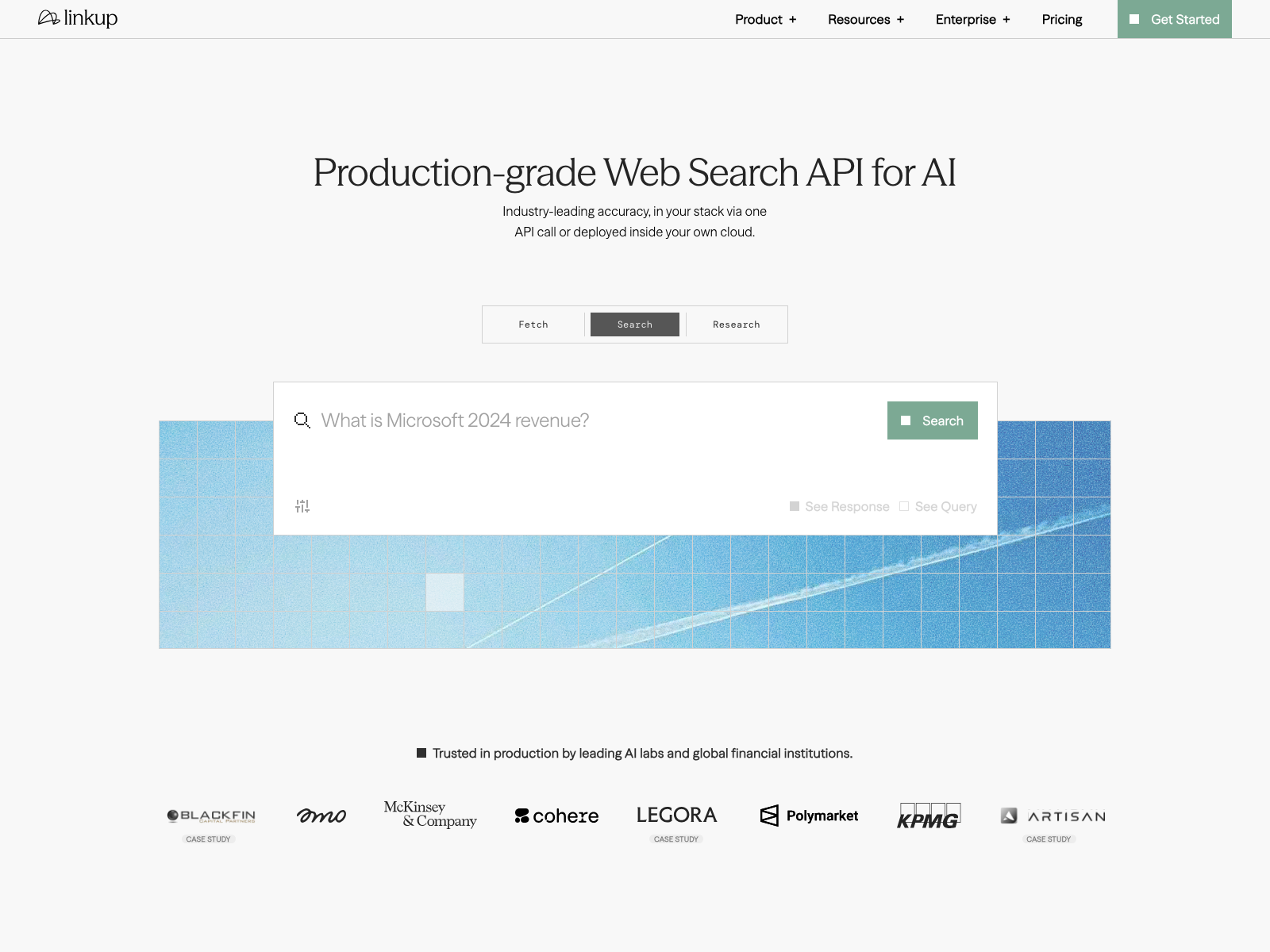
Linkup: In-depth analysis of the enterprise AI retrieval layer of production-grade web search APIs
1. Tool introduction
Linkup is an enterprise-level AI search infrastructure provider headquartered in France (FR). Its core product is a set of production-level Web Search APIs designed to provide real-time, accurate, and manageable Internet data access capabilities for large language models (LLM) and AI Agents. Linkup is not positioned to replace general search engines (such as Google/Bing), but as the "retrieval production layer" of the AI system - the middleware between LLM and the Internet, responsible for transforming unstructured massive network data into structured context that LLM can consume.
Linkup's core value proposition revolves around four keywords: Accuracy, Customizability, Security and Low Latency. Its Search endpoint ranks first in the Verified SimpleQA benchmark with an F-score of 92% (Source: Linkup official documentation and open source evaluation framework https://github.com/LinkupPlatform/eval-simpleQA), and its Research endpoint also ranks first in the SealQA-0 benchmark (61% accuracy). These data mean that Linkup provides industry-leading implementation performance in the key AI engineering practice of "Search-Augmented Generation".
From the perspective of product form, Linkup is not a search engine for C-side consumers, but an API platform for developers and enterprises. It provides a complete spectrum of capabilities from millisecond-level synchronous search to minute-level asynchronous in-depth research, covering different scenarios faced by AI systems when acquiring external knowledge - from simple real-time question and answer to complex multi-source comprehensive reports. The team includes many demanding customers including EY, Cohere, McKinsey, KPMG, Databricks, SNCF (French National Railways) and the German Federal Government (Source: Linkup official website https://www.linkup.so/ and case study page).
Linkup's API design embodies the engineering "hierarchical routing" thinking: by mapping tasks of different complexity, different costs, and different delays to different endpoints (Search / Fetch / Research / Tasks / Extract), developers can make on-demand decisions under a unified API framework, avoiding the waste of efficiency or loss of control caused by the traditional practice of all retrieval requests taking the same path. This is especially critical for enterprise teams that need to finely control the operating costs of AI systems.
2. Core functions
Linkup currently publicly provides five API endpoints, each of which is targeted at different retrieval scenarios. They are significantly different in latency mode, cost structure, and output form. By understanding the design logic of these five endpoints, you can basically grasp the product panorama of Linkup.
2.1 Search (synchronous search)
Search is the core high-frequency entrance of Linkup and is also the endpoint most commonly called by most AI Agents. It accepts a natural language query and returns a sorted list of search results or a natural language answer with quotes.
Search offers three depth modes:
- Fast: sub-second latency, no LLM is called, the query is passed unchanged to the index for retrieval. It is suitable for scenarios that require extremely low latency and do not require query semantic understanding, such as real-time voice agents or simple factual question and answer.
- Standard: Single-round Agentic search, the system understands the query intent, can perform parallel sub-searches and crawl the URL specified in a query. Delay of 1-3 seconds provides a balance between speed and quality, suitable for most search needs in everyday AI applications.
- Deep: Multiple rounds of Agentic search and crawling chain processing, the system will iteratively execute the search-evaluation-research cycle until it finds information that meets the query requirements. Delay of 5-30 seconds, ideal for complex questions that require cross-validation across multiple sources, such as legal research or technical comparisons.
Search supports three output types:
- searchResults: Returns an array of
{name, url, content}, suitable for RAG pipelines that need to process the results themselves at the application layer. - sourcedAnswer: In addition to the search results, a natural language answer with inline quotes is returned, suitable for presentation directly to the end user.
- structured: Returns structured output matching the JSON Schema provided by the caller, suitable for data extraction and ETL scenarios.
Search also provides control parameters such as domain name filtering (includeDomains / excludeDomains, up to 100 domain names), date range limitation (fromDate / toDate ISO 8601 format), upper limit on the number of results (maxResults), and image extraction (includeImages).
Expert View: Search’s three depth modes and three output types are combined into a 3×3 decision matrix, which developers can freely route based on the different requirements of the task on latency, accuracy, and cost. For example, a sales agent can use standard + searchResults (weighing speed and recall) for real-time query of customer company information, while in-depth research on competitive product dynamics can use deep + sourcedAnswer (quality first). This flexibility is not yet fully aligned in competing products such as Tavily and Exa.
2.2 Fetch (synchronous page capture)
Fetch is a URL content extractor. Given a URL, it returns clean LLM-ready consumable Markdown formatted content. Both HTML and PDF document types are supported.
Key parameters include:
renderJs(boolean, default false): Whether to render JavaScript. For client-side rendered SPA sites, dashboards, or modern marketing pages, set to true to get the full content.includeRawHtml(boolean, default false): Whether to also return raw HTML for custom parsing or preservation of structures that Markdown cannot express.extractImages(Boolean value, default false): Whether to extract the image URL list in the page.
Fetch does not process content behind the login wall (returns content visible to anonymous visitors) and returns a 400 error if the page size exceeds 20MB.
Expert view: Fetch is essentially a "content completer" for Search - the relevant source summaries returned by Search are usually just fragments, while Fetch can pull the complete page content into the LLM context for in-depth analysis. In actual workflows, the combination of Search + Fetch is the most common golden partner: Search first locates relevant sources, and then initiates Fetch for high-value pages to enter the full text into the database.
2.3 Research (asynchronous in-depth research)
Research is the most powerful endpoint of Linkup - an autonomous research agent that can conduct multi-step, multi-source autonomous research on the network, and ultimately deliver in-depth reports or precise answers with inline references.
Research offers three modes:
- answer: For questions with deterministic answers, return precise answers after validation across multiple sources. Suitable for "what is the correct answer to a specific question?" scenario.
- investigate: Focus on a single topic to conduct in-depth research from multiple angles and verify claims. Suitable for "in-depth understanding of an entity" scenario.
- research: Structured reports organized by topic to cover multiple topics in parallel. Suitable for open-ended, cross-field comprehensive research.
Research provides four reasoning depth levels (S/M/L/XL) to control the thoroughness of the research:
| Depth | Description | Estimated Delay | Cost |
|---|---|---|---|
| S | Light coverage for short, multi-step surveys | 2-5 minutes | $0.25/time |
| M | Balanced cost-effectiveness, suitable for daily use | 3-7 minutes | $0.50/time |
| L | Thorough research, high-quality answers suitable for delay budget | 5-10 minutes | $1.50/time |
| XL | Exhaustive coverage, suitable for scenarios where integrity takes priority over latency | 10-20 minutes | $2.50/time |
Defaults to L when not specified.
Research adopts an asynchronous life cycle: POST /v1/research returns the task ID immediately (the status is pending), and the client polls through GET /v1/research/:id until the status changes to completed or failed. The official recommendation is that the polling interval is 5-10 seconds. If the polling interval exceeds 1 time/second, the polling interval will be limited.
Expert View: The design logic of Research is to compress "desktop research that traditionally takes human analysts several hours to complete" to automated output at the minute level. Its core value lies in the separation of mode (which determines research strategy) and depth (which determines research budget) - analysts can dynamically allocate resources based on the urgency and importance of the problem. However, it should be noted that Research is still in the Beta stage (as of mid-2026), and its stability still needs to be fully verified under high-frequency production conditions.
2.4 Tasks (asynchronous batch tasks)
Tasks is a batch scheduling endpoint that allows up to 100 Search / Fetch / Research subtasks to be submitted in one request. The system processes them asynchronously in parallel and returns the results of each subtask. Suitable for batch data collection, scheduled crawling, and background workload loads. Delays range from 1 second to 20 minutes (depending on the specific type and configuration of the subtask).
2.5 Extract (structured data extraction, closed beta)
Extract is Linkup’s latest endpoint – given a seed URL and a query, returns downloadable structured rows of data. Suitable for extracting duplicate records from known pages, such as product lists, job lists, business directories, etc. It is currently in closed beta, and you need to apply for access.
Expert view: Extract fills the gap of "extracting structured data from web pages" in the Linkup product line, extending it from a pure search tool to "Web Scraping as API". For teams that need to regularly obtain data from structured pages (such as e-commerce listings, recruitment websites, and yellow pages), this can replace the traditional Scrapy / Puppeteer custom crawler solution, exchanging API calls for maintenance costs.
3. Pricing strategy
Linkup uses a pay-as-you-go model, and pricing is based on a combination of endpoint type and configuration parameters. The platform does not differentiate between individual/enterprise levels. All users share the same set of unit prices, and corporate customers obtain customized prices and additional services through business negotiation.
3.1 Free quota
New users who register will receive 4,000 free queries and can start testing without binding a credit card. This credit is sufficient for the PoC (proof of concept) stage and small-scale prototype development - assuming an AI Agent makes 100 search calls per day, the free credit can support an experiment cycle of about 40 days.
3.2 Pricing details by endpoint
| Endpoints | Configuration | Unit Price | Delay Mode |
|---|---|---|---|
| Fetch | renderJs=false |
$0.001/time | Sync, ~1s |
| Fetch | renderJs=true |
$0.005/time | Sync, ~1-3s |
| Search | fast/standard + searchResults | $0.005/time | Sync, <1-3s |
| Search | fast/standard + sourcedAnswer/structured | $0.006/time | Sync, <1-3s |
| Search | deep + searchResults | $0.05/time | Sync, 5-30s |
| Search | deep + sourcedAnswer/structured | $0.055/time | Sync, 5-30s |
| Research | Depth S | $0.25/time | Asynchronous, 2-5min |
| Research | Depth M | $0.50/time | Asynchronous, 3-7min |
| Research | Depth L (default) | $1.50/time | Asynchronous, 5-10min |
| Research | Depth XL | $2.50/time | Asynchronous, 10-20min |
| Tasks | Mixed (up to 100 subtasks) | Cumulative by subtask type | Asynchronous, 1s-20min |
| Extract | Closed Beta | Unpublished | Asynchronous, depending on data volume |
The above price information comes from Linkup’s official pricing page (https://www.linkup.so/pricing) and official documentation (https://docs.linkup.so/), as of July 2026. The actual price is subject to the official real-time page.
3.3 Enterprise Pricing
Enterprise customers can choose from the following options:
- Customized pricing model: Negotiate exclusive pricing based on usage scale, privatized deployment needs, and SLA requirements.
- Private Index: Build an exclusive and controlled internal data index to support the integration of enterprise-owned data and public network retrieval.
- BYOC (Bring Your Own Cloud): The complete index layer is deployed in the customer's own VPC, and the query data never leaves the customer's territory.
- Exclusive features: IP whitelist, higher refresh frequency SSO, exclusive dashboard, exclusive technical support.
In addition, Linkup provides startups with an application channel for $5,000 free quota (source: Linkup official website/startups page), which is a substantial cost reduction for early-stage AI entrepreneurial teams.
3.4 Three-tier cost analysis
- C-side/Individual Developer: Used as an API consumer, the free quota covers personal projects and small prototypes. If you upgrade to paid use, the cost of Search calls is about $0.005-0.055/time. Based on an average of 500 times per day, the monthly fee is about $75-825. Because the unit price of Research calls is high, it is recommended to only use it for key research tasks in personal scenarios.
- API Developer/Product Integration: Called by endpoint routing, Fetch ($0.001-0.005/time) is suitable for high-frequency and low-value content capture, Search ($0.005-0.055/time) is suitable for online Q&A, and Research ($0.25-2.50/time) is suitable for high-value complex analysis. It is recommended to further reduce costs through batch processing of Tasks.
- Enterprise/Large Scale Deployment: Customized price needs to be obtained through business negotiation. The cost of private indexing and BYOC depends on the data volume, refresh frequency and context scale. The public page does not provide complete contract details. It is recommended to contact the sales team directly to obtain a quote.
Expert View: Linkup's tiered pricing is highly consistent with its endpoint design logic - giving decision-making power to developers to choose appropriate calling links based on task value. However, it should be noted that the price range of the Research endpoint ($0.25-$2.50/time) is much higher than that of Search. If it is used for daily Q&A without control, the monthly bill will quickly expand. It is recommended to implement a "cost routing strategy": route simple factual queries to Search fast, route complex surveys to Research, and set fallback logic in the middle layer.
4. Analysis of advantages and disadvantages
4.1 Core Advantages
- Industry-leading accuracy: The Search endpoint ranks first in the Verified SimpleQA benchmark with 92% F-score (source: Linkup official documentation and the https://github.com/LinkupPlatform/eval-simpleQA open source evaluation tool), and the Research endpoint ranks first in the SealQA-0 benchmark with 61% accuracy. These are not marketing metrics that speak for themselves, but test results that are reproducible with public assessment tools.
- Rich endpoint ecosystem: Five endpoints cover a complete spectrum of capabilities from millisecond-level synchronous search to minute-level asynchronous in-depth research, and each endpoint provides fine-grained parameter control. Developers can complete most retrieval needs within a single API framework without the need to splice multiple third-party services.
- Enterprise-grade security compliance out of the box: SOC 2 Type II certification, Zero Data Retention (ZDR) policy GDPR-compliant SSO support, these capabilities that are a hard threshold in enterprise procurement, Linkup provides by default in all paid tiers, rather than as an add-on feature.
- Flexible Deployment Options: From public cloud APIs to private indexes to BYOC (own VPC deployment), Linkup offers a gradient of data sovereignty from zero to the highest. For regulated industries (financial, healthcare, government), BYOC options allow them to meet the most stringent data residency requirements.
- Active integration ecosystem: Officially provides Python SDK (
linkup-sdk) and JavaScript SDK, supporting OpenAI SDK wrapper LangChain, CrewAI, LlamaIndex, Vercel AI SDK, n8n, Composio and other mainstream frameworks. It also provides an MCP server, which can directly call Linkup tools in MCP clients such as Claude Code, Cursor, VS Code, and Codex. - Source Diversity: Linkup's index covers a wide range of sites and is not limited to sites in a specific language or region. This is particularly important for global AI applications that require multi-language and multi-regional information retrieval.
- 99.9% Availability SLA: Provides enterprise-level service level agreement guarantee, suitable for production environments with strict requirements on stability and reliability.
4.2 Obvious shortcomings
- Research endpoint still in Beta: As Linkup's most powerful endpoint, Research is currently still in Beta (as of mid-2026), and behavior and parameters are subject to change. For production-level in-depth research pipelines that require extremely high stability, there is a certain risk of uncertainty.
- Extract endpoint is in closed beta: Structured data extraction functionality is only available to those who apply, and parameters and behavior are not yet fully public. For teams that need to ingest structured web data on a regular basis, this functionality cannot currently be relied upon going into production.
- Lack of C-side product form: Linkup's delivery form is entirely API, and there is no search interface or Dashboard application for end users. This has a high threshold for non-technical decision-makers who want to quickly experience the value of the product.
- Research cost may be out of control: Deep XL mode costs $2.50 per call. If used directly in production at scale without caching and routing optimization, the cost may be significantly higher than expected. Teams need to establish call auditing and budget control mechanisms.
- Regional Awareness from European Headquarters: Although Linkup serves global customers, the background of its French headquarters (FR ownership) and European team may lead to some uncertainty in terms of response speed, node latency and support coverage in the Asia-Pacific region.
- Competition with search engine giants: Linkup's direct competitors include traditional search engine APIs such as Google Custom Search API and Bing Search API, as well as emerging AI search APIs such as Tavily and Exa. There is still a significant gap with Google/Bing in terms of index coverage and brand recognition.
- Maintenance costs of private indexes: Building and maintaining private indexes requires the team to invest data engineering resources, and the quality of private indexes is highly dependent on data preprocessing and update strategies. For teams with insufficient data engineering capabilities, this can become a hidden burden.
5. Applicable scenarios
5.1 Best adaptation scenario
- AI Agent real-time knowledge access: When the AI Agent needs to make a judgment based on the latest network information (such as "What news did such-and-such company release today?"), the Linkup Search fast/standard endpoint can return relevant sources in sub-seconds, effectively reducing the Agent's hallucination rate. According to data from Linkup’s official website, customers have achieved 30% illusion reduction and 100% critical use case unlocking in production environments.
- Enterprise Compliance Retrieval System: In scenarios such as financial compliance review, legal due diligence, supply chain risk assessment, etc., information needs to be obtained and cross-verified from multiple authoritative sources. Linkup’s Search deep + Research combination automates this process, and SOC 2 and ZDR guarantee audit trails and data privacy.
- Sales and Market Intelligence: Sales enablement Agent can obtain the target company's dynamics (financing, personnel changes, product launches) in real time through Linkup, and then integrate this information into CRM. Case Study: Artisan uses Linkup to provide web-scale data access to its sales agent "Ava" (Source: Linkup Case Study - Artisan).
- Academic and Industry Research: The investigate and research modes of the Research endpoint can automatically complete literature reviews, competitive product analysis, market research reports, etc. Desktop research that traditionally takes analysts 2-4 hours can be compressed to 5-20 minutes.
- Legal AI Assistance: Linkup customer Legora has deployed a production-grade web search infrastructure to provide legal AI with up-to-date legal AI support (Source: Linkup Case Study - Legora).
- Voice AI real-time search: The sub-second delay of Search fast mode makes it suitable for voice interaction scenarios, such as smart speakers, customer service voice assistants and other applications that are sensitive to first word delay.
- Batch data collection and analysis: The Tasks endpoint allows the submission of up to 100 subtasks at one time, which is suitable for background workloads such as scheduled data collection, batch competitive product monitoring, and large-scale public opinion analysis.
5.2 Not applicable/use with caution
- Universal Search Engine Alternative: Linkup is not a Google/Bing replacement. It does not provide a general web search UI, no vertical search cards such as pictures/videos/news, etc., and does not support user interactive browsing. If the team needs a search box product for end users, they should consider solutions such as Google Programmable Search or Algolia.
- Low-frequency internal knowledge Q&A: If the company only needs an internal FAQ bot, and the knowledge base is small in size and updated infrequently, using Linkup's external search capabilities may be over-engineering. Local vector databases (such as Pinecone, Chroma) combined with embedded models can meet the needs and cost less.
- Extra-Long Contextual Role Play: Linkup's strength is in retrieving factual information, rather than providing the long narrative content required for creative writing or role play. Linkup is not the appropriate component for scenarios that require LLM to be creative rather than retrieval.
- Highly customized visual design output: The Markdown format output by Linkup is suitable for LLM consumption, but requires additional front-end processing to be rendered into a user-oriented visual page. If the team needs an out-of-the-box search results page, they need to develop the UI layer themselves.
- High-frequency trading/real-time bidding scenarios that are extremely sensitive to latency: Although Search fast mode has sub-second latency, considering the cumulative overhead of network latency, API gateway processing and result sorting, it may still not be enough for microsecond-level trading decision scenarios. This type of scenario is more suitable for localized indexing solutions.
6. Summary
Linkup has found a precise differentiated positioning in the rapidly growing "AI search infrastructure" track: a Web Search API for AI systems rather than for humans. It is not another search engine, but an intelligent middleware between LLM and the Internet - transforming raw web data into structured context that LLM can consume, while taking on non-functional responsibilities such as accuracy verification, source citation, content cleaning, and permissions management.
From the perspective of product maturity, Linkup has passed the "proof of concept" stage, has an enterprise customer base including EY, Cohere, McKinsey, KPMG, Databricks, SNCF and other well-known institutions, obtained SOC 2 Type II certification, and established a complete functional matrix for enterprise scenarios (Search / Fetch / Research / Tasks / Extract + Private Index + BYOC). This gives it a clear credibility advantage in the transition from PoC to production.
From an engineering perspective, Linkup's most commendable design is its "layered routing" concept - by mapping tasks of different complexity, cost, and latency to different API endpoints, developers can make on-demand decisions within a unified framework, instead of all requests taking the same path. This design directly targets the core pain points faced by enterprise teams when building AI systems: how to achieve the optimal balance between accuracy, cost, and latency. The answer given by Linkup is "it does not make choices for you, but gives you the tools to make choices."
However, Linkup also faces several key challenges: (1) The Beta status of the Research endpoint limits its adoption in production-level deep research scenarios; (2) Compared with traditional search engine APIs such as Google/Bing, there is still a gap in index coverage; (3) The pricing of high-cost endpoints (Research deep XL) may put large-scale deployments under cost control pressure; (4) The positioning of the European headquarters may affect the support response speed in the Asia-Pacific region.
Procurement/Adoption Risk Assessment: For teams planning to introduce Linkup into production, it is recommended to conduct an assessment from the following dimensions - first, confirm whether the core scenario really requires "external Internet search" rather than internal knowledge base Q&A (to avoid over-selection); secondly, during the PoC stage, focus on verifying whether the accuracy of the Search endpoint meets business requirements, and develop a risk plan based on the Beta status of the Research endpoint; thirdly, establish a call audit and cost routing mechanism to prevent Research Uncontrolled calls to high-priced endpoints can lead to out-of-control budgets; fourth, confirm the SLA, BYOC support and Asia-Pacific node coverage with the Linkup sales team to ensure that it matches corporate compliance requirements and service regions; finally, pay attention to the evolution of its competing products (Tavily, Exa, Google Custom Search API) and keep the selection open.
7. Efficiency improvement comparison
The following table is derived based on customer case data and industry analysis officially released by Linkup, aiming to quantify the efficiency comparison before and after using Linkup. Values marked "according to industry analysis" are reasonable estimates based on similar scenarios and are not official commitments.
| Scenario dimension | Traditional solution | After connecting to Linkup | Improvement rate | Data source |
|---|---|---|---|---|
| AI Agent development cycle | It is necessary to build your own crawler, content cleaning, and index construction pipeline, which takes about 3-6 weeks to develop from scratch | Through API integration, the retrieval capability access can be completed in 1-2 days | Shorten the development cycle by 90%+ | According to the integration document of Linkup official website |
| AI Agent hallucination rate | The hallucination rate of LLM without external search support is about 15-30% (according to industry analysis) | After accessing Linkup Search, customers achieve a 30% hallucination reduction | The hallucination rate is reduced to about 10-21% | Linkup official website homepage data |
| Search recall accuracy | The F-score of traditional search engine API in AI question and answer scenarios is about 60-80% (according to industry analysis) | Linkup Search’s F-score on SimpleQA is 92% | An improvement of about 15-50% (vs different competing products) | Linkup official documentation and open source evaluation tools |
| Desktop research efficiency (legal/finance) | Analysts manually search-read-organize, a single report takes 2-4 hours | Research endpoint outputs structured report in 5-20 minutes | Time shortened by 85-95% | According to Research endpoint delay data deduction |
| Enterprise deployment to online time | Self-built search infrastructure, including compliance review, about 3-6 months | Linkup BYOC + private index, about 2-6 weeks | Deployment cycle shortened by 75-80% | Linkup enterprise page data (80% deployment cost reduction) |
| Manpower investment in operation and maintenance | Self-built crawler clusters require dedicated maintenance (about 0.5-1 FTE) | Serverless API calls, zero operation and maintenance | Operation and maintenance costs reduced to close to zero | According to industry analysis |
| Security compliance certification acquisition | It takes 6-12 months + tens of thousands of dollars in audit fees for a self-built system to pass SOC 2 certification | Linkup native SOC 2 Type II + ZDR + GDPR | Certification costs reduced to zero (direct reuse) | Linkup official website corporate page |
| Batch data collection | Self-built Scrapy distributed crawler, development + maintenance takes about 2-4 weeks/project | Tasks endpoint can submit 100 sub-tasks with one API call | Collection online time is shortened by 95%+ | According to Tasks endpoint |
Document deduction | | Multi-source cross-validation | Manually open multiple sources for fact checking, about 10-30 minutes/question | Research answer mode automatic cross-source verification, 2-10 minutes | Efficiency increased by 3-15 times | Deduced from Research endpoint documentation | | Enterprise adoption rate increased | Teams refused to use internal AI tools due to insufficient accuracy | After connecting to Linkup, customers achieved a 75% increase in adoption rate | From "pilot" to "full use" | Linkup official website corporate page customer data |
Note: Among the above efficiency improvement data, the values marked in "Linkup official website" come from the official public page and can be regarded as indicators released by the supplier; the values marked in "According to industry analysis" are reasonable estimates based on industry experience. The actual effect varies depending on factors such as scene complexity, data quality, and integration depth.
8. Automation boundaries
In the AI Agent workflow, it is key to ensure system reliability and compliance by clarifying which areas can be 100% automated and which areas require manual intervention. Linkup's capability spectrum covers multiple levels from fully automated to human-assisted.
8.1 Can be 100% automated and organized
| Sections | Corresponding endpoints | Automation feasibility | Description |
|---|---|---|---|
| Real-time factual Q&A | Search fast/searchResults | ✅ Fully automatic | Return to structured sources in sub-seconds, no human intervention required |
| Known URL content extraction | Fetch | ✅ Fully automatic | Input URL, output Markdown, deterministic conversion |
| Scheduled batch data collection | Tasks | ✅ Fully automatic | Can be scheduled by Cron, and the results will be logged or pushed to Webhook |
| Daily simple information retrieval | Search standard/sourcedAnswer | ✅ Fully automatic | Returns sourced answers in 1-3 seconds, suitable for real-time scenarios such as chat robots and voice assistants |
| Fixed structure data extraction | Extract (after official version) | ✅ Fully automatic | Given the seed URL and query mode, automatically output structured row data |
| High-confidence factual in-depth research | Research answer mode | ✅ Automatic (can be configured to provide manual explanation when failure occurs) | Questions with deterministic answers will be returned after multi-source verification, but it is recommended to switch to manual when the confidence level is lower than the threshold |
8.2 There are sections that require setting up a manual confirmation point (Human-in-the-Loop)
| Rules | Risk points | Suggested strategies |
|---|---|---|
| High-cost in-depth research (Research deep | ||
| Search results involving compliance/regulatory decisions | AI search may miss key information or produce misjudgments (such as the validity judgment of legal precedents) | Research output is used as an "auxiliary evidence package" rather than a "final judgment", and key decisions require manual review of the source chain |
| Pre-information retrieval for irreversible operations (such as information confirmation before payment, release, and contract signing) | The retrieval results may be outdated or incomplete, leading to irreversible operations based on wrong information | There is a section for setting "secondary confirmation": Agent outputs the retrieval summary, and humans perform operations after confirmation |
| Data writing and permission configuration of enterprise private index | Wrong data mapping or permission leakage may lead to improper access of internal data | The source data configuration and permission rules of private index require manual review, and automation is only responsible for synchronization and retrieval |
| Retrieval quality in cross-language, highly professional terminology scenarios | Search results for professional terms (such as medicine, law, engineering) may be inaccurate due to semantic drift | Establish a "retrieval quality sampling" process: randomly sample from the Search/Research output and score it by domain experts, and adjust the strategy below the threshold |
| PR/brand-related real-time information monitoring | False alarms of sensitive or erroneous information may trigger unnecessary crisis responses | Set up manual confirmation routing: all risk levels > medium alarms need to be confirmed by the PR team before triggering follow-up actions |
8.3 Recommended human-machine collaboration architecture
User Query
    │
    ▼
┌──────────────────────────────────────────┐
│ LLM + Linkup Agent │
│ ├─ Search(fast) → Simple factual questions and answers │
│ ├─ Search(standard/deep) → Complex search │
│ └─ Research(mode, depth) → in-depth research │
└────────────────┬────────────────────────┘
                 │
    ┌─────────────────────────────┐
    │ Automatic routing decisions │
    │ ├─ Simple & Low Cost → Direct Output │
    │ ├─ Medium & High Value → Output + Review │
    │ └─ Complex & High Risk → Manual Intervention │
    └──────────────────────────────┘
The core principle of this architecture is "grading by risk and cost": low-risk, low-cost requests go through a fully automatic link; requests with medium risk and costs above the threshold trigger manual inspection before output; high-risk or high-cost requests are designed from the beginning to be human-led and AI-assisted.
9. Security and Compliance
Linkup regards enterprise security compliance as one of its core differentiating capabilities and incorporates multiple security control measures into its product design. For customers in regulated industries (financial, medical, government), this is often the primary consideration in purchasing decisions.
9.1 Security Certification and Compliance Standards
| Certifications/Standards | Coverage | Description |
|---|---|---|
| SOC 2 Type II | Full platform | Available by default (at no additional cost) on all paid tiers, covering security, availability and confidentiality principles. SOC 2 Type II means that the auditor not only reviewed the control design but also verified its operational effectiveness for at least 6 months. |
| Zero Data Retention (ZDR) | Full platform | Linkup promises not to retain query data sent by customers through the API and returned result data. This means that even if a user's system or network is compromised, attackers will not be able to extract historical query records from Linkup's servers. |
| GDPR Compliance | Full Platform | As a French company, Linkup complies with the EU's General Data Protection Regulation by default. This includes data minimization principles, data subject rights (access, erasure, portability), and a 72-hour obligation to report data breaches to supervisory authorities. |
| Single Sign-On (SSO) | All enterprise customers | Supports SAML/OIDC protocols, allowing enterprises to integrate Linkup access with internal identity management systems (such as Okta, Azure AD) for unified identity lifecycle management. |
| IP Whitelist | Enterprise customers | Restrict API keys to only be used within the specified IP address range to prevent unauthorized access after key leaks. |
9.2 Data security architecture
Linkup's deployment architecture supports progressive security enhancements from public cloud to fully private:
-
Public Cloud API (default): All queries are transmitted through HTTPS encryption, SOC 2 Type II certified data center operation, ZDR policy ensures that query data is not stored persistently. Suitable for scenarios that do not require high data sovereignty.
-
Private Index: Customers can build exclusive, access-controlled internal data indexes within the Linkup platform. The enterprise's own data is integrated with public network search, but the permissions are isolated in the customer's exclusive environment. Suitable for scenarios that require data isolation.
-
BYOC (Bring Your Own Cloud): The complete index layer is deployed within the customer's own VPC. Query data never leaves the client context, Linkup only provides the control plane. Suitable for scenarios with the highest requirements on data residency and sovereignty, such as government agencies, financial institutions or medical data platforms.
9.3 Data usage and model training policy
- According to Linkup’s official disclosure, customer query data and result data will not be used for model secondary training. The ZDR strategy technically ensures that data is not persisted.
- Linkup's index is based on publicly accessible web data and does not involve the secondary use of private data.
- Compliance details are subject to the Linkup Terms of Service (https://www.linkup.so/terms-of-use) and Privacy Policy (https://www.linkup.so/privacy-policy).
9.4 Privacy risk reminder
- Authentication restrictions for Fetch: The Fetch endpoint does not process the content behind the login wall, and returns content visible to anonymous visitors. For scenarios where you need to extract information from paywalls or internal corporate systems, Fetch is not up to the task.
- Transmission Encryption of Query Data: Although Linkup promises ZDR, query data may still be intercepted in transit (if the client does not implement TLS properly). It is recommended that clients implement Certificate Pinning and request signing in production environments.
- Data Boundary for Third-Party Integration: When using Linkup through third-party frameworks such as LangChain and CrewAI, the data flowing through these frameworks is not within the control of Linkup. Teams need to assess security risks across the entire data link.
10. Integrated ecology
Linkup has invested a lot of engineering resources in "being integrated" and provides a multi-layer integration solution from SDK to framework adaptation to MCP server. The core idea of its integration design is "zero-friction access" - developers can integrate Linkup in the existing AI technology stack with one line of code or one configuration.
10.1 Official SDK
| SDK | Installation | Supported endpoints |
|---|---|---|
| Python | pip install linkup-sdk |
Search, Fetch, Research, Tasks |
| JavaScript/TypeScript | npm i linkup-sdk |
Search, Fetch, Research, Tasks |
| CLI tool | npm install -g linkup-search-cli |
Search (command line quick test) |
Python SDK usage example:
from linkup import LinkupClient

client = LinkupClient(api_key="<YOUR_LINKUP_API_KEY>")

# Search call
response = client.search(
    query="What is Microsoft's 2024 revenue、",
    depth="standard",
    output_type="sourcedAnswer",
)
print(response)
10.2 AI framework integration
Linkup has been adapted to mainstream AI development frameworks and can be registered directly as a Tool/Retriever:
| Framework | Integration method | Applicable scenarios |
|---|---|---|
| OpenAI SDK wrapper | tool registration as function calling | Add real-time search capabilities to ChatGPT/GPT-4 applications |
| LangChain | Register as Tool or Retriever | Need to search for enhanced LangChain Agent and Chain |
| CrewAI | Register as Tool | CrewAI multi-agent collaboration scenario |
| LlamaIndex | Registered as Tool | RAG pipeline requiring real-time web context |
| Vercel AI SDK | Register as Tool | Build AI applications in front-end frameworks such as Next.js |
| n8n | Node form integration | Low-code automated workflow |
| Composio | Integrated as a tool set | Agent tool management platform |
| Agno | Register as Tool | AI Agent Framework |
10.3 MCP Server
Linkup provides an official MCP (Model Context Protocol) server, supporting direct calls to Search, Fetch, and Research endpoints in the following MCP clients:
- Claude Code / Claude Desktop: Mounted via
mcpServersconfiguration inclaude_desktop_config.json - Cursor: configured via Cursor MCP
- VS Code: Configured via GitHub Copilot MCP
- Codex CLI: Configuration via Codex MCP
MCP server configuration example (claude_desktop_config.json):
{
  "mcpServers": {
    "linkup": {
      "command": "npx",
      "args": ["@linkup/mcp-server"],
      "env": {
        "LINKUP_API_KEY": "<YOUR_LINKUP_API_KEY>"
      }
    }
  }
}
In addition, Linkup also provides a Knowledge Pack for AI assistants, located in the GitHub repository LinkupPlatform/linkup-for-agents, which contains the AGENTS.md routing file and integration instructions for each endpoint. Developers and AI programming tools such as Cursor/Windsurf can automatically read and follow these instructions.
10.4 Open standards compatible
- OpenAPI Specification: Linkup exposes the complete OpenAPI 3.0 specification (https://api.linkup.so/v1/openapi.json), supporting development and testing through any tool that supports OpenAPI (such as Postman, Insomnia, Swagger UI).
- RESTful API: All endpoints follow REST design principles and use standard HTTP methods and status codes.
- cURL Compatible: All endpoints provide sample cURL calls for quick integration in any programming language.
10.5 Integrated ecological assessment
Linkup's integration ecosystem is at the leading level in the AI search API category - it not only has adaptations in mainstream AI frameworks, but also achieves deep integration with coding tools through the MCP server. For the technical team, the access path from "zero to production" is already very clear.
However, limitations that need to be noted: (1) Some integrations (such as n8n, Composio) may not be as mature and complete as the documentation of the core SDK; (2) MCP server is an optional component, and core functions can be directly called through HTTP without using MCP; (3) There is currently a lack of native SDK support for languages such as Go, Rust, Java, etc., and developers of these languages need to use cURL or encapsulate themselves.
11. Implementation recommendations
Integrating Linkup into the production environment involves multiple dimensions such as technology selection, team preparation, architecture design, and ongoing operations. The following recommendations are based on best practices for enterprise-grade AI systems and Linkup’s product features.
11.1 Phased deployment route
Phase 1: PoC (1-2 weeks)
- Register a Linkup account, obtain an API Key, and use 4,000 free credits for proof of concept.
- Integrate the Search endpoint in the sandbox context to verify whether the quality, latency, and recall of search results meet core business requirements.
- Use Playground (https://app.linkup.so/playground) to quickly test the effects of different depth and outputType combinations.
- Recommendation: Focus on evaluating the two hard indicators of "accuracy" and "latency" during the PoC stage, and do not pay attention to cost and governance for the time being.
Phase 2: Core Integration (2-4 weeks)
- Determine the endpoint and configuration parameters based on the PoC results: for simple questions and answers, use Search fast + searchResults, for complex scenarios, use Search standard/deep + sourcedAnswer.
- Use the official Python/JS SDK to complete integrated development, giving priority to the two endpoints of Search and Fetch.
- Implement basic cost routing: choose appropriate endpoints/depth in code based on query type and expected complexity.
- Set up call monitoring: record the endpoint, latency, cost and return result status of each call.
Phase 3: Capability Deepening (4-8 weeks)
- Connect to the Research endpoint for scenarios that require in-depth research, but first enter with small traffic (10-20% of complex queries) to verify the result quality and cost predictability.
- Evaluate whether private indexes or BYOC are required - If hybrid retrieval of internal enterprise data is involved, initiate configuration and testing of private indexes.
- Implement a budget control mechanism: set a monthly budget alarm for calls with Research depth >= L, and automatically downgrade to Search deep when the threshold is exceeded.
- Enable Tasks endpoint for batch data collection testing in non-critical scenarios.
Phase 4: Production Optimization (Ongoing)
- Optimize routing strategy based on actual call data: analyze which queries perform poorly on Search standard and need to be upgraded to Search deep or Research.
- Implement caching strategy: For high-frequency repeated queries (such as "Company A's stock price", "Today's weather"), short-term caching (TTL 5-15 minutes) can be done at the application layer to reduce repeated calls to Search fast.
- Continuously evaluate the stability and cost of the Research endpoint: Once Research is officially GA, expand its application scope in in-depth research scenarios.
- Pay attention to Linkup's API changelog and new endpoint releases (especially the official version of Extract), and evaluate whether to add it to the existing pipeline in a timely manner.
11.2 Team preparation
| Role | Required Skills | Key Responsibilities in Integration |
|---|---|---|
| Backend/API Engineer | Python/Node.js, REST API, JSON Schema | Complete Linkup SDK integration, implement routing logic and error handling |
| AI/ML Engineer | LLM application development Prompt Engineering, RAG | Design the tool definition and prompt template of Agent to call Linkup |
| Data Engineer | Data processing ETL, index management | Manage the construction, refresh and quality monitoring of private indexes |
| Security/Compliance Engineer | SOC 2, GDPR, Data Governance | Audit data flows for security and compliance, configure SSO and IP whitelisting |
| Operation and Maintenance/SRE Engineer | Monitoring, alarming, cost management | Establish observability and budget alarm system for Linkup calls |
Team size recommendations: Minimum viable team is 2-3 people (1 backend engineer + 1 AI engineer + 1 operations engineer), scale data engineering and security compliance resources as needed.
11.3 Cost Control Best Practices
-
Hierarchical routing strategy: Establish clear endpoint mappings for different types of queries. For example: factual Q&A → Search fast + searchResults ($0.005/time); contextual understanding → Search standard + sourcedAnswer ($0.006/time); multi-step reasoning → Search deep + sourcedAnswer ($0.055/time); in-depth research → Research M/L ($0.50-1.50/time). This strategy results in an average cost per query between $0.006-0.02.
-
Cache hot query: For high-frequency queries with low timeliness requirements (such as company profiles, product specifications, common knowledge), short-term caching of 5-15 minutes is implemented at the application layer, which is expected to reduce the number of API calls by 20-40%.
-
Research Budget Isolation: Set an independent monthly budget for the Research endpoint (such as 10-15% of the total), and implement "Research circuit breaker" in the code - an alarm will be triggered when the monthly Research fee reaches 80% of the budget, and when it reaches 100%, subsequent in-depth queries will be automatically downgraded to Search deep.
-
Maximize the use of Startup Credits: New users can apply for $5,000 of free credit for startups (https://www.linkup.so/startups). It is recommended to make full use of this credit during the PoC and initial integration stages to reduce upfront costs.
-
Regularly audit call logs: Analyze call logs every two weeks to identify inefficient calls that use high-cost endpoints but have low actual query complexity, and adjust routing rules.
11.4 Quality Control System
- Accuracy Monitoring: Carry out sampling manual evaluation of the returned results of Search and Research in the production environment (50-100 per week is recommended) to ensure that the end-to-end accuracy is maintained at a business acceptable level.
- Delay Alarm: Set a 2-second P99 delay alarm for Search fast, a 5-second P99 delay alarm for Search standard, and a 30-minute P99 delay alarm for Research.
- Cost Alarm: Set endpoint-level monthly budget and daily consumption alarms, and trigger notifications when the daily consumption of any endpoint exceeds 5% of the monthly budget.
- Availability Monitoring: Externally monitor the availability of Linkup API (such as using UptimeRobot or Datadog synthetic monitoring) to ensure timely discovery and reporting of service interruption events.
11.5 Migration and Exit Strategy
- Data portability: Since Linkup adopts the ZDR strategy, customer data is not stored on the Linkup side, so the main work of migration is to replace API endpoints and adjust routing logic, rather than data migration.
- Competitive product alternatives: It is recommended to encapsulate Linkup in an abstraction layer at the architectural level (such as a unified
WebSearchProviderinterface), so that you can switch to Tavily, Exa, Google Custom Search API or Bing Search API in the future without rewriting the business logic. - Contract Flexibility: For enterprise contracts, it is recommended to aim for quarterly rather than annual contracting, and ensure that the contract includes SLA compensation clauses and early termination clauses to retain the flexibility to switch vendors if service quality is not up to standard.
Main functions of Linkup
- Core Processing Capabilities: Provides core AI capabilities in relevant scenarios to support users to quickly complete tasks.
- Multi-modal interaction: supports text input and result output, and some scenes support image or file upload.
- Workflow Integration: Can be embedded into existing workflows or linked with other tools through APIs to reduce context switching.
Application scenarios of Linkup
- Personal Creation: Quickly generate or process content to improve daily work efficiency.
- Team Collaboration: Unify workflow and reduce repetitive manpower investment.
- Enterprise-grade deployment: Embed capabilities into on-premises systems via API or private deployment.
Linkup’s applicable groups
- Individual Users: Content creators and knowledge workers who need AI assistance to improve their daily work efficiency.
- Developers: Technical teams who need to integrate AI capabilities into their own products or services through APIs.
- Enterprise: Organizations seeking to deploy AI at scale in their field.
Linkup’s technical advantages
- Algorithm Optimization: Special optimization at the model or algorithm level has been carried out for the corresponding scenario to achieve a balance between response speed and result quality.
- Low-latency architecture: Adopts streaming or asynchronous processing architecture to reduce user waiting time and is suitable for high-frequency interaction scenarios.
Linkup’s core parameters and statistics
Specific technical parameters (such as model size, context length, supported file formats, input and output restrictions, etc.) are subject to the official product page. It is recommended that users verify the latest technical specifications and system requirements before choosing to ensure that they match their own usage scenarios.
Linkup’s user and market recognition
Gradually build user awareness in the field, and product capabilities are used by content creators and teams to improve work efficiency. Some industry users have incorporated it into their daily workflow. It is recommended to refer to the latest official disclosures for specific user scale and industry adoption rate data.
Linkup’s cost advantage
- C-side/Individual: Usually a free version is provided to experience the core functions, and high-frequency use requires a paid package subscription.
- API/Developer: Billed by call volume, suitable for development teams that can be flexibly integrated into their own systems.
- Enterprise/Privatization: Contact the business owner to obtain customized quotation and deployment plan. The specific price is subject to the official real-time pricing page.
Linkup’s Summary and Outlook
It provides competitive solutions in its field, and its core value lies in lowering the threshold for AI use in this field. With technology iteration, products are expected to continue to improve in functional coverage and performance.
Current limitations: Some advanced functions require paid subscription, and the free version has function or usage limits; Specific technical details and performance benchmarks have not yet been fully disclosed, and it is recommended to fully verify them through trials before purchasing.
Linkup’s model and version evolution
Continuous iterative updates, the latest version introduces performance optimization and new features. Historical version information can be viewed on the official release page. There is no complete public version evolution timeline yet. It is recommended to pay attention to the official announcement to understand the rhythm of feature updates.
How to use Linkup
- Web client: You can use it by visiting the official website and registering an account. Most functions do not require installation.
- API Access: Provides RESTful API, developers can obtain the API Key and integrate it into their own applications.
Linkup’s Product Pricing
The pricing model is subject to the official real-time page. Usually a freemium or subscription system is used, and basic functions can be used for free. Advanced functions or high-frequency use require paid subscriptions, and users are advised to evaluate the optimal solution based on actual usage.
Related tools: perplexity, you-com
Version Info
- Three-layer API capability public version :Enhanced unified capabilities and enterprise deployment options for Fetch/Search/Research.
- Search API initial public release :Provide high-quality web search portals for AI applications.
User Reviews