 Local NotebookLM
Free
Local NotebookLM
Free
Local NotebookLM is a local-first open source PDF to audio tool that can not only convert papers and long documents into podcasts, interviews, and summaries, but can also access personal knowledge organization and content production processes through Gradio Web UI and FastAPI API.
LocalNotebookLM
Core parameters and statistics
[Brief review in one sentence]: It is not a reader that simply reads out PDFs, but a local knowledge audio pipeline that strings together document extraction, script rewriting, and audio finished product output.
[Promotion Verification]: The warehouse describes itself as “Googles NotebookLM but local” and “A local AI-powered tool that converts PDF documents into engaging audio”. This selling point is basically established, but the prerequisite is not "complete zero configuration", but that users can at least accept the configuration work of LLM, TTS, dependency packages and local resource occupation. The pain point it really hits is that many people don't lack summary tools, but they lack low-threshold local links that can turn long PDFs into audible content and control style and length.
| Projects | Public Information |
|---|---|
| Official positioning | Local-first PDF to audio conversion tool, oriented to content formats such as podcasts, abstracts, interviews, etc. |
| Main entrance | CLI, Gradio Web UI, FastAPI API, Docker |
| Supported LLM providers | OpenAI, Groq, LM Studio, Ollama, Azure, and more |
| Language and format | Support multi-language output, format covering summary, podcast, interview, lecture, analysis, etc. |
| Hardware prerequisites | Minimum 8GB RAM, the official recommendation is 32GB+ memory and 10GB+ available disk for local model scenarios |
| Open Source License | Apache-2.0 |
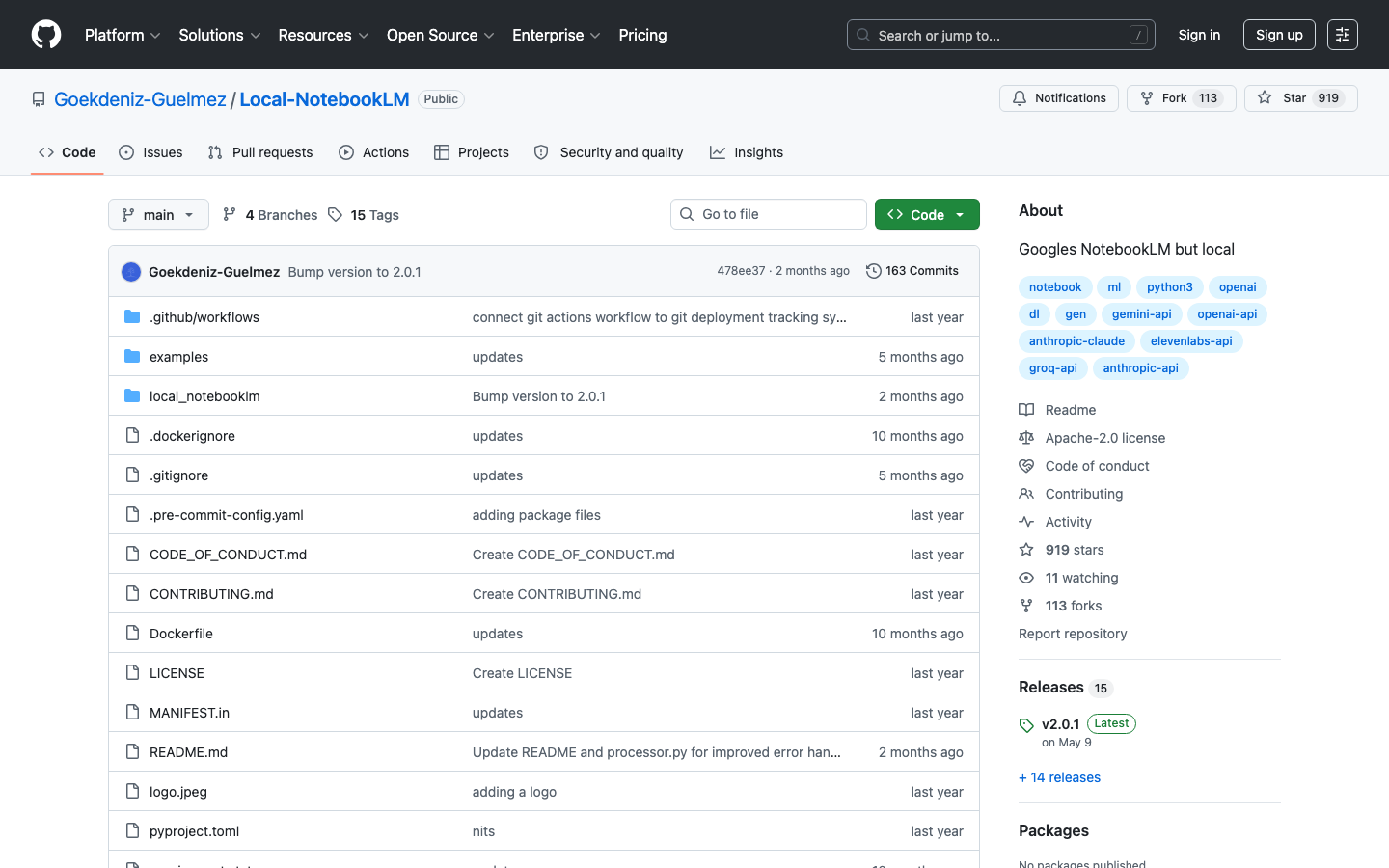
| Community size | GitHub about 919 stars, 113 forks |
| Latest version | v2.0.1 |
Expert opinion: The most noteworthy thing about this tool is not that it can convert PDF to podcast, but that it makes "content rewriting" and "sound packaging" into continuous actions in the same pipeline. Many teams already have RAG, summary, and document reading tools, but the last mile of "turning it into something that can be sent to colleagues to listen to while commuting" is usually done manually. Local NotebookLM just makes up for this part.
User and market recognition
Local NotebookLM's market recognition currently comes primarily from the open source community rather than commercial customer disclosures. The GitHub page has about 919 stars and 113 forks, indicating that it has surpassed the simple demo stage, but has not yet grown into a large-scale commercial SaaS standard that can be directly cited by enterprises when purchasing.
User and market recognition: The first group of people it is most likely to attract are researchers, independent developers, knowledge-based content creators, and small teams that want to distribute internal audio-based knowledge. The reason is simple, these people already have a lot of PDFs, handouts, white papers, research reports, and a real need to "walk and listen".
Publicity Verification: If you only look at the warehouse sample audio, it is easy to mistakenly think that it has reached the naturalness of a mature podcast production software. A more accurate understanding is that it significantly compresses the production time "from document to audible content", but the sound quality, emotional expression and script naturalness still obviously depend on the combination of LLM and TTS you have connected behind you.
Hidden benefits: When many teams are doing knowledge dissemination, the biggest waste is not in generating one version of the summary, but in the three repetitive tasks of "writing the summary, doing the oral broadcast, and then adding the voice for the same material." Local NotebookLM folds these three work chains into one process, which will directly reduce the rework rate.
Cost advantage
The free truth: The software itself is free and open source. You can install it with pip install local-notebooklm. On the surface, it seems to be zero cost; but as long as you do not completely use the local model, the inference and TTS calls such as OpenAI, Groq, Azure, etc. behind it will still incur costs. In other words, what is free is the workbench, but what is not free is the computing power and voice services you access.
| Cost layer | Disclosure | What it actually means |
|---|---|---|
| C-side/Personal | The project body is free, and the Web UI and CLI are free to use | Suitable for personal trial first, but if the document volume is large and growing audio is frequently generated, the API cost will gradually become apparent |
| Developer/API | FastAPI and programmatic interface are free of charge | Suitable for integration into internal tools, but additional LLM/TTS calling fees and deployment and maintenance costs will be borne |
| Enterprise/Private | No separate enterprise package disclosure | The real cost falls on GPU/CPU resources, model caching, document processing stability and internal operations |
Hidden costs: The first is local resource occupation. Officials recommend 32GB+ memory for local model scenarios, which is not friendly to ordinary office machines. The second is the cost of model compatibility testing. Using different LLM/TTS for the same PDF may result in significantly different script quality and audio naturalness. The third is the cost of adjusting parameters for long documents. The length, number of style speakers, language and whether visual mode is enabled will all affect the final usability.
Hidden benefits: If an organization often makes white papers, reports, and industry research into training content, this tool can transform the "labor cost of reading documents" into the "time cost of listening to audio", which is especially suitable for asynchronous communication scenarios.
Main functions
- PDF text extraction and cleaning: First convert the original PDF content into corpus that can be consumed by the model. This is the starting point of the entire link.
- Multi-format script generation: Supports multiple output formats such as summary, podcast, interview, panel-discussion, lecture, analysis, etc. It does not only generate one type of summary.
- Style and length control: The
styleandlengthoptions extend the script from "information compression" to "expression control", which is suitable for different scenarios such as formal explanations, casual podcasts or technical reports. - Multi-speaker audio output: Supports 1 to 5 speakers, which means it can not only do single spoken broadcasts, but also simulate interviews and roundtable formats.
- Multi-entry operation mode: CLI, programmatic API, Web UI, and Docker exist at the same time, covering both personal use and team integration routes.
Expert’s point of view: The real hidden linkage of these functions lies in “format control + multiple speakers + Web/API dual entrance”. The first two determine the audibility of the content, and the last two determine whether it can be integrated into the team process. Many tools only work on one level, but Local NotebookLM tries to do both "production content" and "access to the system".
Model and version evolution
The evolution path of Local NotebookLM is very typical: it started as a personal project that can run from PDF to audio, and gradually grew into an open source tool with multi-entry, multi-model, and multi-format control.
The early stages of Local NotebookLM
0.1.5: This is an early version node that can be clearly identified in the public reference information of the warehouse, which means that the project has the basic stability to be reproduced and referenced externally.
2.x mainline of Local NotebookLM
2.0.0: The 2.x mainline means that the tool is no longer just a script warehouse, but has formed a more complete product form with four entrances: CLI, Gradio, FastAPI and Docker.
2.0.1: The latest version continues to use this main line. The latest submission in the warehouse directly states "Bump version to 2.0.1", indicating that the maintainers are still actively repairing and expanding availability.
Current Limitations: Although the official release list is public, not every milestone comes with very detailed release instructions. It is suitable to regard GitHub Releases as a version clue rather than an enterprise-level changelog system.
Technical advantages
Local NotebookLM belongs to the [productivity/business-side application] type, but its value is not just "one more easy-to-use interface", but to merge document understanding, script rewriting and speech generation into a deployable technology chain.
Mechanics -> Effects -> Scenes:
Multi-provider LLM adaptation: It is not locked to a single model vendor, but is compatible with OpenAI, Groq, LM Studio, Ollama, Azure, etc. The effect is that you can make your own trade-offs between accuracy, latency, and privacy. The most appropriate scenario is a hybrid scenario where the same team has both cloud APIs and local models.
Text and audio two-stage pipeline: generate the script first, and then do speech synthesis. The effect is that the summary, tone and structure are more natural than direct TTS reading of the original PDF, which is especially suitable for research interpretation and training materials.
Programmable Interface: FastAPI server and Python API make it more than just a personal tool. The effect is that it can be connected to internal knowledge bases, course systems or content factories. Suitable for automatically converting PDFs into training audio, podcast materials or review materials.
Quantified cost reduction and efficiency improvement: Take the research team's weekly report as an example. In the past, a 30-page white paper was compressed into an audible explanation. The common process was "45 minutes of reading + 30 minutes of writing and broadcasting + 20 minutes of recording." After using Local NotebookLM, this process may be compressed into "2 minutes of uploading PDF + 10 minutes of adjusting results + 5 minutes of audio export." This is not an official commitment, but a workflow deduction based on a shortened number of sections in the tool chain.
How to use
| Entry | Typical commands/methods | Applicable objects | Description |
|---|---|---|---|
| CLI | python -m local_notebooklm.make_audio --pdf ... |
Developers, researchers | Best suited for batch processing and parameterized control |
| Web UI | python -m local_notebooklm.web_ui |
Non-technical users | Local browser access localhost:7860 |
| FastAPI | python -m local_notebooklm.server |
Internal Platform Team | View the interface at localhost:8000/docs |
| Docker | docker build + docker run |
Teams that need to be isolated and isolated | Facilitate unified dependencies and quick test runs |
Get started quickly in 3 minutes:
pip install local-notebooklm
python -m local_notebooklm.make_audio \
  --pdf documents/research_paper.pdf \
  --format_type podcast \
  --length long \
  --style casual
Human-computer collaboration boundary: Document uploading, parameter selection, and batch generation can be highly automated; but before being used for external release, script naturalness, factual accuracy, correctness of pronunciation, and commercially sensitive information must still be reviewed manually. Especially for industry reports, training materials and customer materials, the first version of the audio cannot be sent directly.
Product Pricing
Local NotebookLM does not have a public SaaS subscription form. The ontology is distributed as an open source project, and the pricing logic is more like "the tools are free, and the model and computing power are charged separately."
C-side/Individual: There is almost no threshold for personal trial, and the largest cash expenditure comes from external model calls.
Developer/API: If you connect to local inference such as Ollama and LM Studio, the unit cost can be reduced to a lower level, but in exchange for higher local hardware and maintenance thresholds.
Enterprise/Private: There is no ready-made contract price that can be quoted directly. If you want to truly use it for internal knowledge audio pipelines, you still need to estimate the document volume, audio duration, model caching and machine costs yourself.
The Truth About Free: Free does not equal low total cost. For low-frequency personal use, it is very economical; for high-frequency batch tasks, its true cost model depends on the LLM/TTS combination you pick up, not the warehouse itself.
Application scenarios
- Research and Paper Interpretation: Convert papers, white papers, and technical reports into audible summaries or interview-style explanations, suitable for commuting and fragmented time absorption.
- Corporate training and internal knowledge dissemination: Convert SOPs, training manuals, and industry reports into internal podcasts to lower the threshold for reading long documents.
- Content creation pre-production process: The creator first turns the information into a draft of the oral broadcast, and then decides whether to further record a real voice or make a video oral broadcast.
- Educational Review Materials: Students convert course PDFs, handouts or reading materials into pronunciation review content to strengthen repetitive memory.
Dimensionality reduction attack scenario: It is most enjoyable to use it in scenarios where there are many documents, little reading time, and you want to quickly reuse the same data into the audio channel.
Current Limitation: If the PDF itself is a scan, the mix of images and text is complicated, or the text can be extracted poorly, the entire chain will be compromised in the first step, and no matter how good the speech model is later, it will not be able to save it.
Applicable people
- Researchers and Analysts: Need to quickly convert long PDFs into audible versions, suitable for listening while walking or recording while reviewing.
- Independent developers and automation teams: They are interested in FastAPI and Python API and can embed them into existing knowledge workflows.
- Content Operations and Course Team: I hope to transform existing text assets into audio communication channels, but do not want to write a spoken script from scratch.
Persuasion Scenario:
- People who just want to get platform-level natural podcasts with one click: It's more like a tool chain, not a fully integrated commercial product.
- People without local deployment capabilities: If it cannot handle dependencies, model services and resource occupation, its free advantage will be offset by the cost.
- Those who deal with highly sensitive regulations or contract content that must be strictly word-for-word accurate: Manual proofreading is still required, paragraph by paragraph, and the generated results cannot be directly regarded as official materials.
Summary and Outlook
The core value of Local NotebookLM is to reduce the speed and threshold of "reading PDF" into "listening to knowledge" at the same time. It does not rely on brand ownership, nor does it rely on a cloud account system, but relies on open source, programmability and local priority to move NotebookLM-style knowledge audio capabilities into the user's own environment. This conversion is very practical for those who already have a large number of document assets.
[Procurement/Adoption Risk Assessment]: It is most suitable for pilot projects, but not suitable for direct production without verification. Three things need to be verified before adoption: first, whether your PDF type is regular enough; second, whether the local or cloud model combination can stably generate natural scripts; third, whether the team is willing to bear the configuration and maintenance costs. The direction worth watching in the future is whether it will continue to strengthen scan processing, multi-language quality and more mature TTS preset management; if these capabilities are completed, it will be more like a complete knowledge redistribution production line than many "summary-only" tools.
Related tools:  Notion AI, google-workspace
Version Info
- Local NotebookLM 2.0.1 :The latest version released by GitHub Releases, the mainline capabilities have been extended to CLI, Gradio Web UI, FastAPI API and collaboration with multiple output formats.
- Local NotebookLM 2.0.0 :The initial version of 2.x mainline is released, and the warehouse README has fully presented the Web UI, FastAPI and Docker entrance; there is no official precise date yet.
- Local NotebookLM 0.1.5 :The early citable version publicly listed in the project citation information means that the tool has moved from the experimental stage to the reproducible distribution stage; there is no official precise date yet.
User Reviews