 LocalAI
Free
LocalAI
Free
LocalAI is an open source local AI engine that provides APIs compatible with OpenAI and Anthropic. It can run LLM, vector, speech, image and video models on ordinary CPUs or GPUs without sending data to the cloud.
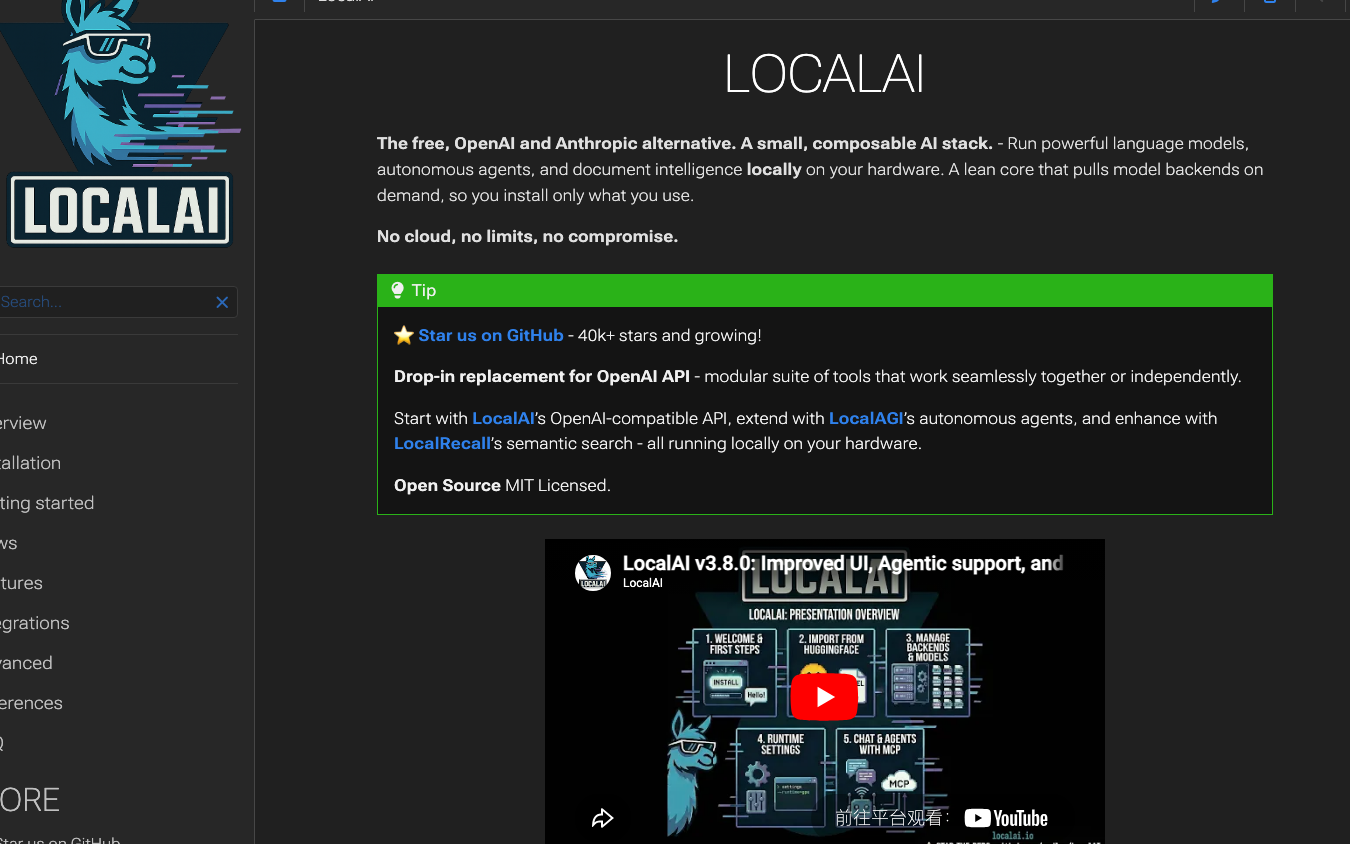
LocalAI
LocalAI is an open source, self-hosted local AI engine that aims to replace the cloud inference services of OpenAI and Anthropic with a method that can run on your own hardware. It exposes a REST interface compatible with OpenAI externally, and internally it is a set of composable model backends, covering tasks such as text generation, vectorization, speech transcription and synthesis, image and video generation, and does not force dependence on the GPU. For teams that prioritize data compliance, offline availability, and long-term cost, LocalAI provides a path that eliminates sending requests to a third-party cloud.
Core parameters and statistics
LocalAI is positioned as an "engine" rather than a single application: the upper layer is a stable OpenAI/Anthropic compatible API, and the lower layer is a model backend installed on demand. The two are decoupled to keep the core streamlined.
| Projects | Information |
|---|---|
| Product positioning | Open source local AI inference engine (OpenAI/Anthropic compatible) |
| Open Source License | MIT |
| Primary language | Go |
| Runtime | Self-hosted binaries/containers, local REST API |
| Hardware requirements | Supports pure CPU operation, optional GPU acceleration, no mandatory GPU dependency |
| Scope of capabilities | Text, vector, speech transcription and synthesis, image, video |
| GitHub Stars | ~46.7k (continuous growth) |
| Number of Forks | About 4.1k |
| Latest version | v4.3.6 (2026-05-30) |
| Official website | localai.io |
The boundaries need to be clear: LocalAI itself does not "come with" the strongest closed-source model. It provides a running context and a unified interface. The final effect depends on the loaded open source model (such as various LLMs, Whisper speech models, diffusion image models, etc.). Therefore, its value is not in "getting top-end capabilities out of the box", but in "organizing controllable open source models into a set of local services that are close to commercial cloud APIs."
User and market recognition
Community scale: The project has accumulated approximately 46.7k stars and 4.1k forks on GitHub. It has maintained a high-frequency release rhythm since it was open sourced in March 2023 (the 4.x series has multiple patch versions within a few days), indicating that it is under active maintenance rather than discontinued.
Typical motivation for adoption: Users who choose LocalAI usually have clear demands - the data does not go out of the local area, needs to be offline or on the intranet, wants to avoid the uncertain cost of billing by token, or conduct experiments on edge devices and personal workstations. It is often compared with Ollama, LocalAGI, vLLM, etc.: Ollama prefers "quickly running through the local chat model", vLLM prefers "high-throughput GPU inference service", and the difference of LocalAI is "multi-modality + OpenAI/Anthropic compatibility layer + no mandatory GPU".
The specific list of corporate customers, installed capacity and revenue have not been officially disclosed. The official real-time page and warehouse information should be used as the basis. It is not appropriate to infer the exact figures based on community discussions.
Cost advantage
C-side/Individual: The software itself is free according to the MIT protocol. Individuals can run it offline on their own laptops or desktops. The main cost is local computing power and electricity. There is no subscription or token billing.
Developer/API: LocalAI replaces "calling the cloud API" with "calling the local isomorphic interface". Developers can transfer requests to OpenAI to local instances without changing too many existing codes, thus eliminating the accumulation of fees based on the number of calls. The cost is that they need to be responsible for model selection, graphics memory/memory planning, and operation and maintenance.
Enterprise / Privatized: For organizations that are regulated or have strong data sovereignty requirements, the hidden benefits of LocalAI are compliance and control - requests and data stay within their own infrastructure, avoiding outbound censorship and cross-border transmission issues. What needs to be verified is the total cost of ownership: GPU server purchase or rental, model licensing (some open source models have terms of use), and internal operation and maintenance investment. Official commercial pricing is not available because the product itself does not charge users; business costs come from infrastructure rather than software licensing.
Main functions
- OpenAI/Anthropic Compatible API: Provides interface conventions consistent with mainstream clouds in the form of drop-in replacement, making it easy to switch existing applications from the cloud to local.
- Multimodal backend: Supports language model, text vectors, speech transcription (such as Whisper class), speech synthesis, image generation and video generation under the same engine.
- On-demand backend installation: The core is kept streamlined, and the model backend is pulled according to usage scenarios to avoid one-time installation of bloated dependencies.
- Local Agent (Agentic) capability: Supported by components such as LocalAGI, autonomous agent workflows with tool calls can be locally orchestrated.
- Local semantic retrieval: Supported by LocalRecall, it provides vector retrieval capabilities and supports local RAG scenarios.
- Running without GPU: Supports pure CPU inference, allowing devices without independent graphics cards to complete basic tasks, and then introduces GPU acceleration on demand.
Focus on implementation: pure CPU is suitable for development joint debugging and lightweight tasks, and clear expectations for the real-time performance of large-parameter models must be made; when enabling the GPU backend, it is necessary to confirm that the driver and video memory match the target model.
Model and version evolution
Main line evolution
- 3.x series (about 2025): Introducing a revised web management interface, agent (Agentic) support and MCP integration, expanding LocalAI from a "reasoning backend" to a platform that can orchestrate local agents.
- v4.3.0 (2026-05-24): The 4th generation mainline function node strengthens the composable backend, unified model management panel and local agent workflow, and further converges the core volume.
- v4.3.6 (2026-05-30): The 4th generation iterative version continues the "streamlined core + on-demand backend" route and continues to polish multi-backend scheduling and stability.
Release rhythm
The 4.x series uses high-frequency patch releases (multiple revisions can be seen within a few days), which is suitable for users who need to keep up with fixes; but it also means that self-hosting parties need to establish their own version upgrade and regression strategies, rather than defaulting to putting every patch into production immediately.
Technical advantages
Mechanism: LocalAI uses Go to write the core, layering "stable external interface" and "pluggable model backend". Externally, it is a fixed OpenAI/Anthropic compatible contract, and internally it is implemented through back-end adaptation to different reasoning.
Effect: This kind of decoupling brings two direct benefits - first, the core is small, startup and distribution are lightweight, and the backend is pulled on demand to avoid bloat; second, the docking cost is low, and the application layer almost does not need to rewrite the calling logic for "cutting from cloud to local".
Applicable scenarios: When the team has written applications around the OpenAI API but needs to run them on the intranet, edge or privacy-sensitive environment, this set of compatibility layers can minimize the migration workload; at the same time, the multi-modal backend allows the same instance to undertake multiple tasks such as text, voice, and images, reducing the complexity of assembling multiple independent services.
What needs to be weighed is: the throughput and latency of local inference are directly constrained by the hardware. LocalAI will not let weak hardware outperform the experience of the cloud flagship model. It optimizes for "controllable, offline, and combinable" rather than "unconditionally fastest".
How to use
- How to obtain: Download the binary for the corresponding platform from GitHub Releases, or start it using the official container image, and the REST service endpoint will be generated locally.
- Load model: Load the required open source model backend (language, voice, image, etc.) through the model management interface or configuration, and install it on demand.
- Access to the application: Change the base URL originally pointing to the cloud OpenAI to the local LocalAI endpoint, and use the existing SDK and request format to call it.
- Extension capabilities: LocalAGI is introduced when local agents are needed, LocalRecall is introduced when local RAG retrieval is needed, and combined according to scenarios.
The typical steps are "first use the CPU to run through the interface and process, and then introduce the GPU and larger models according to performance requirements." The official documentation site provides chapters such as Overview, Installation, Getting started, and Features as a way to get started.
Product Pricing
LocalAI software is free, with no subscription or licensing fees for end users. The real cost comes from the infrastructure and operations to run it.
| Dimensions | Description |
|---|---|
| Software License | Free, MIT Open Source License |
| Personal use | Run locally on your own equipment, the cost is local computing power and electricity |
| Server deployment | Cost depends on CPU/GPU hardware purchase or cloud host rental |
| Model cost | The engine is free, but some open source models come with their own terms of use, which need to be verified separately |
| Commercial support | The official paid support package has not been announced, please refer to the official real-time page |
Application scenarios
- Privacy-sensitive internal assistant: Deploy chat, retrieval and document understanding services on the intranet to ensure that requests and data do not leave the enterprise boundary. It is suitable for financial, medical, government and enterprise scenarios, etc. The focus of verification is compliance boundaries and model permissions.
- Offline and edge inference: Run lightweight models in environments that do not have a stable external network or require localization (factories, vehicles, edge nodes). The focus of verification is the latency and stability of the target hardware.
- Cost-controllable development and prototyping: The team uses local instances instead of cloud calls for joint debugging and stress testing to avoid bill fluctuations during the development period. The focus of verification is the difference in capabilities between local results and cloud models.
Applicable people
- Enterprises and institutions that focus on data sovereignty: Teams that want to keep inference in their own infrastructure and avoid data outsourcing can use its compatibility layer to migrate existing applications at low cost.
- Local-first developers and researchers: People who need to test multi-modal models offline, build local RAGs or agents on workstations or edge devices.
- Cost-sensitive small and medium-sized teams: Teams that want to use one-time hardware investment to replace ongoing token fees and can accept self-operation and maintenance.
Not suitable for the boundary: Users who pursue "the strongest closed-source model effect right out of the box", lack operation and maintenance capabilities, or need the manufacturer's SLA and commercial support are more suitable to use commercial cloud APIs directly; running large-parameter models on weak hardware is also difficult to meet real-time requirements.
Summary and Outlook
LocalAI's core competitiveness is the combination of "OpenAI/Anthropic compatibility layer + multi-modal backend + no mandatory GPU", which allows teams to move cloud inference to their own hardware with lower migration costs in exchange for data sovereignty, offline capabilities and controllable long-term costs. Its limitations are equally clear: the local experience is limited by hardware, the software is free but the operation and maintenance and hardware need to be borne by yourself, and the final effect depends on the selected open source model rather than the engine itself.
What is worth observing in the future is the maturity of the 4.x series in terms of agent capabilities, model management experience and multi-backend scheduling, as well as the depth of integration of the community ecosystem (LocalAGI, LocalRecall, etc.). The implementation suggestion is to first conduct a small-scale pilot using CPU bounded interface compatibility and business processes. After confirming that the latency and quality of the target model meet the standards on its own hardware, it can then be expanded to GPU deployment. Before purchasing for regulated scenarios, additional verification is required of the license terms of the open source model used and the company's internal operation and maintenance capabilities.
Related tools:  Hugging Face, replicate
Technical advantages and capability boundaries
As an AI model and API product, LocalAI’s core capabilities can be deeply understood through the following dimensions, which directly affect technology selection and implementation effects.
Inference Performance and Benchmark Performance The model’s reasoning performance is reflected in its performance on standard NLP tasks (text generation, code completion, semantic understanding, multi-turn dialogue, information extraction, etc.). It is recommended to conduct horizontal comparison through public benchmark test lists (such as MMLU, HumanEval, GSM8K, etc.), but please note that there may be a gap between benchmark test scores and actual business scenario performance. Key indicators that affect the actual user experience include: inference speed (Token/s or response delay, which directly determines the smoothness of the user experience), context window length (which determines the input size that can be processed at a time, affecting the complexity of the tasks that can be processed), and consistency of output quality (the stability of the results of multiple outputs of the same input, which affects the perception of reliability).
API Compatibility and Development Ecosystem The depth of API compatibility with mainstream development frameworks (LangChain, LlamaIndex, Semantic Kernel, etc.) directly affects the cost and cycle of integrated development. It is recommended to pay attention to the following integration dimensions: the coverage of language types supported by the SDK (whether mainstream languages such as Python, JavaScript, Go, and Java have official SDKs), streaming output support (SSE/WebSocket protocol compatibility), function calling and tool usage capabilities (whether it supports mapping model output to structured function calls), the flexibility of structured output (JSON mode), and the ability to integrate with enterprise-level infrastructure (VPC deployment, Private Link, unified identity authentication). Complete API documentation and rich code examples can significantly lower the entry barrier to development and reduce integration time and costs.
Deployment Flexibility vs. Cost Tradeoff Depending on data privacy requirements, latency sensitivity and usage scale, LocalAI can choose cloud API calls or on-premises deployment options. The advantages of cloud deployment are zero operation and maintenance costs and elastic scalability, which is suitable for scenarios with large fluctuations in usage and rapid prototype development; local deployment provides complete data sovereignty and low latency (no network round-trip overhead), but you need to bear the cost of purchasing hardware such as GPUs and operation and maintenance manpower. It is recommended to use a monthly API call volume of 1 million times or a monthly fee of US$1,000 as a reference dividing line: below this threshold, cloud APIs have better cost-effectiveness and flexibility. After exceeding this threshold, the total cost of ownership of the self-deployment solution should be comprehensively evaluated, taking into account factors such as hardware depreciation, electricity, operation and maintenance manpower, etc.
Model selection and version strategy
For the selection of LocalAI series models, it is recommended to match the model capabilities of different versions according to specific usage scenarios. The large-parameter version performs better on complex reasoning and multi-step tasks, but has higher costs and longer delays; the small-parameter version can already provide satisfactory output quality in scenarios such as daily conversations and simple question and answer, and the cost is only a fraction of the large version. The recommended selection strategy is: use small and medium versions in standard scenarios to reduce costs, and only call large version models when complex inference tasks need to be processed. This hierarchical calling strategy can reduce the overall API cost by 40-60% without significantly affecting the output quality.
Version Info
- LocalAI v4.3.6 :The iterative version of the 4th generation engine continues the "streamlined core + on-demand backend installation" architecture, strengthens agent capabilities, model management interface and multi-backend scheduling, and continues to provide OpenAI/Anthropic compatible interfaces on ordinary hardware.
- LocalAI v4.3.0 :The functional nodes of the 4th generation mainline are enhanced around the composable model backend, unified management panel and local agent workflow, further condensing the core volume and pulling backends on demand.
- LocalAI 3.x series :The third generation series introduces a revised web management interface, agent (Agentic) support and MCP integration, expanding LocalAI from a simple inference backend to a platform that can orchestrate local agents; this series is a continuous iteration, and there is no single official precise release date.
User Reviews