 LOVO AI
Free
LOVO AI
Free
LOVO AI is a speech generation platform for AI Audio scenarios, supporting text-to-speech, speech cloning and video dubbing workflows.
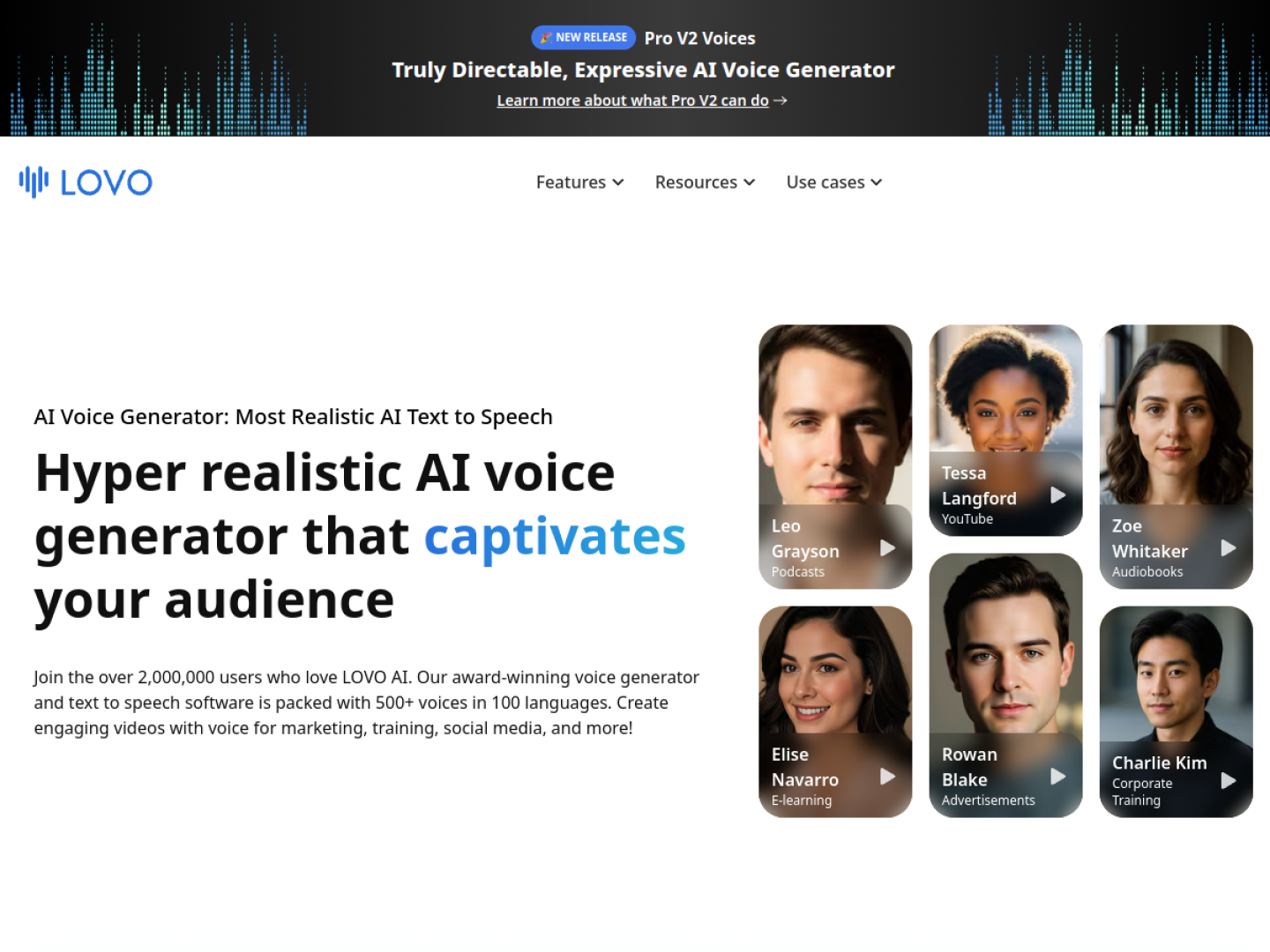
LOVO AI - Deep Tool Analysis
Core parameters and statistics
Tool type determination: The main delivery form of LOVO AI is a Web workbench for direct use by content teams. The API is just a supplementary entrance, so it is more suitable to be classified as a productivity/business-side application rather than a basic model or pure API infrastructure. What it sells is not "a sound model", but integrating scripts, dubbing, subtitles, video editing and export into the same content production chain.
| Parameters | Current public information |
|---|---|
| Official website | https://lovo.ai/ |
| Main delivery form | Web, API |
| Core positioning | AI voice generator + online video editor |
| Official public scale | 2,000,000+ users |
| Voices and Languages | 500+ voices, 100+ languages |
| Subtitle capabilities | Auto subtitle generator supports 20+ languages |
| Voice cloning threshold | The official page states that 1 minute of audio can be used to create custom voices |
| Developer capabilities | Genny API supports X-API-KEY authentication, and exposes speakers, sync TTS, async TTS, async retrieve job and other interfaces |
| Result delivery constraints | API documentation states that the generated audio URL is valid for 24 hours |
| Latest public milestone | 2025-05-23 Release of Pro V2 Voices |
Brief review in one sentence: It is not a TTS website that sells "good sounds" alone, but combines copywriting generation, voice generation, subtitles and video production into a content production workbench, suitable for high-frequency short content and batch dubbing.
Publicity verification: The official website features "500+ voices", "100+ languages", "2,000,000+ users" and "all-in-one voice and video editing platform". These selling points can basically be found in the TTS page and API documentation on the official website. The core pain point is also very clear: the content team does not want to repeatedly switch between the four or five tools of scripting, recording, editing, and subtitles.
User and market recognition
Open market signal: LOVO’s official homepage continues to emphasize 2,000,000+ users. This number itself cannot replace product quality, but at least it shows that it is no longer an early experimental product. What is more meaningful to purchasers is that the official displayed multiple types of content scenarios and multiple case endorsements at the same time, indicating that its focus is on scalable dubbing needs such as marketing videos, educational content, podcasts, advertisements and product demonstrations.
Case Quality: Names such as Griffin Productions, Fiverr, LotLinx, Toothlife, Hour One AI, etc. can be seen in the official website testimonials. What is really worthy of attention here is not "customer reputation", but these cases repeatedly mentioned three keywords: quick audition, reduced revision, and close to industry terminology or brand role setting. This shows that LOVO’s competitive point is not only the naturalness of the sound, but also the friendliness of the workflow that can be iterated repeatedly.
Authenticity Boundary: LOVO discloses customer reviews and usage scenarios, which does not mean it discloses renewal rates, corporate retention rates, or the proportion of large customers. For corporate procurement, these business indicators are still information to be confirmed at the sales or formal evaluation stage and cannot be directly extrapolated from the official website copy.
Cost advantage
C client/individual: The official website clearly states that 14-day trial of Pro and No Credit Card required are very friendly to individual creators because the first round of verification costs are very low. The real limitation is that the public page of the official website emphasizes concepts such as "credit" and "voice generation hours", but does not fully list the details of each level of quota on the crawlable public page. Therefore, what individual users need to confirm most is the length of time that can be exported after the trial period, the commercial authorization boundary, and how to bill after overage.
API/Developer: The Genny API documentation clearly states that TTS credits will be deducted from the account associated with the API key, and the resulting audio URL will expire after 24 hours. This means that development access is not "just connect it and it's done". It is also necessary to add a layer of object storage or internal media asset library. Otherwise, the link expiration after the asynchronous task is completed will directly affect the business link. The Rate Limits page exists, but the public crawl results do not give clear RPM/TPM figures. The throughput upper limit still needs to be based on official real-time documents or business replies.
Enterprise/Team: LOVO regards team collaboration and cloud storage as selling points, but the official website does not disclose the details of seat management, legal terms SLA, data retention period and single-tenant isolation method. The explicit costs on the enterprise side may just be subscription fees, while the hidden costs are concentrated in brand sound licensing, dubbing review, vocal cloning consent documents, internal asset archiving and release approval.
Quantitative deduction of cost reduction and efficiency improvement: Take a 30- to 60-second social media advertisement as an example. The traditional process often involves finalizing the script, finding dubbing, recording, reworking, aligning, and adding subtitles. It is usually a collaborative task of half a day to one day; an integrated workbench such as LOVO is closer to compressing it to complete the first version within 1 to 2 hours, and is especially suitable for A/B multi-version delivery. This conclusion belongs to workflow deduction and is not an official commitment.
Hidden benefits/costs: The biggest benefit is not "free sound", but the reduction of modification costs. The script can be regenerated by changing just one line, without re-appointing actors or re-editing; however, the cost is that the team is more likely to over-generate multiple versions. If there are no clear acceptance rules, it will lengthen the content review time.
Main functions
- Text to Speech: Officially disclosed 500+ voices and 100+ languages, covering common content types such as advertising, education, podcasts, product demonstrations, etc. It’s not about “is there a voice or not?” but it’s about letting the content team quickly audition multiple tones and characters without having to book a live recording first.
- Controllable Voice Generation: Pro V2 Voices supports adding natural language instructions, such as emotion, speaking speed, accent, non-verbal expressions and complex character settings, using square brackets before the script. The real value of this capability is to reduce the rework of "it doesn't sound right and you have to start over again."
- Voice Clone: The official website states that custom voices can be created in 1 minute of audio. For content teams with brand IP roles or fixed host tone, this is to productize "brand voice consistency" rather than just making a one-time novelty feature.
- Online video editing and audio and video synchronization: The homepage directly defines Genny as an all-in-one voice and video editing platform, and emphasizes sync audio and video. It moves LOVO from a single-point TTS to a well-organized film, reducing the context switching of "having to throw away other editors to continue working after speech generation".
- Automatic subtitles and script assistance: The official website reveals that automatic subtitles support 20+ languages, and provide AI writer and image generation capabilities. The hidden linkage here is that scripts, narration, subtitles and visual materials are all strung together in one workspace, instead of four isolated plug-ins.
- Developer API: Public documents provide interfaces such as speakers, sync TTS, async TTS, async retrieve job, etc. For content platforms, education SaaS or marketing automation systems, this means LOVO can be used as a manual tool or embedded in back-end processes.
Expert opinion: The strongest thing about LOVO is not a single function, but the chain of "script generation -> voice selection -> emotional command -> subtitles -> video export" that can be combined in the same workbench. For the content team, this is more practical than simply making TTS more like a real person, because a lot of rework does not occur in the sound itself, but in cross-tool and cross-position handovers.
Model and version evolution
Version Transparency: What LOVO exposes to the outside world is not a traditional software changelog, but mainly product stages and capability releases, so it is more suitable to understand based on milestones, rather than forcibly applying semantic version numbers.
LOVO AI’s latest public milestones
Pro V2 Voices: The official blog released "Introducing Pro V2 Voices: Directable Text to Speech with Natural Language" on 2025-05-23. The focus of this upgrade is not to increase the number of sounds, but to push "directability" to the foreground, allowing users to use natural language to control emotions, speaking speeds, accents, non-verbal expressions, and even complex situational character commands.
The focus of the previous stage of LOVO AI
Genny platform stage: The official website currently describes Genny as an all-in-one voice and video editing platform, indicating that it has moved from a "pure dubbing generator" to a "filmmaking workbench". The official has not disclosed the precise launch date of this stage, but judging from the public product structure, the platform's focus has covered the combined delivery of scripts, dubbing, subtitles, images and video editing.
Version boundaries of LOVO AI
Information to be confirmed: The official website does not disclose the complete historical version timeline, nor does it split all capabilities into independent release notes. For enterprise teams that require strict version tracking, it is best to write the actual purchased version, function switches, credit limit rules and API compatibility into the internal acceptance form, rather than relying solely on the official website marketing page.
Technical advantages
Mechanism 1: Natural language controllable speech: Pro V2 allows you to write instructions directly in square brackets in scripts, instead of just relying on preset style tags. The effect is that the content team can directly insert directorial language such as "more exciting", "like a professor but sick" and "first comfort before shouting for help" into a well-generated script, which is suitable for oral broadcasts in advertisements, plotted short videos and paragraphs in training content that require a sense of performance.
Mechanism 2: A single workspace strings together scripts, dubbing, subtitles, and editing: The homepage reveals a combination of AI Writer, TTS, Auto Subtitle, Online Video Editor, and AI Art Generator. The effect is not to make every capability the deepest in the industry, but to shorten the delivery path for the first version of content, which is especially suitable for teams that need to deliver multiple short videos at high frequency.
Mechanism 3: Provides both manual entrance and program entrance: The Web side is suitable for operations, editing and content planning for quick publication, and the API side is suitable for connecting speakers retrieval and synchronous/asynchronous TTS generation to the internal system. Such a team does not have to choose between "for business use" and "for system connection".
Mechanism 4: Result URL valid for 24 hours: This is both a benefit and a boundary. The advantage is that it delivers light weight and saves long-term hosting pressure; the limit is that all formal businesses must archive the results themselves, and it is not suitable to use temporary URLs as long-term media asset addresses.
Unsuitable boundary: If the team is pursuing film and television-level in-depth sound performances, manual director refinement of very long audiobooks, or must control the underlying acoustic parameters and model deployment, a workbench product like LOVO may not be the best solution. It is better at "getting it right as quickly as possible" for most commercial content, rather than "polishing it to the extreme" with a small amount of high-quality content.
Human-machine collaboration boundary: The first draft of the script, sample sound generation, multi-language first version, localized subtitles and batch export can be highly automated; manual confirmation points should still be retained for final brand setting, review of sensitive expressions, confirmation of character authorization, official advertising release and delivery to high-value customers.
How to use
- Web content team path: Enter Genny, first write or import the script, and then select the voice, language and tone direction; when stronger expressiveness is needed, give priority to using the natural language instruction format of Pro V2 for fine-tuning the tone.
- Dubbing to film path: Complete synchronization and export of TTS, subtitles, and video timeline in the same workspace. For tasks such as short videos, course openings and endings, and product demonstrations, a single tool saves rework than "exporting and then entering the editor".
- Brand Voice Path: If you want to be a fixed host or brand role, you can use voice cloning to upload sample audio to generate a custom voice. However, authorization and voice specification confirmation must be completed before going online.
- API integration path: Obtain the API key from docs.genny.lovo.ai, and use
X-API-KEYto access the speakers, sync TTS or async TTS interface; if you use an asynchronous task, download and transfer the results immediately after recycling, because the returned audio URL is only valid for 24 hours.
Implementation Suggestions: The most stable pilot is not to "replace all content with AI dubbing", but to first use high-frequency, low-risk, repeatable scenarios, such as advertising variations, course clips, product tutorials or internal training, and first look at the rework rate and pass rate before deciding whether to expand.
Product Pricing
Public information status: LOVO has a separate pricing page, and also publicly displays 14-day trial of Pro, No Credit Card required, and Contact Us. However, in the current public page that can be stably crawled, there is no reliable enough complete price and quota details, so it is more suitable to regard it as a product that "can be tried first, and the official budget still needs to be confirmed on the official website real-time page or sales confirmation."
| Level | Current public information | Still needs confirmation |
|---|---|---|
| Individuals/Creators | There is a 14-day Pro trial, no credit card required | The available time of each file after the trial, export permissions, and commercial authorization boundaries |
| Developer/API | API key + TTS credits deduction model has been made public | Each unit price, minimum purchase quantity rate limits numbers, concurrency strategy |
| Team/Enterprise | There are related portals for Contact Us, Teams, and billing information | Seat SLA, contract terms, permissions governance, data retention and compliance support |
The truth about free: LOVO’s free experience is more like a low-threshold verification entrance than a long-term free production tool. For truly high-frequency film production teams, the focus of procurement judgment is not "whether they can have free sex", but "whether the credit limit, exportable time, role authorization and team collaboration terms are controllable."
Application scenarios
- Social media advertising and multi-version delivery: A script often requires multiple tones, multiple personas, and multiple CTAs. LOVO's controllable voice and video synchronization capabilities can significantly reduce re-recording and alignment time.
- Online education and corporate training: Course narration, knowledge point strips, opening credits and multi-lingual training content are all high-frequency repetitive tasks, suitable for batching the first version of dubbing and subtitles.
- Product Demonstration and SaaS Tutorial: The product updates quickly, and the narration changes frequently. The biggest fear is "changing the copy after recording". The advantage of LOVO is that by changing a piece of copywriting, you can quickly regenerate the voice and continue to complete the film.
- Podcast packaging and audio content samples: It is particularly friendly to openings, endings, trailers and column samples, but long-form formal programs still need to pay attention to listening fatigue and brand tonality unity.
- Platform integration scenarios: Education platforms, marketing automation systems, and content generation SaaS can directly access APIs and build speakers retrieval and TTS generation into their own back-end processes.
Dimensionality reduction strike scenario: Content production that requires high frequency, batch production, fast sample production and can accommodate manual final review is the most comfortable battlefield for LOVO.
Applicable people
- Content Operations and Growth Team: Those who need to continuously produce advertisements, social media short videos, tutorials and event materials can best reap the benefits from scripts to finished films.
- Education and Training Team: People who are responsible for multi-language courses, knowledge explanations, and corporate training films, and can standardize the production of narration and subtitles.
- Product Marketing and Pre-sales Team: People who need to quickly generate product demonstrations, functional explanations, and event warm-up videos are suitable to use LOVO to shorten the first version production cycle.
- Development team and platform side: If you want to embed voice generation into your own products or content pipelines, the LOVO API provides a clear entrance, but you still have to handle the logging, authentication and quota management yourself.
- Dissuaded/Not Applicable: Teams that pursue film and television-level director-style sound polishing, are extremely sensitive to generative content compliance, or do not have script specifications and review processes should not regard LOVO as a "brainless replacement for real people" solution.
Summary and Outlook
The core value of LOVO AI is not to "read a piece of text", but to connect scripts, sounds, subtitles, videos and APIs into a shorter content delivery loop. What it touches is a real production problem: not a lack of sound, but a lack of a smooth enough content pipeline. Pro V2 Voices takes it a step further in "directability," which is particularly attractive for spoken-word advertising, educational narration, and character-based content.
Procurement/Adoption Risk Assessment: First, the granularity of the prices disclosed on the official website is limited, and the official budget must be based on the real-time pricing page or sales reply; second, voice cloning involves authorization and brand risks, and you cannot just look at the technical demonstration; third, the API result URL is invalid for 24 hours, and if the team does not have an archive link, it will leave delivery risks; fourth, AI dubbing can significantly shorten the first version time, but it cannot replace brand review, sensitive content control and final release responsibility. A more prudent approach is to pilot a single scenario first to confirm the pass rate, rework rate and authorization process, and then decide whether to expand procurement.
Related tools:  ElevenLabs, udio
Comparison of competing products
| Comparison dimensions | The tool | Competitor A | Competitor B |
|---|---|---|---|
| Core Differences | — | — | — |
| Price | — | — | — |
| Target User | — | — | -- |
Version Info
- Pro V2 Voices :The official blog has publicly released Pro V2 Voices, which focuses on directable TTS that can control emotions, speaking speed, accent and non-verbal expressions with natural language.
- Genny integrated voice and video workbench stage :The official website currently describes Genny as an all-in-one voice and video editing platform, indicating that the product has expanded from single-point TTS to scripting, dubbing, subtitles and video editing workbench; there is no official precise launch date.
User Reviews