 Luma Dream Machine
Free
Luma Dream Machine
Free
Produced by Luma Labs, Luma Dream Machine is one of the flagships in the AI video circuit. The Ray2 series benchmarks against the first echelon in terms of physical realism, motion continuity, and lens language, and is open to developers through the Luma API.
LumaDreamMachine
Core parameters and statistics
Luma Dream Machine started with NeRF real-time 3D reconstruction and evolved into today's flagship AI video model, ranking alongside Sora, Runway, and  Kling AI in the international first echelon.
| Dimensions | Key facts |
|---|---|
| Product Positioning | Flagship AI Video Generation + Creative Agent Platform |
| Model generation | Ray2, Dream Machine 1.6, first release 1.0 |
| Main capabilities | Vincent Video, Tusheng Video Modify, Reframe, Photon images |
| Single paragraph duration | 5s / 10s, can be spliced into a long narrative |
| Lens Control | Camera Motion Concepts (Push, Pull, Pan, Move, Follow) |
| Business level | Free experience Standard, Plus, Unlimited, Studio, API |
| Strategic Positioning | Scaling from Video Models to Luma Agents Creative Workflows |
Parameter interpretation: Dream Machine's differentiated advantage is "physical realism + film and television lens language", which makes the generated videos more "like real shots" in the eyes of professional creators.
User and market recognition
- 2024-06 Dream Machine ignited the community immediately after its debut, and within 48 hours a large number of popular demos hit the screen X/TikTok.
- When Ray2 was launched in 2025-01, it was rated as one of the products "close to the strongest rival of Sora's public version".
- Luma, together with Adobe, Runway, Pika and other companies, is regarded as a core player in the generative video ecosystem.
- Several commercial/short film/music MV production teams openly use Dream Machine.
- Luma API exports capabilities to third-party platforms and SaaS to build a B-side business landscape.
Cost advantage
Luma Dream Machine adopts a "points system + subscription file + API billing" combination.
| Plan | Price | Key Rights | Adaptable Objects |
|---|---|---|---|
| Free | $0 | Free monthly points, basic generation | Personal experience |
| Standard | $9.99/month | 720 points, commercial license | Individual creator |
| Plus | $29.99/month | 2,520 points, priority queue | Heavy Creator |
| Unlimited | $94.99/month | Unlimited leisure file generation | High-output creator |
| Studio | $399.99/month | 31,680 points, for small studios | Studio/Team |
| Luma API | Per Call | Commercial API, Webhooks, SLA | Developer/Enterprise |
Cost interpretation: The Standard and Plus files are more cost-effective for individual creators; the Studio file actually puts Luma in the position of "small creative studio infrastructure".
Main functions
- Dream Machine: core capabilities of Vincent Video and Tush Video.
- Ray2 model: Long-motion physical coherence and complex camera movements.
- Camera Motion Concepts: Describing lens language in industry terms.
- Modify: Make stylized/character-based modifications to existing videos.
- Reframe: Intelligently change the proportion and composition (one-click switching between horizontal and vertical screens).
- Photon: Luma's self-developed image model serves as the image base for video generation.
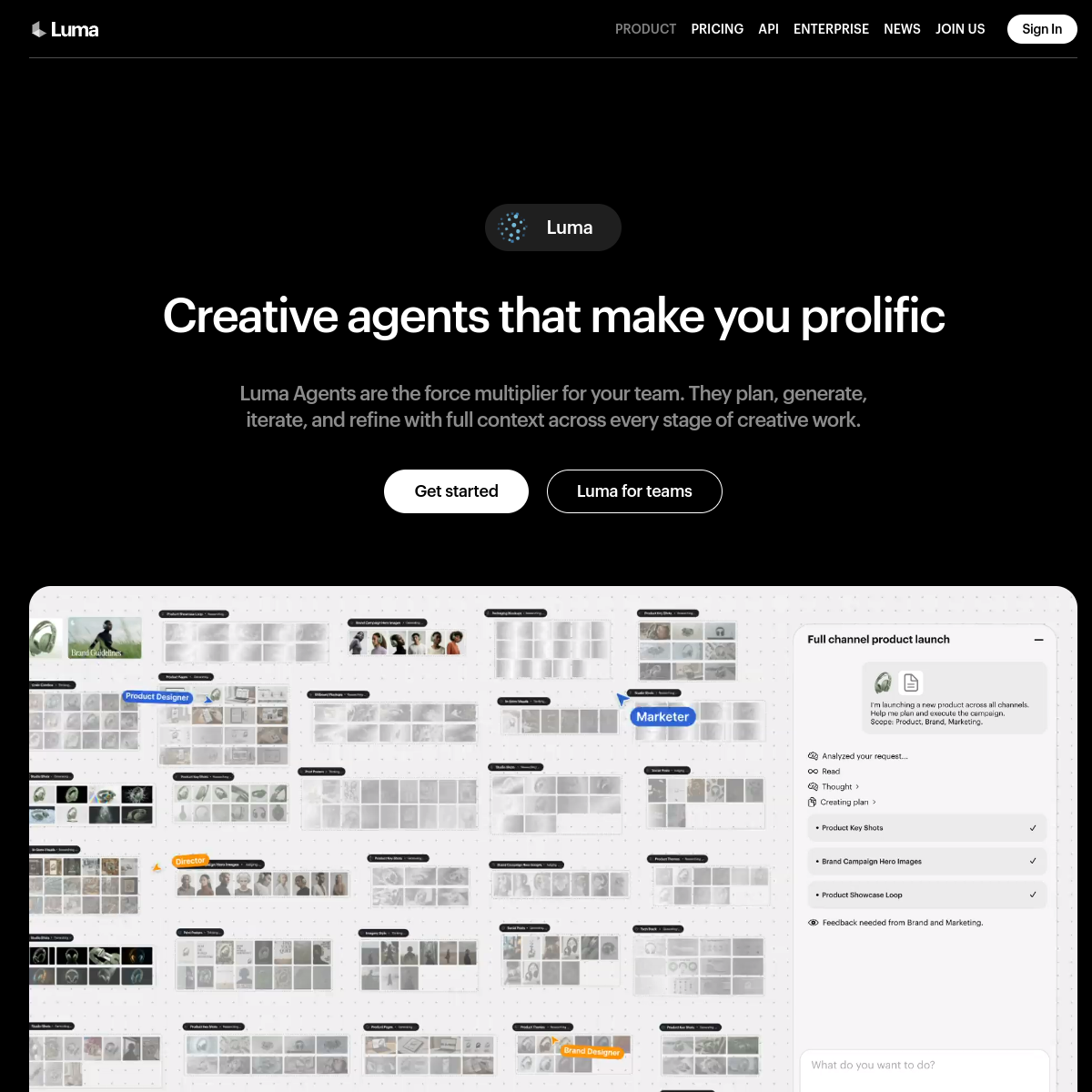
- Luma Agents: String Dream Machine, Photon, Modify, Reframe, etc. into automated workflows.
- Storyboarding: Putting together multiple shots into a narrative short film.
- Brand & Style: Training exclusive style templates.
- Luma API: commercial API, supports callbacks and SLA.
Model and version evolution
| Version | Time | Changes |
|---|---|---|
| Ray2 + Luma Agents | 2025-09 | Upgrade Ray2, launch Luma Agents workflow |
| Ray2 | 2025-01 | Ray2 model released, physical realism greatly upgraded |
| Dream Machine 1.6 | 2024-11 | Camera Motion Concepts Camera Motion Semantic Control |
| Dream Machine first release | 2024-06 | Phenomenal release, 5s high-definition video + strong performance |
| Luma Capture / NeRF | 2022 | NeRF 3D reconstruction lays the foundation for vision |
Technical advantages
- NeRF background: Deep understanding of 3D geometry/lighting/perspective transformation.
- Ray2 physical reality: strong expression of complex movements, human body movements, and fluids.
- Lens language: Camera Motion Concepts turns film language into prompt words.
- Photon image base: self-developed image model and video unified pipeline.
- Luma Agents: Upgraded from "Single Build" to "Creative Workflow".
- Business friendly: clear business authorization and enterprise API system.
How to use
| Entrance | Adaptation Crowd | Key Competencies |
|---|---|---|
| lumalabs.ai/dream-machine | All users | Web author main entrance |
| Luma iOS App | Mobile users | Mobile generation, viewing and sharing |
| Luma Agents | Heavy Creators | Multi-step Automated Workflows |
| Luma API | Developer/Enterprise | Commercial API, Callback SLA |
| Photon | Designer | Still image generation (material base for video) |
Typical process: Log in to Dream Machine → Text or upload images → Select models such as Ray2 → Set duration, lens language, style → Generate → Modify/Reframe secondary refinement → Splice into short films in Storyboard → Use Luma Agents to achieve mass production → Integrate into products through API.
Product Pricing
- Free Try it for free.
- Standard / Plus / Unlimited / Studio multiple subscriptions, covering individuals to small studios.
- Luma API provides a commercial interface billed on a per-call basis.
- Commercial authorization is clearly opened with the subscription level, making it easier for B-end users to use it in compliance.
Application scenarios
- Advertising/Branding/TVC Creative Storyboarding and First Edition Finishing.
- Short Videos/Reels/TikTok High-quality short videos.
- Music MVs, art videos, concept films.
- Pre-production previz and scene testing of movies/short plays.
- Cross-proportion media delivery: Reframe can change the horizontal and vertical screens with one click.
- Product/product demonstration videos and e-commerce content.
Applicable people
- Creative Studio / Independent Creator.
- Advertising/Branding/Marketing Team.
- Film and television pre-production and script development team.
- Photon + Dream Machine full stack visual creator.
- Developers and SaaS teams who want "clear commercial authorization + API availability".
Summary and Outlook
Luma Dream Machine uses Ray2 and Luma Agents to complete the upgrade from "phenomenal video model" to "creative agent workflow". It forms the "first echelon of AI video" together with Runway, Sora, Kling AI, and Pika. Worthy of attention in the future: Ray2’s iteration in long videos and character consistency, the expansion of Luma Agents workflow, the unified pipeline of the Photon image model and Dream Machine, and the penetration of API business on the B side.
Comparison of competing products
| Comparison dimensions | Luma Dream Machine | Competitor A | Competitor B |
|---|---|---|---|
| Core Differences | — | — | — |
| Price | — | — | — |
| Target Users | — | — | — |
Note: The above comparison is based on product public information, and actual differences are based on user experience.
Version Info
- Ray2 + Luma Agents :The Ray2 series has been fully upgraded in terms of physical coherence of long movements, complex lens language, character performance and scene consistency; Luma Agents (creative agents) have been simultaneously launched to string Dream Machine, Photon, Modify, Reframe and other capabilities into an end-to-end "creative production line".
- Ray2 :Released Ray2 video generation model, focusing on physical reality and complex motion, supporting Reframe and multi-scale output.
- Dream Machine 1.6 :Introducing Camera Motion Concepts (camera semantic control) to make lens commands close to the language of the film and television industry.
- Dream Machine first release :Dream Machine was officially released, with 5-second high-definition video generation + strong performance, quickly forming a phenomenon-level discussion.
- Luma Capture/NeRF :The predecessor product, Luma Capture, allows iPhone users to use NeRF to capture 3D scenes, laying Luma’s technical foundation in generative vision.
User Reviews