 Luthor
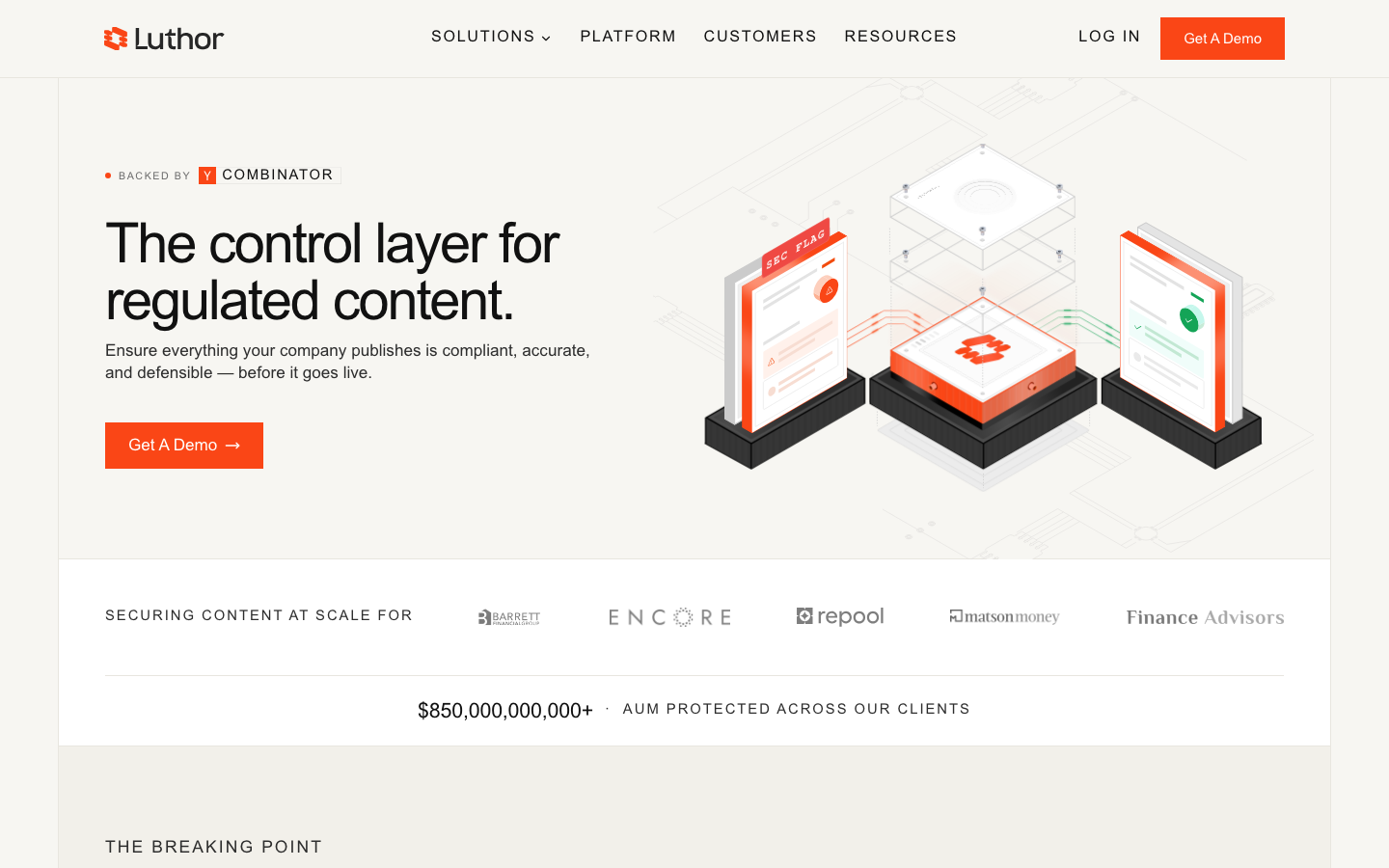
Luthor is an AI marketing compliance review platform for regulated industries, providing automated compliance review before publishing marketing content for companies such as finance, banking, credit, and insurance. Covering SEC Marketing Rule, FINRA 2210, UDAAP, GDPR and other regulations, the AI preliminary screening + manual final review mode reduces compliance review time by 90%, supports text, pictures, video, audio and other multi-channel content access, and provides a complete audit trail report.
Luthor
Luthor’s core parameters and statistics
Luthor does not provide general AI dialogue or content generation capabilities, but focuses on the vertical scenario of "marketing compliance review in regulated industries" - automatically detecting whether marketing content contains illegal statements (such as profit promises of financial products, exaggerated efficacy of medical advertisements, misleading statements of bank advertisements) before publishing the marketing content, reducing the risk of regulatory penalties.
| Projects | Public Information |
|---|---|
| Product Positioning | AI Marketing Compliance Audit Platform |
| Core Competencies | Content compliance review, risk marking and regulatory reference, audit report generation |
| Product Form | SaaS Web Platform + API |
| Business model | Enterprise subscription system, pricing based on review volume/policy coverage |
| Place of Residence | United States (US) |
| Supported Languages | English (en-US) |
| Security Certification | SOC 2 Type II, GDPR Compliant SEC 17a-4 Ready |
| Encryption standards | AES-256 (at rest) + TLS 1.2+ (in transit) |
| Data isolation | Multi-tenant complete isolation, data is not mixed and stored |
| AI data training | Customer data is never used for model training or fine-tuning |
| Regulatory coverage | SEC Marketing Rule, FINRA 2210, TILA, RESPA, NMLS, Reg Z, UDAAP, FDIC, FTC |
| Content access type | Text, image, video, audio SMS, social media URL |
| Customer Asset Protection | $850 Billion+ AUM |
| Investors | Y Combinator |
Brief review in one sentence: Luthor is not another AI writing tool, but a "marketing compliance access control for regulated industries" - automatically intercepting illegal statements and providing legal basis before marketing content reaches customers, freeing the compliance team from item-by-item review.
The actual meaning of efficiency improvement: According to official ROI calculator data, companies that review 100+ marketing content per month can reduce manual review time by 90% after deploying Luthor. A single content review is shortened from an average of 4 hours to 24 minutes to complete the initial screening, and approximately 4,320 man-hours can be recovered throughout the year for high-value compliance work. For a team with annual compliance costs of $360,000, Luthor reduces total costs to about $86,000, a net savings of $274,000.
Luthor’s users and market recognition
Luthor has a clear positioning in the compliance technology (RegTech) track and has been adopted and verified by many leading companies in the financial industry. Its market recognition is reflected in three levels: customer quality, financial background and third-party trust endorsement.
Enterprise Clients and Industry Coverage: Luthor serves clients with a combined managed assets of more than $850 billion, covering asset management and investment advisors (RIAs), banks and credit unions, mortgage lenders, insurance brokers and other segments. Typical clients include PCM Encore (over $1 billion in assets under management), Barrett Financial Group, Matson Money, Repool, Finance Advisors and others. Client sizes range from small and medium-sized RIAs to large financial institutions, demonstrating that Luthor's product capabilities can accommodate compliance review needs of different sizes.
Core pain points reflected in customer testimonials: PCM Encore Chief Compliance Officer Sam Rice commented that "Luthor makes marketing compliance from a stressful experience to a smooth experience"; Brandon Lawrence of Barrett Financial Group mentioned that "Faced with Reg Z, state regulations and NMLS compliance requirements, Luthor blocks all content before it goes online"; the head of marketing for a mid-sized federal credit union with $10 billion in assets under management said "200+ marketing content needs to be reviewed every quarter, Luthor Let's scale our marketing output without increasing our manpower." These feedbacks point to the same core value - in the context of AI accelerating content production, the traditional manual review model has become a bottleneck, and Luthor provides matching automated compliance capabilities.
Financing and Endorsement: Luthor is a startup incubated by Y Combinator. This background itself means that its business model and product direction have been screened and approved by top startup accelerators. Luthor is SOC 2 Type II certified, which requires ongoing monitoring and annual re-inspections as a compliance prerequisite for doing business in the financial services sector. In addition, Luthor passed a GDPR compliance assessment and met SEC 17a-4 record retention standards, demonstrating that its security architecture meets the threshold of trust that financial regulators place in service providers.
Competitive landscape positioning: Participants in the marketing compliance technology track where Luthor is located include Hadrius (RIA compliance), COMPLY (compliance management platform), Greenboard (fintech compliance), Smartria (RIA compliance software), etc. Compared with these competing products, the core difference of Luthor is that it "focuses on AI real-time review before marketing content is released" rather than pan-compliance management. Its policy engine is directly embedded in the content creation and release process rather than existing as an independent compliance management system.
Luthor’s Cost Advantage
Luthor's cost value is not achieved through low-price competition, but by replacing high-cost manual compliance reviews with AI automated reviews to achieve a "quantifiable input-output ratio" business model.
C client/individual users: Luthor is for enterprise customers and does not provide a personal or free version. For individual creators or small teams with only sporadic compliance review needs, it is more cost-effective to directly use the public regulatory guidance manual than to purchase Luthor. The value of Luthor can be fully unleashed in large-scale, high-frequency marketing content review scenarios.
Developer/API Access: Luthor provides an API interface for enterprises to integrate into internal content management systems (CMS) or marketing workflows. However, API pricing is not public and needs to be confirmed through business communication. Compared with a self-built compliance review system, the hidden advantage of Luthor API lies in the continuous maintenance and update of its regulatory database - a self-built system requires a dedicated regulatory research team to track rule changes from various regulatory agencies, which is an uneconomical option for most enterprises.
Corporate/Private Return on Investment: This is the core demonstration of Luthor's cost advantage. According to the modeling data of the official ROI calculator, a baseline of reviewing 100 pieces of marketing content per month, 4 hours of manual review per piece, and a compliance staff salary of $75 per hour:
| Cost items | Pure manual review | After using Luthor | Changes |
|---|---|---|---|
| Annual Manual Review Cost | $360,000 | $86,000 (including Luthor input) | Savings $274,000 |
| Average single review time | 4 hours | ~24 minutes (AI initial screening) | 90% reduction |
| Recoverable hours/year | — | 4,320 hours | Equivalent to 2 full-time compliance personnel |
| Return on Investment (ROI) | — | 319% | — |
| Payback period | — | About 3 months | — |
Data Interpretation: The above data comes from Luthor’s official ROI calculator, and the input parameters can be adjusted according to the actual situation of the company. The core conclusion is: For teams that review more than 50 pieces of content per month, Luthor’s investment can be repaid within 3-6 months. The primary source of savings is not "cutting the compliance team," but rather freeing up limited manpower from repetitive reviews to focus on high-risk edge cases and policy development.
The Free Truth: Luthor does not have a free tier, nor does it provide a public self-service subscription entrance. All customers are required to go through the Demo appointment, needs assessment and business quotation process. This constitutes an implicit threshold for budget-sensitive small and medium-sized enterprises. However, compared with the penalties that may result from a regulatory violation (the settlement amount for false advertising lawsuits in the financial industry often reaches millions of dollars), the investment in automating compliance reviews is usually considered a necessary expense under the risk assessment framework.
Hidden benefits: The hidden values brought by Luthor include: ① Audit readiness - each review automatically generates an audit trail with regulatory references, saving the amount of preparation work when responding to regulatory inspections; ② Cross-department efficiency improvement - the marketing team no longer needs to wait for the compliance team's item-by-item review. After the AI preliminary screening, it directly enters the manual final review, shortening the marketing go-live cycle by about 3 times; ③ Brand reputation protection - avoid the crisis of public trust caused by illegal advertising. This loss is difficult to quantify but has far-reaching impact.
Main features of Luthor
Luthor's functional system is designed around the overall design of "full access → intelligent review → clear traceability". It is not a simple AI content scoring tool, but a set of governance layers that can be embedded in corporate marketing compliance processes.
-
Multi-channel Content Ingestion: Supports compliance review of multiple content types such as text, images, videos, audio SMS, social media post URLs, etc. This means companies can complete omni-channel compliance checks from social media posts to TV ad scripts without having to switch tools. Applicable tasks: Compliance review of global marketing materials for multinational financial institutions, covering all customer contact channels such as official website apps, social media, emails, and text messages.
-
Policy Engine: core review capability, automatically runs multiple compliance policies for each piece of content and marks the risk level. The output of each policy includes the judgment result (COMPLIANT/QUEUED/RISK DETECTED), risk level (LOW/MEDIUM/HIGH) and the specific regulatory provisions cited. Enables enterprises to configure custom policies to meet internal compliance requirements. Applicable tasks: Detect illegal expressions such as "guaranteed returns" and "risk-free investment" in marketing content, and automatically recommend adding necessary disclaimers.
-
Risk Detection and Regulatory Reference: When AI detects a non-compliant statement, it not only marks the location, but also cites specific regulatory provisions (such as "This statement violates FINRA 2210 communication rules and a risk disclosure statement needs to be added") to help compliance personnel quickly understand the reasons for the violation and make targeted modifications. Applicable Task: Understand "why this passage is illegal" rather than just receiving a "high risk" label.
-
Full-link audit trail (Audit Trail): Each review of each content generates an tamper-proof audit record, including the operator, timestamp, review results, and modification history, complying with SEC 17a-4 record retention standards. Audit reports can be summarized on a quarterly basis to quantify the protective value of compliance efforts to the business. Applicable tasks: Respond to compliance inspections by regulatory agencies and provide a traceable chain of review evidence.
-
Brand Alignment & Data Privacy: In addition to legal compliance reviews, Luthor also supports brand tone consistency checks and PII (personally identifiable information) leak detection to ensure that marketing content also meets corporate standards in terms of style and privacy protection. Applicable tasks: Detect marketing content that accidentally contains customer personal information or statements that deviate from brand positioning.
[Expert View]: The most ingenious design of Luthor lies not in the AI review itself, but in the context of "review → citation → modification → review". Traditional compliance tools either only flag problems without providing solutions, or provide solutions without tracing the basis for decision-making. Luthor connects three sections: mark the issue → give regulatory citations → suggest modifications → re-examine and confirm. This closure has transformed compliance review from a "one-time access check" to an "iterative quality control process", and the role of the compliance team has also changed from "interceptor" to "quality engineer".
Luthor’s model and version evolution
Luthor's product iteration direction reflects a clear trend: evolving from "single channel text compliance" to "omni-channel, omni-modal, in-depth governance". Since Luthor adopts the SaaS continuous delivery model, there is no large version number in the traditional sense. The following milestones are based on public function nodes.
Initial release phase (~2025-Q2)
- Luthor Initial Platform Release (~2025-06): The initial version of the platform is online, and its core capabilities focus on compliance review of financial marketing copywriting. The first release covers two core regulations, SEC Marketing Rule (Rule 206(4)-1) and FINRA 2210, and the product form is a pure text review. This stage mainly serves the marketing compliance needs of the asset management and investment advisory (RIA) industry, and verifies the product’s detection accuracy and workflow adaptability in real scenarios.
Channel expansion stage (~2025-Q4)
- Multi-Channel Ingestion Release (~2025-10): Moderation capabilities are expanded from plain text to multiple content types such as images, videos, audio SMS, social media, and URLs. The policy engine has been simultaneously upgraded, adding support for regulations such as TILA, RESPA, NMLS, Reg Z, and UDAAP. The strategic intent at this stage is clear – to expand beyond the RIA segment into broader regulated industries such as banking, credit and consumer finance.
Trust infrastructure phase (~2026-Q2)
- SOC 2 Type II Certified Release (~2026-04): Passed SOC 2 Type II certification, which is a key trust threshold for financial institutions to choose SaaS service providers. At the same time, the AI review transparency function has been launched - each review result displays the complete decision-making basis and regulatory reference links, solving the trust problem of "AI black box" in compliance scenarios. Audit trail capabilities enhanced to meet SEC 17a-4 standards. At this stage Luthor began entering into the vendor evaluation process for large financial institutions.
Continuous iteration (~2026-07 to present)
The current version continues to expand the regulatory database and policy templates, adding support for FDIC advertising rules, state-specific regulations, and cross-border compliance scenarios. As can be seen from the Luthor resource page, its knowledge base has covered a wide range of regulatory fields such as ADA website compliance, CAN-SPAM email compliance, GDPR, CCPA, and DMCA, indicating that the policy engine is expanding in the direction of pan-compliance.
Version Note: Luthor has not disclosed the precise version number. The above time nodes and functional milestones are inferred based on the content of the official page. SaaS products operate in a continuous delivery model, and feature updates are not tied to a specific version number.
Luthor’s technical advantages
Luthor's technical architecture is not simply a layer of UI with a ready-made LLM, but an in-depth engineering implementation around the two core constraints of "structured expression of regulatory knowledge" and "traceability of review results".
Semantic matching driven by regulatory knowledge graph: Luthor's core technology is not to let LLM directly answer "whether this content is compliant", but to convert regulatory regulations (such as the seven requirements of the SEC Marketing Rule of FINRA 2210) into executable policy rules, and then perform semantic-level matching on marketing content. This hybrid architecture of "rules engine + semantic understanding" is more interpretable and audit-compliant than a pure LLM solution - each review determination can be traced back to a specific regulatory provision, rather than a black box judgment of the model. This is crucial for compliance scenarios: What regulatory agencies need during inspections is not "AI says there is no problem", but a complete logical chain of "which regulatory provisions are based on and how to determine compliance."
AI Transparency and Full Traceability: Luthor's AI review process does not output results in one go, but records the complete decision-making path - what the model saw, which rules were matched, and why it was determined to be high risk. This mechanism directly responds to the core requirement of financial supervision for "model interpretability". At the practical level, compliance personnel can expand each risk mark to view the basis for its judgment. If there is a misjudgment, the deviation can be manually corrected and recorded. In theory, these feedback data can be used to continuously optimize the model.
Secure and compliant infrastructure: Luthor's security architecture embodies the design idea of "born for financial supervision": AES-256 static encryption + TLS 1.2+ transmission encryption, KMS-based automatic key rotation, multi-tenant data complete isolation RBAC permission control + SSO (OAuth/SAML) + MFA three-layer access control. Immutable audit logs of all operations, meeting SEC 17a-4 retention standards. SOC 2 Type II certification provides ongoing verification by an independent third party.
Zero Data Retention Policy: Luthor explicitly states that customer data is never used for AI model training or fine-tuning, and submissions are not retained by the model provider. This strategy is the minimum threshold in a financial compliance scenario - if the service provider uses customer data to improve the model, it itself poses a data leakage risk. Luthor makes "keeping customer data safe" part of its security commitment, not optional.
Multi-modal content analysis: Luthor supports content review in multiple modalities such as text, pictures (OCR recognition of slogans and copywriting), video (voice transcription + screen text extraction), audio (speech-to-text analysis), etc. This means marketing teams cannot bypass text review by embedding offending copy in images or videos. From a technical implementation perspective, this requires the parsing pipelines of different modalities to be connected in series to a unified policy engine, rather than independent review of each modality - the real technical barrier lies in cross-modal semantic alignment.
How to use Luthor
Luthor adopts a sales-led (Sales-Led) enterprise deployment model and does not provide self-service registration and out-of-the-box use. The complete usage process is divided into four stages:
Phase 1: Needs Assessment and Demo (1-2 weeks)
Visit luthor.ai, click "Get A Demo" and fill in the company information (name, company, industry, compliance requirements). Luthor's team of policy and legal engineers communicate with businesses about specific content review processes, regulatory obligations and compliance goals. The key output from this stage is clarity on the scope of regulations, the level of scrutiny and integration requirements that the business needs to cover.
Phase 2: Integration and Configuration (days to weeks)
Luthor promises integration "in days, not months." Specific steps include:
- Configure regulatory preferences - select the industry to which the company belongs and the corresponding regulatory agency (SEC/FINRA/FDIC/state-level regulation, etc.)
- Access content sources - Integrate marketing content into the Luthor review pipeline through API or file upload
- Set custom policies - configure special rules for the company's internal compliance requirements based on standard regulatory templates
- Configure user permissions - set access permissions and approval processes by role (marketer/compliance officer/administrator)
- SSO integration – connect to enterprise identity management systems through OAuth or SAML
Phase 3: Commissioning and Calibration (1-2 weeks)
Luthor review is run on actual content, and the compliance team performs manual review against AI flagged results, calibrating detection thresholds and false positive rates. The core goal of this stage is to build the team's trust in the AI review results - too high a false positive rate will lead to a "crying wolf" effect, and too high a false negative rate will lose compliance significance.
Phase 4: Officially launched
A must-have process for embedding Luthor review into marketing content releases. A typical "AI preliminary screening + manual final review" workflow is:
Marketer submits draft → Luthor AI automated review (30-60 seconds) →
Generate Compliance Report (High Risk/Medium Risk/Compliance) →
Compliance officer reviews high-risk flagged items → Confirm/Reject/Modify →
Final Approval → Release
API integration: For enterprises with customized needs, Luthor provides API interfaces. However, API documentation and endpoint information must be obtained from the business section and are not publicly available. In theory, API integration can directly call compliance review from the content management system without going through the Luthor web interface. It is suitable for scenarios where the review volume is very large and needs to be embedded into its own workflow. The specific endpoints and authentication methods are subject to the official documents after business docking.
Luthor Product Pricing
Luthor adopts a pure enterprise subscription system. All prices must be confirmed through business communication. There is no public pricing page.
Pricing Model: According to the official ROI calculator, Luthor’s pricing depends on three core variables:
- Review Volume: The amount of marketing content that needs to be reviewed each month
- Policy Coverage: Breadth of regulatory library required (SEC/FINRA only, or coverage of state and cross-border regulations)
- Workflow Complexity: the number of systems and approval levels that need to be integrated
Price range reference: Although there is no public price, judging from the deduction of the ROI calculator, the total annual cost of using Luthor for an enterprise that reviews 100 pieces of content per month is about $86,000 (including Luthor investment), and the net cost after deducting labor savings is about $20,000. Based on this estimate, Luthor's annual subscription cost could range from $50,000 to $150,000, depending on the variables mentioned above.
Cost comparison with alternatives:
| Scenario | Annual Cost (Estimated) | Regulatory Coverage Maintenance | Integration Complexity | Applicable Scale |
|---|---|---|---|---|
| Luthor Enterprise | $50,000-$150,000 | Automatic updates, vendor maintenance | Low-Medium (SaaS) | 50+ content reviewed monthly |
| Self-built review system | USD 200,000-500,000+ | Requires self-built regulatory research team | High (fully customized development) | 500+ content reviewed monthly |
| Purely manual outsourcing review | US$150,000-400,000 | Depends on outsourcer capabilities | Low (manual docking) | Monthly review 100-500 Content |
| Non-industry general compliance tool | US$30,000-100,000 | Does not cover industry-specific regulations | Medium (requires secondary development) | Monthly review below 50 |
Additional Note: The costs of the above alternatives are deduced estimates based on industry experience and are not official Luthor data. The upfront development cycle of a self-built review system is usually 6-12 months, and the hidden costs are much higher than the superficial figures. Luthor's core pricing advantage lies in "socializing the cost of regulatory maintenance" - companies can obtain continuously updated compliance review capabilities without building their own regulatory research teams.
Luthor application scenarios
Typical application scenarios for Luthor focus on industries that require high-frequency publishing of regulated marketing content. The following four scenarios have been verified by customers:
-
Financial Marketing Advertising Review (RIAs and Broker-Dealers): Marketing content by asset managers and investment advisors is subject to strict compliance with the SEC Marketing Rule (Rule 206(4)-1) and the FINRA 2210 Communications Rule. Every statement involving investment performance and rate of return may trigger compliance risks. Deduction: Under the traditional model, the compliance review of a fund brochure requires the compliance officer to compare the regulatory requirements section by section, which takes 2-4 hours; after using Luthor, AI completes the initial screening and marks all potential violation points within 1 minute, and the compliance officer only needs to review the marked part, and the total time is reduced to 15-30 minutes. Acceptance focus: Whether the AI's detection rate for "income commitment" violations reaches more than 95%, and whether the false positive rate is less than 20%.
-
Bank and Credit Union Deposit and Loan Advertising Compliance: Banks’ advertising of deposit rates and loan products are subject to TILA, RESPA, Reg Z and FDIC advertising rules. Declarations of noncompliance may result in regulatory fines and class action lawsuits. Deduction: From "violations discovered after release and fined" to "AI automatic interception before release", passive compliance is transformed into active defense. Acceptance Concern: Whether to cover state-specific regulatory differences (such as differences in disclosure requirements in New York vs. California).
-
NMLS Compliance Review by Mortgage Lenders: Mortgage ads are subject to the ad review rules of NMLS (National Multi-State Licensing System), and states have different requirements for rate disclosure, license number display, etc. Luthor automatically detects whether each ad contains the correct licensing information and meets the target state's disclosure standards. Acceptance concerns: Is there a regular update mechanism for state-level regulations, and how long does it take to push updates after new regulations take effect?
-
Insurance and Consumer Products Regulated Industries: Insurance advertising is subject to the exclusive rules of each state's insurance department; consumer products such as food, drugs, alcoholic beverages, and tobacco are regulated by agencies such as the FDA, FTC, and TTB. Luthor is expanding its policy engine to cover these areas of consumer regulation. Acceptance focus: Whether the compliance rule base of the consumer goods industry has the same depth and timeliness as that of finance.
-
Dimensionality reduction strike scenario: Enterprises that require high-frequency (monthly review of 100+ items) and batch compliance review of multi-channel marketing content. AI replaces the heavy labor of manual reading one by one, transforming the compliance team from "readers" to "gatekeepers". For teams with more than 50 reviews per month and annual compliance costs exceeding $200,000, Luthor's return on investment can be compressed to 3-6 months.
-
Human-machine collaboration boundary: 100% automated and regulated - compliance risk scanning, regulatory clause matching, standard compliance report generation, and automatic release of low-risk content. There are certain areas that must be manually confirmed - final compliance judgments on high-risk content (when brand reputation and major regulatory risks are involved), verification of AI model calibration effects after regulatory updates, edge cases containing ambiguous expressions or innovative marketing forms, and compliance decisions when cross-border regulatory conflicts occur.
Applicable people for Luthor
Luthor's product positioning determines that its applicable audience is concentrated within corporate roles in regulated industries, rather than individual users or the developer community.
-
Compliance Team: the most direct beneficiary. Luthor frees compliance personnel from the repetitive task of reading marketing content item by item, allowing them to focus on high-value work such as strategy development, edge case judgment and cross-department collaboration. Implementation Tips: The compliance team needs to accept the accuracy of the AI review results (it is recommended to establish a human-machine control test during the trial operation phase to quantify the accuracy and false alarm rate of AI detection). Misfit Boundary: If the enterprise compliance team is extremely small (1-2 people) and the monthly review volume is less than 20, the cost-effectiveness of purchasing Luthor may not be significant.
-
Marketing Team: Indirect but obvious. AI review drastically shortens the cycle time for marketing content from draft to live—no more waiting in line for compliance teams to review. Deduction: The publishing cycle of marketing content is shortened from 3-5 days of "submit → wait for compliance review → modify → resubmit → re-review" to 1 day of "submit → AI review → compliance confirmation → release". Implementation Tips: Marketing teams need to adjust their content creation habits and move compliance review to the creation stage instead of the last moment before release.
-
Legal & Compliance Management: Executives responsible for supervising the formulation of compliance strategies and regulatory docking. The audit trails and compliance reports provided by Luthor provide a clear chain of evidence of compliance in the face of regulatory inspections. Acceptance focus: Whether the format and content of the audit report meet the inspection requirements of regulatory agencies, and whether it supports on-demand export and customized report dimensions.
-
Information Security & Procurement Team (Security & Procurement): Technical and managerial personnel responsible for evaluating the security qualifications of third-party service providers. Luthor's SOC 2 Type II certified AES-256 encrypted SSO/MFA support and zero data retention policy are required to get on financial institutions' vendor lists. Acceptance Concerns: Coverage of SOC 2 reports and most recent audit date; whether data storage geolocation complies with corporate data residency policies; GDPR data processing agreement signing process.
-
Not suitable for the boundary: ① Enterprises in non-English markets - Luthor currently mainly supports English content review, and support for Chinese, Japanese, and European languages has not been publicly confirmed; ② Enterprises that only need internal compliance system management - if the core need is "establishing a compliance management system" rather than "reviewing specific marketing content", a compliance management platform (such as COMPLY or a custom system) may be more suitable; ③ Teams with extremely low review volume - the monthly review volume is less than 10 Enterprises with such content are not worth investing in enterprise management-level compliance tools; ④ Enterprises that require in-depth customization of AI models - Luthor provides a standardized policy engine and does not support model fine-tuning for specific business scenarios.
Summary and Outlook
Luthor's positioning is highly differentiated in the AI tool market - it does not pursue general AI capabilities, but accurately cuts into the just-in-demand scenario of "marketing compliance in regulated industries", building clear competitive barriers at the intersection of compliance technology (RegTech) and AI.
Current core advantages: ① Scenario verticality - encapsulating AI capabilities as "compliance review" rather than "content understanding", making it irreplaceable in highly regulated industries such as finance and banking; ② Trust infrastructure - SOC 2 Type II certification, zero data retention AI transparency mechanism together constitute the trust baseline for financial institutions when selecting suppliers; ③ Quantifiable ROI - an average return on investment of 319% and 3 The monthly payback period provides a clear financial basis for purchasing decisions; ④ Y Combinator endorsement - the screening effect of the entrepreneurial accelerator reduces the risk perception of early customers.
Current main limitations: ① Opaque pricing - there is no public price system, all customers need to go through the Demo + business quotation process, which constitutes an implicit threshold for small and medium-sized enterprises with limited budgets; ② Limited language coverage - currently English is the main focus, and the expansion plan for non-English markets has not been disclosed; ③ Uneven depth of industry coverage - the regulatory coverage of the financial industry is relatively complete, but the depth of the compliance rule base in regulated industries such as consumer goods, medical, and pharmaceuticals needs to be verified; ④ The impact of false positive rates on the user experience - If the false positive rate of AI is too high, compliance teams may have a "crying wolf" effect and ignore true risk flags, which will completely negate the efficiency gains of automated reviews.
Follow-up observation points: ① Whether to launch self-service registration and standardized pricing tiers to lower the adoption threshold for small and medium-sized enterprises; ② The timetable and coverage of multi-language support - this is a key prerequisite for entering the EU and Asia-Pacific markets; ③ The evolution from passive review to proactive recommendations - currently Luthor marks violations and provides regulatory references, but whether it can further provide regulatory-compliant rewriting recommendations will be the next stage of product differentiation; ④ The speed of category expansion of the compliance strategy library—whether the same level of rule depth as finance can be established in more regulated industries such as insurance, pharmaceuticals, and food.
Procurement and Adoption Risk Assessment: For businesses in financial or regulated industries that review more than 50 pieces of marketing content per month and have annual compliance costs in excess of $150,000, Luthor deserves a dedicated assessment for inclusion in their compliance toolchain. Recommended procurement path: ① First confirm through demo whether Luthor covers all regulatory regulations involved in the enterprise (especially state-level and specific industry rules); ② During the 2-4 week trial run period, establish a comparison record of AI review results and manual review to quantify the accuracy and false positive rate; ③ Confirm whether the latest audit date of the data residency strategy and SOC 2 report meets the enterprise security baseline; ④ Write the timeliness clause for synchronization of regulatory updates into the procurement contract - the timeliness of the compliance review tool directly determines its value. Delayed update of the review tool is more dangerous than none (creating a false sense of security); ⑤ Start piloting with a single business line, verify the ROI model, and then expand to the entire enterprise.
Version Info
- Luthor Continuous Release :There is no official precise date yet. Continuously iterate on regulatory databases, policy engines, and AI detection capabilities.
- SOC 2 Type II Certified Release :Obtained SOC 2 Type II certification to enhance AI audit transparency and audit tracking capabilities.
- Multi-Channel Ingestion Release :Added multi-channel content compliance review capabilities for images, videos, and audio to expand the coverage of the policy engine.
- Initial Platform Release :The initial version of the Luthor platform is launched, focusing on compliance review of financial marketing copywriting, covering SEC Marketing Rule and FINRA 2210.
User Reviews