 Mailchimp
Mailchimp is the world's most well-known email marketing and automated marketing platform, providing email marketing, customer journey automation CRM, landing pages and social publishing functions. Acquired by Intuit for $12 billion in 2021, it serves millions of users around the world.
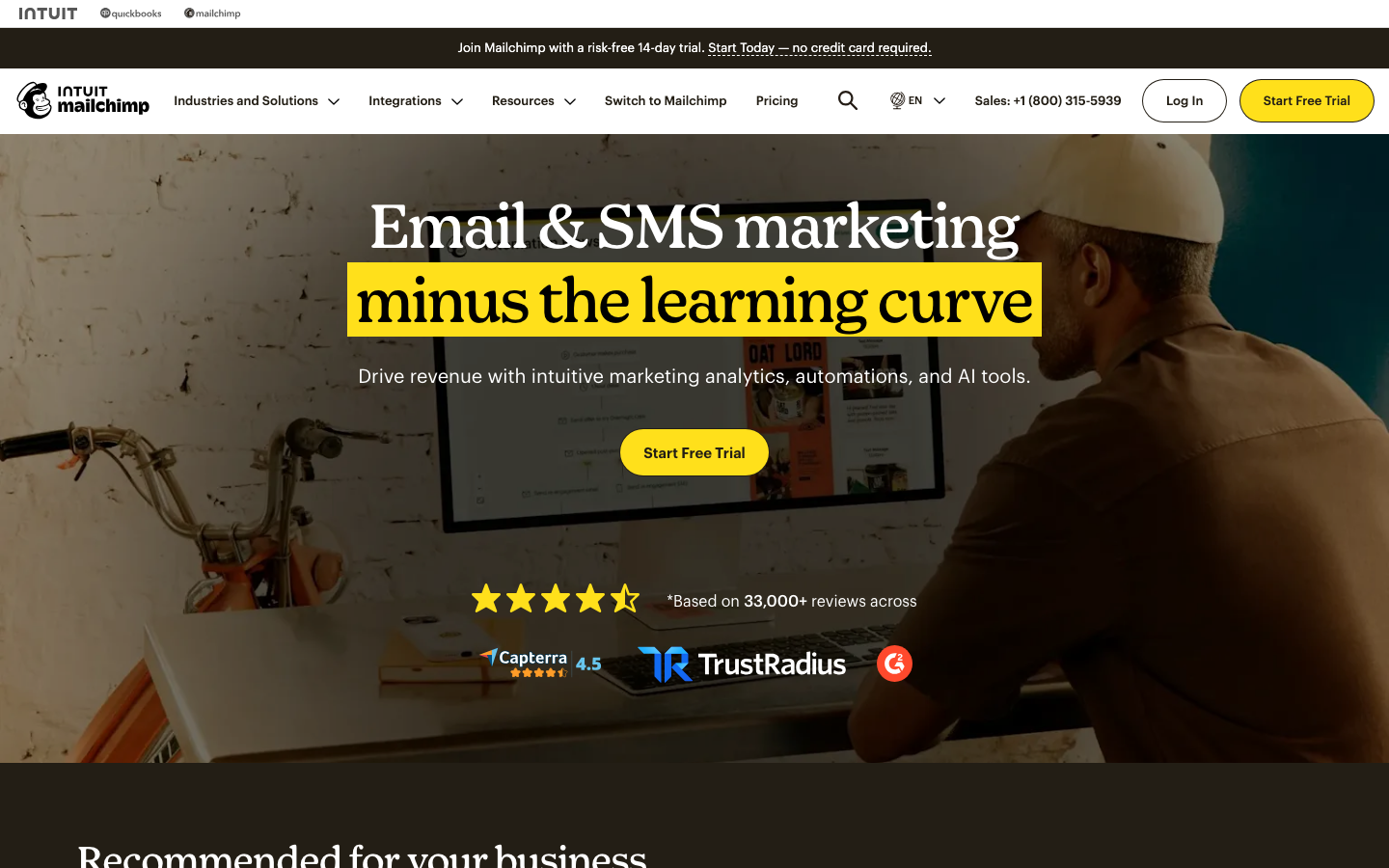
Mailchimp
Mailchimp’s core parameters and statistics
Mailchimp is the world's most recognized email marketing and automated marketing platform. It is officially positioned as an "All-in-One Marketing Platform" and provides one-stop capabilities from newsletter sending to full-link marketing for small and medium-sized enterprises and individual creators. After being acquired by Intuit for US$12 billion in 2021, it is evolving towards a "marketing operating system for small and medium-sized enterprises".
| Parameter item | Data |
|---|---|
| Product Positioning | All-in-One Email Marketing and Automated Marketing Platform |
| Core Form | SaaS Web + Mobile App + REST API + Transactional Email API |
| Acquisition Information | Acquired by Intuit for approximately $12 billion in 2021 |
| User scale | Millions of active users around the world (the exact number is not officially disclosed) |
| Product Ecology | Email + Automation + CRM + Landing Page + Social Publishing + Website Construction |
| Number of integrations | 300+ official integrations (including Shopify, Salesforce, WooCommerce, Canva, etc.) |
| Latest version | 2026.07 |
| Pricing model | Billed by the number of contacts, 4 packages (Free / Essentials / Standard / Premium) |
| Free plan | Free package (500 contacts, 1,000 messages/month, basic functions) |
| AI capability portal | Generative AI copywriting Intuit Assist (Beta), Send Time Optimization, Content Optimizer |
| Supported platforms | Web, Android, iOS, API |
| Supported languages | en-US, de-DE, fr-FR, es-ES, it-IT, pt-BR, ja-JP |
Brand Awareness: Mailchimp's brand awareness in the field of email marketing is almost equal to "email marketing" itself. The free plan has extremely low entry barriers for individual creators with low contact volume.
Ecological Leverage: 300+ official integrations make it not only an email sending tool, but also a marketing data hub connecting Shopify, Salesforce, Google Analytics, QuickBooks and other systems, reducing the hidden costs of manually moving data across systems.
AI capability positioning: AI functions are embedded in workflows such as email construction, audience analysis, and sending strategies - users can get AI-generated copywriting, predicted audience behavior, and optimized sending time without leaving the operating interface.
Mailchimp’s users and market recognition
Mailchimp’s market recognition is mainly based on three dimensions: brand accumulation, user scale and Intuit ecological endorsement, but the official has not disclosed precise MAU or revenue data.
User Scale: The official page uses the expression "Millions of users trust us with their email marketing", indicating that its active user base has reached one million. According to the official comparison page, which claims to be "#1 email marketing platform" (based on a comparison of the number of competing customers disclosed in December 2023), Mailchimp's penetration rate in the field of email marketing for small and medium-sized enterprises is in the industry's leading position.
Acquisition Endorsement: Intuit acquired Mailchimp in 2021 for approximately $12 billion, one of the largest acquisitions in the SaaS space. Intuit’s ecosystem (QuickBooks, TurboTax, Credit Karma) is bringing the value of financial-marketing data linkage for small and medium-sized enterprises to Mailchimp.
Industry Awareness: Mailchimp's brand is highly recognized among non-technical users and is often used as a synonym for "email marketing". However, in the field of in-depth e-commerce analysis (such as SKU-level purchase tracking LTV modeling), professional users prefer to compare e-commerce-specific platforms such as Klaviyo.
Community & Ecosystem: The official integration directory provides 300+ app connectors, including Shopify, Salesforce, WooCommerce, Canva, Google Analytics, QuickBooks, Squarespace Commerce, and more. Developers can extend functionality through the REST API and Transactional Email API.
Mailchimp’s Cost Advantage: Three-Tier Cost Structure
Mailchimp's costs need to be dismantled from the three layers of C-side, developers, and enterprises, while paying attention to the inflection point effect of the per-contact billing model.
C-side/personal cost
| Cost Item | Description |
|---|---|
| Free package | 0 yuan, 500 contacts, 1,000 letters/month, basic templates and reports |
| Start with Essentials | ~$13/mo (500 contacts), unlimited sending, A/B testing, 3 users |
| Start with Standard | ~$20/month (500 contacts), automation, AI content, 5 users |
| Starts with Premium | Starting from ~$350/month, premium segmentation, unlimited users, Phone Support |
Free tier trap: The Free package only supports a monthly limit of 500 contacts and 1,000 messages, and lacks core optimization functions such as Send Time Optimization and A/B testing. Upgrades are almost inevitable as your contacts grow.
Developer/API Cost
REST API and Transactional Email API (formerly Mandrill) are pay-per-send and billed separately from the main marketing package. Specific API pricing is subject to official developer documentation. The hidden costs are the initial learning curve for Mailchimp-specific data models (audiences, tags, automation, etc.) and the fact that some integrations only support one-way sync.
Business costs
Premium packages are priced according to contact tiers, and for prices above 100,000 levels, you need to contact sales. Enterprise procurement focuses on: annual increase in contact billing, data migration export fees, SSO/RBAC permission granularity SLA terms. Compared with Klaviyo's per-profile billing, Mailchimp's costs may be higher in e-commerce scenarios with a large number of one-time purchasing users; templates and channel optimization in Chinese and Asian languages are not as mature as in the English market.
Mailchimp’s main functions: functional linkage and synergy
The function of Mailchimp is not an isolated module, the core value lies in the "data closure" between modules. There are significant synergies among the following six functional groups.
Email design and templates
- Drag-and-drop builder: Classic email editor and new generation "email builder" modes, support building from blank or starting from 100+ responsive templates.
- Customized HTML: Supports direct editing of HTML/CSS, suitable for design teams with strict brand requirements.
- Dynamic content: In the same email, different content blocks are displayed based on recipient tags, location, purchase history and other conditions to achieve "one person, one email" personalization.
- Canva integration: Call Canva design materials directly within Mailchimp without switching tools.
Expert Viewpoint: The linkage effect of "dynamic content" and "Canva integration" is that designers produce multiple versions of visual materials in Canva, and marketers use dynamic content rules to assign to different audience segments on the same interface, reducing the cross-tool switching chain of "design → export → upload → matching".
Customer journey automation (Automation Flows)
- Visual Editor: A process design interface based on Trigger→Condition→Action, supporting preset templates such as welcome series, abandoned order recovery, birthday promotion, and reactivation.
- AI Generated Automation: New feature in Beta stage - users enter business description, AI automatically generates a complete automated process and supporting email draft, and users only need to review and publish.
- Cross-channel triggering: Supports not only email events, but also SMS, social media interactions, and webhook triggers.
Expert View: Official data shows that automation tools can help increase click-through rates by up to 115% (compared to mass emails), but this data is based on statistics from 2020-2023, and the actual benefits depend on the accuracy of the process design and the granularity of audience segmentation.
Audience Management and CRM
- Tagging and Grouping: manual tagging + behavioral automatic tagging + predicted demographic tags (Predicted Demographics), supporting dynamic segmentation of multi-level condition combinations.
- Marketing CRM: Unified management of contact information, interaction history, purchase records and communication preferences, supporting custom fields.
- Predicted Demographics: Predict the age, income, purchase intention and other characteristics of the audience based on the AI model, helping merchants without a data science team to achieve "Look-alike" audience targeting.
Expert Viewpoint: The synergy between "predicted demographics" and "dynamic content": AI-predicted audience characteristics are directly used as matching conditions for dynamic content, achieving "data science-driven one-to-one marketing" without the need for additional tools.
AI content generation (Generative AI / Intuit Assist)
- AI copywriting generation: Enter the product name and marketing goals, and automatically generate the email subject line and body copy.
- Intuit Assist (Beta): AI growth assistant across the Intuit platform that turns data into actionable marketing recommendations and generates personalized content. Currently free for Premium, Standard, and Legacy users, but in beta (pricing and terms subject to change).
- Subject Line Helper: Automatically recommends subject lines with high open rates based on historical data and best practices.
- Smart Recommendations: An AI-based product recommendation engine that automatically selects products from the product catalog that are most suitable for the audience to display.
Expert Viewpoint: The value of the linkage of AI copywriting + product recommendations lies in: when generating copywriting, it automatically extracts product selling points and converts them into email content blocks, and intelligently matches the audience's interests and preferences - this solves the processing breakpoint in traditional marketing of "only after the copywriting is written, it is discovered that the product image does not match the audience".
Landing page and website construction
- Landing Page Builder: A drag-and-drop website building tool that focuses on the design of conversion paths for marketing goals (registration, download, purchase).
- A/B Test: Supports traffic split testing on the landing page version, and automatically converges to the high-conversion version.
- Website Construction: Simple multi-page website tool, suitable for small and micro businesses to build a basic online image of their brand.
Reporting and Analysis
- Basic Report: Standard indicators such as open rate, click rate, unsubscribe rate, spam complaint rate, etc.
- Revenue Attribution: Track direct sales revenue generated by emails (requires integration with e-commerce platforms such as Shopify).
- Content Optimizer (Standard/Premium): AI-driven email content scoring tool that evaluates copy readability, subject line effectiveness, and overall design quality before sending, and gives suggestions for improvement.
- Send Time Optimization: Based on each contact's historical interaction data, AI predicts the time point when they are most likely to open the email, and automatically optimizes it when sending.
- Google Analytics Integration: Correlate and analyze email interaction data with website behavior data.
Mailchimp’s version evolution and product milestones
Mailchimp iterates in a continuous delivery model, and officially discloses key updates through the "What's New" page and quarterly Release Notes.
Critical version node
| Version/Event | Time | Core Changes |
|---|---|---|
| Mailchimp was founded | 2001 | Founded by Ben Chestnut, Mark Armstrong, and Dan Kurzius, originally as an email service provider |
| Free package launched | ~2009 | Launched the "Freemium" model, becoming a key driving force in the popularity of email marketing for small and medium-sized enterprises |
| Automation function online | ~2013 | Introducing automation triggers, evolving from "manual sending" to "event-driven sending" |
| Intuit Acquisition | 2021-09 | Intuit acquires for approximately US$12 billion, starting a financial-marketing ecosystem integration |
| Mailchimp Rebrand | ~2023.09 | Integrate the Intuit ecosystem, launch CRM suite and website building functions, and update the brand visual |
| Centralized release of AI functions | ~2024 | Content Optimizer, Intuit Assist (Beta), AI automated generation and other functions will be intensively launched |
| 2025 Q4 Update | ~2025.10 | Launch of new customer journey builder AI email subject line optimization and enhanced predicted demographics |
| 2026.07 Update | ~2026.07 | Enhanced AI content generation and intelligent sending time optimization functions, Revenue Intelligence starts Beta |
Evolutionary context
Email Sending Tool Period (2001-2009): With the mission of "making email marketing easier", the launch of the free package significantly lowered the threshold for use using the Freemium model.
Automation Marketing Platform Phase (2010-2020): After the introduction of the automation engine, it evolved from a "sending tool" to a "marketing process orchestration platform". Visual Automation Flows and 300+ integrated ecosystems were formed during this stage.
AI-driven marketing operating system period (2021-present): After the acquisition by Intuit, the strategic focus shifted to the "marketing operating system for small and medium-sized enterprises", and AI capabilities were embedded in each module rather than an independent product line. Revenue Intelligence, where AI predicts high-value customers and suggests strategies, is in beta.
Mailchimp’s technical advantage: AI embedding and sending infrastructure
Mailchimp’s technical advantage lies not in the performance leadership of a single AI model, but in its engineering ability to embed AI capabilities into mature marketing workflows.
Cross-platform linkage of Intuit Assist: Intuit Assist is a unified AI layer across Mailchimp + QuickBooks + TurboTax + Credit Karma. It generates copywriting, insights and process suggestions directly in the workflow interface, reducing the context switching loss of "leaving the current interface → asking questions → returning to paste". Suitable for accounts with existing usage history and data accumulation.
Sending infrastructure: Mailchimp maintains sending reputation channels with major email service providers such as Gmail, Outlook, and Yahoo, and ensures arrival rate through SPF/DKIM/DMARC verification and automatic bounce processing. For small and medium-sized enterprises that lack self-built email infrastructure, this is the core hidden value; ultra-high sending volume or high-risk control scenarios such as finance and medical care require the establishment of a dedicated channel with the Deliverability team.
Smart Recommendations Recommendation Engine: Based on hybrid recommendations of collaborative filtering + product catalog metadata, the best product match for each recipient is calculated in real time when sending. The actual effect depends on the quality of the product catalog data.
API and Integration: REST API covers audience management, campaign creation, report acquisition; Transactional Email API independently handles triggered emails (password reset, order confirmation); 300+ integrations reduce manual data handling through OAuth and Webhooks.
Adaptability Boundary: Customized sending strategies that are not suitable for large-scale self-built sending and receiving channels, scenarios that require direct access to the bottom layer of the AI model, and personalized recommendations that require millisecond-level real-time performance. In these scenarios, professional ESP or self-built AI recommendation pipelines are more suitable.
Mailchimp usage entrance and typical path
Mailchimp offers many ways to use it:
| How to use | Suitable for everyone | Core features |
|---|---|---|
| Web client (mailchimp.com) | Marketers, business operations | Complete functions, visual editing, no installation required, recommended first choice |
| Mobile App (iOS/Android) | Team leader, quick review | View reports, approval activities, light operations |
| REST API | Developer | Custom integration and data synchronization, SDK covers Python, Ruby, PHP, Node.js, Java |
| Transactional Email API | Developer | Triggered email sending (order confirmation, password reset), independent billing |
Typical path
Marketers: Send the first email → Register → Import contacts (CSV/integrated synchronization) → Select template → Call Generative AI to generate copy → Content Optimizer score → Send Time Optimization → Release monitoring.
Operators: Set up the automated process → Select the preset template (Welcome Series/Abandoned Order Recovery) → Configure triggers, conditions and actions → Test and verify → Go online to monitor the decay of the conversion funnel.
Developer: API Integration → Generate API Key → Manage audiences and campaigns via REST API → Set up Webhook to receive event notifications → Transactional Email API to send triggered emails.
Notes
- Free package emails include a Mailchimp branding strip at the bottom, which can be removed for Essentials and above.
- Be sure to preview across clients before sending (the rendering of Gmail, Outlook, and Apple Mail is quite different).
Product Pricing at Mailchimp: Tier Structure and Cost Inflection Points
The pricing model is subject to the official real-time page. Usually a freemium or subscription system is used, and basic functions can be used for free. Advanced functions or high-frequency use require paid subscriptions, and users are advised to evaluate the optimal solution based on actual usage.
Mailchimp application scenarios: task types and actual benefits
The following scenarios cover Mailchimp’s most typical implementation paths. Each scenario is marked with core verification indicators and human-machine collaboration boundaries.
Scenario 1: Newsletter and content marketing distribution
Applicable parties: individual bloggers, self-media, and content entrepreneurial teams.
Task Flow: Create emails → Generative AI generates subject line variations → A/B testing → Send Time Optimization → Monitoring reports.
Cost reduction deduction: The traditional method of manual writing + timing + analysis takes about 2-3 hours per article; the Mailchimp method of AI-generated draft + automatic timing + automatic reporting takes about 30-45 minutes. Save 65-75% time on repetitive operations.
Human-computer collaboration boundary: A/B test execution, sending time optimization, and data aggregation can be 100% automated; email style and tonality, sensitive wording, and promotional compliance must be manually confirmed.
Key points of verification: Open rate vs industry benchmark value, unsubscribe rate < 0.2%, spam complaint rate < 0.1%.
Scenario 2: E-commerce abandoned order recovery and automatic follow-up after purchase
Applicable parties: Shopify/WooCommerce/Squarespace independent website sellers.
Task flow: Integrated e-commerce order synchronization → Abandoned order trigger (1h after unpaid purchase) → Recovery email (including Smart Recommendations) → Thank you after purchase → Cross-sell → Repurchase incentive.
Cost reduction deduction: The traditional method requires 5-8 hours per week to manually export orders + follow up one by one; the Mailchimp automated process runs 7×24, only about 2 hours for the first configuration, and about 1 hour for subsequent monthly adjustments. From 5-8 hours per week → 3 hours per month, saving 85-90% in operational hours.
Human-machine collaboration boundary: Abandoned order detection, standard recovery emails (≤3 emails), and product matching can be automated; high customer unit price (>¥2,000) strategies, discount threshold approval, and promotion frequency adjustments must be manually confirmed.
Key points of verification: total conversion rate of abandoned orders, average order value (AOV), and exit rate of each email.
Scenario 3: Customer Lifecycle Marketing (Onboarding → Retention → Activation)
Applicable parties: SaaS companies, membership products, education course platforms.
Task flow: User registration → Welcome sequence → Behavior triggering (advanced tutorial after key operations) → Silent warning (triggering retention after not logging in for 7 days) → Reactivation activity.
Cost reduction deduction: Traditionally, the marketing team maintains Excel comparison tables + manual stratification 12-16 hours a month; Mailchimp automatically stratifies through Predicted Demographics + Behavioral Targeting, and Automation Flows diverts traffic based on conditions. Save 60-70% from 12-16 hours → 4-6 hours per month.
Human-machine collaboration boundary: Behavioral data collection and labeling, and basic hierarchical distribution can be automated; VIP exclusive speech skills and legal compliance clause notifications must be manually confirmed.
Key points of verification: Each sequence completion rate Onboarding → activation conversion cycle, silent user return rate.
Scenario 4: Event promotion and landing page conversion
Applicable parties: B2B corporate marketing department of the event organizer.
Task flow: Create landing page (registration form) → Send invitations in layers → Registration confirmation + calendar reminder → Pre-event reminder → Follow-up after the event.
Cost reduction deduction: A single event with 200 people takes about 6-8 hours in the traditional way (manual sending, exporting RSVP, and matching industry information); Mailchimp landing page embeds the form → automatic synchronization → Automation Flows automatically sends three rounds of reminders. From 6-8 hours → 1.5 hours for first setup, only 30 minutes for subsequent template reuse.
Key points of verification: Landing page visit → registration conversion rate, email sequence open rate, actual attendance rate vs RSVP rate.
Who is Mailchimp suitable for: Who should use it and who should not use it
Mailchimp's "universality" is both a strength and a boundary. The following is an adaptation assessment hierarchical by role.
Very suitable for people
- Individual creators/self-media bloggers: The Free package can manage 500 subscribers, which is suitable for lightweight content distribution needs with Newsletter as the core. AI copy generation lowers the threshold for writing, and A/B testing helps quickly find the optimal subject line style.
- Small and Medium Enterprise Marketing Operations Staff: The Standard package’s combination of customer journey automation + AI content + predictive demographics covers the complete workflow of daily email marketing. 300+ integrations reduce data movement across systems. About 1-2 people can independently undertake the entire email marketing process.
- E-commerce Entrepreneur (Shopify/WooCommerce independent site): There are highly matching preset templates for e-commerce scenarios such as abandoned order recovery, product recommendations, and post-purchase sequences. The integration of Intuit ecosystem (QuickBooks) provides extended value for e-commerce financial management.
Preconditions
- Have accumulated at least 100+ potential contacts (accounts with zero lists need to be built through landing pages or forms first).
- Have basic knowledge of email marketing (understand the concepts of open rate, click rate A/B testing, etc.).
- Accept the "per-contact" cost model (rapid contact growth may cause monthly fees to jump).
Not suitable for groups of people (persuasion scenarios)
- Medium and large stores that require in-depth e-commerce analysis: If the business relies on SKU-level purchasing behavior analysis, customer lifetime value (LTV) modeling, and complex RFM segmentation, e-commerce-specific platforms such as Klaviyo are deeper than Mailchimp in these dimensions.
- Scenarios that require rigorous long-form writing or academic communication: Mailchimp’s AI focuses on marketing copywriting and is not suitable for scenarios such as generating in-depth industry reports, academic papers, technical documents, etc. Grammarly or professional AI writing tools are more suitable for these scenarios.
- Large Enterprise CRM Scenario with Over 100,000 Contacts: Mailchimp's per-contact billing costs escalate quickly when your mailing list exceeds 100,000. At the same time, enterprise-level CRM requires more sophisticated sales-marketing collaboration (such as HubSpot's two-way CRM synchronization), more complex permission structures, and more flexible private deployment options. Mailchimp may not be the optimal choice in these scenarios.
- Chinese/Asian market-focused companies: Mailchimp’s email templates, sending channel optimization and customer support are mainly focused on the English market. There are few template options for Chinese emails, and the arrival rate of Simplified Chinese sending channels may not be as good as that of local ESP service providers (such as Tencent Mail SendCloud, etc.).
Summary and Outlook of Mailchimp
Core summary
Mailchimp's core competitiveness lies in "brand trust + free entry + integration density" - it is the last choice in the field of email marketing that does not require "persuading the boss". The Free package is enough to verify the ROI of email marketing; the AI + automation + e-commerce integration of the Standard package constitute a cost-effective "three-piece marketing package".
Current Limitations
- The cost inflection point of billing by contact: In e-commerce scenarios, one-time purchase users still occupy the contact quota. It is recommended to monitor the "contact activity rate" every quarter as an indicator for switching the pricing model.
- AI function package lock: Core AI functions such as Content Optimizer and Intuit Assist are locked to Standard and above packages. Competitors tend to provide basic AI capabilities for free, which may become a potential risk for attrition.
- Chinese support shortcomings: Chinese templates, Simplified Chinese sending channels and customer service support are significantly weaker than those in the English market. Enterprises that focus on Chinese content should give priority to evaluating local ESPs.
- Insufficient e-commerce depth: E-commerce analysis stays at the order-level granularity, which is different from Klaviyo's SKU-level analysis and LTV model. It is recommended to use Mailchimp as the reach layer and use dedicated BI tools for in-depth analysis.
- Intuit Assist is still in Beta: Data privacy terms, payment model (currently free), and cross-platform data usage scope have not yet been finalized. Enterprise users should pay attention to Intuit’s privacy policy.
Procurement/Adoption Advice
- Start-up/Individual (<500 contacts): Free package, zero-risk trial, verify the funnel conversion efficiency before deciding to upgrade.
- E-commerce sellers (5,000-50,000 contacts): Standard + e-commerce integration has become a cost-effective option, and it is recommended to lock in the tiered price in the annual contract.
- Enterprise (>50,000 Contacts): Contact sales to obtain contract quotes, confirm annual billing increases, data export costs, SSO/RBAC permissions SLA terms. It is recommended to compare both HubSpot Marketing Hub and Klaviyo as alternatives.
Future Outlook
The next evolutionary direction is the official release of Revenue Intelligence (AI predicts high-value customers and automatically generates marketing strategies), and the deepening of cross-product collaboration in Intuit Assist. If the data closure of "QuickBooks financial data → Mailchimp marketing advice → Credit Karma consumer insights" can be achieved, Mailchimp will be upgraded from an email marketing tool to a marketing operating system for small and medium-sized enterprises - but data privacy and cross-platform management will be long-term challenges.
Related tools:  Notion AI, google-workspace
Mailchimp’s model and version evolution
Continuous iterative updates, the latest version introduces performance optimization and new features. Historical version information can be viewed on the official release page. There is no complete public version evolution timeline yet. It is recommended to pay attention to the official announcement to understand the rhythm of feature updates.
How to use Mailchimp
- Web client: You can use it by visiting the official website and registering an account. Most functions do not require installation.
- API Access: Provides RESTful API, developers can obtain the API Key and integrate it into their own applications.
Version Info
- Mailchimp July 2026 Update :Enhanced AI content generation and intelligent sending time optimization functions
- Mailchimp 2025 Q4 :Introducing new customer journey builder and AI email subject line optimization
- Mailchimp Rebrand :Integrate the Intuit ecosystem and launch CRM suite and website building functions
User Reviews