 Thatch
Mao Mao Chong is an AI writing tool for academic researchers. It was developed by Hunan Mao Mao Chong Technology Co., Ltd. It integrates thesis writing assistance, topic development guidance, defense PPT production, plagiarism checking and weight reduction, etc. into the same platform, providing one-stop service from thesis conception to final defense. The self-developed MMC-20B vertical model and access to the DeepSeek R1 full-blood version inference model have received Pre-A round financing from Qiji Chuangtan Angel Round and Alpha Commune.
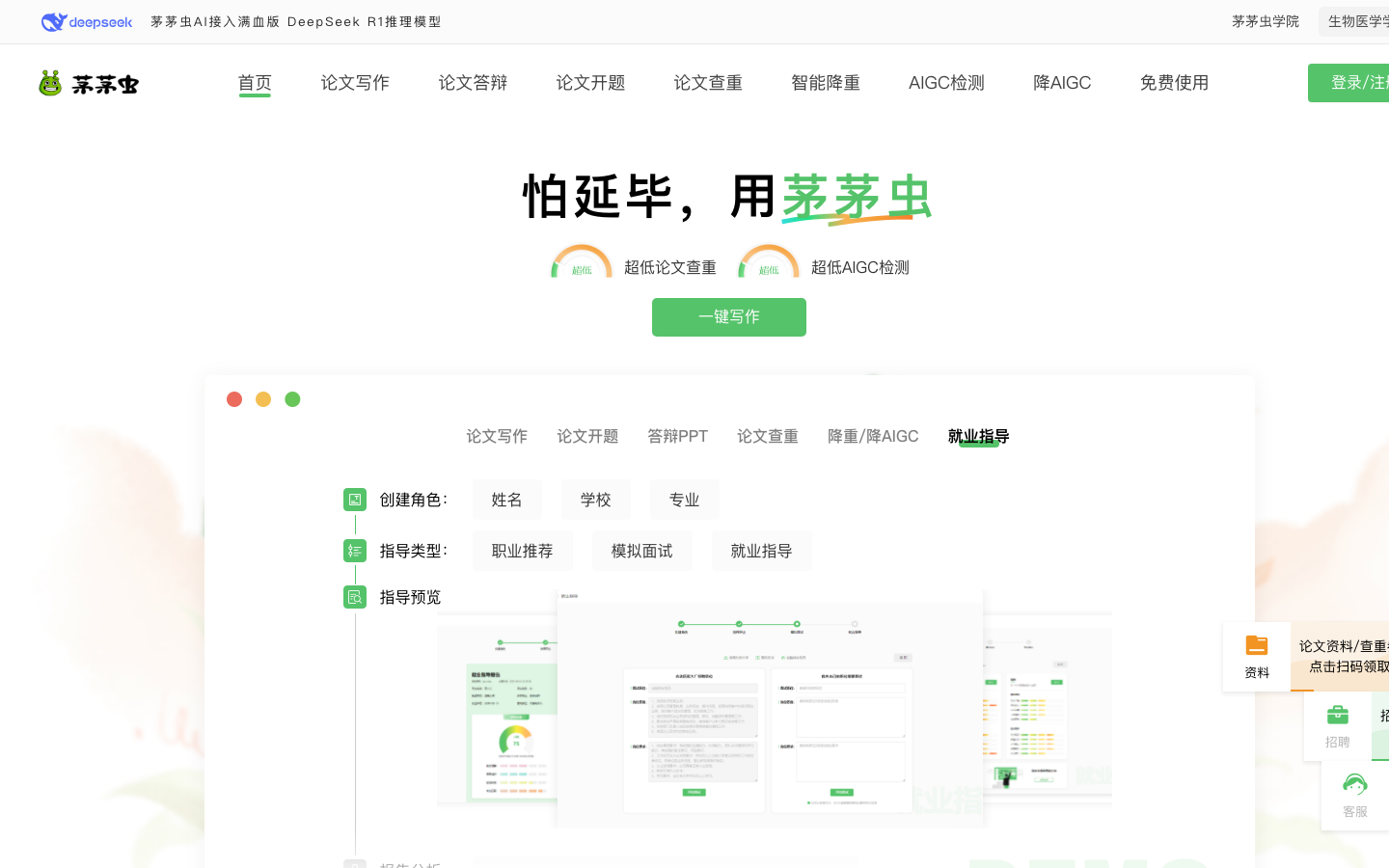
Maomaochong: One-stop AI academic paper writing platform
The core parameters and statistics of Cao Cao Chong
Maotaochong is not positioned as a general writing tool, but as a vertical platform specifically built for academic paper scenarios. Its core difference is to stuff the complete link \u201cProject preparation → Writing → Plagiarism check → Reduce weight → Defense \u201d into one workbench, instead of letting students repeatedly move content between different tools. The platform relies on the dual-engine architecture of the self-developed MMC-20B vertical model and the DeepSeek R1 full version inference model, and has privatized data resources of 500 million+ Chinese papers and 100 million+ English papers.
| Projects | Public Information |
|---|---|
| Official positioning | One-stop AI academic paper writing platform |
| Covered in sections | Thesis writing, proposal guidance, defense PPT, paper plagiarism check, intelligent weight reduction AIGC detection, AIGC reduction rate |
| Target users | College students, scientific researchers, master's and doctoral students |
| Official slogan | If you are afraid of delaying the completion, use thatch and bugs |
| Place of Belonging | China (Changsha, Hunan) |
| Supported Platform | Web (PC Browser) |
| Underlying model | Self-developed MMC-20B + DeepSeek R1 full-blood version inference model |
| Data resources | 500 million + Chinese papers 100 million + English papers privatization data |
| Algorithm Registration | "Cao Mao Chong Text Generation Algorithm" has passed the National Cyberspace Administration of China's Deep Synthesis Service Algorithm Registration (2024-02) |
| ICP filing | Hunan ICP filing number 2022010311-6 |
| Company establishment | 2022-03-09 |
| Financing stage | Angel round (Miracle achievements, millions) → Pre-A round (Alfa Commune, tens of millions) |
One-stop solution for the whole thesis process: Mao Maochong is not just doing \u201cAI\u201d writing a paper. From topic selection analysis, literature review, assignment book writing, to text generation, plagiarism detection and AIGC suspicion rate detection and reduction, to defense PPT and defense Q&A preparation - the entire process is completed in the same workbench, eliminating format loss, data transfer and context break problems caused by cross-tool switching.
Multiple versions of plagiarism checking: The platform provides three plagiarism checking types: bachelor's version, graduate version, and journal version, which respectively correspond to different plagiarism checking standards and database coverage for undergraduate thesis, master's and doctoral thesis, and journal submission. This layering is relatively rare among similar tools.
Users and market recognition of Maomaochong
The market recognition of Cao Mao Chong can be evaluated from four dimensions: financing endorsement, government cooperation, algorithm compliance and school-enterprise cooperation, rather than simply the number of users - the latter is not officially disclosed.
Financing endorsement: In November 2023, it received a multi-million angel round investment from Qiji Chuangtan (founded by Dr. Lu Qi); in November 2024, it received a tens of millions of Pre-A round financing from Alpha Commune. Alpha Commune, co-founded by former Lanxun Technology CEO Xu Siqing and former Sinovation Ventures co-managing partner Jiang Yameng, is China's leading early-stage investment fund. The leading investors in both rounds of financing are all first-line institutions, which verifies the credibility of the team’s background and technical route.
Government and Industry Recognition: In January 2024, it was admitted to the Hunan Xiangjiang New Area\u201cWillow Branch Action\u201d Enterprise Gradient Cultivation Plan; in February 2024,\u201cMaoChong Text Generation Algorithm\u201d passed the fourth batch of deep synthesis service algorithm registration by the Cyberspace Administration of China. This is an important qualification for the compliant operation of an AI writing platform for C-end users. In January 2024, ByteDance’s Volcano Engine provided millions of levels of AI computing power support to Maochong, indicating that its technical architecture has been recognized by leading cloud manufacturers.
School-Enterprise Cooperation: Build an industry-university-research cooperation base with the School of Foreign Languages of Hunan Normal University, sign a strategic cooperation agreement with Changsha Yuelushan National University Science and Technology City, and explore the development of the AI industry with the School of Business Administration of Hunan University. These cooperations not only provide the platform with academic resource input, but also constitute trust endorsement in the university market.
Industry activities: In July 2024, Luo Zanji, member of the Standing Committee of the Changsha Municipal Party Committee and Minister of the Organization Department, and his delegation visited and investigated; in March 2025, he participated in the Changsha CPPCC\u201c Playing with AI Practice Course\u201d event; in April 2025, he attended the national generative artificial intelligence large model regulatory policy and safety standards promotion meeting. These official event participation records indicate that Cao Cao has some influence in the local AI ecology.
User scale: The official has not disclosed the specific number of registered users and paying users. It cannot be ruled out that the number of users is still in the early climbing stage. In terms of market awareness, Maomaochong has accumulated a certain reputation in the vertical field of essay writing, but there is still a gap in brand awareness with established plagiarism checking tools such as CNKI.
The cost advantage of Cao Cao Chong
The cost structure of Cao Mao Chong is geared towards C-end individual users and does not provide API access or enterprise privatization deployment. Therefore, the cost analysis focuses on the individual payment level and compares it with alternatives.
Cost structure for C-side/individual users: Maomao Chong adopts a per-article package system instead of billing based on the number of words or tokens. The official website discloses three packages on the \u201cfree use\u201d page:
| Package name | Price | Number of available articles | Average price per article |
|---|---|---|---|
| Special meal | 229.99 yuan | 6 articles (writing/proposal proposal/defense PPT, etc.) | About 38.33 yuan/article |
| FamilyMart | 319.99 yuan | 12 articles (one-stop package) | About 26.67 yuan/article |
| Man-Han Banquet | 369.99 yuan | 18 articles (one-stop package) | About 20.56 yuan/article |
Single article cost comparison and deduction: Taking a 15,000-word undergraduate thesis as an example, using general AI tools (such as DeepSeek, ChatGPT) to complete the proposal report, text writing, weight reduction, etc. in a step-by-step manner, the API call cost alone can be controlled within 5-10 yuan (assuming free quota or extremely low-price model). The unit price of Mao Mao Chong's package is in the range of 20-38 yuan/article, which is higher than the pure API calling plan, but its value lies in the out-of-the-box duplication checking database (500 million+ Chinese papers) and duplication reduction linkage mechanism - these are not capabilities that can be directly obtained by general APIs.
Free channels and hidden costs: Maomaochong provides a variety of activities to obtain free duplication check coupons and AIGC test coupons (such as sharing them with classmates), and you can complete duplication check and detection at zero cost. However, free coupons usually have usage restrictions (such as daily limit per person, limited to specific types of plagiarism checks). In actual use, the complete paper writing process usually still requires the support of a paid package.
Cost comparison with alternatives:
| Comparison items | Cao Maochong | CNKI plagiarism check (official) | PaperPass/PaperYY | General AI writing (DeepSeek, etc.) |
|---|---|---|---|---|
| Single cost of plagiarism check | About 20-38 yuan (shared evenly among packages) | 150-300 yuan/article (undergraduate) | 10-50 yuan/article | Does not support plagiarism check |
| Writing + weight loss + defense | One-stop packaging | Not supported | Partially supported | You need to assemble your own tools |
| Duplicate checking database | 500 million+ Chinese papers | Authoritative academic database | Big difference | Not supported |
| AIGC detection | Supported | Partially supported | Partially supported | Not supported |
Enterprise/Institution Scenario: Maomao Chong currently does not open enterprise API or batch purchase entrance. For bulk purchasing scenarios for universities, individual negotiations need to be conducted through official business channels. There is currently no public corporate pricing standard.
Main functions of Cao CaoChong
The function matrix of Cao Cao Chong is organized around the three stages of paper writing: front-middle-end. Each stage has corresponding tool modules, and there is data linkage between the modules.
-
Essay writing assistance: AI one-click writing, supports personalized generation of full text after feeding relevant literature, intelligent generation of abstracts and outlines, and customized references. The writing process can choose the DeepSeek R1 inference model or the self-developed MMC-20B model as the underlying engine. Implementation Tips: The generated first draft can be used as a structural reference, but the accuracy of the academic content, data authenticity and citation standardization must be manually verified to avoid false citations caused by AI illusion.
-
Project Proposal Guidance: Covers five sub-modules: topic selection analysis, literature review, task statement, project proposal report, and project proposal PPT. After inputting the research direction, the platform can assist in generating core elements of the proposal report such as research background, research questions, innovation points, and expected results. Implementation Tips: The topic selection analysis results of the proposal report rely on platform data resources. For unpopular or cross-disciplinary directions, the platform's data coverage may be insufficient. It is recommended to combine cross-validation with professional databases such as CNKI.
-
Paper plagiarism check: Supports three types of plagiarism checking: bachelor's edition, graduate edition, and journal edition, and performs duplication rate detection based on a private database of 500 million+ Chinese papers and 100 million+ English papers. Implementation Tips: Maomaochong's plagiarism checking database is not officially authorized by CNKI, and its plagiarism checking results cannot replace the school's designated plagiarism checking system (such as CNKI, VIP, Wanfang). Students should use it as a reference for pre-plagiarism check, and still need to use the school's designated plagiarism check system for final inspection before submitting it to the school.
-
Intelligent weight reduction: For paragraphs with high repetition rates in the plagiarism check results, one-click AI rewriting can be used to reduce the weight and reduce the repetition rate. Duplication reduction and duplication checking are linked within the same platform, eliminating the need to manually mark highly repeated paragraphs. Implementation Tips: The quality of AI weight reduction depends on the rewriting strategy. Excessive weight reduction may lead to semantic deviation or blunt language. It is recommended to review the text after weight reduction paragraph by paragraph and manually adjust unsound expressions.
-
AIGC detection and AIGC reduction rate: Detect the suspected proportion of AI-generated content in papers and provide rewriting services to reduce the suspected AIGC rate. This function directly corresponds to the compliance review requirements of colleges and universities for AI-assisted writing. Implementation Tips: The accuracy of AIGC detection is directly related to the platform algorithm. Currently, the detection standards for AI-generated text are not unified across platforms, and the detection results are for reference only.
-
Defense PPT production: Automatically convert thesis content into a defense presentation, supporting defense manuscript writing and defense question and answer preparation. The generated PPT can be previewed and adjusted within the platform, reducing repeated typesetting work from paper to PPT. Implementation Tips: The automatically generated PPT layout is relatively template-based. For defense scenarios with special layout or design requirements, it is recommended to manually optimize based on the generation.
-
Employment Guidance and Knowledge Community: The platform has columns such as selected knowledge, student cases, industry trends, product logs, etc., providing educational content such as paper writing skills, research methodology, etc.; it also has academic resources in the \u201cSchool of Biomedical Sciences\u201d area. This constitutes ancillary content ecology surrounding paper writing, but the activity and content update frequency are subject to the official real-time status.
Cao Cao Chong’s model and version evolution
The version evolution of Maotaochong corresponds to its function expansion process from a single-point writing tool to a full-process paper platform. During this period, it has experienced the adjustment of the technical route of model self-research and external access in parallel.
2022: Product launch and accumulation of duplicate checking database
The company was established in March 2022, and the Maomaochong paper writing assistant was officially launched on October 20. The initial version has AI paper writing assistance and duplication checking and duplication reduction as its core functions, relying on the founding team’s technical accumulation in the field of paper duplication checking and massive paper data resources. The technical route at this stage is mainly based on external large-scale models, and the product form is lightweight web applications.
2023: Function module expansion
- March 2023: Added functions such as AI one-click writing, personalized full-text generation of relevant literature, intelligent generation of abstract outlines, and customized references. The writing ability has been upgraded from \u201cassisted paragraph generation\u201d to \u201cfull-text generation\u201d.
- May 2023: Added thesis defense function (defense PPT, defense manuscript, defense Q&A), covering the last section of thesis delivery.
- July 2023: Added thesis proposal function (topic selection analysis, literature review, task statement, proposal report, proposal PPT). At this point, the five core modules have been initially integrated, forming a complete link of \u201cproposal proposal → writing → duplicate checking and reduction → defense\u201d.
- November 2023: Received millions of angel rounds of investment from Qiji Chuangtan, and the funds were used for model self-research and team expansion.
2024: Model self-research and compliance milestones
- January 2024: Obtained support from the million-level AI computing power of Byte Volcano Engine to provide training and inference infrastructure for self-developed vertical models.
- February 2024:\u201cMaoChong text generation algorithm\u201d passed the fourth batch of deep synthesis service algorithm registration by the Cyberspace Administration of China, and its operational compliance was officially recognized.
- November 2024: Received tens of millions of Pre-A round financing from Alpha Commune. At the same time, the self-developed MMC-20B vertical model completed training and went online, and the platform began to form a dual-engine architecture of self-developed MMC-20B + external general-purpose large model.
2025: AIGC detection and DeepSeek R1 access
- First half of 2025: Added AIGC detection and AIGC rate reduction functions to directly respond to universities’ compliance review requirements for AI-assisted writing. The plagiarism check types are expanded to three types: bachelor's edition, graduate edition, and journal edition.
- Second half of 2025: Access to the DeepSeek R1 full version reasoning model, which will significantly improve paper reasoning capabilities and academic logic coherence. At the same time, the product log will be continuously updated (version update records will be available in February/March/June/July 2025).
2026 to present: Continuous iteration
The current online version (web-2026.06) has integrated the DeepSeek R1 inference model and continues to optimize the user experience of each functional module. The product log shows that there will still be active updates in 2026, but the specific version number and change points are subject to the official website announcement.
Model Architecture Overview
Cao Cao Chong currently uses a dual-model parallel strategy:
- Self-developed MMC-20B: A vertical academic writing model with 20 billion parameters. It is pre-trained and fine-tuned on its own paper data set based on open source architecture, and is optimized for the format specifications, citation standards, academic expression and other scenarios of academic papers.
- DeepSeek R1 Full Version: Connected to DeepSeek's reasoning enhancement model to improve the depth of reasoning, logical coherence and the quality of answers to complex academic questions.
The division of labor between the two is: MMC-20B handles academic formats and standardized expressions, and DeepSeek R1 handles deep reasoning and complex logic. In actual use, users can choose different models in different scenarios, or the platform can automatically route them.
Technical advantages of Cao Cao Chong
The technical barrier of Cai Mao Chong is not in the ability of general-purpose large models, but in the three levels of data accumulation in academic scenarios + engineering integration of paper processes + comprehensive design of duplication checking and duplication reduction linkage.
Massive private paper data forms a moat: The privatized data of 500 million+ Chinese papers and 100 million+ English papers is the core technical asset of Maomaochong. These data are not only used for pre-training and fine-tuning of the MMC-20B model, but also directly serve duplication detection and duplication reduction and rewriting - comparing with 500 million+ papers one by one during duplication detection, and performing synonymous rewriting based on the academic corpus during duplication detection. The data magnitude directly determines the recall rate of duplication detection and the naturalness of duplication reduction. In contrast, general-purpose AI writing tools do not have such a dedicated database, and duplication checking scenarios must rely on third-party interfaces.
The hidden value of engineering thesis process: The integration of the five segmented data of topic proposal, writing, plagiarism checking, weight reduction, and defense means that the research framework generated by students in the topic proposal stage can be directly transferred to the writing stage as an outline, and the plagiarism check results can be directly used as input for weight reduction—data does not need to be manually moved, and the format will not be lost. This process-as-data architecture saves students under deadline pressure not just a few minutes, but multiple hours of repeated format conversion + contextual understanding between different tools.
Efficiency advantages of the linkage mechanism for duplication checking and duplication reduction: In general scenarios, duplication checking and duplication reduction are two independent things - the duplication checking report gives the repetition rate, and then you need to manually locate highly repeated paragraphs and rewrite them paragraph by paragraph. The linkage mechanism of Cao Maochong directly uses the duplication check results as the input for weight reduction. The platform automatically identifies highly repeated paragraphs and triggers AI weight reduction, compressing the link of \u201c detection → positioning → rewriting \u201d into one operation. This linkage mechanism can significantly reduce the frequency of repeated operations in actual use.
Computing power cooperation reduces training costs: Through the million-level AI computing power support of the Volcano Engine, Cao CaoChang obtained the computing power resources of leading cloud vendors during the model training phase, avoiding the high initial investment of building a self-built GPU cluster. At the same time, accessing DeepSeek R1 instead of self-developed full-size general-purpose large models also reduces the cost and risk of model development - the training cost of MMC-20B, which focuses on vertical academic scenarios, is much lower than training a 100-billion-level general-purpose model from scratch.
First-mover advantage of algorithm registration compliance: Passed the deep synthesis service algorithm registration in February 2024, and is among the first batch of AI writing tools to obtain this qualification. For university procurement and government-enterprise cooperation scenarios, this qualification is the entry threshold for entering the supplier list - products without algorithm registration cannot legally provide AI text generation services to Chinese users.
How to use Cao Cao Chong
Maomao Chong uses the web page as the only entrance, and there is no need to download and install it. The complete usage process is divided into four steps:
- Registration and Login: Visit the official website https://www.mmc.cc/, use your mobile phone number or scan the QR code on WeChat to register. After logging in, you enter the personal workbench, and all functional modules are arranged in the form of a navigation menu.
- Choose a starting point: According to the stage of the paper, select the corresponding entrance from the workbench - if you are in the topic selection stage, start with \u201cThesis Proposal\u201d; if the topic has been determined, go directly to \u201cThesis Writing\u201d.
- Execution of thesis process:
- Project proposal: Fill in the research direction and keywords, and the system will generate a proposal report framework (topic analysis, literature review, task statement), which can be modified and confirmed section by section.
- Writing: Enter the topic and chapter requirements of the paper, select the underlying model (MMC-20B or DeepSeek R1), and generate the full text of the paper with one click. Supports personalized generation after feeding reference PDF.
- Plagiarism Check: Upload the completed manuscript, select the plagiarism check type (bachelor/graduate/journal), the system will generate a plagiarism check report after comparing it with the 500 million+ paper database, and mark the repeated paragraphs and repetition rate.
- Duplication Reduction: Directly click on the highly repeated paragraphs in the duplication check results, and use the \u201cIntelligent Duplication Reduction\u201d function to rewrite them with one click. The weight can be reduced multiple times until the repetition rate reaches the target.
- AIGC detection: Detect the suspicious rate of AI-generated content on the paper, and use the \u201creduce AIGC rate\u201d function to reduce the AIGC score based on the results.
- Defense preparation: After the thesis is finalized, use the \u201c Defense PPT\u201d module to automatically generate presentations and defense manuscripts, which can be previewed and adjusted online.
- Export and Delivery: After completing the entire process, export the paper to Word/PDF format and submit it to the school system; the PPT will be exported for defense display.
Important note: Maomaochong's plagiarism check report cannot replace the official plagiarism check system designated by the school (such as CNKI, VIP). It is recommended to use it as a pre-checking tool and use the official system for final confirmation before submitting it to the school. The content of AI-generated papers must be manually verified to ensure that the data is authentic, the references are standardized, and the logic is self-consistent to avoid the risk of academic misconduct.
Mao Mao Chong’s product pricing
Maomao Chong adopts the business model of free traffic + package payment. It does not provide flexible billing by word count or token, nor does it open API access.
How to obtain free quota: Users can obtain free paper plagiarism checking coupons and AIGC testing coupons by participating in platform activities (such as sharing to classmate groups, inviting friends to register, etc.). These free coupons usually have usage restrictions (such as daily limit per person, specified plagiarism check type), and are suitable for a single plagiarism check or experience scenario.
Paid package details: The official website announces three packages, covering the needs of users with different usage frequencies:
- Special meal (229.99 yuan): Available quota for 6 papers, covering basic projects such as thesis writing, proposal report, defense PPT and so on. The average price per paper is about 38.33 yuan, which is suitable for undergraduates who only need to complete 1-2 papers.
- Family Bucket (319.99 yuan): 12 articles available, one-stop package for all projects. The average price per article is about 26.67 yuan, which is suitable for graduate students who need multiple rounds of writing and iterations of duplication checking and duplication reduction.
- Manhanxi (369.99 yuan): There are 18 available quotas, and the average price per article is about 20.56 yuan. It is suitable for high-frequency users who are working on multiple papers at the same time or who need frequent weight reduction and adjustment.
Price Evaluation: Taking the undergraduate thesis writing scenario as an example, a thesis usually requires 3-5 plagiarism checks from proposal to defense (one for the first draft, one for the revised draft, and one for the final draft), plus writing and weight reduction. The FamilyMart package (319.99 yuan/12 articles) is the most cost-effective among the three grades, with a single service cost of about 27 yuan. Compared with offline paper services (ghostwriting, duplication reduction, duplicate checking and packaging are usually 500-2,000 yuan per article), Maomaochong has obvious cost advantages; but compared with pure AI writing tools (such as DeepSeek, which is free to use), Maomaochong’s payment threshold is a factor that needs to be considered.
Enterprise/institutional bulk purchasing: The official enterprise pricing plan has not been disclosed. Bulk purchasing by universities must be negotiated individually through the official website contact information. Before formal purchasing, it is recommended to complete the following verifications: ① Trial a small scale to verify whether the coverage of the duplication check database meets the school's requirements; ② Confirm whether the accuracy of AIGC testing can be recognized by the department; ③ Obtain a detailed service level agreement (SLA).
Application scenarios of Cao Cao Chong
The functional design of Maomaochang is highly focused on academic paper writing, and the following five scenarios are its main application areas.
-
Full-process assistance for undergraduate thesis: From the proposal in the second semester of junior year to the defense in the first semester of senior year, thesis writing spans more than half a year. The value of Mao Mao Chong lies in the fact that the tool requirements for each stage of \u201cProposal → Writing → Plagiarism Checking → Duplication Reduction → Defense \u201d are contained in one platform to prevent students from repeatedly switching between multiple tools such as CNKI Duplication Checking, Baidu Library Duplication Reduction WPS and PPT. Key points of verification: Whether the data source of the plagiarism check report covers the subject scope of the school; the deviation between the final plagiarism check system designated by the school and the results of the duplication check is within the acceptable range.
-
Master's and PhD thesis writing: Master's and PhD thesis are longer in length (30,000-100,000 words), have stricter duplication checking requirements (usually requiring a duplication rate of less than 10%-15%), and require higher precision in weight reduction. The graduate version of Cao Mao Chong’s plagiarism checking and AIGC detection functions directly correspond to this scenario. Key points of verification: Whether the database for plagiarism checking in the graduate version contains a database of master's and doctoral theses (different from the undergraduate thesis database); for papers with dense subject terminology, whether the professional expressions after weight reduction can still remain accurate.
-
Pre-checking for plagiarism before submission of journal articles: After academic researchers complete journal articles, they can use Caochao to conduct pre-checking for plagiarism and AIGC pre-checking before submission to discover duplication rate or AI suspected rate issues in advance and make targeted modifications. Key points of verification: Whether the database for plagiarism checking in the journal version covers the published paper library of the target journal; different journals have different requirements for plagiarism checking rates (ranging from 10% to 30%), which need to be adjusted according to the standards of the target journal.
-
Course Papers and Daily Academic Writing: For small academic writing tasks such as course papers, reading reports, and literature reviews for college students, you can use the writing assistance function of Cao CaoChong to quickly generate a first draft framework, and then manually fill in the specific content and data. Key points to check: For course papers that do not have a high proportion of credits, is it worth purchasing a separate package? It is recommended to give priority to free coupons or shared packages.
-
Academic Writing for Biomedical Sciences: Maomaochong has a \u201c School of Biomedical Sciences\u201d special area to provide special support for medical paper formats, medical terminology, and clinical research methodologies. Verification Points: Medical papers have strict requirements for data authenticity and ethical review, and the applicable boundaries of AI-assisted writing in this scenario require extra caution.
Applicable people for Cao Cao Chong
Mao Mao Chong's crowd adaptation has a clear boundary for academic writing - it is good at academic scenes with formal formatting, plagiarism checking requirements, and oral defense, rather than general writing.
-
College Undergraduates: Facing the rigid requirements for graduation thesis, there is clear compliance pressure on indicators such as duplication detection rate, AIGC suspicion rate, etc. Maomaochong's one-stop process reduces the coordination cost from topic proposal to delivery, and the package pricing (approximately 27-38 yuan/article service) is within an acceptable range. Prerequisite: It is necessary to confirm that the duplication checking database of Maomaochong covers the subject of the school; the school tutor allows or accepts AI-assisted writing.
-
Master's and Ph.D. graduates: The paper is long and requires high plagiarism checking. The AIGC review is strict and has higher requirements on weight reduction quality and AIGC detection accuracy. MaomaoChang's graduate version plagiarism check and DeepSeek R1 inference engine have certain advantages in academic logic support. Prerequisite: It is necessary to verify through actual testing whether the weight reduction quality meets the expression requirements of the subject major; for highly innovative cutting-edge research, the logical contribution of AI-generated content is limited.
-
Scientific researchers and young teachers: need to quickly transform research ideas into first drafts of papers, or need to conduct pre-checking for plagiarism before submission. Cao Cao Chong's \u201cFeeding Literature Generating Full Text\u201d function can upload the reference paper PDF and generate a first draft. Prerequisite: The author is 100% responsible for the originality and data authenticity of scientific research papers. AI-generated content is only used as a structural reference and cannot directly replace research conclusions.
-
On-the-job academic qualification improvement crowd: Need to complete a dissertation but have limited time, and have an urgent need for writing efficiency. Maomaochong's one-stop process can reduce the time cost from proposal to defense. Prerequisite: The platform cannot complete research and data analysis on behalf of the author, and the substantive academic work and data collection still need to be completed independently.
-
Not suitable for the crowd:
- Non-academic writing users: Maomaochong's process design, model tuning, and database resources are all geared toward academic paper scenarios. For non-academic writing needs such as new media copywriting, marketing content, novel creation, and business plans, general-purpose AI tools (such as DeepSeek, ChatGPT, and Kimi) provide better results and lower costs.
- Scenarios where the authority of plagiarism check is urgently needed: If a school or journal clearly specifies a specific plagiarism check system such as CNKI, VIP, Wanfang, etc., the results of the plagiarism check by Cao Cao Chong can only be used as a reference for pre-checking plagiarism and cannot replace the designated system.
- Highly innovative and original research scenarios: Academic papers in cutting-edge fields require a lot of original research and independent thinking. AI assistance has limited marginal contribution in such scenarios - it is good at standardized expressions, but not good at proposing truly novel research questions and breakthrough methods.
Summary and Outlook
The core competitiveness of Maomaochong lies in the combination of \u201cacademic paper data assets + full-process engineering integration + duplication detection and duplication reduction linkage. The 500 million+ Chinese paper database provides data barriers for duplication checking and duplication reduction that cannot be replicated by general tools; the one-stop process from proposal to defense hits the real pain point of college thesis writing - not the efficiency issue of a single section, but the hidden cost of coordination across sections; the linkage mechanism of duplication checking and duplication reduction brings the iterative efficiency of \u201cdetection→positioning→modification\u201d in this paper to a new level of magnitude.
Current Limitations and Risks:
- Insufficient authority in plagiarism checking: Maomaochong’s plagiarism checking database is not officially authorized by CNKI, and its plagiarism checking results may not be recognized by the school where the student is located. Students still need to use the school's designated system to conduct a formal plagiarism check before final submission, which means that \u201cplagiarism check\u201d does not really eliminate the problem.
- Academic Compliance Risks of AI Writing: More and more universities are beginning to review the suspected AIGC rate in papers. Although Maomaochong provides AIGC detection and AIGC reduction functions, the acceptance and management policies of AI-assisted writing vary greatly among schools. Some universities explicitly prohibit the use of AI to generate the main content of papers. Violation may result in failure of the paper or academic sanctions.
- Technical dependencies of the underlying model: The performance upper limit of the self-developed MMC-20B model coexists with the external dependencies of DeepSeek R1. If DeepSeek adjusts the API strategy or the model capability iteration is insufficient, Cao Cao Chong's reasoning ability may be affected. The continuous training and iteration of self-developed models also requires stable computing power and financial investment.
- User Scale and Brand Awareness: Compared with established service providers such as CNKI Duplicate Checker that have established deep trust, Cao Cao Chong still has a gap in brand awareness and user base. Under the paid package model, how to attract new users to complete the first payment conversion is a key challenge for continued growth.
Procurement and Adoption Risk Assessment: For individual student users, it is recommended to first obtain duplication check coupons through free activities and conduct a small-scale actual test, focusing on verifying two indicators - whether the deviation between the duplication check results and the school's designated system is within an acceptable range (recommended deviation < 10%), and whether the text semantics after the duplication reduction remains coherent. For universities or institutions with bulk purchasing needs, Maomaochang should be required to provide SLA commitments, data privacy protection terms (whether paper data will be used for model training), and detailed coverage instructions for the duplication check database before signing a formal contract. Overall, Cao Cao Chong has differentiated data and process advantages in the essay writing aid tool track. However, as an AI assistant tool, the academic originality and data authenticity of the paper must always be checked by the author himself - no AI tool can replace rigorous academic research and a responsible academic attitude.
Related tools:  Notion AI,
  Jasper
Version Info
- Maomao Chong Essay Writing Assistant (First Edition) :Maomaochong Paper Writing Assistant is officially launched. It provides online paper writing services to college students with AI paper writing assistance and duplication checking and duplication reduction as its core functions.
- Cao Mao Chong Paper Writing Assistant (DeepSeek R1 version) :The current online version of the official website covers the full process of academic writing modules such as essay writing assistance, topic development guidance, duplication checking and AIGC detection, and defense PPT production. It has been connected to the DeepSeek R1 full-blooded version of the inference model. There is no official precise release date yet.
- Maotaochong Paper Writing Assistant (MMC-20B version) :Integrate the self-developed MMC-20B vertical model, add AIGC detection and AIGC rate reduction functions, and expand the coverage of plagiarism checking types to bachelor’s edition, graduate edition, and journal edition. There is no official precise release date yet.
- Maomaochong full-process paper platform :Complete the integration of the five major modules of writing, plagiarism checking, plagiarism reduction, topic development, and defense, forming a one-stop service for the entire paper life cycle. Received tens of millions of Pre-A round financing from Alpha Commune. There is no official precise release date yet.
- Maotaochong Paper Writing Assistant (Extended Function Version) :On the basis of writing and duplication checking, a new paper topic proposal function is added, including sub-modules such as topic selection analysis, literature review, assignment letter, topic proposal report, topic proposal PPT and other sub-modules. There is no official precise release date yet.
- Mao Mao Chong Thesis Writing Assistant (Defense Version) :A new thesis defense function module has been added to support defense PPT generation, defense manuscript writing and defense question and answer preparation. There is no official precise release date yet.
User Reviews