 Marblism
Free
Marblism
Free
Marblism is an AI full-stack application generator. Users describe their needs in natural language, and AI automatically generates complete front-end, back-end and database codes and can be deployed with one click. It is aimed at entrepreneurs, product managers and developers and uses AI to accelerate application prototype development.
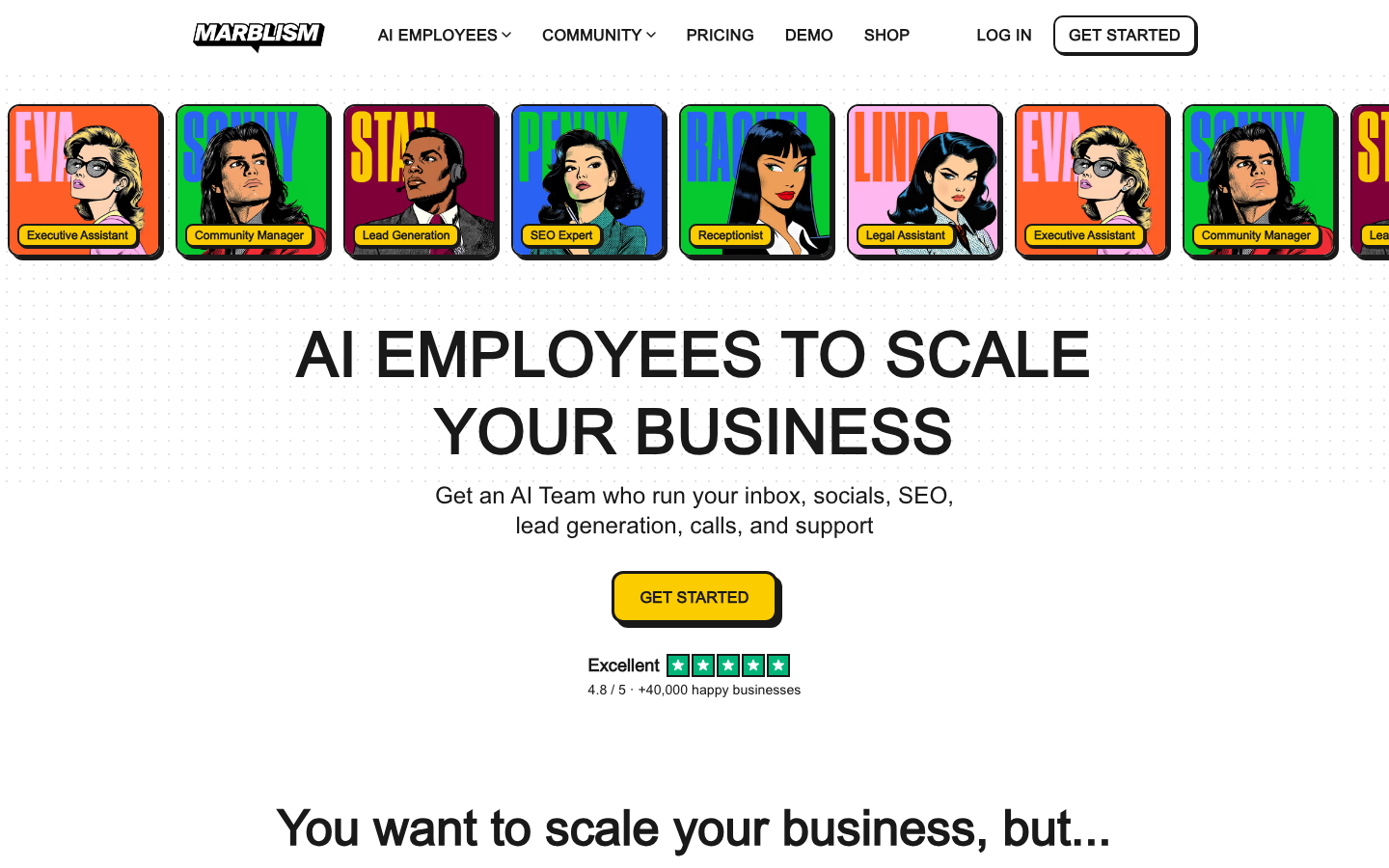
Marblism: AI full-stack application generator, 10x faster from natural language to deployable applications
Core parameters and statistics of Marblism
Marblism is positioned as an AI full-stack application generator (main type: Productivity/Business-side Application, Type D). Its core value lies in compressing "application development" from a skill-intensive work that requires weeks of coding into a several-hour process of "natural language description → AI generation → one-click deployment". It is aimed at the scenario of "I have an idea and want to see it run quickly" - not to replace developers, but to eliminate the waiting cost from idea to prototype.
| Projects | Public Information |
|---|---|
| Product positioning | AI full-stack application generator |
| Core capabilities | Natural language → complete project code generation, one-click cloud deployment, conversational iterative modification |
| Technical base | Underlying LLM (specific model not disclosed) + project framework template engine |
| Output technology stack | Front-end: React/Vue; Back-end: Node.js/Python; Database: PostgreSQL/SQLite |
| Platform | Web |
| Home | US |
| Business model | Freemium (limited free generation + paid deployment) |
| Supported languages | en-US |
Brief review in one sentence: Marblism is not another low-code platform, but a tool that "uses vernacular to describe requirements, and AI directly spits out complete runnable applications." You say, "Make me a team task board that supports drag-and-drop sorting and member assignment." It outputs front-end components, back-end API, database table structure and deployment configuration - a complete set of accessible web applications.
The difference from letting ChatGPT write code directly is that ChatGPT generates scattered code snippets, while Marblism generates an engineering project with a complete file structure, dependency declaration, routing configuration, and database migration script. It understands the structural constraints of "application" as a system as a whole, rather than just the splicing of code at the syntax level.
Users and market recognition of Marblism
The track in which Marblism operates—AI application generators—is one of the fastest growing AI tool categories in 2024-2025. Major competitors on the same track include Bolt.new (StackBlitz), v0.dev (Vercel), Lovable, Claude App Generator, and OpenAI’s Canvas. The common feature of these tools is to transfer the entry point of "application development" from the IDE to the conversational interface.
From the perspective of market signals:
- C-side users: The adoption rate has increased significantly among product managers, independent entrepreneurs, hackathon participants, and founders with non-technical backgrounds. The core driving factor is "You don't need development resources such as scheduling, you can make prototypes by yourself."
- B-side scenarios: Some small and medium-sized enterprises and entrepreneurial teams use Marblism to quickly build internal tools (Admin panels, data entry forms, report display pages), replacing traditional low-code platforms such as Retool or Appsmith in lightweight scenarios.
- Competitive landscape positioning: Unlike Bolt.new's "online IDE + AI generation" route, Marblism focuses more on "generating complete projects from scratch" rather than "using AI-assisted coding in existing projects". The latter is for engineers who already have development capabilities, and the former is for people who have product ideas but don’t want (or can’t) write code.
The specific number of users and monthly active data are subject to official disclosure. There is currently no absolute monopoly in this field, and each product is differentiated in terms of production quality, deployment experience and technology stack preferences.
Cost Advantages of Marblism
Cost analysis needs to be broken down into three layers: C-end individual user API/developer, enterprise/privatization:
- C-side/individuals (entrepreneurs, product managers): The free version provides a limited number of application generation quotas, suitable for experience and simple prototype verification. The paid version is billed based on the number of projects and deployment resource consumption. The typical cost range is based on the official website pricing page.
- API/Developer: No independent API products are disclosed, and no programmatic calling interface is currently provided. If you need to embed AI application generation capabilities into your own workflow, there is currently no official solution.
- Enterprise/Privatization: Provide enterprise solutions (business confirmation required). Details such as deployment methods (whether privatization/VPC is supported), data isolation strategies, and security audit capabilities that are of concern in enterprise scenarios have not yet been made public.
The following figure is a comparison of the cost and ability to generate competing products with mainstream AI applications:
| Comparative Dimensions | Marblism | Bolt.new | v0.dev (Vercel) | Lovable |
|---|---|---|---|---|
| Core experience | Natural language → complete project generation | In-browser IDE + AI code completion/generation | Generate front-end components from screenshots/descriptions | Description → Full-stack application generation |
| Technology stack | React/Vue + Node.js/Python + PostgreSQL/SQLite | Any web technology stack (online IDE) | React + Tailwind + shadcn/ui | React + Supabase |
| Free quota | Limited generation times | Limited points/month | Limited generation times | Limited generation times |
| Payment starting point | Please refer to the official website | $20+/month | $20+/month | $20+/month |
| Deployment method | One-click deployment to your own cloud | One-click deployment (StackBlitz) | Direct deployment to Vercel | One-click deployment + own domain name |
| Enterprise plan | Business confirmation required | Undisclosed | Vercel Enterprise | Business consultation available |
| Suitable for people | Non-technical users/entrepreneurs | Developers | Front-end developers | Product managers/entrepreneurs |
The truth about free: The core limitation of the free version is not the functional emasculation, but the number of builds and the persistence of the generated project - free-generated applications may go offline after a certain period of time or be unable to obtain production-level deployment resources. This is a reasonable business design, but users need to pay attention: if the "usable prototype" derived from the free trial is to be used for formal customer demonstrations or internal production, it will almost certainly require a paid upgrade.
Hidden Costs:
- Code Review Cost: AI-generated code may contain security vulnerabilities, improper practices, and unreasonable dependency choices. Before production is launched, professional developers must be deployed to conduct security reviews and architecture reviews. This cost is easy to overlook in the excitement of "generating apps with AI", but it is the largest hidden expense in moving prototypes into production.
- Maintainability Risk: The code structure, comment quality, and test coverage generated by AI are usually not as good as the systematic output of professional engineers. During long-term maintenance, team members need to spend extra time understanding and modifying the code generated by AI. This time cost may offset the speed advantage of initial development.
- Migration Barriers: If an application generated by Marblism needs to be maintained independently of the platform in the future, its code quality and technical debt level determine the level of migration costs. It is recommended to evaluate the technical feasibility of "if you need to iterate independently from the platform later" before adoption.
Hidden benefits:
- Communication Cost Reduction: Product managers can directly generate interactive application demos to confirm requirements with stakeholders, eliminating the need for multiple rounds of translation of "PRD → Prototype → Development → Rework", reducing rework costs caused by deviations in demand understanding.
- Reduced cost of trial and error: Entrepreneurs can use Marblism to verify the feasibility of product ideas within hours before investing large amounts of development resources. If it doesn't work, hours are lost instead of weeks.
Main functions of Marblism
Here are the core features of Marblism and their use in real-world workflows:
-
Natural language full stack application generation
Describe the application requirements (such as "Create a team task management tool that supports Kanban view, drag-and-drop sorting, member assignment and deadline reminder"), and AI automatically generates front-end UI components, back-end API routing, database table structure, routing configuration and deployment scripts. Applicable tasks: Build application prototypes from 0 to 1, especially suitable for CRUD, form, Kanban, and content management applications. Expert View: The "synergy" here is that Marblism handles the front-end and back-end data flows at the same time - when the user describes "adding a task assignment function", it not only adds an Assignee selector on the front end, but also generates the corresponding user query API on the back end, establishes associated foreign keys at the database layer, and handles permission verification at the API layer. This is system-level consistency that a single AI conversation cannot achieve.
-
Conversational iterative modification
Based on the generated application, continue to modify it through natural language instructions - "change the sidebar to a dark theme", "add search function", "change the to-do list to paginated display". AI understands the existing code structure and makes incremental changes. Applicable tasks: Rapid response to demand changes in the prototype iteration phase.
-
One-click deployment and online preview
After the generation is completed, there is no need to configure a server or domain name. The platform provides the option of one-click deployment to the cloud and supports online preview. Best for: Get your prototype instantly available with a shareable online URL for user testing or team review.
-
Project code export
Supports downloading the generated complete project code locally for developers to subsequently maintain and expand themselves. Applicable tasks: When transitioning from the prototype stage to the formal development stage, use AI-generated code as a baseline for manual iteration.
-
Customizable technology stack selection
It supports selecting the front-end framework (React/Vue), back-end language (Node.js/Python), and database type (PostgreSQL/SQLite) before generation, allowing users to choose the most appropriate combination based on the team's technical reserves and project needs. Applicable tasks: Ensure that the generated application is compatible with the team's existing technology stack and reduce the learning curve for subsequent maintenance.
[Publicity Verification]: Marblism promotes "generating complete applications using natural language" - for standard CRUD applications (to-do lists, blog systems, background management panels, content publishing systems), the effect does reach usable levels, and the completeness of the output structure exceeds expectations. However, for the following scenarios, the generation quality will decrease significantly:
- Requires complex business rules engine (such as multi-level approval flow, dynamic pricing strategy)
- Involving real-time collaboration (such as online collaborative documents, simultaneous editing by multiple people)
- Requires highly customized interactions (such as drag-and-drop canvas, visual editor, animation sequence)
- Requires deep integration with third-party APIs (complex configuration of payment gateways, email services, cloud storage SDKs)
Conclusion: The "complete application" of Marblism is currently defined as a "functionally usable prototype", and manual engineering quality control is required before it can be "directly produced".
Marblism model and version evolution
Marblism’s product iteration rhythm is subject to official release information. The following is the version history based on publicly available information:
| Version identification | Time point | Key changes |
|---|---|---|
| v0.1 (launch) | ~2024-06 | The product is initially launched, supporting basic natural language application generation function |
| v1.0 (current) | ~2025-09 | The current stable version, improves the generation quality, adds one-click deployment and technology stack selection |
The main evolution directions between the two versions include: improvement of the engineering degree of generated code (from "runnable" to "clear structure"), simplification of the deployment process (reducing manual configuration steps), and expansion of technology stack options. For specific version numbers, change logs and functional milestones, it is recommended to refer to the official Changelog or product blog.
It should be noted that as a SaaS product, Marblism’s core capabilities (underlying LLM, generation strategy, template library) are continuously updated on the server side, and the user side can use the latest version without manual upgrade.
Technical advantages of Marblism
The technical architecture of Marblism can be abstracted as: User natural language input → LLM understands requirements → Project structure template matching → Module-by-module code filling → Integrity verification → Deployable project output.
Compared with the traditional "let AI write code" approach, Marblism's differentiation is reflected in three levels:
-
Project-level code generation, not fragment level Generic conversational models such as ChatGPT are good at generating function or component-level code snippets, but cannot automatically manage dependencies and project structure between multiple files. Marblism internally maintains project templates for multiple application types (CRUD, Kanban, blog, backend management, etc.). When generating AI, instead of writing all the code from scratch, business logic is intelligently filled in based on the template skeleton. This means that the generated results naturally have an engineered directory structure, dependency configuration and routing system.
-
Full stack consistency guarantee When a user describes a function involving front-end and back-end interaction (such as "display a list of comments on the task details page and support replies"), Marblism must simultaneously generate front-end components (comment box + list rendering), back-end API (GET/POST comment interface), database model (comments table structure), and glue code for front-end and back-end data joint debugging. This full-stack consistency is the essential difference between "understanding an application" and "understanding a piece of code." Marblism's generation engine ensures this consistency through predefined cross-layer data flow templates, rather than letting LLM infer front-end and back-end interface contracts on its own.
-
Iterable code structure The generated code is not a one-off product. Marblism's conversational modification capability allows users to iterate multiple times on the basis of the generated application. AI needs to understand the existing code state and make incremental changes, rather than regenerating each time. This requires the platform to maintain an internal state representation of the project at each build so that subsequent modifications can pinpoint the code locations that need to be changed.
Dimensionality reduction attack scenario: Entrepreneurs need to quickly verify product ideas - from "I have an idea" to "seeing a runnable prototype", the traditional path requires: requirements analysis (0.5 days) → prototype design (1-2 days) → front-end development (3-5 days) → back-end development (3-5 days) → joint debugging and testing (2-3 days), a total of 2-4 weeks. Marblism compresses this process to 2-4 hours, achieving a nearly 20x speedup. Of course, this speed advantage is mainly reflected in the prototype stage of "from 0 to 1", and the production stage of "from 1 to 100" is still the home field of professional developers.
How to use Marblism
The entrance to Marblism is the web side, and the usage process is clear and concise:
- Visit the official website: Open marblism.com and register/log in to your account.
- Describe application requirements: In the dialog input box, use natural language to describe the application you want to build. It is recommended to provide a list of key features, target user types, and desired technology stack preferences.
- Sample input: "Help me create a team project management tool that supports multi-project spaces, task boards, Gantt chart views, member permission management and work time statistics. The front-end uses React, the back-end uses Node.js, and the database uses PostgreSQL."
- Waiting for AI generation: The system processes the requirement description and generates complete project code. The generation time depends on the complexity of the requirement, usually ranging from seconds to minutes.
- Online preview and testing: After the generation is completed, you can preview the application running effect in the browser and test each functional process.
- Iterative modification: Make modification requests by continuing the dialogue (such as "Change the theme color to blue", "Add deadline display on the task card").
- One-click deployment or export: After confirming the effect, you can choose to deploy to the cloud to obtain the public URL with one click, or download the complete project code locally.
Human-machine collaboration boundary (Type D forced deepening):
- 100% Automable: Code generation, online preview and deployment process for standard CRUD applications. For "add, delete, modify, query + form + list + simple Kanban" type applications, Marblism can achieve a fully automatic link from requirement description to accessible prototype.
- Human-in-the-loop required:
- Security Review: Before deployment in production, a code security audit must be conducted by a security engineer or a security-aware developer. The code generated by AI may have common vulnerabilities in the OWASP Top 10 (such as SQL injection, XSS, and lack of authentication).
- Performance Verification: In high concurrency scenarios, the database query and cache strategy API design generated by AI may not be optimized enough, and manual performance testing and optimization are required.
- UI/UX Fine Polishing: The UI generated by Marblism is usable but not polished enough. Customer-facing applications require visual polishing and interaction optimization by designers or front-end engineers.
- Compliance Audit: Scenarios involving personal data processing (GDPR/CCPA, etc.) require manual confirmation of compliance with data storage, transmission and privacy policies.
- Not automatable: Domain modeling of core business logic, business rule coding that requires in-depth industry knowledge, and scenarios with strict regulatory requirements for security and reliability (financial transactions, medical diagnosis, autonomous driving-related applications).
Product Pricing for Marblism
Marblism uses the Freemium business model. Specific pricing tiers, functional limitations and resource quotas are subject to the real-time pricing page of the official website. The following is an overview based on public information:
- Free version (Free): Provides a limited number of application generation credits, suitable for first-time experience and simple prototype testing. Freely generated applications have no functional limitations, but may be limited by deployment resources (such as concurrent access, storage space).
- Paid version (Pro/Team): Unlock advanced features such as more projects, higher deployment resource quotas, custom domain name support, etc. Ideal for individuals and small teams who need to put multiple prototypes into use internally and externally.
- Enterprise Edition: Customized on demand, providing private deployment options, SLA guarantee, exclusive technical support, security audit reports and other enterprise-level services. Please contact the commercial team to confirm pricing and delivery options.
Purchasing advice: It is a reasonable path for individual users and independent entrepreneurs to start with the free version to verify the feasibility of the product. In a team scenario, it is recommended to use the free version to complete prototype verification first, confirm that the application direction and generation quality meet the needs, and then upgrade to the paid plan. Enterprise scenarios need to pay attention to three terms: data residency, code ownership, and SLA.
Application scenarios of Marblism
The following are typical application scenarios of Marblism in actual workflows and their effect deduction:
-
Prototype verification
After product managers or entrepreneurs describe product ideas in natural language, they will get an interactive application demo within 2-4 hours, which can be directly used for user testing, investor presentations, or team reviews. Deduction: From "2 weeks for requirements document + prototype diagram" → "2-4 hours for AI to generate a runnable application", the time is shortened by about 85%. The time saved can be invested in more rounds of user feedback and requirement verification.
-
Quick setup with internal tools
When business departments such as HR and finance need simple data entry, approval, and report viewing tools, they no longer need to wait for development by the IT department. Business personnel can obtain available tools by describing their needs. Deduction: Traditional IT schedule is 2-4 weeks → Self-service AI generation takes 2 hours, which shortens the time by about 95%.
-
Hackathon/Startup Competition
In the 24-48-hour time-limited competition, Marblism can quickly generate the basic application framework. Participants can focus their time on core innovation points and differentiated functions instead of repeatedly building basic CRUD modules.
-
Teaching and Technology Demo
In programming education scenarios, teachers can use Marblism to quickly generate sample applications for students to analyze; technical evangelists can use it to quickly build demonstration applications to demonstrate specific technology stacks or architectural patterns. Deduction: 4-8 hours to build sample applications manually → 30 minutes for AI generation.
-
MVP Building for SaaS Products
When entrepreneurs verify SaaS ideas, they first use Marblism to quickly build an MVP version and put it on the market to verify the PMF. After passing the verification, the professional development team will carry out formal development based on the verified requirements. Deduction: The MVP development cycle is shortened from 1-3 months to 1-2 weeks, and the capital investment is reduced from hundreds of thousands to thousands of yuan.
Applicable groups of Marblism
- Solo Entrepreneur/Non-Technical Founder: Has a product idea but lacks coding skills or team support. Marblism lets you be your own CTO—at least during the product validation phase. Prerequisite: You need to be able to clearly describe product requirements and business logic in natural language.
- Product Manager: Used to quickly generate product demos, help stakeholders intuitively understand product solutions, and reduce communication costs caused by "document understanding deviation". Prerequisites: You need to understand the basic functional boundaries of web applications to avoid making complex requirements that cannot be achieved by AI.
- Full-stack Developer (Accelerated Prototype Phase): Developers can use Marblism to accelerate the preliminary work of "scaffolding + module filling" and focus on areas where AI is not good at, such as system architecture, core complex business, and security compliance. Prerequisites: Ability to conduct code review and AI-generated code quality assessment.
- Non-technical business people (Operations, Marketing HR): Need simple internal tools but don’t want to rely on the IT department. Prerequisites: The requirements are relatively standardized (CRUD class, form class), and the output is mainly for internal use rather than for customers.
Does not fit boundaries:
- In industries with strict regulatory requirements for code security and compliance (financial transaction systems, medical data platforms, government systems), it is not recommended to directly use AI to generate code and go online. At least it needs to undergo a complete security audit and reconstruction by professional developers.
- Application scenarios that require complex real-time collaboration (online collaborative documents, simultaneous editing by multiple people, real-time audio and video) or high-performance computing (big data processing, real-time stream computing), the performance of AI-generated code in these dimensions usually does not meet production requirements.
- For consumer-oriented products that require highly customized UI/UX experiences (complex interactive animations, custom design systems, accessibility standards compliance), AI-generated default styles often require deep designer intervention.
- Commercial software products with long-term maintenance and continuous iteration - AI-generated code is less maintainable, test coverage, and architectural consistency than code systematically built by professional developers. If the project plans to operate for more than 3 years, it is recommended that the core logic be rewritten by a professional team after prototype verification.
Summary and Outlook of Marblism
Marblism represents a clear offshoot of the "AI as development" trend: app generation for non-developers. It does not allow developers to write code faster, but allows people who cannot write code to make runnable applications. At this stage of 2024-2026, it has proven practical value in the "from 0 to 1" prototype verification section-entrepreneurs can spend hours instead of weeks to verify an idea.
In terms of technology trends, as the code understanding and generation capabilities of the underlying LLM continue to improve (such as Claude Sonnet 4, GPT-5, DeepSeek V4, etc.), there is still significant room for improvement in the generation quality of Marblism tools. In the next 1-2 years, there will be more and more scenarios where "AI-generated code can be directly put into production". But before that, the shortcomings in security, maintainability and engineering specifications of AI-generated code are still key bottlenecks that prevent it from entering core production systems.
Procurement/Adoption Risk Assessment: Before a team or individual decides to adopt Marblism (or similar tools), it is recommended to conduct an assessment from the following dimensions:
- Code Ownership: Confirm the intellectual property ownership of the generated code in the platform terms of service - is the generated application code fully owned by the user? Does the platform have the right to use the generated code to improve its own model? This is a non-public but extremely important legal provision.
- Security Verification: The security protection level of AI-generated code varies from person to person, and security audit resources need to be invested before production and use. Cheap prototypes may come with expensive security fixes later on.
- Technical Debt Assessment: If the project plans to operate for a long time, it is necessary to evaluate the transition plan of "prototype made with AI → rewrite by a professional team" instead of using AI-generated code directly as a long-term maintenance baseline.
- Vendor lock-in risk: Is the code generated by Marblism portable? Is the cloud deployment solution used tied to a specific platform? It is recommended to confirm the feasible path of "self-maintenance without the platform" in the early stage of adoption.
- Privacy and Data Compliance: Does the application requirement description entered by the user contain sensitive business data? The storage, transmission and retention strategies of these data during AI processing need to confirm whether they meet corporate compliance requirements.
Related tools:  GitHub Copilot,
  Cursor
Version Info
- current :Current version.
- launch :Product goes online.
User Reviews