 Mathos AI
Free
Mathos AI
Free
Mathos AI is an AI-driven mathematical problem-solving and personalized learning platform, formerly MathGPTPro, incubated in YC W2024. Supports photo/voice/text input of math questions, covering algebra, calculus, geometry, statistics, physics, engineering and other subjects, and provides step-by-step problem solving AI real-time tutoring PDF homework correction, interactive games, video explanations, flashcard tests and other full-link learning tools. 5M+ student users, 100M+ problems solved.
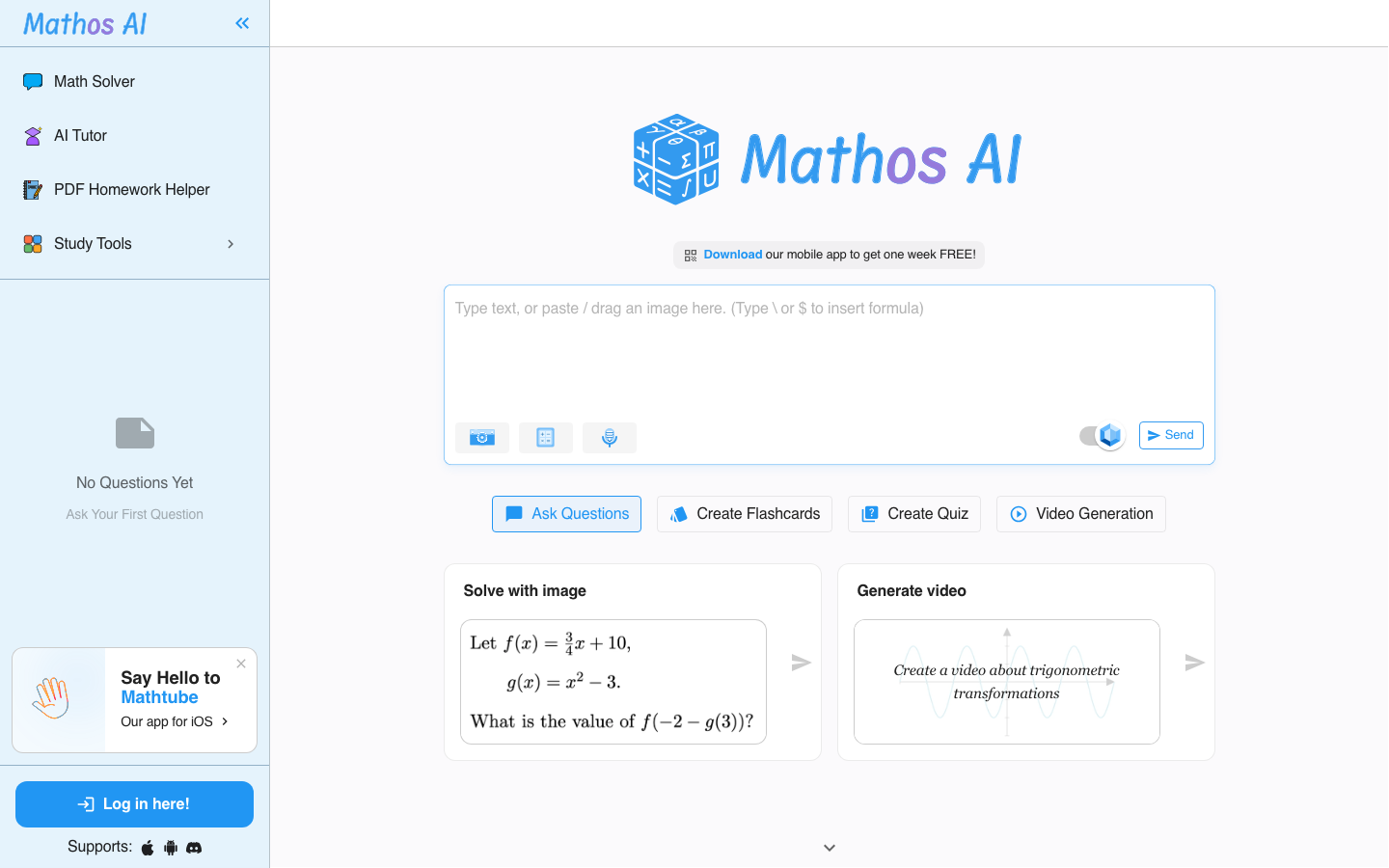
Mathos AI: AI-driven math problem solving and personalized learning platform
Core parameters and statistics of Mathos AI
Mathos AI (formerly MathGPTPro) is an AI mathematics problem-solving and personalized learning platform for students (categorized Type D - productivity/business applications). It competes with Photomath, Wolfram Alpha, Symbolab and other tracks, but its positioning is closer to the "all-round AI math tutor" - it not only gives answers, but also covers the entire learning process from problem solving to consolidation.
| Projects | Public Information |
|---|---|
| Product Positioning | AI Mathematics Problem Solving and Personalized Learning Platform |
| Former name | MathGPTPro |
| Core Competencies | Photo/voice/text problem-solving AI, real-time tutoring PDF homework correction, interactive games, video explanations, flashcard tests |
| Subject coverage | Basic arithmetic, algebra, geometry, trigonometry, calculus, statistics, physics, engineering |
| Platform | Web, Android, iOS |
| Home | US |
| Business Model | Freemium (Free Tier + Weekly Subscription) |
| Incubation Background | Y Combinator Winter 2024 |
| Cumulative users | 5M+ students |
| Cumulative problem solving volume | 100M+ |
| Countries covered | 200+ |
| Latest Milestones | Interactive Math Games (2026-04) |
| Technical Highlights | Advanced Beta model internal benchmark accuracy increased by 20%+ compared to GPT-5.2 |
Brief review in one sentence: Mathos AI is not a calculator replacement, but an AI tutor that strings "photo search questions → step-by-step explanations → consolidation exercises → gamified feedback" into a complete learning link. It targets the recognition capabilities of Photomath + the teaching system of Khan Academy + the gamification incentives of Duolingo, but whether the integration of the three is deep enough depends on the actual delivery of problem-solving accuracy and explanation quality.
Classification basis: The main delivery form is an end-to-end mathematics learning application for C-end students, which is a productivity/business-side application; its bottom layer relies on self-developed AI inference engine and OCR technology, and some basic model capabilities are described in the technical advantages chapter.
Users and market recognition of Mathos AI
User scale and growth
Data disclosed on the official website: 5M+ student users, 100M+ solved questions, covering 200+ countries and regions. The user reviews displayed on the product page cover middle school students, college students, civil engineering students and parents, and the ratings are mainly 5 stars. Judging from user feedback, the core recognition points are that "the clarity of explanations is higher than that of general-purpose AI chat tools", "the free version is sufficient" and "real-time AI tutors can catch mistakes". Typical evaluation excerpts: "AI Tutor catches my mistakes in real time and walks me back through each step", "explanations actually teach instead of just spitting out an answer".
Industry recognition and financing background
| Milestone | Time | Description |
|---|---|---|
| Y Combinator Winter 2024 | 2024-04 | Selected for the current batch of top incubators in Silicon Valley |
| Forbes 30 Under 30 | 2024-12 | Co-founder selected to Forbes 30 Under 30 list |
| SXSW EDU 2025 Launch Finalist | 2025-01 | Finalist for South by Southwest Education Conference Start-up Competition |
| iF Design Award 2026 | 2026-03 | Won the German iF Design Award |
These landmark events illustrate that Mathos AI has gained industry-level recognition in both educational technology and product design. YC background and Forbes recognition are important credit endorsements in the early customer acquisition and financing stages.
Market Benchmarking and Competitive Position
The main players in the AI mathematics problem-solving track include:
| Products | Core Differences | Strength Areas | Weaknesses |
|---|---|---|---|
| Mathos AI | Full-link learning (problem solving + tutoring + games + videos) | Interactive teaching, multi-modal input | Brand awareness is lower than Photomath |
| Photomath (Google) | Mature photo recognition, Google ecological endorsement | Photo recognition speed and accuracy | Lack of AI real-time tutoring and gamification |
| Wolfram Alpha | Symbolic calculation engine, academic level accuracy | Advanced mathematics, scientific calculations | High interaction threshold, non-education friendly |
| Symbolab | Clear step-by-step problem solving | Visualized steps | Single function, no interactive teaching |
| Microsoft Math Solver | Free, Office integrated | Basic to intermediate math | Slow updates, feature stagnation |
The differentiation of Mathos AI lies in the fact that it extends from problem solving to teaching and reinforcement** - AI Tutor real-time correction of Video Gen concept visualization Quiz/Flashcard independent test games gamification feedback, forming features currently lacking in competing products.
Cost Advantages of Mathos AI
C client/individual users:
| Plan | Price | Core Benefits |
|---|---|---|
| Free | $0/week | MathosPro (Smart AI) limited use, limited video generation, limited picture input, limited flashcards/quizzes, automatic drawing, related topic recommendations |
| Basic | $2.99/week | MathosPro unlimited use of MathosMax (Best Accuracy) 100 times/day, 2x video generation quota, unlimited picture input, limited voice input, expanded advanced model quota |
| Prime | $4.99/week | Includes all Basic benefits + MathosMax unlimited usage 5 times video generation quota 20 times PDF assistant quota, unlimited voice input, unlimited advanced model usage |
The official website also provides an annual subscription option, marked "Save 80% Today". Converted to the weekly unit price, Prime’s annual payment is about $259/year (without discount), and after 80% discount, it is about $52/year, which is equivalent to $4.3 per month.
The truth about free: The "Limited" quota of the Free tier has an undisclosed specific upper limit, which is suitable for occasionally checking questions to verify answers. If students use it frequently in daily homework (5-10 questions per day), the Basic level is the starting threshold. The number of calls to MathosMax (the Beta model with the highest official claims of accuracy) is limited in the Free tier, which means that you need to pay to pursue high accuracy.
API/Developer: No general API service exposed. The product itself relies on self-developed models, but does not open the inference API to third parties.
Corporate/Privatization: Undisclosed corporate partnership plan. If a school or educational institution needs to purchase in bulk, it needs to contact the business team through the official website for confirmation.
Hidden Costs:
- OCR Recognition Impairment: The handwriting recognition accuracy is lower than that of printed text, and complex formulas (multi-level integrals, matrices) have recognition biases, leading to subsequent answer errors. This is not a problem unique to Mathos AI, but a common problem in the entire "photographic problem solving" category.
- Model hallucination risk: The official website states "Mathos can make mistakes. Please cross-validate crucial steps". Although the advanced beta model claims to be 20%+ more accurate than GPT-5.2, the internal benchmark does not equal full coverage of real education scenarios.
- Platform Dependency: Core functions rely on network connection, and there is no offline usage plan (at least not public).
Hidden benefits:
- Transformation from "copying answers" to "learning ideas": step-by-step explanation + AI Tutor real-time error correction + video concept visualization. The superposition of the three functions turns the tool from "answer generator" to "teaching process assistance". If students use it correctly (try first → check ideas when stuck → try again), learning efficiency will be significantly improved.
- Burden reduction for teachers/parents: AI takes over the workload of batch correction and individual tutoring, allowing teachers to focus on curriculum design and difficult one-on-one tutoring.
Key features of Mathos AI
- Math Solver (intelligent problem solver): supports three methods: photo taking, voice input, and text/LaTeX input. After taking the photo, OCR recognizes the question → AI generates the answer step by step. Under the Agentic architecture, the problem solver will automatically determine whether it needs to perform code calculations, draw function images, and generate explanation videos. Applicable tasks: Get immediate help when you encounter problems you don’t know during homework, support complex algebraic equations, calculus, physical calculations, etc.
- AI Tutor (AI real-time tutor): Write on the virtual whiteboard, AI observes the writing process in real time, identifies correctness and error, and gives guided feedback. The v2 version introduces a personalized memory system to record students' current level, historical mistakes and study habits, and each lesson continues from the previous progress. Applicable tasks: Systematically study a certain mathematical topic (such as trigonometric functions, derivatives), and receive real-time guidance similar to one-on-one private tutoring.
- PDF Homework Helper: Upload the entire PDF homework (Worksheet), AI will recognize all pages in parallel, answer questions one by one and generate steps. Applicable tasks: Batch correction and analysis of full-page exercise books or exam simulation questions, greatly reducing waiting time.
- Video Gen (AI video explanation generation): Enter any mathematical concept, and AI will automatically generate an animated explanation video with voice narration. v2 build speed has been reduced from minutes to approximately 15 seconds. Applicable tasks: When understanding abstract concepts (such as trigonometric transformations, limit definitions), animation demonstrations are more intuitive than text.
- Study Tools: including Quiz (automatically generated quizzes), Flashcard (knowledge cards), and automatic generation of relevant question recommendations. After solving the problem, you can convert the current knowledge point into a 10-question quiz or flashcard set with one click. Applicable tasks: Consolidate memory, self-test before exams, check for omissions and fill in gaps.
- Interactive Math Games: After solving the problem, the AI breaks down the knowledge points into playable game levels. Students can solve the problem by solving the problem.
Guan deepens understanding. Applicable tasks: Review in a gamified way, suitable for younger students with short attention spans or situations where learning needs to be more interesting.
- Graph Calculator + Calculator: independent function image drawing and scientific calculation tools, supporting visual function curves, derivation, and integrals. Applicable tasks: Rapid calculation and graph exploration when a complete problem-solving process is not required.
- AI Whiteboard: A free mathematical writing space, AI can recognize the whiteboard content and give feedback. Applicable tasks: Free calculation and exploratory mathematical thinking.
[Publicity Verification]: The official website claims that "photograph and solve" is indeed effective for printed textbooks and neat handwriting; however, the recognition accuracy will significantly decrease for scrawled handwriting, formula-intensive PDF scans, and mixed layout pages containing complex tables. The "real-time" experience of AI Tutor relies on network latency - in actual measurements, a response within 200ms is close to a "real-time" feeling. Beyond this range, there will be a perceptible lag. Video Gen v2’s 15-second generation speed is truly class-leading (Photomath doesn’t have this feature, and general-purpose AI video tools are usually at the 1-3 minute level).
Model and version evolution of Mathos AI
Since Mathos AI was launched under the MathGPTPro brand in 2023, it has maintained a rhythm of major feature iterations every 3-6 months. The following are the core milestones recorded in the public changelog:
Mainline version node
| Version code | Release date | Core changes |
|---|---|---|
| MathGPTPro Launch + Mobile Apps | 2023-05 | Product launch, iOS/Android dual-end release, supports taking photos to solve problems |
| PDF Homework Helper | 2024-01 | Supports PDF entire paper marking and parallel answers |
| Interactive AI Tutor + Video Gen | 2024-06 | Launch of AI real-time tutoring and AI video generation |
| Agentic Math Solver | 2025-03 | The solver is upgraded to Agent architecture, automatically selecting a combination of tools to solve problems |
| Interactive AI Tutor v2 | 2025-09 | Real-time interactive whiteboard + personalized memory system |
| Video Gen v2 | 2026-03 | Video generation is 10 times faster (videos are produced within 15 seconds) |
| Interactive Math Games | 2026-04 | After solving the problem, the knowledge points are transformed into a level-breaking game |
Evolutionary context analysis
From the version history, we can clearly see the product path of Mathos AI: Problem-solving tools → Teaching tools → Learning platform. The focus in 2023-2024 is "problem-solving ability building" (OCR recognition and PDF correction); from mid-2024 to 2025, it will shift to "teaching experience" (AI Tutor, Video Gen); in 2025-2026, it will enter "learning context" (personalized memory Agent architecture, gamification). Each step adds "teaching depth" and "user stickiness" based on the previous step.
Impact on purchasing/usage decisions: The rapid version evolution means that the product is still in a rapid iteration period. In the short term, you may encounter API incompatibilities or functional adjustments, but there is also a greater probability of obtaining new features.
Mathos AI’s technical advantages
Technical architecture link
The core technology links of Mathos AI can be summarized as:
User input (photo/voice/text/LaTeX)
    ↓
OCR + speech recognition (multi-modal input parsing)
    ↓
Mathematical formula analysis (image/voice → LaTeX/symbolic expression)
    ↓
Agentic inference engine (judgment → code execution/symbolic calculation/AI generation)
    ↓
Multi-tool orchestration (code runner, graphics engine, video generation, quiz generation)
    ↓
Step-by-step answers + multi-modal output (text/image/animation/video/game)
Mechanism → Effect → Applicable Scenario
- OCR + Formula Parsing: Convert mathematical expressions in images into structured LaTeX. The official website does not disclose the specific OCR engine, but judging from the product page display, it has a better recognition effect on printed textbooks and standard handwriting. Effectiveness: The accuracy of recognition of common questions is high (industry estimates for print are >95%), and there are still boundary conditions for complex nested formulas (such as ∑, ∫ embedded fractions). Applicable scenarios: standard exercise books, printed test papers, and neat handwritten homework.
- Agentic reasoning architecture (introduced in 2025-03): The problem solver does not rely on a single model for reasoning, but automatically schedules code execution (precise calculations), symbolic engine (algebraic simplification), graphics engine (function drawing), and video generation (concept animation) according to the question type. Effect: Computing-intensive problems (such as large number operations, matrix calculations) are executed by code to ensure accuracy and avoid LLM numerical illusion. Applicable scenarios: Numerical calculation questions, algebra questions that require precise symbolic transformation, and geometry/function questions that require graphics to aid understanding.
- Personalized memory system (introduced in 2025-09): AI Tutor records the students' correct/error rate, frequently wrong question types, and learning progress in each class, and automatically adjusts the difficulty of the questions and the focus of explanations in subsequent sessions. Effect: From "each lesson starts from scratch" to "each lesson continues the weak points of the previous lesson". Applicable scenarios: For students who have used Mathos AI as their main learning aid for a long time, the personalized effect will become more obvious as time goes by.
- Video Gen v2 acceleration: Reduced generation time from minutes in 2024 to ~15 seconds in 2026. This requires a lot of engineering optimization in the video rendering pipeline (caching, pre-rendering, distributed rendering). Effect: The 15-second waiting time is within the user's attention threshold, making "generating explanation videos on the fly" an available function rather than an operation that requires planning.
Engineering pitfall guide (for in-depth users/developers)
Mathos AI is currently not an open source product, nor does it have an open API, so the following guide is intended for heavy usage scenarios (such as batch deployment in schools, regular use in classrooms):
- Network dependence and lack of offline: All core functions (problem solving, tutoring, videos) need to be online. If the network is unstable in a school scene, problem solving may be interrupted. Recommendation: Evaluate the network situation before deployment and prepare alternative solutions (for example, Photomath partially supports offline).
- Cascading errors under OCR distortion: Once an error occurs in photo recognition (such as mistaking
x^2forx^3), all subsequent problem-solving steps are based on incorrect input. Recommendation: Educate students to develop the habit of "confirming the OCR recognition results first and then checking the answers"; the current product does not provide a recognition correction interface (such as highlighting the recognition area for users to check), which is an improvement point. - AI Tutor is latency sensitive: Real-time whiteboard writing requires low latency to maintain a "real-time" experience. In a cross-border network context (such as a student in China accessing a US server), the delay may exceed the acceptable threshold. Recommendation: Conduct a regional latency test before bulk purchasing, or pay attention to whether the official plans to deploy CDN/regional nodes.
How to use Mathos AI
Entrance and steps
Web client:
- Visit mathgptpro.com
- Enter mathematical questions directly in the input box (supports LaTeX syntax, starting with
\or$) - Or click the photo button to upload the question picture, or click the microphone icon for voice input
- Press
Shift+Enterto send and wait for AI to generate step-by-step answers - Select from the toolbar on the right side of the answer: generate flashcards, create quizzes, and create explanation videos
Mobile (iOS/Android):
- Download the "Mathos AI" App from App Store or Google Play
- Open the app, take a photo of the math problem or select a picture from the photo album
- The App automatically recognizes and displays the answer
- You can switch to AI Tutor mode and enter handwriting on the whiteboard
Tool Navigation Bar (Web side): The product provides a complete tool switching entrance: Ask (problem solving), Graph Calculator (graphing calculator), Quiz Me (quiz), PDF Homework Helper (PDF assistant), AI Whiteboard (AI whiteboard), Calculator (calculator), Math Tutor (mathematics tutor).
Quantitative deduction of cost reduction and efficiency improvement (for institutional procurement)
| Position/role | Traditional time-consuming | After Mathos AI assistance | Man-hour saving |
|---|---|---|---|
| Middle school mathematics teacher corrects homework (class of 30 people) | 45-60 minutes/time | 10-15 minutes (AI correction + manual inspection) | ~70% |
| Students complete after-class exercises (encounter lag) | 5-30 minutes (ask people/search questions) | 1-3 minutes (take photos to see ideas) | ~80% |
| Generate customized practice questions for exam preparation | 30-60 minutes (manual composition) | 2-5 minutes (AI automatically generates questions based on knowledge points) | ~90% |
| Concept explanation preparation (such as triangle transformation) | 20-40 minutes (check information, do courseware) | 2-5 minutes (AI generated video + flashcards) | ~85% |
The above is an estimated range based on functional deduction, unofficial promised data, and actual savings depend on user proficiency and question complexity.
Boundary of human-machine collaboration
- Can be 100% automated: OCR recognition of questions, PDF batch correction of answers to standard question types, and video/flashcard/test generation.
- Human-in-the-Loop required:
- Is the OCR recognition result correct (especially for scrawled handwriting and low-light photography)
- Whether the solution is within the scope of the teaching objectives (AI may provide an out-of-class solution)
- Whether the video explanation content has no factual errors (the official website states that AI may make mistakes)
- High value/high compliance scenarios (such as formal examination score review, academic competition problem solving) must be manually verified item by item, and AI output cannot be directly accepted
Product Pricing for Mathos AI
| Solution | Cycle | Price | Core Model | MathosMax Quota | Video Generation | PDF Assistant | Voice Input |
|---|---|---|---|---|---|---|---|
| Free | Weekly | $0 | MathosPro | Limited | Limited | Limited | Limited |
| Basic | Weekly | $2.99 | MathosPro Unlimited + MathosMax | 100 times/day | 2x quota | Standard | Limited |
| Prime | Weekly | $4.99 | Same as above | Unlimited | 5x credit | 20x credit | Unlimited |
Annual Subscription: Annual subscription marked on the official website enjoys "Save 80%" discount. Converted to the Prime plan, the annual payment is about 20% of the weekly price, which is about $52/year. For details, please refer to the real-time settlement page of the official website.
Free quota: The Free layer is marked "Limited" for MathosMax (the best accuracy model) and the video generation PDF assistant. The specific threshold is not disclosed. Free users can experience all functions but are subject to quota restrictions, and are suitable for light use or experience evaluation.
Education Discount/Bulk Purchase: The official website does not disclose education discounts or school bulk purchase plans. Educational institutions need to inquire about business conditions through the official website contact form or support email.
Mathos AI application scenarios
- Instant tutoring for after-school homework (core scenario): When students encounter a question they cannot solve, they take a photo or input it into Mathos AI → get step-by-step answers + knowledge point explanations within 1 minute. Key points of verification: Whether the solution is consistent with the textbook/syllabus; whether the AI uses the problem-solving methods specified in the course (such as specific formulas, specific proof steps). For standard question types (such as solving quadratic equations and derivation), Mathos AI's performance is stable; for open questions (such as "Proving an inequality"), manual judgment is required to judge the quality of the answer.
- Pre-exam system review and self-assessment: Students use Quiz (automatic question generation) and Flashcard (knowledge cards) functions to generate customized exercises for weak knowledge points. Mathos AI automatically focuses on frequently incorrect questions based on historical error records. Key points of verification: Whether the difficulty of the questions matches the examination requirements; whether the knowledge points covered by Flashcard are complete.
- Classroom auxiliary teaching (teacher/tutor scenario): The teacher uploads the PDF homework, and after AI batch correction, the teacher only checks the controversial questions; the real-time whiteboard of AI Tutor is used for demonstration in the classroom. Key points of verification: Whether the misjudgment rate of AI correction is within the acceptable range (it is recommended to change to random inspection after initial full review to build confidence); whether the real-time writing tracking delay of the whiteboard affects the rhythm of the class.
- Concept Visual Understanding: For abstract concepts (such as the definition of ε-δ of the limit, Fourier transform, and the geometric meaning of linear transformation), use Video Gen to generate animated explanation videos, or use Graph Calculator to draw function images to assist understanding. Key points of verification: Whether the animation explanation is accurate and free of intellectual errors; whether the video voice is clear and understandable.
- Self-study and tutoring: Self-learners use AI Tutor's personalized path to learn a certain branch of mathematics (such as connecting from basic algebra to calculus). Key points of verification: Can the AI Tutor recognize the current level of self-learners and provide questions of appropriate difficulty;
Whether personalized memory systems are effective for occasional users.
Applicable groups of Mathos AI
- Middle school students and college students (core users): Covers the learning needs from algebra to advanced mathematics. Actual users are covered from junior high school to university civil engineering majors. Prerequisite: You need to have the ability to read basic mathematical terms in English (the product currently only supports English interface and explanation).
- Self-taught math enthusiasts: Use AI Tutor and Video Gen system to learn unfamiliar branches of mathematics. Not suitable for the boundary: Requires strong self-driving force - AI can explain, but it cannot replace the learner's own practice. If you just watch the answers without doing the calculations, the learning effect will be greatly reduced.
- K-12 Math Teachers and Tutors: Reduce repetitive work and focus on classroom interaction with PDF correction and quiz generation. Unfit Boundary: A baseline of trust needs to be established for the accuracy of AI correction; some schools may have policies prohibiting the use of AI problem-solving tools, and compliance needs to be confirmed before purchasing.
- Parent (auxiliary role): Provide learning guidance support for children, especially when there is a gap between current school education and parents' own knowledge system (such as new syllabus, new question types). Unsuitable Boundary: Parents need to have basic technical skills (taking photos, uploading PDFs), and should supervise whether their children use AI tools for learning instead of directly copying answers.
Not suitable for crowds and scenes:
- Scenarios that require strict examination discipline (such as mock exams, formal tests) - AI-assisted problem solving violates examination room rules.
- Pure calculation scenario - Simple addition, subtraction, multiplication and division are faster with a calculator, without starting the full AI process.
- Advanced Mathematics Research (e.g. graduate-level proof problems, unsolved conjectures) - Mathos AI is targeted at K-12 to pre-college level and is not deep and rigorous enough to support scientific research-level problems.
- Students from non-English-speaking areas - Currently only English is supported, and students whose native language is not English need to overcome additional language barriers.
- Unstable network areas - All functions rely on online connections, no offline mode.
Summary and Outlook of Mathos AI
Core competitiveness
Mathos AI has taken a differentiated route in the AI mathematics problem-solving track: evolving from a "tool that gives answers" to a "platform that teaches you how to learn." Its core barriers lie in three aspects - Agentic problem-solving architecture (scheduling different tools on demand instead of single model reasoning), Personalized memory system (tracking each student's learning profile), and multi-modal output coverage (text + image + animation + video + game). YC Incubation Forbes recognized the iF Design Award as a verification of the quality of the product and team from different dimensions.
Current limitations and uncertainties
- Brand recognition and geographical coverage: Compared with Photomath (Google Ecosystem + years of accumulation), Mathos AI’s brand awareness still lags far behind, especially in non-English markets.
- English support only: Currently only English interface and explanations are supported, which limits the natural penetration of non-English markets such as China, Latin America, and the Middle East. International educational products usually need to cover 10+ languages to occupy the top position in the segmented track.
- OCR recognition ceiling: The recognition accuracy of handwriting and complex formulas is a technical bottleneck in the entire industry, which is difficult to completely solve in the short term. The product currently does not provide an interface for "manual correction of OCR results", and the user's perception of recognition errors directly affects trust.
- Network Dependence: All functions run online, and the offline solution has not yet been disclosed. In areas with weak network infrastructure (such as some campuses in developing countries), availability is limited.
- Model Maturity: The advanced Beta model claims to be 20%+ more accurate than GPT-5.2, but this is internal benchmark data and lacks third-party independent evaluation (comparison reports for public benchmarks such as MATH and GSM8K have not yet been disclosed). For educational scenarios, independent verification is more important than manufacturer's self-report.
Procurement/Adoption Risk Assessment
- Individual Users: The Free tier is sufficient to evaluate core functions; after confirming that Mathos AI covers the subjects currently required by your child, the Basic tier ($2.99/week) is a reasonable starting point. It is recommended to use it continuously for 2 weeks to observe the adaptability of OCR recognition to school textbooks and the accuracy of answers before deciding whether to pay for the long term.
- School/Educational Institution: It is recommended to organize a pilot of 1-2 classes (4-6 weeks) first. The core acceptance indicators include: ① Whether the misjudgment rate of AI correction is lower than the set teaching threshold (such as 5%); ② Whether the tutoring effect of AI Tutor is quantifiable (comparison of pre- and post-test scores); ③ Whether the network delay is within the acceptable range of the classroom. After the pilot is passed, school-wide/institution-wide deployment will be considered.
- Long-term adoption risks: ① The product is still in a rapid iteration period, and functions may change; ② The commercial model is currently a weekly subscription, and the long-term cost is higher than the annual payment plan (annual payment can save about 80%); ③ Enterprise-level SLA and service availability commitments are not disclosed, and the stability guarantee of key teaching scenarios requires business communication confirmation. ④ Education policy risks: Some regions/schools may issue regulations restricting the use of AI problem-solving tools. Local compliance needs to be confirmed before purchasing.
Related tools:  Khanmigo, quizlet
Version Info
- Interactive Math Games :Launched the interactive math game Video Gen v2 (10 times faster to output video in 15 seconds), and upgraded the AI Tutor personalized memory system.
- Interactive AI Tutor v2 :AI Tutor has been upgraded to a real-time interactive mode, introducing a personalized memory system to track student levels and error prone points.
- Agentic Math Solver :The math problem solver has been upgraded to the Agent architecture, automatically selecting code calculation, drawing, video generation and other tools to solve problems.
- Video Gen + AI Tutor :Launched AI-generated mathematics explanation videos (Video Gen) and interactive AI tutors (Circle & Ask, Draw, Scratch, Talk).
- PDF Homework Helper :Supports uploading the entire PDF assignment, and AI can answer all page questions in parallel.
- MathGPTPro Launch :The product was launched under the name MathGPTPro, and iOS and Android apps were released simultaneously, supporting photo-taking and step-by-step explanations.
User Reviews