 Maxim AI
Free
Maxim AI
Free
Maxim AI is an end-to-end evaluation, simulation and observability platform for modern AI applications and agents, covering Prompt experiments, offline/online evaluation, production logs, tracking, alarms, data sets and Bifrost LLM gateway. It is suitable for products and R&D teams that need to incorporate AI quality engineering into the release process.
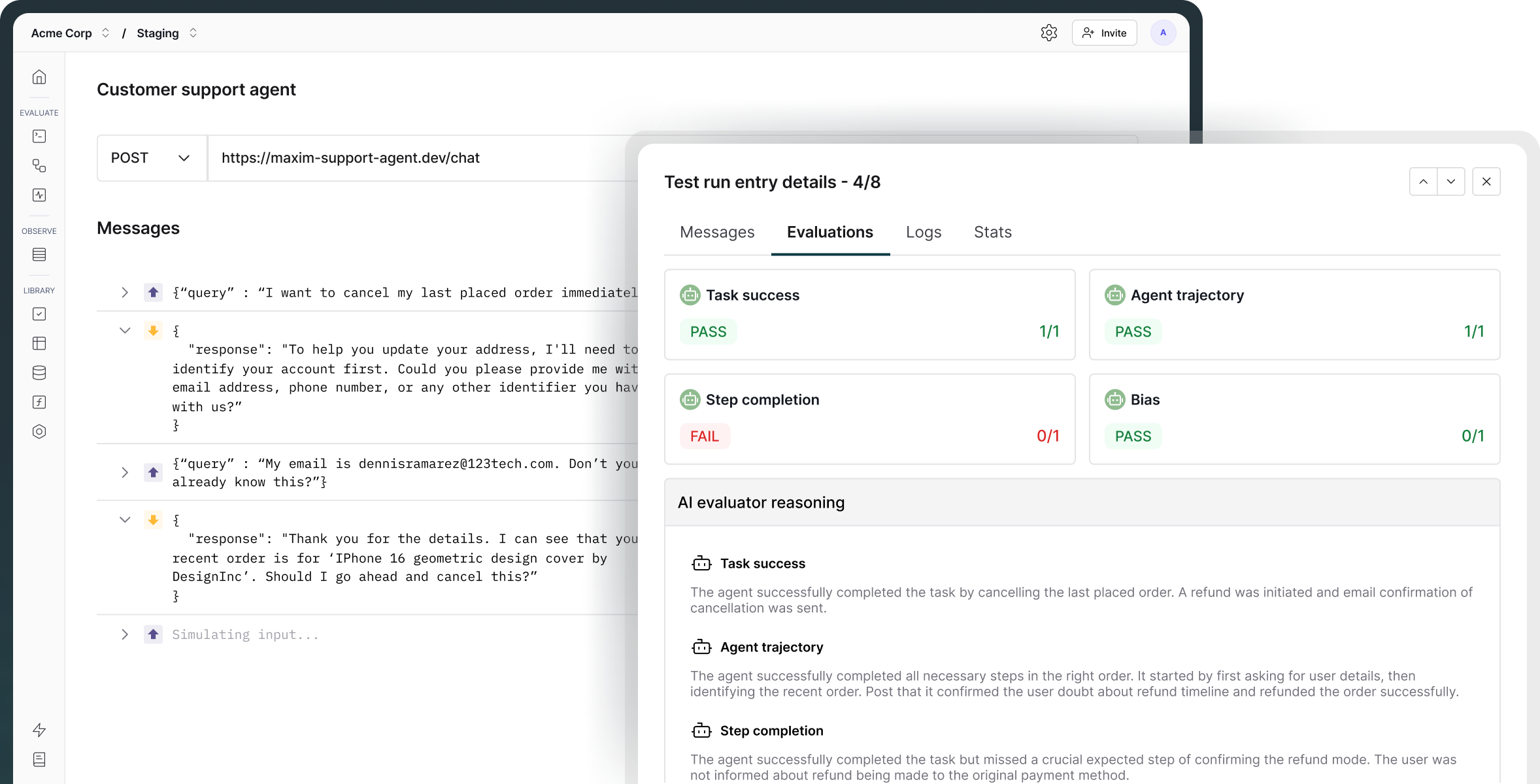
MaximAI
Core parameters and statistics
| Projects | Public Information |
|---|---|
| Product positioning | GenAI evaluation and observability platform / end-to-end platform for simulation, evaluation and observability |
| Core objects | AI agents, AI applications, prompts, workflows, voice agents, HTTP endpoints |
| Main modules | Experimentation, Agent simulation and evaluation, Agent observability, Bifrost LLM gateway |
| Document Capability Domain | Prompt Playground, MCP, Offline Evals, Online Evals, Tracing, OpenTelemetry, Simulations, Evaluators, Datasets, Dashboards, Audit Logs, CI/CD, Maxim CLI |
| Gateway coverage | Bifrost unified management of AI traffic for 1000+ models |
| Company entity | H3 Labs Inc |
| Founding and Financing | Founded in 2023; Seed round received $3M in financing, led by Elevation Capital |
| Latest public update | Published on 2026-01-16 December 2025 Updates |
| Support Platform | Web, API |
Positioning boundaries: Maxim AI is not a general chatbot, nor is it a basic model training platform. It solves quality engineering issues before and after AI products enter real user scenarios: use data sets, simulations and evaluations before going online to reduce regression risks; use log trace, online eval and alarms to locate quality fluctuations after going online.
Product Main Line: The documentation page splits the platform into four lines: Experimentation, Evaluation, Observability and Data engine. This split is critical, because the Agent problem is usually not a lack of single-point model capabilities, but a lack of closure between Prompt, tool invocation, retrieval, user multi-round context, evaluation criteria, and production feedback.
User and market recognition
Customer Signal: The product homepage displays customer or user logos such as EY, ByteDance, Babylist, RLDatix, Yousician, Milestone, Rise Science, Clinc, Comm100, Mindtickle, Atomicwork, etc.; this shows that the target market of Maxim AI is not individual toy-type evaluation, but B2B AI teams that require cross-product, R&D QA, and customer success collaboration.
Financing and Team Signal: Elevation Capital’s portfolio page shows that Maxim AI was founded by Vaibhavi Gangwar and Akshay Deo in 2023, and raised $3M in Seed round financing. Investors include Elevation Capital and angel investors from Postman, Chargebee, Groww, Razorpay, Media.net and other companies. This background has a direct impact on product positioning: Maxim AI is clearly more focused on developer tools and enterprise infrastructure than lightweight content generation tools.
Case Signal: In public customer stories, Atomicwork uses Maxim AI for AI evaluation, debugging, and continuous improvement; SiliconANGLE also discussed it in the context of eval engineering, simulation, and observability in its 2026-05 interview report. Third-party reports cannot replace the facts on the product page, but they can illustrate that market discussions have classified Maxim AI into the direction of Agentic AI governance and quality engineering.
Undisclosed items: Maxim AI has not publicly disclosed the total number of paying customers ARR, renewal rates, penetration rates by industry, and SLA achievement data; these indicators need to be subject to corporate procurement communication or subsequent formal disclosure.
Cost advantage
C-side/individuals and small teams: The Developer plan is Free Forever, and the public quota includes up to 3 seats, 1 workspace, 10k logs per month, 3-day data retention and email support. It is suitable for independent developers or small teams to first verify log access to Prompt experiments and basic eval processes, but data retention and collaboration capabilities are limited.
Developer/API Tier: Professional public price is $29/seat/month, paid monthly, including unlimited seats, up to 3 workspaces, 100k logs per month, 7-day data retention, simulation runs, online evals and 14-day free trial. For teams that are building Agents, the key costs are not just seat fees, but also the number of eval runs, log volume, model calling fees, manual annotation, and test data maintenance.
Enterprise/private tier: Business is $49/seat/month and includes unlimited workspaces, 500k logs per month, 30-day retention, RBAC, PII management, scheduled runs, custom dashboards, and private Slack support; Enterprise is Custom and includes Custom SSO, In-VPC deployment, custom log limits, custom data retention, audit logs, custom SLAs, advanced compliance, custom BAAs, data isolation, and dedicated CSM. The true cost to the enterprise is primarily determined by log size, data retention, private deployment, compliance review, and support level.
Main functions
- Prompt and Experiment Workbench: Prompt IDE, Prompt versioning, Prompt chains and Prompt deployment allow the team to organize Prompt iterations outside the code, which is suitable for converting experimental results into reusable versions instead of relying on scattered documents and manual comparison.
- Agent Simulation: The Agent simulation and evaluation page emphasizes simulating real multiple rounds of interactions across scenarios, user personas, and test cases, and can be used for pre-launch stress testing of conversational Agents such as customer service, sales, and voice assistants.
- Offline and Online Evals: The document covers both Offline Evals and Online Evals. The former is suitable for regression before release, and the latter is suitable for continuous monitoring after production; the combination of the two can connect "testing before going online" and "quality drift after going online" to the same set of indicator systems.
- Observability and Tracking: Tracing, OpenTelemetry, Logs, Dashboards, Exports and Reporting help the team locate Agent failure points, such as retrieval errors, tool call failure, Prompt version regression, or reduced response quality.
- Datasets and Evaluation Library: Evaluators, Datasets, Context Sources, Prompt Tools and other modules are used to precipitate test inputs, expected outputs, contexts and evaluation rules, reducing the cost of constructing test sets from scratch for each version iteration.
- Bifrost LLM gateway: Bifrost is oriented to multi-model traffic management, and the product page emphasizes across 1000+ models; it puts model routing, gateways, governance and observation into a more unified infrastructure layer.
- Enterprise Governance Capabilities: The Enterprise plan includes SSO, In-VPC deployment, audit logs, advanced compliance, BAA, data isolation and custom SLAs, for organizations with security and compliance requirements.
Model and version evolution
Maxim AI is a cloud platform that continuously iterates and does not disclose semantic product version numbers; therefore, the version context is more suitable to be understood in terms of Maxim Updates and major capability nodes.
Mainline update
2026-01-16 / December 2025 Updates: Public updates cover capabilities such as logging and observability overhaul, MCP gateway, file attachment evals, prompt collaborative conflict handling, and external annotation. This node illustrates that Maxim AI is enhancing production log throughput, collaborative prompt editing, and multi-modal review input.
2025-12-16 / November 2025 Updates: Public updates include flexible data curation, cost charts, reasoning column and other capabilities. Data sets no longer revolve around fixed input/output fields, but can extract more fine-grained data from traces, sessions, tool calls, retrieval steps, evaluator reasoning, and human rater comments.
2025-11-05 / Synthetic Data, Retro Evals, Workspace RBAC: Public update using synthetic dataset generation for multi-round testing of Prompts, HTTP endpoints, Voice and No-code agents, and enhancing workspace-level RBAC. This node promotes evaluation data production and authority management to enterprise scenarios at the same time.
2025-07-04 / Bifrost, Voice Agent, CrewAI: The public update brings Bifrost, voice agent support and CrewAI integration into the main line, indicating that the platform continues to expand from traditional Prompt eval to Agent runtime, voice agent and multi-framework ecosystem.
Version judgment
For the production team, the "version" of Maxim AI should not only look at the date, but also look at three dimensions: whether the evaluation input covers the real task form, whether the production log can be returned in time, and whether the governance capability meets the enterprise's security boundaries. If one of these dimensions is missing, the platform will be more like a testing tool; if all three are present at the same time, it will be closer to an AI quality engineering infrastructure.
Technical advantages
Mechanism: Simulation and evaluation are advanced to the release process. Turn Agent behavior into repeatable test assets through scenarios, personas, datasets, and evaluators. The effect is that the product team can do regression comparisons after model prompts or tool chain changes, instead of relying on manual on-site trial chats; applicable scenarios are customer service agents, voice agents, sales assistants and multi-tool agents.
Mechanism: Production logs and online eval reflow. Tracing, logs, online evaluations, and alerts turn real-life problems into analyzable samples. The effect is that the team can discover the quality degradation caused by a certain type of user intention, a certain tool call, or a certain model routing; the applicable scenario is an AI product that has been online, has continuous traffic, and needs to measure cost and quality trends.
Mechanism: Data engine connects Prompt, trace and test set. Flexible data curation and synthetic data generation allow teams to extract variables from operational data, construct new test samples, or generate similar scenarios. The effect is that the evaluation set no longer ages statically; the applicable scenario is a team whose business continues to change, users have diverse expressions, and need to keep the test set fresh.
Mechanism: Combination of gateway and observable. Bifrost unifies multi-model traffic, while Maxim's observation and eval capabilities provide quality feedback. The effect is that model switching fallback and cost governance are no longer completely separated from quality indicators; the applicable scenario is for teams that access multiple model suppliers at the same time and need to make trade-offs between delay, cost and answer quality.
How to use
| How to use | Entrance | Typical steps | Adaptation scenarios |
|---|---|---|---|
| Web workbench | Get started free / Sign in | Create workspace -> Create a new Prompt or Agent project -> Configure datasets and evaluators -> Run test runs | Product QA, Prompt engineering team collaboration |
| SDK / API | Docs, Maxim API keys, SDK documentation | Access logs or tracing -> Send runs/logs -> Configure online evals and dashboards | Production observations of existing AI applications |
| OpenTelemetry | Tracing via SDK / OpenTelemetry | Manage Agent link -> Collect tool calls, retrieval, generation -> Analyze trace | Multi-step Agent debugging |
| CI/CD vs. CLI | Maxim CLI, CI/CD documentation | Trigger eval during release process -> Compare version results -> Block obvious regressions | Pre-release quality gate control |
| Enterprise Deployment | Book a demo / Enterprise | Confirm SSO, In-VPC, data isolation BAA, SLA -> Small-scale PoC -> Expand to multiple teams | Organizations with high compliance and security requirements |
The implementation path is recommended to start with a high-value Agent, such as customer service canceling orders, diversion of sales leads, or voice appointment confirmation. In the first stage, 50-100 real scenarios and basic evaluators are established. In the second stage, production traces are connected and failed samples are returned to the data set. In the third stage, online eval, alert, dashboard and CI/CD quality access control are integrated into the release process.
Product Pricing
| Plan | Public price | Public quota and capabilities | Typical positioning |
|---|---|---|---|
| Developer | Free Forever | Up to 3 seats, 1 workspace, 10k logs/month, 3-day retention, email support | Independent developer, small team verification |
| Professional | $29/seat/month | Unlimited seats, up to 3 workspaces, 100k logs/month, 7-day retention, simulation runs, online evals, 14-day free trial | Growth-stage collaboration team |
| Business | $49/seat/month | Unlimited workspaces, 500k logs/month, 30-day retention, RBAC, PII management, scheduled runs, custom dashboards, private Slack support | Business teams who need stronger governance |
| Enterprise | Custom | Custom SSO, In-VPC deployments, custom log limits, audit logs, custom SLAs, advanced compliance, BAA, data isolation, dedicated CSM | Large enterprises and high compliance scenarios |
Price Boundary: The public page provides monthly seat prices and some log quotas, but does not disclose all overage billing, private deployment BAA, SLA, annual commitment discounts and data retention expansion prices. When it comes to production-level procurement, the real-time pricing page and commercial contract should prevail.
Application scenarios
- AI Customer Service Agent pre-launch testing: Organize common consultation, unsubscription, refund, address modification, complaint escalation and other scenarios into simulation tests to verify indicators such as task success, trajectory, bias, step completion and reduce the risk of first-round exposure of real users.
- Prompt and model version regression: After the model supplier's Prompt version or tool calling strategy changes, use the fixed data set and evaluator to compare the output quality to avoid "local optimization leading to overall regression."
- Voice Agent Quality Verification: Use voice simulation and multiple rounds of scenario testing to evaluate call initiation, user interruption, information confirmation, task completion rate, etc., suitable for customer service, reservations, and sales outbound call scenarios.
- Production observability and fault location: Locate high latency, high cost, low score eval or specific tool call failure through traces, logs, dashboards and alerts, and support the engineering team to quickly replay the problem.
- Enterprise AI Governance: Use audit logs, RBAC, PII management, SSO, In-VPC, and data isolation to control cross-team use, suitable for organizations that integrate AI applications into formal release and compliance processes.
Applicable people
- AI Product Manager and Prompt Leader: Prompt experiments, test reports, evaluation sets and version comparisons need to be organized in a low-code manner to reduce reliance on R&D manual verification for each launch.
- AI/ML Engineering and Agent Development Team: Need to track multi-step call links, debug tool calls, evaluate the impact of model switching, and put eval into CI/CD.
- QA and Quality Engineering Team: Need to convert manual acceptance criteria into repeatable evaluators, test runs, and regression suites.
- Platform Engineering and Security Team: Focus on SSO, RBAC, audit logs, In-VPC, PII, BAA, SLA and data isolation, hoping to unify AI quality and governance to the platform layer.
The boundary of incompatibility is also clear: if the team only has one-time demos, no continuous release rhythm, no stable evaluation standards, or the Agent has not yet been connected to the real business system, Maxim AI's platform capabilities will appear to be overweight. At this time, it is more suitable to establish a baseline with simple logs and manual testing first, and then introduce the complete platform after high-frequency iterations and production risks arise.
Summary and Outlook
The core value of Maxim AI is to advance the quality of AI products from "subjective judgment after manual trial" to the continuous process of "simulation, offline evaluation, online observation, data reflow and governance". It is particularly suitable for teams that are already building or operating AI Agents: the question is no longer whether a usable answer can be generated once, but whether the system remains stable, explainable, and traceable every time the model prompts, tools, context, and business rules change.
The current limitations are mainly at three points: first, the complete enterprise cost requires business confirmation; second, the public page does not disclose the overall customer scale, renewal rate and SLA achievement data; third, the value of the platform depends on the team's ability to accumulate high-quality data sets and evaluation standards, and the tool itself cannot replace the quality engineering methodology.
When implementing it, it is recommended to first select an Agent with clear business results for piloting. The indicators can be set to task completion rate, manual regression rate, failure classification coverage, average debugging time, and online high-risk sample recall rate. After pilot verification, it will be expanded to multi-team workspace, CI/CD quality access control online eval and enterprise governance capabilities; enterprises should focus on reviewing log quota, data retention, private deployment SSO, audit logs, BAA, SLA and data isolation terms before purchasing.
Related tools:  GitHub Copilot,
  Cursor
Version Info
- December 2025 Updates :Maxim Updates is the latest public product update, including logging and observability overhaul, MCP gateway, file attachment evals and prompt collaborative conflict handling capabilities.
- November 2025 Updates :The public update includes flexible data curation, cost charts, reasoning column and other capabilities, strengthening the process of precipitating evaluation data sets from logs and test runs.
- Synthetic Data / Retro Evals / Workspace RBAC :Public updates include synthetic data generation, retro evals and workspace-level RBAC, and multiple rounds of test data generation for Prompt, HTTP endpoint, voice and no-code agent.
- Bifrost / Voice Agent / CrewAI Updates :The public update incorporates Bifrost LLM gateway, voice agent support and CrewAI integration into the main product line, expanding Agent production infrastructure capabilities.
User Reviews