 Mend
Mend
Mend (formerly WhiteSource) is a leader in open source component security (SCA), providing AI-enhanced vulnerability detection, remediation recommendations and license compliance management.
Mend
Mend’s core parameters and statistics
Mend (formerly WhiteSource) is an AI-native application security platform (AppSec) for enterprises and development teams, covering four product lines: SCA (software composition analysis), SAST (static application security testing), AI security and automated dependency management. The official positioning is "Application Security and AI Security, Unified" - integrating traditional application security and the new risk aspects introduced by AI into the same governance system.
| Projects | Public Information |
|---|---|
| Official positioning | Application Security and AI Security, Unified |
| Product Matrix | Mend AppSec (SCA + SAST), Mend AI (AI security), Mend Renovate Enterprise (dependency update) |
| Brand History | Formerly WhiteSource, renamed Mend in 2024 |
| Core capabilities | SCA component analysis, SAST code audit, AI security governance, automatic dependency update, license compliance |
| Pricing model | Annual subscription based on the number of contributing developers (Contributing Developer) |
| Support ecosystem | 200+ programming languages and package managers, deeply integrated with IDE, CI/CD, and code repository |
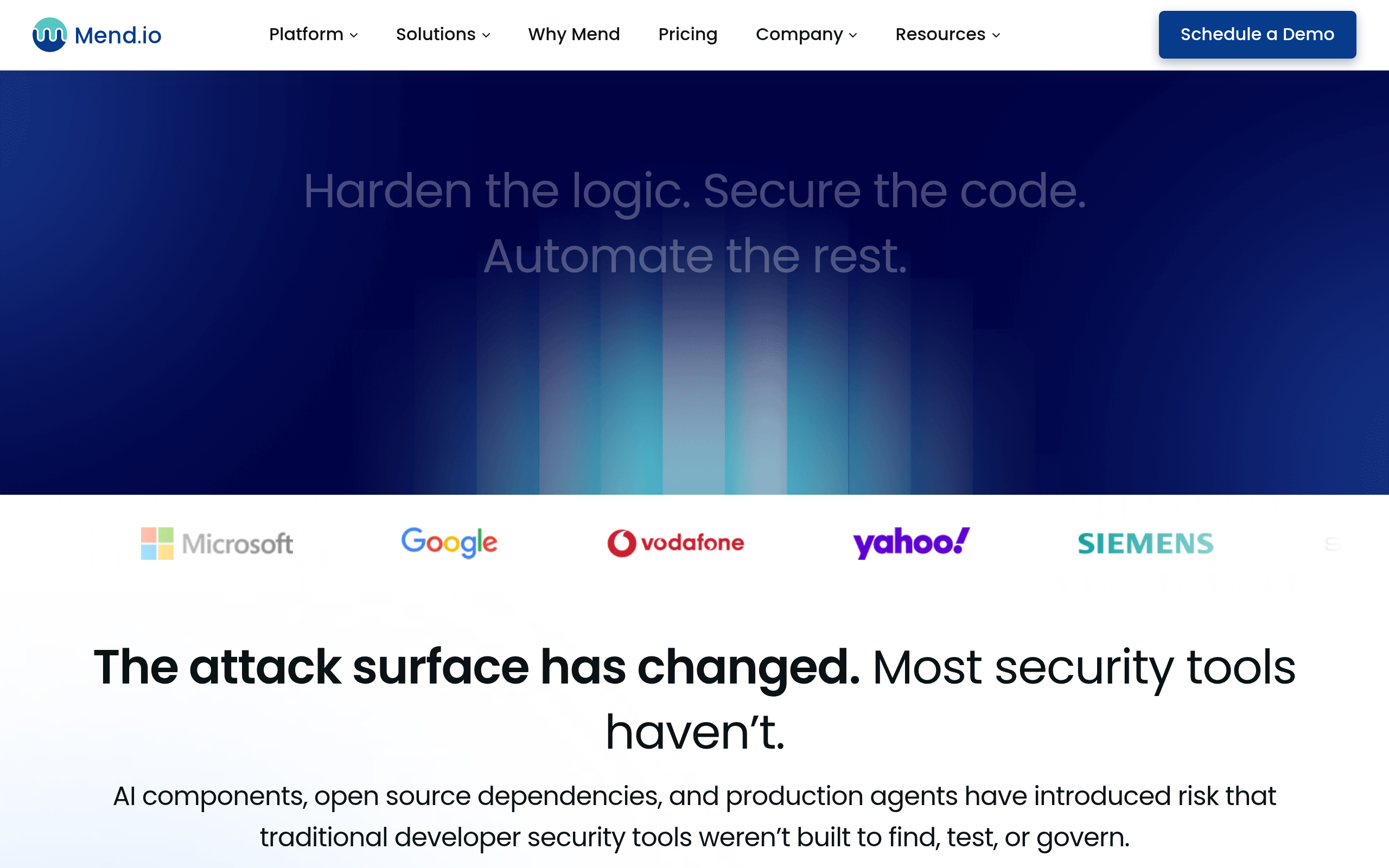
| Benchmark customers | Microsoft, Google, Yahoo, Siemens, Vodafone, Ping Identity, WTW, Vonage, Seagate |
| Compliance Certification | SOC 2 Type II, ISO 27001 |
| Public Pricing | Mend AppSec ≤$1,000/dev/yr; Mend AI ≤$300/dev/yr; Mend Renovate Enterprise ≤$250/dev/yr |
Brief review in one sentence: Mend is not a single vulnerability scanner, but an enterprise-level AppSec governance middle platform that integrates SCA, SAST, AI security and dependency automation into the same platform. Its core competitiveness lies in the depth of license compliance and the forward-looking layout of AI security.
Publicity verification: The official claim of "reducing remediation effort by 75%" and "reducing vulnerability repair time by 80%" in customer cases are supported by public cases such as WTW and Yahoo, and are not empty marketing. However, the figure of 75% has been quoted by many users in the Gartner Peer Evaluation (GPI) and is verifiable.
Mend’s users and market recognition
Mend's market recognition is at the top of the SCA and AppSec fields, based mainly on customer matrix, third-party reviews and community influence, rather than public revenue or specific customer numbers (the latter is not officially disclosed).
Customer depth: The logo wall displayed on the official page includes Microsoft, Google, Yahoo, Siemens, Vodafone, Ping Identity, WTW, Vonage, Seagate, Sportradar and other well-known companies across the technology, finance, manufacturing, and communications industries. These customers are not only used for brand endorsement, but also provide publicly available detailed case studies (Customer Success Stories), covering quantitative indicators such as MTTR reduction by 80% and automated audits shortened from 1 week to 15 minutes.
Gartner Peer Insights Rating: The official page quotes multiple Gartner five-star reviews, covering security and development leaders in education, medical IT services, consumer goods and other industries. Keywords include "quick and accurate", "fast feedback loop", "reduces vulnerabilities in production by about 80%".
Industry status: In the SCA track, Mend is in the first echelon with Snyk, Black Duck (Synopsys), and Sonatype. But its point of difference lies in the depth of license compliance - covering 4500+ open source licenses, which makes it more convincing than Snyk in strong compliance industries such as finance and manufacturing.
Known limitations: After the brand was renamed from WhiteSource to Mend, market perception is still being rebuilt, and some industry surveys still confuse Mend with the old brand. In the developer community, Mend's GitHub discussion activity is lower than that of Snyk, which has a stronger reputation for developer experience and CLI toolchain.
Mend’s cost advantage
Mend's cost structure has become more transparent on its public pricing page in 2026 - it is billed based on the "number of developers contributed" and split into three independent product lines, which can be combined on demand rather than bundled.
C-side/personal scenario: Mend does not provide a free version for individual developers. However, the open source version of Renovate (community version) can be self-hosted for free and provides basic automatic dependency update capabilities. It is suitable for personal projects or small teams when the budget is zero. Please note that the Community Edition does not include enterprise-level SLA, Merge Confidence and dedicated support.
Developer/API/Team scenario:
- Mend AppSec: ≤$1,000/dev/yr, includes SCA + SAST + AI generated code security + AI fix suggestions + automatic dependency updates. This is Mend's core product, suitable for medium to large teams that move security left to the development phase.
- Mend AI Premium: ≤$300/dev/yr, as an overlay module of AppSec, it provides AI-BOM discovery, shadow AI detection, system prompt word reinforcement, automatic red team testing, and runtime guardrails. Suitable for teams that have already started using AI models and agents.
- Mend Renovate Enterprise: ≤$250/dev/yr, focused on automated dependency updates, including Merge Confidence rating and exclusive SLA. Suitable for organizations with large number of warehouses and high frequency of dependency updates.
Enterprise/privatization scenario: The real implementation cost is higher than the public price. Billing by contributing developer means that only "developers who actually submit code to the warehouse" are counted as seats, but large enterprises need to add the following hidden costs:
- License Compliance Module: Public pricing not listed separately, typically requires Mend AppSec Enterprise Edition to unlock deep compliance analysis (4500+ license libraries + conflict detection).
- Private Deployment: Mend supports two modes: SaaS and Self-hosted. Self-hosted requires the enterprise to bear its own infrastructure and operation and maintenance manpower.
- Integration Governance Cost: Connecting Mend to the existing CI/CD pipeline IDE plug-in and alarm system requires initial configuration work, which may involve the adaptation of tools such as Jenkins, GitHub Actions, and Slack/Jira.
Cost comparison (for reference on the same track):
| Dimensions | Mend | Snyk | Black Duck (Synopsys) |
|---|---|---|---|
| Billing method | By number of contributing developers | By number of developers + by project | By scanner instance |
| Public starting price | Mend AppSec ≤$1,000/dev/yr | Snyk Open Source free/paid starting price is more complex | Undisclosed, usually ≥$30,000+/year |
| AI module | Mend AI ≤$300/dev/yr (can be stacked) | Snyk AI (built into some plans) | Not billed separately |
| License Compliance | Depth (4500+ licenses) | Base Coverage | Depth (relies on Black Duck KB) |
| Self-hosted option | Supported (with Renovate CE) | Pure self-hosted not supported | Supported |
Mend’s main functions
Mend's product matrix covers the entire link of "code writing → construction → deployment → operation". The core functions are expanded by product line as follows:
Mend AppSec (SCA + SAST)
- AI-enhanced SCA component discovery: Automatically scan the project dependency tree (including transitive dependencies), identify all open source components and generate SBOM (SPDX/CycloneDX format). Unlike general SCA tools, Mend's Reachability Analysis can determine whether the vulnerable function is actually called by the code, thereby filtering out 60-70% of low-risk alarms that "exist but do not affect".
- High-precision SAST code audit: Officially claimed to have +38% precision and +48% recall rate compared to competing product benchmarks. SAST integrates directly into IDEs (VS Code, JetBrains) and CI/CD pipelines to scan code before it is submitted.
- AI fix suggestions and automatic PR: After scanning a vulnerability, Mend's AI model analyzes the available fix version and patch path, and automatically generates a Pull Request to submit to the developer. Officials claim that AI repair suggestions are 46% more accurate than competing benchmarks.
- Agentic SCA delivery: Mend SCA can directly inject vulnerability information (including reachability analysis) into AI programming assistants (Cursor, Copilot, Windsurf), perform security verification while AI generates code, and achieve "security as generated".
- Policy engine and automatic blocking: Enterprises can customize security policies (such as "GPL license prohibited", "Log4j version > 2.17", "CVSS ≥ 7.0 must be blocked"), and builds that do not comply with the policy are automatically blocked and developers are notified.
Mend AI (AI Security Governance)
- AI-BOM and Shadow AI Discovery: Automatically scan the AI models, frameworks and dependencies used in the code base, generate an AI Bill of Materials (AI Bill of Materials), and detect undeclared "shadow AI" components.
- System Prompt Word Reinforcement: Analyze the content, structure and potential abuse risks of AI system prompt words, and mark design flaws that may lead to injection, data leakage or unauthorized access.
- Automated Red Team Testing: Built-in security test cases for conversational AI, covering attack surfaces such as prompt injection, context leakage, data exfiltration, bias and hallucination, and can be mapped to OWASP, NIST, ISO/IEC and EU AI Act standards.
- Runtime guardrails: Apply real-time safety filters between users and AI models to prevent model output from out-of-bounds behavior. This feature is still under continuous development, and the scope of official availability is subject to official documentation.
Mend Renovate Enterprise (dependency update)
- Automated dependency update: Automatically detect outdated dependencies and create update PRs, covering open source and private packages. Official claims can reduce dependency security risks by 70%.
- Merge Confidence Rating: Before merging dependent update PRs, Mend uses statistical analysis to evaluate the probability of the update passing the test, helping the team avoid build failures caused by incompatible upgrades.
- Technical Debt Reduction: Reduce the accumulation of technical debt caused by long-term backlogs of outdated components through continuous dependency updates, freeing up time for new feature development.
[Expert View]: The real value of Mend does not lie in a single function - SCA, SAST, and AI security each have stronger focused tools - but in the synergy of the three product lines. For example: after SCA discovers a Log4j vulnerability, the AI module automatically determines whether the component is used by the AI workflow, and Renovate pushes a repair PR. The entire process from discovery to repair does not require manual system switching. This linkage across product lines reduces the hidden cost for security teams of switching between multiple consoles.
Mend’s model and version evolution
Mend completed the brand change from WhiteSource to Mend in 2024, which is the most critical turning point in product evolution. Starting from 2025, the product focus will be expanded from a single SCA to a dual-track AppSec + AI security.
Brand renaming and main line release
- 2024.1 (~2024-01): The brand was renamed from WhiteSource to Mend and a full line of product upgrades were released. This name change is not only a visual change, but also represents a strategic leap from "open source component scanning" to "complete application security platform". There is no official precise date yet.
- 2025.1 (~2025-02): Launch of Mend AI Remediation, introducing AI-driven automated remediation recommendations and vulnerability prioritization. This version is the first public appearance of Mend’s AI product line and marks Mend’s official entry into the field of AI security. There is no official precise date yet.
- 2026.x (speculated ~2026): Based on current product page information, Mend has launched Mend AI (including red team testing, prompt word reinforcement, runtime guardrails) and Mend Renovate Enterprise as independent product lines to the market in 2026, and has disclosed third-line pricing. Additionally, Agentic SCA—infusing SCA intelligence into AI programming assistants—is also a typical feature of this period.
Version characteristics
Mend's version iterations are not made public as frequently as consumer-grade tools. As an enterprise-level B2B product, its feature updates are mainly delivered continuously through the SaaS side, eliminating the need for users to manually upgrade. The release cadence of self-hosted versions needs to be confirmed through official channels. For PoC evaluation, it is recommended to use the official SaaS environment directly instead of waiting for a specific version number.
Mend’s technical advantages
Mend's technical advantage comes from its three-layer architecture of "AI native security engine + unified data plane + deeply integrated ecosystem", rather than a parameter competition of a single model.
Reachability-driven SCA accuracy: Traditional SCA tools rely on CVE matching to alert, but Mend's reachability analysis tracks the code execution path to determine whether the vulnerable function is actually called. This means that in large projects, it can compress effective alarms to 30-40% of the total amount, reducing the fatigue of the security team "checking them one by one without actual impact". Mechanically, Mend is implemented through bytecode/IL level call graph analysis - more accurate than pure source code regular matching, but the scanning time is correspondingly increased.
Contextual understanding of AI remediation: Mend’s AI remediation model not only matches CVEs to remediation versions, but also analyzes the current project’s dependency topology and API compatibility. The official claims that the accuracy of repair suggestions is 46% higher than that of competing products. The mechanism behind it is to use a public vulnerability database + project semantic analysis + historical repair pattern inference at the same time, rather than simple patch string matching. In complex scenarios of transitive dependencies, AI still needs to manually review compatibility - this is a boundary that has not been clearly stated by the official.
Unified policy engine: Mend's policy engine spans the three product lines of SCA, SAST and AI security - enterprises can define a policy (such as "Do not allow components with SSPL licenses to enter the production environment") in the same interface, and the policy will take effect in SCA scanning SAST rules and AI component lists at the same time. For large organizations, this means that security policies only need to be defined once, rather than configured separately across three sets of tools.
SBOM and AI-BOM dual-track standardization: Mend supports both traditional SBOM (SPDX/CycloneDX) and AI-BOM output, meeting the requirements of the US EO 14028 and the EU Cyber Resilience Act for software bill of materials, as well as the new requirements of AI governance for model bill of materials. This has practical implications for businesses requiring export compliance or participating in government projects.
Architecture Link:
Developer IDE/CLI → Mend Agent/Plugin → Mend Cloud API → [SCA Engine | SAST Engine | AI Security Engine] → Policy Engine → Blocking/Alert/Auto PR
         ↑ |
         └──────────────────────────────────────────────────────────────────────────────────────────────────────────────────────
How to use Mend
The usage path of Mend depends on the size of the team and the product line selected. It adopts a deployment strategy of SaaS cloud as the main part and self-hosting as the supplement.
Quick start path
| Stage | Action | Time-consuming reference | Verification key points |
|---|---|---|---|
| Registration and access | Register a corporate account at mend.io and associate the code warehouse (GitHub/GitLab/Bitbucket) | 30 minutes | Permission scope and number of warehouse limits |
| First scan | Select 1-2 typical projects to run a full SCA scan and generate SBOM | 5-30 minutes depending on project size | False negative rate vs manual audit baseline |
| Policy configuration | Set security policy (license blacklist CVE threshold, blocking rules) | 2-4 hours | Whether the policy accidentally blocks normal construction |
| AI repair pilot | Enable AI automatic repair of PRs in non-critical projects and observe the merge rate | 1-2 weeks | Whether the AI recommended version passes the test |
| Extended promotion | Promote to the entire organization's warehouse, configure IDE plug-ins and CI/CD pipeline | 2-4 weeks | Developer adoption rate, false positive rate |
Key integration methods
- IDE plug-in: VS Code and JetBrains IDEs can directly install the Mend plug-in to display dependency security risks in real time during the coding phase.
- CI/CD Pipeline: Automatically trigger scans for every build through integrations with GitHub Actions, Jenkins, GitLab CI, CircleCI, and more.
- AI Programming Assistant Integration: Mend SCA can be linked with Cursor, Copilot, and Windsurf to embed security verification when AI generates code.
- CLI Tools: Mend CLI supports local scanning and CI context integration for teams that don’t want to install plugins.
Actual implementation process
For enterprises that require strict compliance, it is recommended to follow the three-step process of "pilot → control → expansion":
- Pilot (2 weeks): Select 1-2 services of medium complexity, connect to Mend SCA + SAST, and compare with the current manual audit results, focusing on the false negative rate and false positive rate.
- Control (1 month): Enable AI to repair PR on a pilot basis, and count the merge rate and rollback rate. Verify the accuracy of AI recommendations on key components (Log4j, Spring, OpenSSL, Jackson).
- Extension (2-3 months): Promote to the entire organization, enable automatic blocking by the policy engine, and connect to Mend AI to manage AI component risks.
Mend’s Product Pricing
Mend disclosed pricing for three product lines in 2026 based on the number of contributing developers, which is a relatively transparent pricing strategy among enterprise-level security tools.
| Product line | Unit price (≤/dev/yr) | Core content | Suitable scenarios |
|---|---|---|---|
| Mend AppSec | $1,000 | SCA + SAST + AI Code Security + AI Fix Suggestions + Automatic Dependency Updates | Medium to large development teams who need to unify SCA and SAST |
| Mend AI Premium | $300 (stacked) | AI-BOM, Shadow AI Discovery, Red Team Testing, Hint Word Hardening, Runtime Guardrails | Organizations that already use or plan to use AI models/Agents |
| Mend Renovate Enterprise | $250 (stacked) | Automatic dependency updates + Merge Confidence + Exclusive SLA | Teams with large warehouse volumes, frequent dependency updates, and need for reliable merge evaluation |
Key Terms:
- Contributing Developer refers to the only developer who submits code to the monitoring warehouse during the billing cycle. This means that outsourced teams or developers who contribute part-time are counted by head count, not by number of commits.
- Three product lines can be purchased independently or in combination. Enterprises can purchase Mend AppSec alone or stack AI Premium and/or Renovate Enterprise.
- Public pricing is the upper limit. The actual contract may have discounts due to annual payment, multiple years, and seat size, and needs business confirmation.
- The in-depth analysis capabilities of License Compliance Module are provided in AppSec Enterprise Edition. Please contact the sales team for additional billing.
- Self-hosted/privatized deployment: Renovate has a community open source version that can be self-hosted for free; the privatized deployment terms of AppSec and AI Premium require business confirmation.
Pricing Comparison with Competitors: Snyk's annual contracts for large teams are usually in the $500-$1,500/dev/yr range (including SCA + Container + IaC), Black Duck usually starts at ≥$30,000/year and is billed per scanner instance rather than developer. Mend’s public list price of $1,000/dev/yr is in the upper mid-range among leading SCA tools, but considering the combined value of its three product lines of SCA + SAST + AI, the actual price/performance depends on whether the enterprise needs the full set of capabilities.
Application scenarios of Mend
Mend's implementation scenarios focus on medium and large organizations that need to move security left to the development stage and face pressure from open source license compliance.
- Open source security access control for DevOps pipeline: Automatically scan newly introduced dependencies during each build. If high-risk vulnerabilities or license violations are found, the build will be blocked and the developer will be notified. Key points of verification: Whether the blocking delay affects the normal release rhythm, and whether the false blocking rate of the policy is controlled within an acceptable range.
- Enterprise-grade SBOM / AI-BOM compliance generation: Meets US EO 14028, EU Cyber Resilience Act requirements for software bill of materials, and new AI governance requirements for model bills of materials (AI-BOM). Mend automatically generates SBOM and AI-BOM compliant with SPDX/CycloneDX standards. Verification focus: Whether the generated BOM passes the verification of third-party audit tools.
- Open Source License Audit and Governance: Legal and compliance teams use Mend’s 4500+ license library to scan code repositories to ensure that no license components that restrict commercial use, such as GPL, SSPL, AGPL, etc., are introduced. Scenario value: Reduce a manual audit that originally took 1 week to 15 minutes (customer case verification).
- Batch fixes for Log4j emergency response: When a new high-risk CVE breaks out, Mend automatically scans the affected warehouses across the organization, AI recommends fix versions and creates fix PRs in batches. Scenario value: Reduce emergency remediation MTTR from days to hours.
- Security verification of AI-generated code: Using a team of AI programming assistants such as Cursor and Copilot, Mend’s Agentic SCA can complete security verification while AI generates code. Scenario value: Intercept unsafe dependencies introduced by AI before code submission, rather than fixing them after going online.
- Supply chain security governance for AI models: For teams using open source AI models (such as Llama, BERT, Whisper), Mend AI automatically discovers and evaluates the security risks and license restrictions of these models. Scenario value: Prevents teams from bringing open source models into production without understanding the model license or security status.
Applicable groups of Mend
Suitable for the crowd
- Security Engineer and AppSec Team: SCA and SAST alarms need to be managed uniformly to reduce the cost of switching between multiple tools. Mend’s unified policy engine and reachability analysis can directly improve alarm screening efficiency. Prerequisite: The team already has a basic DevSecOps process, rather than starting from scratch.
- Legal and Compliance Team: Systematic auditing and ongoing monitoring of open source licenses is required. Mend's 4500+ license library and conflict analysis is one of the most mature on the market today. Prerequisite: Enterprises have strict license compliance requirements, such as finance, manufacturing, and government industries.
- DevOps and Platform Engineering Teams: Need to embed security access into the CI/CD pipeline without causing too much friction for developers. Mend’s auto-repair PR and policy engine has a clear advantage here. Prerequisite: CI/CD infrastructure is in place.
- AI/ML teams and AI security leaders: Use AI models and agents but lack visibility into their security risks. Mend AI’s AI-BOM, red team testing, and cue word reinforcement provide a path from discovery to prevention. Premise: Organizations are already using AI models in production contexts, not just in the experimental phase.
Not suitable for boundaries/dissuade people
- Individual developers or micro teams (1-5 people): Mend does not provide a free version (except Renovate CE), and the cost of $1,000/dev/yr is a heavy burden on small teams. This type of scenario is better suited to Snyk’s free tier or GitHub Dependabot.
- SAST only or Container scan only teams: Mend’s strengths are SCA + License Compliance + AI Security. If you only need standalone SAST, SonarQube or Semgrep may be a lighter choice; if you only need container scanning, Trivy or Docker Scout are more cost-effective.
- Teams that focus on source code security auditing rather than dependency management: If security risks mainly come from logical vulnerabilities in self-developed code (such as injection, authentication bypass), rather than third-party dependency vulnerabilities, then SAST-focused tools (such as Checkmarx, Fortify) are more suitable than Mend's SCA core.
- Organizations not involved in the use of open source software: Mend's core capabilities revolve around open source components and AI models. If an organization uses entirely self-developed code and does not use any third-party libraries and AI models, Mend's value will drop significantly.
Summary and Outlook
Mend's positioning in 2026 has evolved from a single SCA tool to a comprehensive AppSec platform covering SCA, SAST, AI security, and automated dependency management. Its core barriers lie in three aspects: depth of license compliance (4500+ license library + conflict analysis, one of the most mature in the industry), forward-looking layout of AI security (AI-BOM, red team testing, prompt word reinforcement are the earliest among similar tools), and synergy between product lines (the linkage of SCA → SAST → AI → Renovate does not require cross-system switching).
Current Limitations and Uncertainties:
- Although the capabilities of SAST and SCA are managed uniformly on the same platform, compared with SonarQube (SAST depth) or Snyk (SCA developer experience), the single point function is not the strongest - the value of Mend lies in "integration" rather than "single point perfection".
- AI repair recommendations may recommend incompatible version upgrades in complex transitive dependency scenarios. It is recommended to manually review before merging PRs, especially upgrades involving infrastructure components (such as Spring Boot, OpenSSL, TensorFlow).
- Market recognition is still being rebuilt after the brand change from WhiteSource to Mend. Some old brands are still cited in surveys such as Docusign and Gartner, which may affect the efficiency of information collection when making purchasing decisions.
- Mend AI Premium is a new product line, and its runtime guardrail function is marked as "continuous development." When evaluating the AI security module, companies should refer to the GA functions in the official documents as the standard, and distinguish between "preview" and "official release" capability boundaries.
Procurement and Adoption Risk Assessment: For enterprises (finance, manufacturing, government) that need to strictly manage open source licenses, Mend is one of the most mature SCA options on the market. It is recommended to use Mend AppSec as the core solution for the first round of procurement. Enterprises should perform the following verifications before purchasing: use the actual dependency tree of their own projects to test the scanning speed and false negative rate in the trial environment; verify the version compatibility of the AI repair recommendations on key components (Log4j, Spring, Jackson, OpenSSL, TensorFlow); confirm the specific billing method of the license compliance module in the enterprise version; and confirm whether the operation and maintenance requirements of self-hosted deployment are within the capabilities of the team. It is not recommended to migrate directly from competing products without completing the PoC comparison - the value of Mend lies in "integration" rather than "single point transcendence". It is only truly worth the money when you need third-line product synergy.
Related tools:  Notion AI, google-workspace
Version Info
- Mend AI Remediation :Introducing AI-driven automated remediation recommendations and vulnerability prioritization. There is no official precise date yet.
- Mend Renames from WhiteSource :The brand was renamed Mend and product upgrades were released across the board. There is no official precise date yet.
User Reviews