 MessageBird
MessageBird is Europe's leading cloud communications platform, providing SMS, voice, chat, email APIs and AI-driven customer conversation engines, covering 200+ countries around the world.
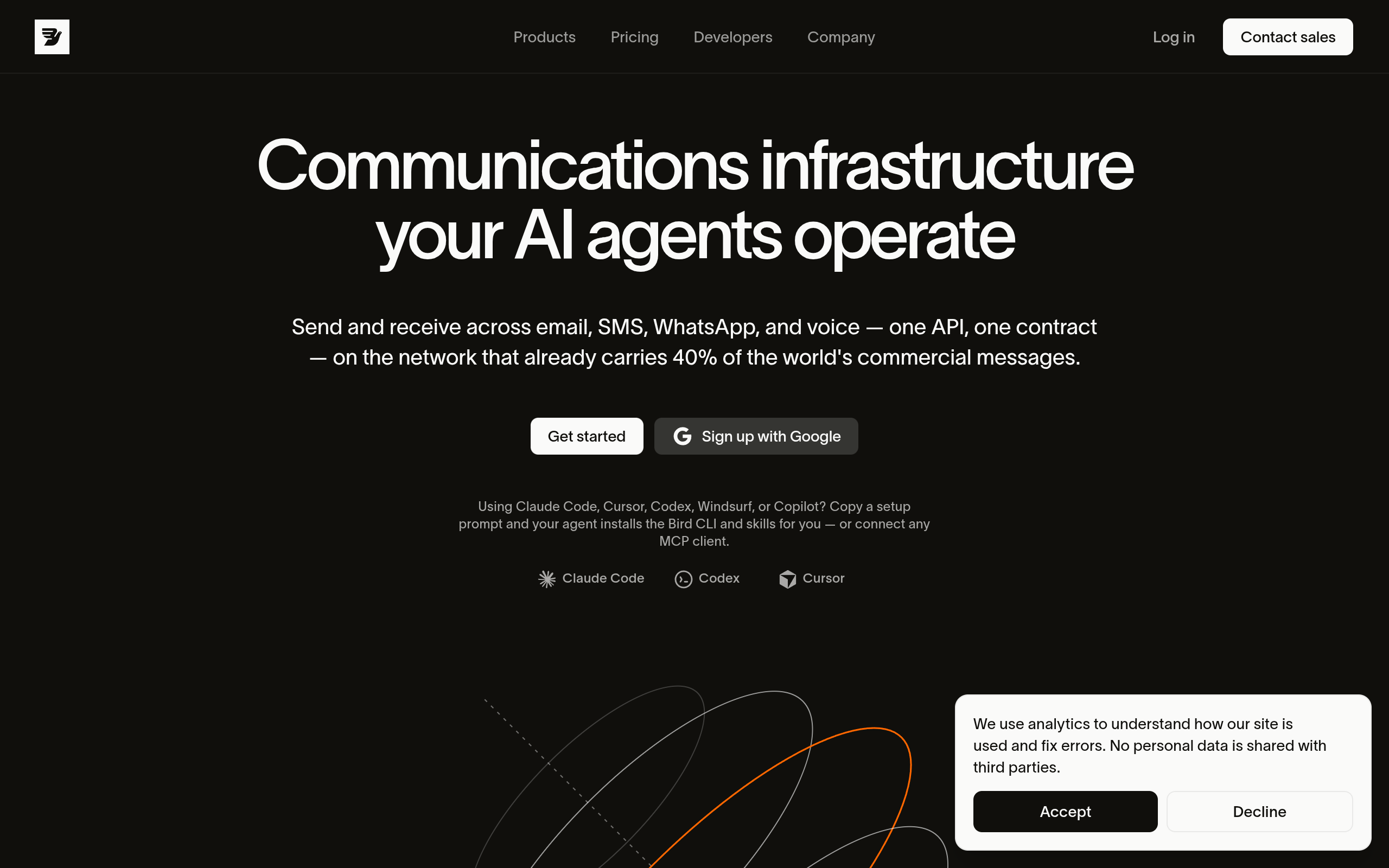
MessageBird(Bird)
Core parameters and statistics
| Projects | Data |
|---|---|
| Product positioning | Omni-channel cloud communication and AI intelligent communication infrastructure |
| Current brand name | Bird (bird.com), MessageBird is the original brand name |
| Headquarters | Amsterdam, Netherlands |
| Core Products | Email API, SMS API, Voice API, WhatsApp API, Verify, Lookup, RCS, Push, Realtime |
| AI Products | MCP Server, AI Agent Skills, AI Voice TTS, Intelligent Routing |
| Global coverage | 190+ countries, direct operator connection |
| Market share | Carrying approximately 40% of the world’s commercial message volume |
| Operational History | 15 years of experience in communications infrastructure |
| Compliance Certification | SOC 2 Type II, ISO 27001, GDPR, A2P 10DLC |
| Notable Clients | Binance, Zillow, Airwallex, Glovo, Al Jazeera, Aramex |
MessageBird (now brand Bird) completed a brand upgrade in 2025-2026, transforming from a single messaging API provider to a unified AI intelligent communication platform. Its core value is that it covers all mainstream communication channels such as Email, SMS, Voice, and WhatsApp through a set of APIs, an SDK, and an MCP endpoint. Developers and AI Agents do not need to integrate each channel separately.
The key differences with competing products such as Twilio are : pay-as-you-go billing with no seat fees, MCP natively supports AI Agent communication, and a single SDK covering all channels developer experience. The bottom layer of the platform is built with the same set of authentication, idempotent, paging, and current-limiting Webhook primitives. You can operate all channels after learning them once.
User and market recognition
MessageBird (Bird)'s market position presents a dual-track pattern of "infrastructure-level penetration and preemptive layout in the AI era".
Infrastructure Scale: The Bird network carries approximately 40% of the world's commercial message traffic, covering 190+ countries, and maintains direct connectivity partnerships with Tier-1 operators. The infrastructure accumulated over 15 years of operation means that it has formed barriers in hidden dimensions such as ISP reputation, sending IP preheating, and anti-spam compliance, which are difficult for competing products to copy in the short term. The customer list covers global enterprises such as Binance (cryptocurrency notifications), Zillow (real estate news alerts), Airwallex (cross-border payment notifications), Glovo (delivery status push), etc., proving its reliability in high throughput, low latency, and cross-border compliance scenarios.
Pioneer in the AI era: Bird is one of the first manufacturers to natively support MCP (Model Context Protocol) at the communication infrastructure level. Its MCP Server allows AI clients such as Claude, Cursor, VS Code, and ChatGPT to directly call communication tools such as send_email, check_suppression, and create_domain, upgrading the AI Agent from "can only generate text suggestions" to "can directly perform business operations." This differentiated positioning has gained early reputation among developers in the AI Agent wave of 2026 - in the Claude Code and Cursor communities, Bird MCP is often listed as the "AI Agent communication standard".
Developer Ecosystem: Provides three language SDKs: TypeScript, Python, and Go, as well as three interaction methods: CLI, REST API, and MCP. There are out-of-the-box integration examples for major Node.js frameworks (Express, Next.js, NestJS, Fastify, Nuxt, Hono, Bun, Astro, Koa, Remix, etc.). MCP Server supports both hosted mode (mcp.platform.bird.com, zero installation) and local mode (bird mcp, CLI built-in).
Industry Recognition: In third-party selection, Bird is often positioned as the "European version of Twilio, but with a more modern API design and more native AI support." In user reviews of platforms such as G2, developers rate their SDK experience and document quality relatively high, but they are still inferior to local manufacturers in terms of the breadth of operator coverage in the Asia-Pacific region and the completeness of Chinese documentation.
Cost advantage
Bird's pricing strategy is clearly different from the three-tier billing model of "seat fee + platform fee + usage fee" of traditional communication platforms. It adopts a flat structure of pure pay-as-you-go billing, zero platform fee, and zero seat fee**.
C-side/Individual Developer: The free tier provides 1,000 emails per month, no need to bind a credit card, and supports sandbox testing mode. Sandbox sending does not count towards the quota limit and is suitable for personal project verification and prototype development. The daily sending limit is 50 emails (free tier). Exceeding the limit will trigger suspension rather than overage billing.
API/developer billing: Pricing is based on the principle of "decreasing ladder" - the greater the usage, the lower the single cost.
| Tier | Monthly delivery volume | Monthly fee | Unit price per thousand messages |
|---|---|---|---|
| Free | 1,000 letters | $0 | — |
| Startup | 50,000 letters | $15 | $0.30 |
| Startup | 100,000 letters | $30 | $0.30 |
| Growth | 100,000 seals | $80 | $0.80 |
| Growth | 250,000 caps | $175 | $0.70 |
| Growth | 500,000 caps | $295 | $0.59 |
| Growth | 1,000,000 seals | $530 | $0.53 |
| Growth | 2,500,000 seals | $1,039 | $0.42 |
| Enterprise | 2,500,000+ seals | Business customization | Negotiable price |
SMS, WhatsApp, Voice Pricing: Currently in the product upgrade stage, new APIs will be released soon. The historical pricing reference is that SMS is priced according to national tiers ($0.03-0.08/message within Europe), and WhatsApp is priced according to the conversation model. The official page shall prevail.
Enterprise/privatized and high-throughput scenarios: The Enterprise tier supports multi-year contracts, invoice settlement, limit negotiation, and dedicated IPs ($24.95/month/unit, up to 5 in the Growth tier). Compared with traditional communication platforms, the cost difference of Bird is mainly reflected in:
| Cost Dimension | Bird | Twilio | SendGrid |
|---|---|---|---|
| Platform fee | $0 | There may be a monthly fee based on usage | $0 |
| Seat fee | $0 | Some products are based on seat | Not applicable |
| Email unit price (100K level) | $0.30/thousand items | ~$0.50-0.80/thousand items | ~$0.30-0.50/thousand items |
| Dedicated IP | $24.95/month | Included or additional charge | Included in higher tiers |
| API complexity | Single SDK omni-channel | Multiple SDKs scattered | Email only |
Hidden Cost Tip: Unused volume will not be accumulated on a rolling basis, overage will be charged at the published rate (the default upper limit is 5 times the package amount), and it will be automatically suspended after reaching the upper limit rather than unlimited overage. These mechanisms prevent "out-of-control billing" scenarios, but they also mean that packages need to be upgraded in advance when traffic bursts.
Main functions
Bird's functional architecture revolves around the three main lines of "unified API primitives + omni-channel communication capabilities + AI Agent native integration". It is not a simple API aggregation, but a redesigned multi-channel shared communication abstraction layer from the bottom.
1. Unified Communications API Layer
- Email API: Supports HTML/plain text template React Email integration, dedicated sending IP, hosted preheating ISP aware routing SPF/DKIM/DMARC automatic processing. Each message returns independent delivery status and event logs for each recipient.
- SMS API: Tier-1 operator direct connection, 190+ country coverage, A2P 10DLC compliance automatic processing (brand review completed within 48 hours), intelligent routing distinguishes paths by destination, Voice OTP downgrade fallback (automatically switches voice verification code when SMS is delayed), 6-digit verification code delivered within 3 seconds.
- Voice API: PSTN + SIP dual stack, declarative JSON Flow driver IVR (say/gather/dial/transfer), streaming TTS supports 30+ languages, first byte audio <250ms, supports recording and real-time transcription (WebSocket).
- WhatsApp API: Official Cloud API, pre-approval templates + conversation messages + interactive buttons/lists, delivery and read receipts, the same typed API interface.
- Auxiliary products: Verify (verification code and identity verification), Lookup (intelligent phone number identification), RCS (rich media communication), Push (mobile and web push), Realtime (real-time messages and events).
2. AI and Agent native capabilities
- MCP Server (hosted + local dual mode): This is Bird’s most differentiated AI feature currently. MCP Server The exposed manually curated toolset includes:
send_email,send_email_batch,list_emails,get_email(including per-recipient delivery status and event log),list_suppressions,check_suppression,add_suppression,remove_suppression,create_domain,verify_domain,list_domains,get _domain,create_dedicated_ip,list_dedicated_ips,assign_dedicated_ip,delete_dedicated_ip,create_ip_pool,list_ip_pools,get_ip_pool,update_ip_pool,delete_ip_pool,list_webhooks,get_workspace,whoami. Expert View: This set of tools is not automatically generated from the API specification, but is manually selected one by one - each tool corresponds to a communication task that the AI Agent will actually perform. Destructive operations (such asremove_suppression) are clearly marked, and the host can ask the user for confirmation before execution. This solves the two most common problems when AI Agents call APIs: Token waste due to too fine granularity of tools, and lack of security protection for misoperations. - AI Agent Skills (plug-in market): Provides
bird-aimarket plug-in, one-click installation of Skills + MCP Server, and automatic configuration of Cursor/Claude Code/VS Code integration. - AI CLI for Agents: A lightweight alternative for Shell Agents (Claude Code, Cursor terminal) - JSON output, semantic exit code, and consumes less Tokens per operation.
- Streaming AI TTS: Voice API has built-in neural network speech synthesis, 30+ languages, first byte <250ms, the model is preloaded before the call is connected, achieving "zero wait" voice broadcast.
- Test Mode: Can simulate all delivery states such as
delivered,bounced,complained,queued, etc., without the need for real recipients or budget consumption. It is suitable for AI Agent to repeatedly test the communication process during the development stage.
3. Developer infrastructure
- Same Authentication System: Unified API Key format, supports
send vs manage,read vs writegranular permission control, Key prefix + fingerprint can track the operation record of each Key. Supports the coexistence of multiple keys, and rotation does not require downtime. - Impotency Guarantee: Each POST/PATCH/DELETE request supports
Idempotency-Key. Replay returns the existing results (no repeated execution). Repeated Key with different Body returns 409. - Standard Webhooks: Follow Standard Webhooks specification, HMAC-SHA256 signature, independent key for each endpoint, 5-minute replay window, key rotation supports 24-hour dual-sign overlap period.
- Cursor paging: Cursor-based paging method, the list order is stable and unchanged, and there is no "page drift" problem.
- Rate Limit Transparency: Each response (including non-429) carries the IETF RateLimit header, and the client can predict the remaining quota before triggering the rate limit.
Model and version evolution
As a communication infrastructure platform, Bird's "version evolution" is not a large model iteration, but a continuous upgrade of the product capability layer. The following summarizes key milestones by product line and time dimension:
Brand and Strategy Evolution
| Time | Version/Event | Change Point |
|---|---|---|
| ~2025-2026 | MessageBird → Bird brand upgrade | Renamed from "MessageBird" to "Bird", brand positioning upgraded from "Message API" to "AI Intelligent Communication Infrastructure", official website moved to bird.com |
| 2026-02 (approx.) | AI Conversations (Inbox AI) | Launched AI-driven omni-channel conversation engine, LLM integrated into customer service workflow |
| 2025 (approx.) | Inbox AI | Introducing AI-assisted reply and sentiment analysis |
| 2021 | Valuation reaches US$3.8 billion | Completed US$200 million in financing, becoming one of the largest cloud communication platforms in Europe |
| 2009 | Company established (founded by Robert Vis) | Started with SMS API and gradually expanded to omni-channel |
Product capability evolution
| Stage | Time | Key Competencies |
|---|---|---|
| Single SMS API | 2009-2015 | SMS API as the core, focusing on direct connection to European operators |
| Multi-channel expansion | 2015-2020 | Add Voice, WhatsApp, WeChat and other channels, acquire SparkPost (email engine) |
| Omni-channel inbox | 2020-2024 | Launch of Inbox, Flow Builder low-code workflow AI-assisted reply |
| AI Intelligent Communication | 2025-present | MCP Server, AI Agent Skills, streaming AI TTS, brand upgrade to Bird |
Release Notes
Bird's products are delivered in the form of SaaS API and do not do "version number release" in the traditional sense. Among the above milestones, version_number corresponds to the annual product code, and release_date marked as ~YYYY-MM means that there is no official precise date yet, and the official product announcement shall prevail.
Technical advantages
Bird's technical advantage does not lie in a single "killer feature", but in the consistency of the full-stack design from the bottom unified abstraction layer to the upper-layer AI Agent integration.
Unified communications primitives (cost reduction at the architectural level): Traditional communication platforms usually split SDKs by channel - one SDK for SMS, another for Voice, and another for Email. Developers need to maintain multiple sets of authentication, retry, and error handling logic. Bird chooses to do the opposite: all channels share the same underlying set of primitives (Auth / Idempotency / Errors / Webhooks / Pagination / Rate Limits / Suppressions). This means that developers can learn API design once and operate all channels. In terms of engineering costs, the time it takes for a team to integrate Email + SMS + WhatsApp from scratch can be shortened from 3-4 weeks to less than 1 week.
MCP native integration (AI Agent’s communication layer): Bird’s MCP Server is not a simple API wrapper, but redesigns the tool granularity for the AI Agent’s interaction mode. The traditional REST API requires the Agent to first GET /domains, then parse JSON, then POST /email/send, and then poll GET /email/status - consuming a lot of Tokens and steps. Bird MCP's get_email returns the message content + recipient-by-recipient delivery status + event log in one call, compressing 3-5 steps of interaction into 1 step. For Token-sensitive Agent applications, this means that the cost of each communication operation can be reduced by 60-80% (calculated based on Token consumption of tools such as Claude Code).
Zero-configuration authentication for hosted MCP: Bird's hosted MCP Server (mcp.platform.bird.com) uses the OAuth 2.0 standard's RFC 9728 protected resource metadata + RFC 7591 dynamic client registration. The entire authentication process requires zero configuration for users - the client automatically discovers the authorization endpoint, automatically registers, browser OAuth authorization, and Token automatically refreshes. Compared with the traditional API Key method, the hassle of "generate Key -> copy -> paste into contextual variables" is eliminated, and the risk of Key leakage is also avoided. Token permissions take effect based on the intersection of "client request ∩ user authorization ∩ user actual permissions". Scope at the org:owner and platform-admin levels cannot be delegated.
Latency optimization of streaming TTS: Voice API's AI TTS adopts a model preloading strategy - starting to load the voice model during the signaling phase of call connection, making the first byte audio delay less than 250ms. Compared with the "load model after connection" solution, user-perceived delay is reduced by about 60%.
ISP Reputation Network Effect: The sending IP reputation and ISP relationship accumulated over 15 years of operation are Bird’s most hidden but most difficult to copy technical assets. The warm-up process of newly sent domain names is managed by the platform, and SPF/DKIM/DMARC are automatically configured to reduce delivery failures caused by DNS configuration errors. The platform provides per-ISP delivery breakdown analysis and per-message audit logs.
How to use
Bird provides four levels of usage paths, covering the full spectrum of needs from "sending the first email in 5 minutes" to "AI Agent automatically performing communication operations".
Entrance comparison
| How to use | Suitable for people | Features | Cost |
|---|---|---|---|
| Web Dashboard | All users | Log in to bird.com to manage sending domains, view delivery analysis, and configure Webhook | Free registration |
| REST API | Developer | Standard REST interface, supports curl and any HTTP client | Pay-as-you-go |
| SDK (TS/Python/Go) | Developer | Type-safe language SDK, including automatic retry and error handling | Pay-as-you-go |
| CLI (bird) | Developers and AI Agent | Terminal tools, JSON output, semantic exit codes, OAuth login | Pay-as-you-go |
| MCP Server (hosted) | AI Agent user | Remote endpoint mcp.platform.bird.com, browser OAuth login, zero installation |
Pay-as-you-go |
| MCP Server (local) | AI Agent user | Run stdio mode through bird mcp command and reuse CLI login |
Pay-as-you-go |
Get started quickly (send your first email in 3 steps)
# 1. Register an account and obtain API Key
# Visit https://bird.com/dashboard/signup

# 2. Use curl to send email
curl -X POST https://api.bird.com/email \
  -H "Authorization: AccessKey <YOUR_API_KEY>" \
  -H "Content-Type: application/json" \
  -d '{
    "from": "onboarding@yourdomain.com",
    "to": ["user@example.com"],
    "subject": "Hello from Bird",
    "html": "<p>Your first email is <strong>live</strong>.</p>"
  }'

# 3. Verify sending status
# Check the delivery status on Dashboard or through get_email API
SDK Quick Example (TypeScript)
import { BirdClient } from '@messagebird/sdk';

const bird = new BirdClient({ apiKey: process.env.BIRD_API_KEY! });

//Send a single email
await bird.email.send({
  from: 'onboarding@messagebird.dev',
  to: ['user@example.com'],
  subject: 'Welcome to Bird',
  html: '<p>You are in.</p>',
});
MCP Server access (AI Agent solution)
Hosted Mode (Recommended): Configure in any client that supports remote MCP:
{
  "mcpServers": {
    "bird": {
      "url": "https://mcp.platform.bird.com"
    }
  }
}
The first connection will trigger the browser OAuth authorization process, which can be used after selecting the workspace and permission scope. Works with Claude Desktop, ChatGPT, Cursor, VS Code, Claude Code and more.
Local mode (via CLI):
bird auth login # Browser OAuth login, select workspace and permissions
bird mcp # Start stdio MCP server
Configure in Cursor or VS Code:
{
  "mcpServers": {
    "bird": {
      "command": "bird",
      "args": ["mcp"]
    }
  }
}
Verify availability
Execute the following tools in the MCP client to confirm successful integration:
> Call whoami to find my email, then send me a test email from onboarding@messagebird.devProduct Pricing
Bird's pricing continues the single principle of "pay as you go, zero platform fees". It does not charge based on seats or lock in layers based on functions.
Email Pricing Details
| Plan | Monthly delivery volume | Monthly fee | Unit price per thousand pieces | Suitable scenarios |
|---|---|---|---|---|
| Free | 1,000 letters | $0 | — | Personal development, prototype verification |
| Startup | 50,000 emails | $15 | $0.30 | Startup team, low-frequency transaction emails |
| Startup | 100,000 letters | $30 | $0.30 | Growth projects |
| Growth | 100,000 emails | $80 | $0.80 | Mid-Scale Marketing + Business Emails |
| Growth | 250,000 seals | $175 | $0.70 | Growth business |
| Growth | 500,000 emails | $295 | $0.59 | Sending at scale |
| Growth | 1,000,000 seals | $530 | $0.53 | High throughput business |
| Growth | 2,500,000 emails | $1,039 | $0.42 | Bulk Email System |
| Enterprise | 2,500,000+ seals | Business customization | Negotiable price | Large enterprises, customization needs |
Pricing for other channels
Channels such as SMS, WhatsApp, Voice, RCS, and Push are currently in the API upgrade stage, and new pricing models will be released soon. Historical reference: SMS is billed on a country tier basis and WhatsApp is billed on a conversational model. For details, please refer to the real-time page of bird.com/pricing.
Additional function fee
- Dedicated IP: $24.95/month/unit (optional with Growth plan, up to 5 units)
- Overage Protection: The default overage limit is 5 times the package amount. Once the upper limit is reached, sending will be automatically suspended.
- Unused Amount: No rolling accumulation
Price comparison with competing products
| Comparing Dimensions | Bird | Twilio SendGrid | AWS SES |
|---|---|---|---|
| Free quota | 1,000 messages/month | 100 messages/month (or 100 days free) | 62,000 messages/month (sent from EC2) |
| Startup price (50K) | $15 | ~$19.95 (basic) | ~$0.10/thousand items + EC2 fee |
| Growth price (1M) | $530 | ~$799.95 (Professional) | ~$0.10/thousand items + EC2 fee |
| SMS Coverage | 190+ Countries | 190+ Countries | N/A |
| MCP/AI native support | Native MCP Server | None | None |
| SDK coverage | TS/Python/Go + MCP | TS/Python/Java/Go/ Ruby/PHP/C#/.NET/ Rust | Additional SDK required |
| Platform fee | $0 | $0 | $0 |
Application scenarios
Bird's communications infrastructure carries differentiated business roles in different industries. The following four scenarios have been verified by large-scale customers:
1. Global customer notification of cross-border e-commerce
- Task Type: Cross-border order confirmation, logistics tracking push, return process notification
- Actual revenue: Covered through a combination of three channels: Email (order confirmation) + SMS (logistics exception) + WhatsApp (customer service conversation), the same API manages all communications. Customer Reference Airwallex, Aramex. Deduction of cost reduction and efficiency improvement: When the e-commerce customer service team handles cross-border logistics inquiries, the traditional method requires them to log in to the three backends of the email system SMS platform WhatsApp Business API respectively, and each person handles about 120 orders per day. Through Bird's unified API + AI Agent to automatically query the delivery status and reply, the average daily processing volume of a single person can be increased to 300+ orders, and the query response time is reduced from an average of 15 minutes to less than 2 minutes. Deduction description: This is an engineering estimate based on public customer cases, an unofficial commitment value, and the actual improvement depends on the complexity of the business process.
- Human-machine collaboration boundary: Order confirmation and logistics notification messages can be sent 100% automatically; for messages involving sensitive operations such as refunds, claims, address changes, etc., the AI Agent automatically generates a draft reply but must be sent after manual review, and the "automatic sending" mode cannot be set.
2. Authentication and secure communication in financial technology
- Task type: OTP verification code sending, transaction confirmation notification, abnormal login alarm
- Actual revenue: SMS + Voice OTP downgrade fallback mechanism ensures verification code delivery rate. Clients refer to Binance. The SMS verification code is delivered within 3 seconds. If the SMS is delayed, Voice will automatically switch to broadcast the verification code. Cost reduction and efficiency improvement deduction: In the traditional OTP solution, the SMS delivery rate is about 92-95% (due to operator filtering and roaming issues), resulting in 5-8% of users requiring secondary verification. Each secondary verification adds about $0.05 in cost and 30 seconds of user experience delay. Through Bird's SMS+Voice OTP downgrade strategy, the final delivery rate of verification codes can be increased to 99%+, and the second-step verification rate is reduced to less than 1%. Deduction Note: Delivery rate improvement is based on the marginal effect of operator direct connection + downgraded routing. The actual value varies by region and operator.
- Human-machine collaboration boundary: OTP sending and transaction confirmation notifications can be 100% automated; confirmation notifications involving large-amount transfers (such as a single transaction >$10,000) must retain manual review confirmation points on the Business system side, even if triggered by the AI Agent.
3. Bulk email marketing and delivery rate optimization
- Task type: Promotional email, user recall, newsletter subscription
- Actual Benefits: The combination of dedicated IP + hosting warm-up + ISP-aware routing ensures high delivery rates. The platform provides ISP-by-ISP delivery breakdown analysis to help operations teams identify issues being blocked by specific email service providers. Cost reduction and efficiency increase deduction: For a team that sends 5 million marketing emails per month, a 1% increase in delivery rate is equivalent to reaching 50,000 more users. At a customer lifetime value (CLV) of $0.50/seal, a 5% increase in deliverability (from 92% to 97%) could generate approximately $125,000 in additional revenue. Calculated based on the Bird Growth 500K package of $295/month (approximately $0.59/thousand items), even if expanded to 5 packages, the monthly cost is approximately $1,475, and the ROI is still significant.
- Human-machine collaboration boundary: The email sending process can be 100% automated; however, the compliance review of email content (such as confirmation that it does not contain sensitive words and the unsubscribe link is valid), the reputation management of the sending domain, and the suspension decision when the ISP complaint rate is abnormal must be confirmed by the operator, and AI should not independently decide to "suspend sending" or "modify content."
4. AI Agent automatically performs communication operations
- Task Type: Developers directly send test emails, manage sending domains, and query delivery logs through the Bird MCP Server of tools such as Cursor/Claude Code.
- Actual benefits: When developers write code in the IDE, the AI Agent can automatically complete operations such as "send verification emails", "check bounce reasons", and "add new sending domain names" without leaving the editor or copying and pasting curl commands. Cost reduction and efficiency improvement: When back-end developers integrate the notification function, they need to manually test the email sending process each time - write code → deploy → trigger → log in to the email service to check the log → return to the IDE to fix the bug. A single iteration takes about 10-15 minutes. Through MCP Server, AI Agent can automatically execute tests in the IDE → obtain results → return error information, and compress a single iteration to 1-2 minutes. At 20 iterations per week, this saves about 3-4 hours per week.
- Human-computer collaboration boundary: Read-only or sandbox operations such as sending test emails and querying logs can be 100% automated; operations involving production-bound "delete sending domain", "remove bounce suppression record", "modify DNS configuration" and other operations, the MCP tool has been marked as destructive and requires the AI Host to pop up a confirmation box before execution, and the user must confirm manually.
Applicable people
Bird's product characteristics determine that its target audience has obvious "developer-friendly" and "international communication" tendencies, and at the same time forms a clear unsuitable boundary for some scenarios.
-
Back-end and full-stack developers: Development teams that need to integrate email, WhatsApp and other notification capabilities into their products. Bird’s unified SDK and MCP Server significantly lower the barrier to multi-channel integration. Prerequisites: The team should have basic REST API understanding and DNS configuration capabilities (send domain verification). Misfit boundary: If the business only requires a single email sending capability and is extremely price sensitive (>1 million emails per month), the marginal cost of AWS SES + self-built infrastructure may be lower than Bird's Growth tier pricing.
-
AI Agent Developers and Prompt Engineers: Teams that are building AI Agents that can perform actions rather than just generate text. Bird's MCP Server is one of the few communication platforms on the market that natively supports AI Agents to perform communication operations. Prerequisite: Using MCP mode requires the AI Host to support remote MCP or stdio MCP (Claude Desktop, Cursor, VS Code, Claude Code, etc. are already supported). Misfit Boundary: If the AI Agent only needs to generate a draft email without actually sending it (such as an AI writing assistant), the communication API is over-integrated and ordinary LLM calls can be used.
-
Growth and Operations Team: Operations staff responsible for email marketing, user notifications, and cross-border communication. Bird’s Dashboard provides ISP-by-ISP delivery analysis, open rate tracking, and A/B testing capabilities. Prerequisite: You need to cooperate with the developer to complete the sending domain configuration and DNS verification. Not suitable for borders: If the target market is mainly mainland China, Bird's integration depth in the WeChat ecosystem and operator direct connection efficiency are lower than those of local manufacturers (such as SendCloud, SUBMAIL), and the Dashboard does not have a Chinese interface.
-
Multinational Enterprises/Globalization Team: Enterprises with customers in Europe, the Middle East, Asia-Pacific and other places that need a unified communications platform to manage multi-country delivery compliance. Bird's A2P 10DLC's ability to automatically handle GDPR compliance for direct operator connections in 190+ countries is of greatest value in such scenarios. Prerequisite: Enterprises should have a clear person in charge of cross-border communications compliance. Not Fit for Borders: If your enterprise communications needs are concentrated entirely in one country (such as the US only) and you already have a stable Twilio or SendGrid integration, the cost of switching may be higher than the benefits. It is recommended that assessments be made only when new projects or existing contracts expire.
Summary and Outlook
Bird (MessageBird) has taken a market route that is different from Twilio: it does not pursue the breadth of SDK language coverage (currently only supports TS/Python/Go), but instead focuses on two differentiated directions: API design consistency and AI Agent native integration. The former reduces developers' cognitive load and integration costs, while the latter seizes the ecological niche of "communication as a tool" in the AI Agent wave of 2025-2026.
Core Advantages: The developer experience of a unified SDK covering all channels is still scarce in the industry; the native support of MCP Server makes it one of the preferred infrastructures for AI Agent communication; the ISP reputation and routing quality accumulated in 15 years of operator relationships form a moat that is difficult to replicate; the pricing structure of zero platform fees and zero seat fees has obvious cost advantages in small and medium-scale scenarios.
Current limitations: Asia Pacific region operator coverage and localization are lower than Twilio; SMS/Voice/WhatsApp API is currently in an upgrade transition period, and new product pricing and availability have not yet been fully disclosed; SDK language coverage is only three, not friendly enough for developers of traditional enterprise technology stacks such as Java/Ruby/PHP; Dashboard lacks a Chinese interface, and the self-service experience in the Chinese market is limited; when the brand switches from MessageBird to Bird, there may be a compatibility transition period for old documents and third-party integrations.
Follow-up observation points: The pricing competitiveness and availability of the new SMS/Voice/WhatsApp API after its official release; whether the MCP Server will expand more tools (such as WhatsApp sending, voice calling, verification code sending); whether to add more SDK language support (Java, Ruby, PHP); expansion plans for data centers and operator direct connections in the Asia-Pacific region.
Procurement and Adoption Risk Assessment: For individual developers and start-up teams, the free tier’s 1,000/month email quota is enough to support prototype verification. No credit card is required for registration, and the adoption risk is extremely low. For small and medium-sized teams, it is recommended to first use the Startup-level email service to verify Bird's API experience and delivery quality, and then expand to the Growth level and more channels after confirming satisfaction. For large enterprises, it is important to confirm: whether the official release schedule of the new SMS/Voice/WhatsApp API matches business needs; whether data residency and latency in the Asia-Pacific region meet compliance requirements; whether the SLA terms and overage protection mechanism in the Enterprise contract cover peak traffic scenarios. During the transition period of brand switching, it is recommended to clarify the "decommissioning schedule of MessageBird old API" and "backward compatibility guarantee" in the procurement contract to avoid business interruption caused by brand migration. For AI Agent integration scenarios, it is recommended to start with the managed MCP mode (zero installation, zero configuration), and then decide whether the local CLI mode is needed to achieve higher offline autonomy after verifying the feasibility.
Related tools:  Notion AI, google-workspace
Version Info
- MessageBird AI Conversations :Launched an AI-driven omni-channel dialogue engine and integrated LLM into customer service workflow. There is no official precise date yet.
- MessageBird Inbox AI :Introducing AI-assisted reply and sentiment analysis functions. There is no official precise date yet.
User Reviews