 MinusX
Free
MinusX
Free
MinusX is an Agentic BI platform for AI data processing scenarios, emphasizing self-hosting, context-managed MCP access and data relations from Q&A to dashboards to alerts.
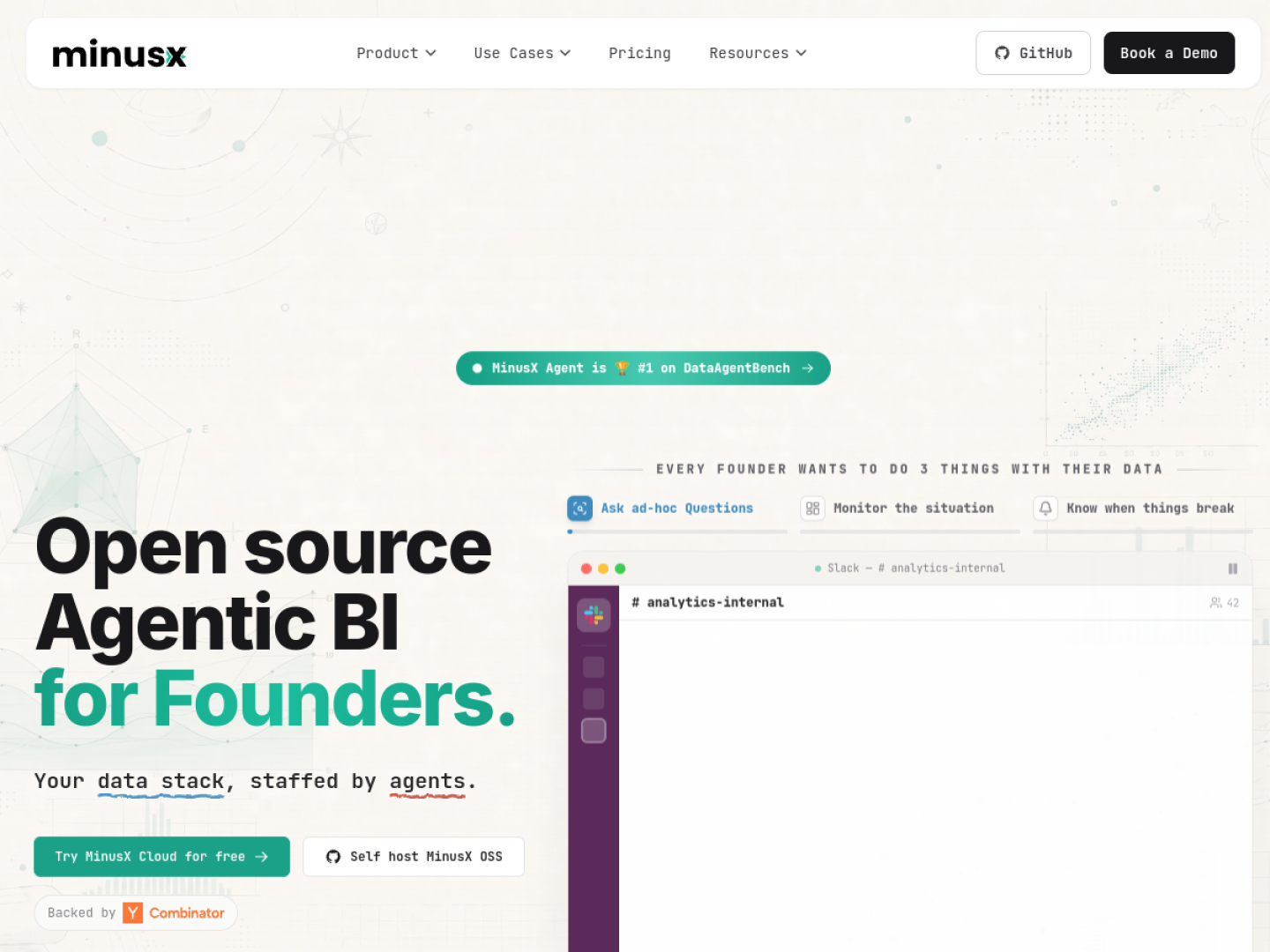
MinusX - In-Depth Tool Analysis
Core parameters and statistics
| Parameters | Current public information |
|---|---|
| Core Positioning | Agentic BI Platform for Founders, Analysts, and Business Teams |
| Tool type determination | Productivity/business-side applications (the main delivery form is a complete BI workbench and team collaboration product, rather than a pure API or pure MCP server) |
| Deployment form | MinusX Cloud, MinusX OSS, self-hosted, exclusive / On-prem Enterprise |
| Official public capabilities | Ad-hoc Q&A, AI dashboard Slides/Data Stories, Alerts & Reports, Knowledge Base, Evals, Slack, MCP |
| Data access | Postgres, BigQuery, Athena, DuckDB, Google Sheets, CSV and other publicly listed data sources |
| Security and compliance signals | Official website footer disclosed SOC2 Type II, GDPR |
| Latest business stage | Agentic BI and Proactive Analytics stage, the corresponding capabilities have been disclosed on the homepage and pricing page |
| Benchmark Signal | The official website discloses that its data agent is #1 on DataAgentBench as of 2026-06 |
A brief comment: MinusX does not post natural language Q&A in a chat box on the surface of BI. Instead, it attempts to integrate Q&A, modeling context, dashboards, alarms, story-based reporting and external collaboration into the same analysis execution chain.
Tool type determination demonstration: Although MinusX has disclosed the MCP endpoint Slack Bot and self-hosting capabilities, what users actually purchase and implement is a complete set of business analysis workbench, including data access, context management, visualization, team workspace and proactive alarms. Therefore, the main type should be classified as "productivity/business-side application", and the secondary attributes should complement its Agent and MCP capabilities, rather than writing it as a general automation framework.
User and market recognition
Public recognition signal: The official website homepage directly gives DataAgentBench's #1 ranking as of 2026-06, which is one of its strongest technical endorsements. However, this type of benchmark is more suitable for proving the "upper limit of data task agent capabilities" and cannot be directly equivalent to the success rate of enterprise implementation.
Customer and usage scenario signals: The official website displays Aamove, Bird, Habuild, Lynx Analytics and other logos, and discloses Habuild cases. The most valuable thing in the case is not the brand name, but the change in workflow: the original analysis response of "a few days to a week" was reduced to "minute-level self-service analysis", and at the same time, most ad-hoc requests were released from the analyst queue.
Authenticity Verification of Evaluations: MinusX’s public evaluations are not just about “being able to write SQL”, but also about “non-technical people can also ask questions on their own, products and leadership can directly connect views, and analysts turn from question answerers to in-depth analysis”. This shows that the core pain point it hits is analysis bandwidth, not just SQL generation itself.
Cost advantage
C-side/Small Team: The pricing page is public and the Open Source plan is free, suitable for self-hosting by small teams with infrastructure capabilities. For budget-conscious teams, this is not “zero cost,” but rather swaps the explicit subscription fee for deployment, monitoring, upgrades, and model key management costs.
Founders and Business Team: The Founders plan is publicly priced at 40/user/month, with no platform fee and including 500 agent credits/user/month. This type of solution is suitable for embedding BI assistants into daily business rhythms, but the credits limit means that high-frequency exploration or large-team sharing scenarios will soon reach an upper limit, and it is not suitable for directly extrapolating the "single-user subscription price" to the total team cost.
Team-Level Collaboration: The Team plan is publicly available for $600/month with 20 users and 10k pooled agent credits, and includes team workspaces, shared Evals, and debugging tools. For teams that already have a stable analytics collaboration, this often feels more like a formal BI budget than a personal tool budget for each person buying an AI SQL tool.
Enterprise & Private: Enterprise is exposed as a custom offer and includes dedicated support, custom data integration Dedicated / On-prem deployment and SSO / SAML. The real procurement threshold for this part is often not the software fee, but the data access list, permission model, online schedule and internal security audit.
Developer and API side cost boundary: MinusX currently exposes productization capabilities and MCP entrance, and does not have a separate "pure API call price list". For the development team, the main cost is not RPM/TPM, but BYO LLM keys, database connection permissions, caching policies and evaluation set maintenance.
Quantitative deduction of cost reduction and efficiency increase (unofficial commitment): In the typical link of "leadership asks about a business change, analysts need to cut SQL, add context, draw graphs, and write conclusions", MinusX is more like reducing this link from 0.5-1 day to 10-30 minutes to get the first round of analysis, and reducing "week-level queuing" to "minute-level self-service questioning". The real savings are not to write fewer SQL statements, but to reduce cross-post round trips and repeated interpretation of indicator calibers.
Main functions
- Natural language data exploration: The
Explorepage supports direct questions, follow-up questions, change graphics, and save as Questions. The core value is not just Q&A, but that conversational context is continuously utilized, reducing the need to explain business issues from scratch each round. - AI Assisted Dashboard: The official document is made public and agents can directly create sales boards, add charts, add date filters, and insert text descriptions in the chat sidebar. It pushes "analysis results" directly to "reusable dashboards" instead of stopping at one-time answers.
- Knowledge Base and Context: Support Table Context whitelist and Text Context. The former uses a tree context to limit visible tables and columns, while the latter uses text to define indicators, naming conventions and common pitfalls. This is the key to MinusX upgrading "knowing the schema" to "understanding the company's business caliber".
- Evals and Credibility Governance: Both the homepage and documentation put Evals in a key position, allowing the team to verify query quality with test questions. For BI tools, this is more important than "the model is smarter" because it is about whether errors can be prevented before being reported to management.
- Proactive Analytics: Alerts, Reports, and Nudges have been published on the homepage, and the document page is marked
Coming Soon. This shows that MinusX wants to move from "you ask" to "it monitors", but it also means that the maturity of active analysis capabilities should still be based on the real-time product page. - Slack and MCP collaboration: Slack supports channel @mention, private messages, chart postback, and status reactions; MCP exposes data retrieval and file retrieval tools, allowing clients such as Claude, ChatGPT, and Cursor to directly query the BI workbench.
Expert View: Hidden Linkage: The real difference of MinusX is not in a single point of function, but in the chain of `Q&A -> Visualization -> Dashboard -> Reports/Slides -> Slack/MCP Distribution -> Evals Review -> Knowledge Base Feedback'. Most AI SQL tools can only solve the problem of "finding numbers". MinusX tries to "explain numbers, precipitate caliber, distribute conclusions, and continue monitoring" as well.
Not suitable for boundaries: If the team only has occasional query needs, no stable indicator system, and no shared semantic layer, the value of MinusX's Knowledge Base, Evals, and team workspace will be significantly overestimated. For lightweight teams that "only check basic reports once or twice a day", it may not be more cost-effective than off-the-shelf BI plus a simple chat plug-in.
Model and version evolution
The public milestones of MinusX are very clear. It can be seen that it does not start directly from a "new BI platform", but gradually moves from the Metabase AI assistant close to the existing workflow to the complete Agentic BI.
2024-08-25: In-browser Metabase / Jupyter assistant phase
Starting Form: The official blog describes MinusX as a Chrome extension that adds a side conversation layer to existing analysis tools, allowing agents to operate the interface through clicks and typing, rather than requiring teams to migrate to a completely new platform.
Business Significance: This step solves the BI migration resistance. Rather than "replacing the existing stack", it first proves that it can bring immediate benefits to existing environments such as Metabase and Jupyter.
2024-09-01: Free Software and self-hosting phase
Public changes: The official blog announced that the code is open under the MIT license and emphasizes the transparent use of data, the ability to run own models, and the scalability to more internal applications.
Business Implications: This is not a pure open source gesture, but turning "trust" into an executable choice. For data-sensitive teams, self-hosting and owning models are entry requirements, not bonus points.
2025-06 to 2025-07: Rapid expansion of product capabilities
2025-06-05: Supports asking questions directly within the Metabase Dashboard page without having to jump out of the dashboard to rebuild the context.
2025-06-21: Released MBQL Agent, which can build Metabase GUI Questions in natural language and take into account tables, models, filtering and basic visualization.
2025-07-22: Released Explorer Agent, revealing that it will scan Cards, Dashboards, Snippets, and provide citation sources, proactive clarifications, and in-depth searches.
2026-06: Agentic BI and proactive analytics commercialization phase
Current stage: The official website homepage and pricing page have put Cloud, OSS, Slack, MCP, Knowledge Base, Evals and Proactive Analytics into the same product narrative, and disclosed the three-tier business structure of Founders/Team/Enterprise. This stage shows that MinusX is no longer just a Metabase auxiliary plug-in, but a complete BI workbench.
Technical advantages
Mechanism 1: Context whitelisting instead of full library streaking: Table Context supports whitelisting and tree inheritance, allowing the parent context to control which data models the sub-team can see; Text Context uses text to tell the model indicator definitions, naming rules and filtering traps. The effect is to transform "the model knows all tables" into "the model knows which tables to look at and how to interpret these tables", which is more suitable for teams with governance requirements.
Mechanism 2: Directly from conversational Q&A to reusable analysis assets: Explore session results can be saved as Questions and then added to Dashboard; Dashboard also supports AI conversational adding of charts and text blocks. This way users don’t have to repeatedly set up between “ad hoc exploration” and “formal dashboard”.
Mechanism 3: Move credibility forward to evaluation and citation: Explorer Agent openly supports citation source cards, and Evals supports testing query quality. The effect is that there is an extra layer of "verification before dissemination" in the analysis link, which is especially suitable for data teams with multiple calibers and historical baggage.
Mechanism 4: The external collaboration entrance is not exported afterwards, but natively accessed: Slack integration responds to questions in the channel through webhook and account mapping; MCP is provided to clients such as Claude, ChatGPT, and Cursor through the /api/mcp endpoint and OAuth 2.1 with PKCE. The effect is that the data does not just stay on the BI page, but enters the team's real collaboration interface.
Public MCP capability list: The documentation page clearly provides five tools: SearchDBSchema, ExecuteQuery, ListAllConnections, SearchFiles, and ReadFiles. They cover schema search SQL execution, connection enumeration, issue/dashboard retrieval and file content reading, which is sufficient for external AI clients to initiate a complete data retrieval against the MinusX workbench.
How to use
- Determine a minimum requirement first: Prioritize high-frequency requirements such as "leadership weekly meeting indicator questioning" or "product manager self-service funnel checking". Define success criteria as “getting a first-round reviewable analysis within 30 minutes,” rather than requiring a company-wide replacement of existing BI at the outset.
- Establish context and governance: After accessing the database, do not open the entire table immediately. First make a whitelist, supplementary indicator definitions and common filtering rules in the Knowledge Base, and then let the team start Q&A.
- Transition from Explore to Dashboard: Precipitate the stable and reusable question and answer results into Questions, and then let the agent assemble them into Dashboard. This reduces the repetitive cost of “asking once every time”.
- Integrate the external entrance into the team workflow: If you need to ask questions in the channel, connect to Slack. If you need to directly check BI with Claude or Cursor, connect to MCP. The public access path of MCP is
Settings -> Integrations -> MCP. After the client gets the endpoint, it will automatically complete the login authorization through OAuth 2.1 with PKCE. - Use Evals to control the expansion speed: Before expanding to more business teams, first make key issues into an evaluation set, and continuously verify the query quality and business caliber to avoid erroneous conclusions from being quickly amplified from the perspective of management.
Product Pricing
| Plans | Current Public Prices | Who Is Appropriate | Key Limitations/Description |
|---|---|---|---|
| Open Source | Free | Developers and small teams with self-hosting capabilities | Self-deployed, BYO LLM keys, core BI capabilities publicly available |
| Founders | $40/user/month | Founders, single business owners, small teams | Includes 500 agent credits/user/month, no platform fees |
| Team | $600/month | Growing Team | Includes 20 users, 10k pooled agent credits, team shared Evals and debugging tools |
| Enterprise | Customization | Large teams and compliance scenarios | Dedicated / On-prem, SSO / SAML, custom integration, dedicated support |
The truth about the free model: The Open Source plan is indeed free, but it does not include hosting SLA and platform-side operation and maintenance. Although Founders and Team have clearly marked prices, the agent credits design means that high-frequency exploration and multiple rounds of evaluation will drive up the real cost, and you cannot use the seat price alone as a budget.
Terms disclosed but still needing review: The pricing page also discloses Annual save 20% and Bring your own LLM keys for 50% off any plan, as well as several Coming soon add-ons. Because add-on packages have not yet been refined, long-term budgets involving storage, additional credits, or data modeling services should still be based on the official live page.
Application scenarios
- Founder's Business Dashboard: suitable for tracking business indicators such as revenue, retention, cash burn, and conversion. The cool thing is that you can follow up from an exception to the cause, charts and reporting materials, without having to pass the problem to the analyst and wait for the results.
- Self-service analysis for product and growth teams: suitable for funnels, groupings, experimental results, and weekly report organization. The most typical benefit in public cases is to change "you have to queue up to ask analysts" to "the business itself asks questions at the minute level".
- Enhancement layer for existing Metabase teams: If the team already uses Metabase extensively, MinusX's Dashboard Q&A, MBQL Agent, and Explorer Agent will be more convenient than starting a new set of BI, because it only consumes existing questions, cards, and model assets.
- Collaborative distribution within the team: It is suitable to sink the query entrance to Slack, open the search entrance to AI clients such as Claude and Cursor, and directly call internal BI capabilities through MCP.
Human-machine collaboration boundary: Interpreting business changes, generating the first round of charts, and organizing Slides can be highly automated; however, when it comes to high-value outputs such as financial disclosures, board materials, external sales commitments, and data caliber changes, manual confirmation points should still be retained, and agents cannot be directly released as final conclusions.
Applicable people
- Founders and Business Leaders: People who need to ask business questions quickly, but don’t want to learn SQL or wait for analysis schedules first.
- Analysts and Data Owners: People who need to take a lot of repetitive Q&A off their hands while retaining contextual governance, measurement and caliber control.
- Existing Metabase/Modern Data Stack Team: Already have warehouses, models and tables, but what is missing is a layer of people with self-service and collaborative analysis experience.
- Technology and Platform Teams: Teams that care about self-hosted BYO keys, SSO/SAML, On-prem and MCP access will have an easier time understanding its long-term value.
Dissuaded/Not applicable: Teams that have no manageable data model at all and just want to use a chat box to replace all analysis processes are not suitable for joining MinusX directly. It relies on data context, indicator caliber and team collaboration habits. Without these prerequisites, the output will look smart but not stable enough.
Summary and Outlook
The strength of MinusX is not "another AI that can write SQL", but it connects the most labor-intensive links in BI: first ask, then chase, then draw a graph, then enter the Kanban board, then enter Slack/MCP, and then do Evals feedback. For existing data teams, it is more like an analytical bandwidth amplifier; for founders and business leaders, it is like a data colleague that can fall into the daily workflow.
Not suitable for boundaries: If the enterprise's data model itself is chaotic, the indicator caliber has not been maintained for a long time, and the organization is unwilling to do contextual governance, MinusX will not magically fix these basic problems. It is better at amplifying teams that already have a certain data order, rather than replacing data governance itself.
Procurement/Adoption Risk Assessment: First, DataAgentBench and product demonstrations prove the upper limit of capabilities, which does not mean that all enterprise libraries are equally stable; second, credits, BYO keys, and self-hosting will make the total cost structure more complex than the superficial seat price; third, Slack, MCP, and multi-data source access will expand the scope of permissions, and whitelists, account mappings, approval points, and evaluation sets must be set up during the pilot period. A more prudent approach is to conduct a 2-4 week pilot from one business domain and a set of key issues to confirm that the accuracy, response speed, rework rate and authority management are all up to standard, and then expand to a larger scope.
Version Info
- Explorer Agent stage :The official blog released Explorer Agent, which emphasizes in-depth search, citation tracing, proactive clarification and long link analysis across cards, dashboards and fragments.
- Free Software and the self-hosting phase :The official blog announced that MinusX has opened up its core code under the MIT license, emphasizing that it can run its own models and expand internal tools.
- In-browser Metabase AI assistant stage :The official blog revealed that MinusX cuts into Jupyter and Metabase in the form of a Chrome extension, and performs Q&A and operations inside the original analysis tools.
- Agentic BI and Proactive Analytics phases :The official website homepage and pricing page have disclosed DataAgentBench's ranking of Cloud/OSS dual-mode MCP/Slack integration and Proactive Analytics capabilities as of 2026-06. There is no official precise date yet.
User Reviews