 Mirascope
Free
Mirascope
Free
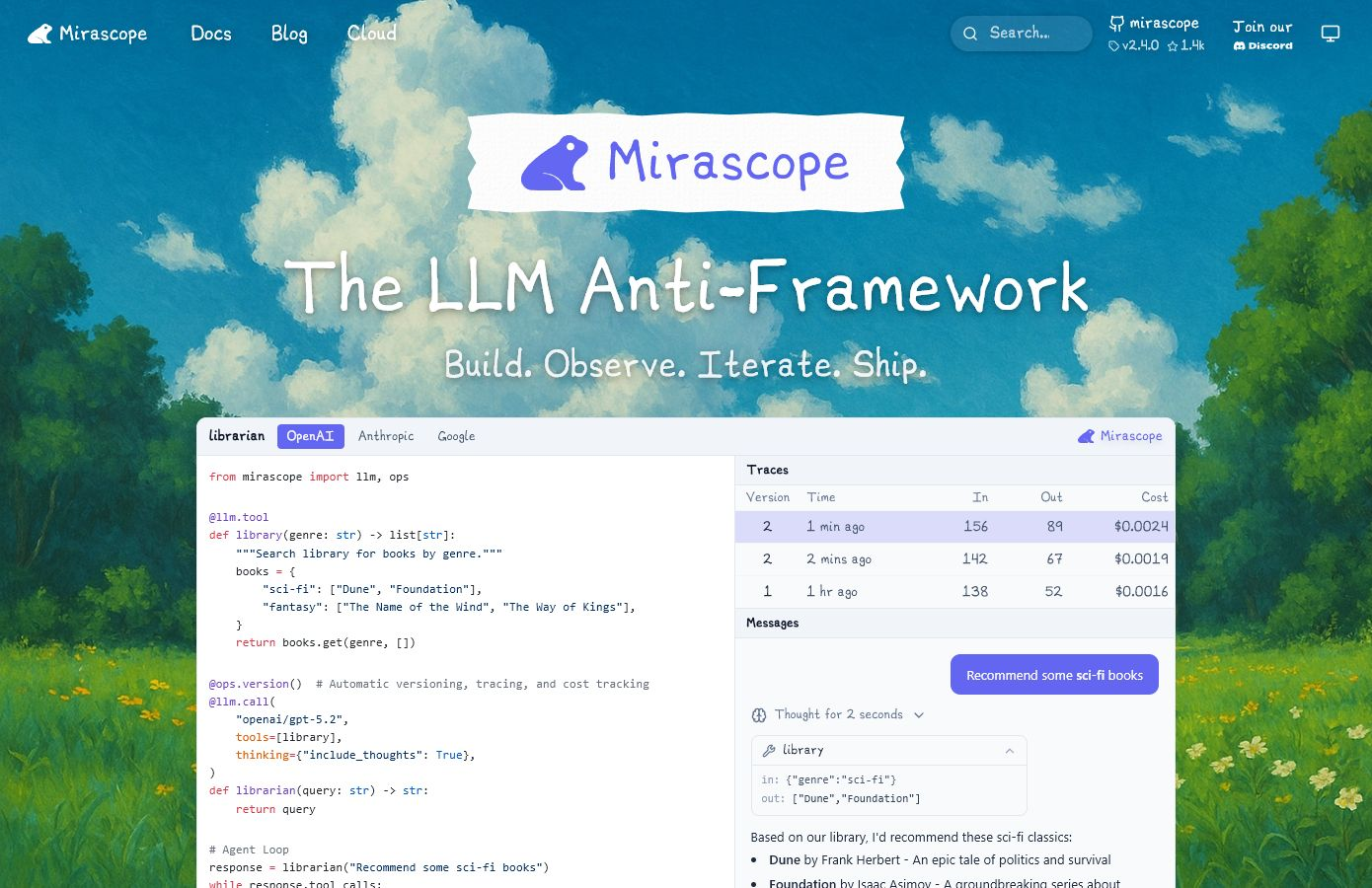
Mirascope is an open source LLM development toolkit maintained by Mirascope, Inc., officially called "LLM Anti-Framework". With Python/TypeScript SDK as the core, it provides unified model calling, tool calling, structured output, streaming response Agent loop, Provider routing OpenTelemetry observation, function version management and error handling capabilities without forcibly taking over the application architecture. It is suitable for precipitating LLM prototypes into maintainable engineering code.
Mirascope
Core parameters and statistics
Mirascope's official positioning is "The LLM Anti-Framework". To be more precise, it is a lightweight SDK for LLM application development, rather than a full-stack Agent platform that requires developers to migrate to a specific runtime. It attempts to stand between native model APIs and heavy-duty Agent frameworks: retaining the capability boundaries of Providers such as OpenAI, Anthropic, Google, xAI, Ollama, MLX, etc., while reducing the amount of repetitive engineering with unified interfaces, type hints, decorators, and response objects.
| Project | Current Public Information |
|---|---|
| Official website | https://mirascope.com/ |
| Documentation | https://mirascope.com/docs |
| GitHub repository | https://github.com/Mirascope/mirascope |
| PyPI package | https://pypi.org/project/mirascope/ |
| Official slogan | The LLM Anti-Framework |
| PyPI Summary | Every frontier LLM. One unified interface. |
| Main languages | Python, TypeScript |
| Python requirements | >=3.10 |
| Open Source License | MIT |
| Latest version | 2.5.0, released on 2026-06-24 |
| Community size | GitHub about 1.5k stars, 119 forks |
| Cloud service status | Mirascope Cloud has stopped, SDK continues to be maintained |
Capability Boundary: Mirascope does not provide basic model training, vector database hosting, business workflow platform, or closed SaaS console. Its core value is at the code level: packaging model calls, messages, tools, structured output, streaming response providers, routing agent loops and observability into a more stable development interface. For AI engineers who are already familiar with Python/TypeScript, it is more trouble-free than writing multiple sets of Provider SDKs directly; for non-technical users who only need a chat interface, it is not a suitable entry point.
User and market recognition
Mirascope's adoption signals come primarily from the open source community, package management platform, and documentation activity, rather than commercial SaaS customer demonstrations. The GitHub repository is described as "The LLM Anti-Framework", and the public star size is about 1.5k, indicating that it has entered the visible range of LLM engineering tools, but has not yet reached the ecological volume of head frameworks such as LangChain and LlamaIndex.
From a positioning perspective, Mirascope is more like a "composable library" than a "platform". The official website documentation explains it as a React-style abstraction in LLM development: It has a more engineering experience than directly calling the native API, but does not overly take over the control flow like large frameworks. This differentiation appeals to two types of teams: engineering teams that have stepped through the complexity of heavy frameworks, and early-stage product teams that want to maintain migration flexibility between multi-model providers.
The PyPI page shows that the package is classified as Production/Stable, supports Python 3.10 to 3.14, and provides all, anthropic, google, mcp, mlx, openai, ops and other extras. This splitting method shows that the project does not push all dependencies to users at once, but allows the installation scope to be selected based on Provider and observation capabilities, which is more friendly to production-bound dependency management.
Cost advantage
Mirascope's current mainline business form is very clear: the open source SDK is free to use, and the cost mainly comes from the model provider, log/trace backend and engineering maintenance called by developers. After v2.4.0, Mirascope Cloud has been officially discontinued. The official Cloud page also states that the team will focus on open source SDK and recommends users to export observation data to OTEL compatible backends such as Langfuse, Jaeger, Grafana Tempo, Datadog, etc.
Individual and small team costs: You can install it directly on demand through pip install "mirascope[openai]", uv add "mirascope[anthropic]", etc. There is no subscription fee for the SDK itself. The main expense is inference fees for OpenAI, Anthropic, Google, xAI, or native models.
Developer team cost: The saving point of Mirascope is not to reduce the unit price of tokens, but to reduce the repeated work of multi-provider adaptation, tool call encapsulation, structured output parsing, error handling and observability access. For teams testing multiple models at the same time, a unified interface can reduce model switching and A/B verification costs.
Enterprise Cost Boundary: With Cloud retired, enterprises should no longer purchase Mirascope as a hosted monitoring platform. During production deployment, you need to choose your own OTEL backend, log retention policy, sensitive information desensitization process, and key management solution. Mirascope is more like an engineering library, and the responsibility for cost management remains within the user's own platform system.
Main functions
- Unified model calling: Call different Providers through
llm.Model("provider/model")or@llm.call(...)to reduce the interface differences of SDKs such as OpenAI, Anthropic, and Google. - Provider routing: The documentation states that Mirascope uses a model ID prefix matching system to select Providers, such as
openai/,anthropic/,google/,ollama/,mlx-community/, etc. - Tool call: Use
@llm.toolto declare ordinary Python functions as model callable tools, and tool parameters and docstrings can be converted to model-side schema. - Structured Output: Organize model output around Pydantic/type system, suitable for extraction, classification, RAG result verification and automation tasks.
- Streaming response: Supports streaming processing of text and tool calls, suitable for building real-time chat, command line assistants and long task progress feedback.
- Agent loop: The official example shows that after the model calls the tool, the conversation continues through
execute_tools()andresume(), and developers can explicitly control the logic of the loop. - Ops observation module:
mirascope.opsprovides tracing, session, span, function version management and LLM instrumentation, and connects to external backends based on OpenTelemetry. - Local Model and Extended Provider: Supports local/lightweight running paths such as Ollama and MLX, and allows customized Providers, suitable for hybrid cloud and local inference scenarios.
Model and version evolution
Mirascope's version evolution revolves around two main lines: one is to expand Provider and model API support, and the other is to return to the pure SDK and OpenTelemetry ecosystem after stripping off Cloud-related capabilities. The current official website navigation still shows the document version v2.4.0, but both GitHub Releases and PyPI show that the latest package version is v2.5.0, so the version field should be based on the public release source.
| Version | Release Date | Key Changes | Judgment |
|---|---|---|---|
| 2.5.0 | 2026-06-24 | Added XAIProvider to support Grok through Responses API | The latest public version |
| 2.4.0 | 2026-03-08 | Stop Mirascope Cloud and remove cloud backend/api related modules | Important architecture shift |
| 2.3.0 | 2026-02-27 | Merging community contributions and site style fixes | v2 pre-mainline version |
| 2.2.2 | 2026-02-05 | Fix Cloud OTEL intValue number handling | Fixed version before Cloud stripping |
Version Selection Recommendations: New projects should start with v2.5.0 first; if the team previously relied on Mirascope Cloud or old api modules, they need to evaluate the breaking changes of v2.4.0 before migrating to an OTEL compatible backend. The production environment should fix the SDK version and perform regression testing on tool calls, structured output, and Provider return formats.
Technical advantages
The advantage of Mirascope is not "the most functions", but "just the right amount of abstraction". The native Provider SDK gives developers the greatest control, but will cause repeated adaptation when switching between multiple models; the heavy-duty Agent framework provides many out-of-the-box capabilities, but may make execution paths, state management, and error handling opaque. Mirascope controls abstraction in the call, tool, response provider and observation layers, allowing business code to still retain clear Python/TypeScript control flow.
Type and function priority: Use ordinary functions, decorators and type annotations to express prompts, tools and output structures to reduce the implicit state caused by DSL or graphics orchestration. Teams can manage LLM applications using existing test lint, type check, and code review processes.
Provider native capabilities retained: Mirascope is not a simple OpenAI compatibility layer. The documentation emphasizes that it will convert calls into the corresponding API format according to Provider routing, with the goal of striking a balance between unified interfaces and Provider features. v2.5.0 adds xAI/Grok Responses API support, which also reflects the route of following model ecological changes.
OpenTelemetry path clear: After Cloud is retired, Mirascope returns observation capabilities to OTEL standards. Mechanically, teams can export traces to existing APM/observability stacks; the effect is to reduce vendor lock-in; applicable scenarios are engineering organizations that already have Langfuse, Jaeger, Grafana Tempo, Datadog or self-built OTEL pipelines.
How to use
| Usage path | Entrance | Typical steps | Adaptation scenarios |
|---|---|---|---|
| Python SDK | PyPI / uv / pip | Install mirascope[openai] or mirascope[all] -> Configure Provider API Key -> Write @llm.call or llm.Model call |
Backend service, script Agent prototype |
| Tool call | @llm.tool |
Declare the business function as a tool -> Pass it to the model call -> Execute response.execute_tools() -> resume() Continue |
Multi-step Agent, calculation/retrieval/business operation |
| Structured output | Document LLM module | Define output schema -> Call model -> Verify and use structured results | Extract, classify, form fill RAG verification |
| Ops Observation | mirascope.ops |
Configure TracerProvider -> ops.configure() -> Mark functions with @ops.trace, @ops.version |
Production debugging, version backtrace, cost and call chain analysis |
| Local model | Ollama / MLX Provider | Configure local running context -> Use corresponding model prefix -> Share call layer with remote Provider | Privacy sensitive, offline experiment, low-cost PoC |
The minimum implementation path is to first select a real business call instead of starting from the complete Agent platform. First use Mirascope to wrap a single LLM call to verify Provider routing, error handling and structured output; then add tool calls and streaming responses; when the project enters multi-person collaboration or online pilot, then connect to the ops module to export trace, session and version information to the team's existing observation system.
Product Pricing
Mirascope SDK is open source software and there is currently no publicly available SaaS subscription price. It is important to note that the official Cloud page clearly shows that Mirascope Cloud has been discontinued and the team will focus on Python and TypeScript SDK; therefore, it should not be described in the catalog as a cloud monitoring platform that is still available for purchase.
| Cost item | Whether to be charged by Mirascope | Description |
|---|---|---|
| SDK usage fee | No | MIT license, Python package and source code public |
| Model call fee | No | Determined by OpenAI, Anthropic, Google, xAI, Together or self-hosted model environment |
| Observation backend | No | Can be connected to OTEL compatible systems such as Langfuse, Jaeger, Grafana Tempo, Datadog, etc. |
| Cloud Mirascope Cloud | Unavailable | The official service has been stopped and is no longer a purchasing path |
| Enterprise Support | Undisclosed | The official website does not disclose the independent commercial support package, and official real-time communication should prevail |
Purchasing Judgment: If the team wants to buy a "one-stop LLMOps cloud platform", Mirascope is not a suitable option at the moment; if the team wants to standardize the LLM calling code and leave observations in its own OTEL backend, Mirascope's open source model is more flexible.
Application scenarios
- Multi-model application development: Switch between OpenAI, Anthropic, Google, xAI or local models for the same business, reducing the transformation costs caused by Provider SDK differences.
- AI Agent prototype to engineering: Use explicit code to control Agent loop, tool execution and error branches to avoid early prototypes being tied up by implicit framework states.
- Structured information extraction: Convert texts such as contracts, work orders, customer service conversations, and research materials into verifiable structured objects, and use the type system to reduce the probability of dirty data entering downstream.
- RAG and Knowledge Assistant: Preserve clear boundaries between retrieval, answering, citation checking, tool invocation and observation to facilitate regression testing and quality tracking.
- Production Observability Access: Incorporate LLM calls, function version sessions and spans into the existing monitoring system through OpenTelemetry, suitable for teams with existing DevOps/platform engineering capabilities.
- Local/hybrid model experiment: Combine with providers such as Ollama and MLX to conduct privacy-sensitive or low-cost experiments, and then migrate to the cloud frontier model according to the effect.
Applicable people
- AI Application Engineer: Needs stable calls to multiple LLM Providers in code and wants to retain control over tool execution, streaming responses, and error handling.
- Platform and back-end team: Hope to provide a unified LLM calling layer for the business line, and at the same time connect observability to the existing OpenTelemetry stack.
- Agent Product Team: Already have a clear business process and want to incorporate Agent loop, tool invocation and structured output into the testing and release process.
- Research and Prototyping Team: Need to quickly compare different providers, models and prompt writing methods, but do not want to introduce an overly heavy framework.
- Not suitable for boundaries: Not suitable for completely no-code users, teams that need to host the chat UI, purchasers who only want to purchase the LLMOps SaaS console, or scenarios that require a basic model training/fine-tuning platform.
Summary and Outlook
The core value of Mirascope is to advance LLM application development from "manual splicing of various Provider SDKs" to "unified but controllable engineering interfaces". It does not try to define the entire structure of the application like the heavy-duty Agent framework, but abstracts away the most common and most error-prone parts: model calls, tools, structured output, streaming response providers, routing Agent loops and OpenTelemetry observations.
The biggest change to note right now is that Cloud has been discontinued and Mirascope has returned to the mainline open source SDK. This shift reduces platform lock-in and means users must prepare their own observation backends, key management, log masking, and production release processes. For teams with engineering capabilities, this is a cleaner componentization route; for users looking for a one-stop platform, they need to be paired with Langfuse, Grafana Tempo, Datadog, Jaeger or other OTEL-compatible tools.
The focus of future observations includes three items: whether Provider coverage continues to keep up with frontier model changes, whether the capabilities of TypeScript and Python SDK remain consistent, and whether the de-Cloud route after v2.4.0 can lead to more stable open source community contributions. In the short term, Mirascope is suitable as a "light abstraction base" for the LLM application code layer, especially for teams that want to maintain migration flexibility and engineering testability in a multi-model ecosystem.
Related tools:  GitHub Copilot,
  Cursor
Version Info
- Mirascope v2.5.0 :The latest version disclosed by GitHub Releases and PyPI adds XAIProvider, supports Grok through the Responses API, and simultaneously increases the minor version number.
- Mirascope v2.4.0 :Important changes to the version. Mirascope Cloud has been officially discontinued, the api module and cloud backend related capabilities have been removed, the main line of the project has been converted to pure LLM SDK, and users are recommended to use other OTEL backends.
- Mirascope v2.3.0 :The v2.3 series of public versions includes document/site style fixes and the merging of community contributions, continuing the v2 SDK mainline.
User Reviews