 Mistral 3
Free
Mistral 3
Free
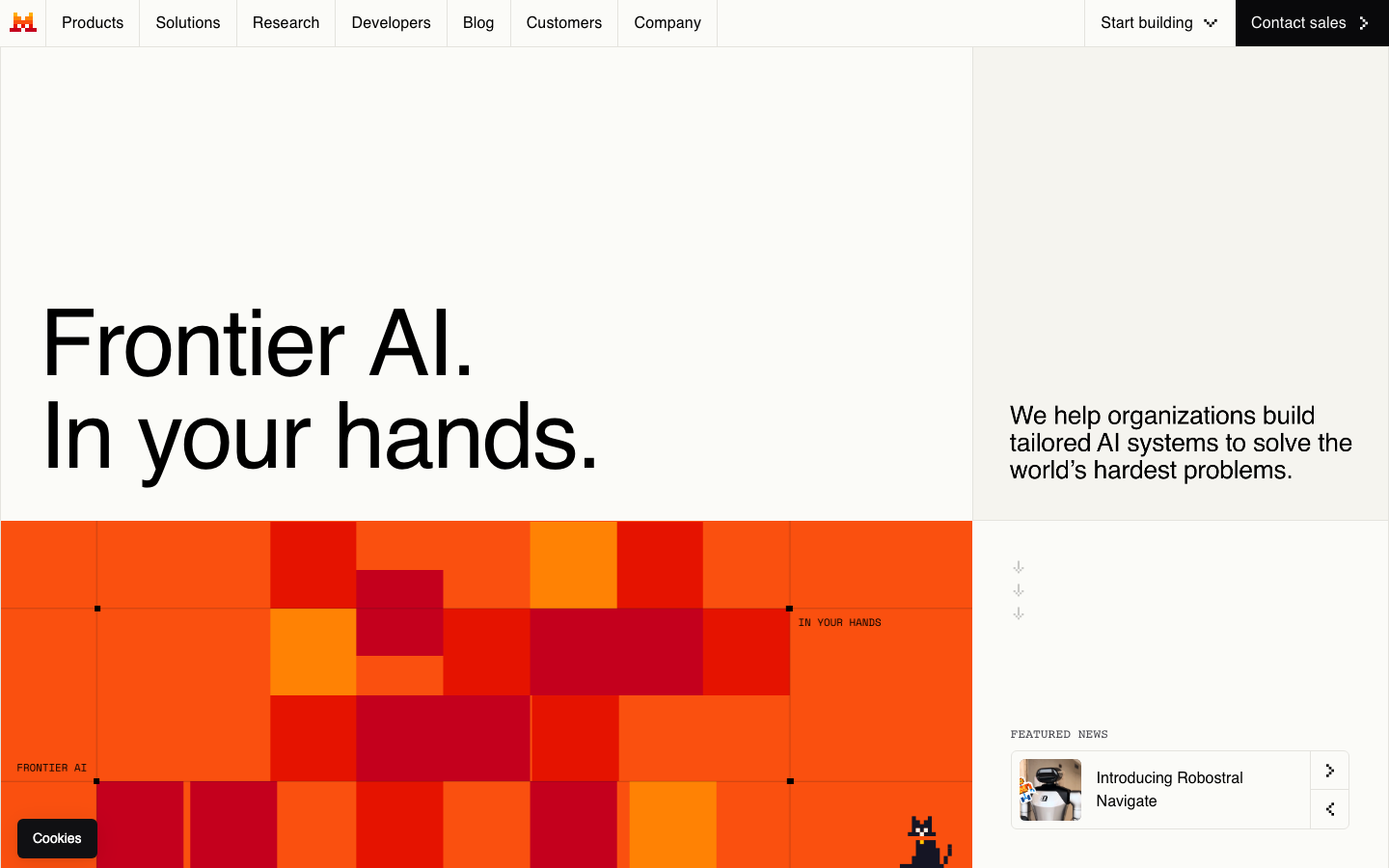
Mistral 3 is a new generation model family built by Mistral AI for multi-modal, multi-language, edge deployment and enterprise customization scenarios, covering the small parameter Mistral 3 to the larger Mistral Large 3 route.
Mistral 3
Core parameters and statistics
The main delivery form of Mistral 3 belongs to [Basic Large Model/API Infrastructure]. It is not a single chat product, but a family of models delivered around multi-modality, multi-language, edge deployment, and enterprise controllability.
| Projects | Public Information |
|---|---|
| Family composition | Ministral 3 (3B, 8B, 14B) and larger routes |
| Scope of capabilities | Text, images, multilingual |
| Public multi-language signal | Covering 40+ languages, see public information |
| Deployment direction | Edge devices, data centers, enterprise private environments |
| Technical roadmap | Multi-modal MoE, hardware optimization |
| Enterprise product support | Studio, Forge, Compute, Vibe and other platform systems |
A brief comment: Mistral 3 does not pursue "one model to conquer the world", but wants to open up the route from edge to enterprise cloud, from open source to customization.
Publicity Verification: Both official and public information emphasize controllability, deployability, and multi-hardware adaptation. This positioning is in line with Mistral's consistent line; however, the actual performance of each model variant still depends on the task type and deployment context.
User and market recognition
Mistral's market recognition mainly comes from two layers: one is its "controllable AI" positioning in the European and enterprise markets, and the other is that it has packaged models, agent platforms and deployment infrastructure into a complete product stack.
Expert View: Many teams use Mistral, not because it ranks first on all lists, but because it provides a path that is relatively less locked by a single cloud vendor. This is important for organizations that emphasize data sovereignty and private deployment.
Hidden benefits: If an organization requires models, agents, custom training, and private deployment at the same time, Mistral's full-stack route will reduce tool splicing costs.
Current limitations: The public information is not completely consistent with the unified benchmark, accurate price, long context strategy and stable concurrent performance disclosure of different models. It must be verified according to the specific model before purchasing.
Cost advantage
FREE FACTS: There are open source or publicly weighted routes to the Mistral 3 family, but real enterprise use often involves Studio, Forge, Compute, and private deployment costs.
C-side/Individual: If you are just chatting and doing light development, you may not necessarily need to use the complete Mistral 3 route.
Developers/API: The biggest advantage for developers is that the model has rich gradients, small parameters can be used for edge and low-cost inference, and large parameters can undertake highly complex tasks.
Enterprise/Private: The real cost advantage lies in flexible deployment and the ability to make trade-offs between cloud, edge, and private environments, rather than being tied to a single closed-source API.
Hidden costs: Multiple model families also mean complicated selection. The more models there are, the higher the evaluation and maintenance costs.
Main functions
- Multi-modal understanding: Joint processing of text and images.
- Multi-language capability: For international application scenarios.
- Multi-size model gradient: small models to large models covering different computing power and cost layers.
- Edge-to-cloud deployment adaptation: suitable for different environments such as RTX PC, Jetson, and data centers.
- Enterprise Customization: Can be used with Forge and customized training routes.
Expert view: Hidden linkage is in "model family + deployment stack". If there are only models without deployment and customization tools, the value of the enterprise will be reduced; Mistral is exactly making up for this complete set.
Model and version evolution
Mistral 3 represents family evolution rather than a single model explosion.
Mainline release
- Mistral 3: A new generation of family name nodes that will be visible to the public at the end of 2025.
Historical nodes
- Mistral Large 3: A larger scale route, assuming flagship capability positioning.
Publicity Verification: The naming of this generation is more tightly bound to the product stack, indicating that Mistral is no longer satisfied with just making "a good model", but is making an AI platform that can be used by enterprises.
Technical advantages
Performance and Throughput: The official homepage and public information emphasize multi-hardware adaptation, inference optimization, distributed execution and low-precision optimization, but the TTFT, RPM, TPM and long-term voltage stabilization test results of all models are not uniformly disclosed. Therefore, the model and contextual measurements must be carried out before deployment.
Adaptation Boundary: The best at multi-language enterprise applications, privatized deployment, multi-modal document processing and edge reasoning; the worst at handing over all tasks to a maximum model without making hierarchical selection.
API Example:
curl https://api.mistral.ai/v1/chat/completions \
  -H "Authorization: Bearer <YOUR_API_KEY>" \
  -H "Content-Type: application/json" \
  -d '{
    "model": "mistral-large-latest",
    "messages": [{"role": "user", "content": "Summary of the core ideas of this document"}],
    "temperature": 0.2,
    "max_tokens": 1024,
    "stream": false
  }'
The specific model name and response_format are subject to the official real-time documentation.
How to use
| Path | Suitable for the crowd | Description |
|---|---|---|
| API/Console | Developers | Quick access to model capabilities |
| Studio | Application Team | Building Agents and AI Apps |
| Forge | Corporate R&D | Model customization and evaluation |
| Self-host / Cloud partner | Large organizations | Meet data sovereignty and deployment control |
Usage Suggestions: Layer by task first. Use small models for light tasks, and large models for complex reasoning and multi-modal tasks. Don’t default to the flagship model from the beginning.
Dissuade Scenario: Teams that do not have model evaluation capabilities but want to understand the whole family at once will often suffer from the complexity of selection.
Product Pricing
Mistral provides public pricing pages and API pricing pages, but different models, hosting environments, and enterprise deployment strategies vary greatly. The exact cost is subject to the official real-time page.
- Personal: More suitable to experience through Le Chat or light entrance, not necessarily directly on the Mistral 3 family.
- Developer: Inference costs can be controlled by model level.
- Enterprise: Also include private deployment, custom training and governance costs.
Free Truth: Open source or open weight lowers the barriers to trial but does not lower enterprise governance and evaluation costs.
Application scenarios
- Multi-language customer service and knowledge service: Cross-language scenarios have more advantages.
- Joint understanding of documents and images: suitable for corporate documents, tickets, and screenshot scenarios.
- Edge AI Devices: Small parameter models are suitable for local deployment.
- Enterprise Customization Agent: Combine Studio and Forge to form a relationship.
Dimensionality reduction attack scenario: It requires both model capabilities and the deployment of controllable and multi-language adaptation organizations. Its advantages can be best felt.
Applicable people
- Enterprise AI Platform Team: Requires full stack controllability.
- International Product Team: Multi-language requirements are clear.
- Edge Reasoning Team: Hope to achieve cost balance at different hardware layers.
Dissuade/not applicable to people: Teams that just want to find the “strongest chat model” and don’t care about deployment and governance may not need such a complicated system. Current Limitations: The deployment and tuning costs of Mistral 3 are relatively high. For small teams, it is necessary to evaluate whether there are sufficient engineering resources to support a self-hosted solution.
Summary and Outlook
The value of Mistral 3 lies in bundling model capabilities and enterprise deployment capabilities. It's not the best-fits-all answer for everyone, but it's a competitive route for organizations that value data sovereignty, edge deployment, and multilingual capabilities.
Current Limitations: Public benchmarks, price transparency, and stable concurrency information for different models still need to be verified on a case-by-case basis.
Procurement/Adoption Risk Assessment: Before adoption, it is recommended to complete the task matrix to clearly distinguish which tasks use small models and which tasks use large models, and then evaluate the total cost of the API and private deployment routes. If this is not possible, the model gradient advantage of Mistral 3 will become a selection burden.
Related tools:  DeepSeek,
  ChatGPT
Version Info
- Mistral 3 :The new generation model family version shown in public information includes Mistral 3 and the larger Mistral Large 3, focusing on multi-modal, multi-language and cost-effective reasoning.
- Mistral Large 3 :The main line node of the large model visible in public information, there is no official precise date yet, and it can be regarded as the flagship capability line in the Mistral 3 family.
User Reviews