 Mode Analytics
Free
Mode Analytics
Free
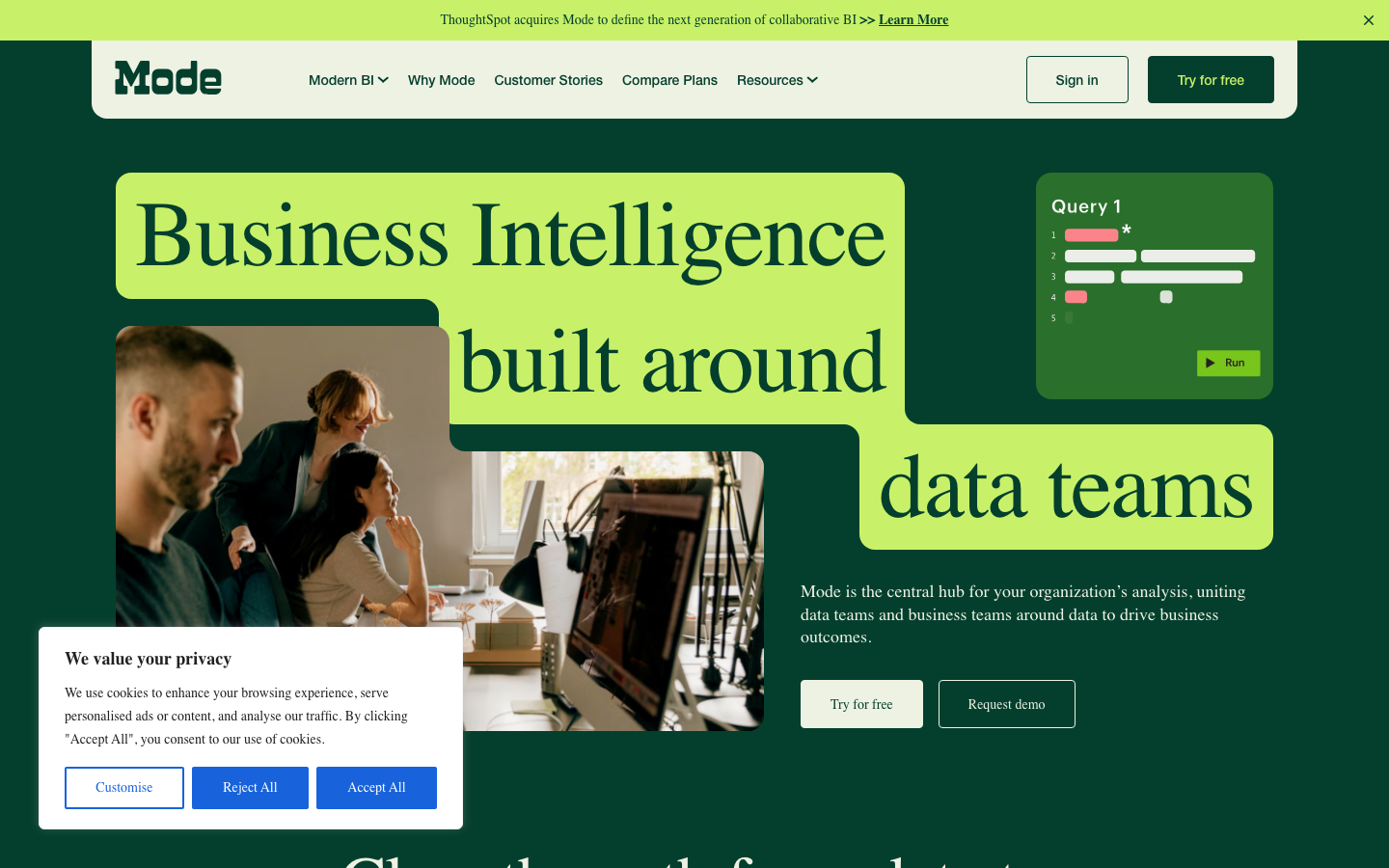
Mode Analytics is a cloud collaboration platform for data analyst teams that integrates the SQL editor Python/R Notebook, visual dashboards, and AI-assisted analysis in a unified workspace. It supports direct connection to data warehouses (Snowflake, Redshift, BigQuery, etc.) and analytical results are delivered in the form of shareable reports. Mode was acquired by ThoughtSpot in 2021 and currently operates as an independent brand. Mode AI features will be launched in 2024, including natural language generation SQL (AI Combiner) and automatic analysis and interpretation.
ModeAnalytics
Core parameters and statistics
Mode Analytics is targeted at a special group of BI tool users - data analysts. It is not a BI for "people who don't understand technology" (such as Looker Studio or Tableau Pulse), but a collaboration platform for "analysts who write SQL and run Python".
| Projects | Public Information |
|---|---|
| Official positioning | The collaborative data platform for analysts |
| Core Interaction | SQL Editor + Python/R Notebook + Visualization |
| Data connections | Snowflake, Redshift, BigQuery, PostgreSQL, and more |
| AI capabilities | Mode AI (AI Combiner Natural Language→SQL) |
| Collaboration features | Report sharing, version management, team workspace |
| Deployment method | Cloud SaaS |
| Owned company | ThoughtSpot (acquired in 2021, independent brand operation) |
| Relationship with ThoughtSpot | Mode = Analyst Workbench; ThoughtSpot = AI Analysis Platform |
| Latest version | 2026-H1 |
Positioning difference: Mode is not a tool to "lower the threshold for data use" - it is precisely a tool to "make professional analysts more efficient". It complements ThoughtSpot (self-service analysis for business users): ThoughtSpot allows non-technical people to ask data, and Mode allows analysts to write code for in-depth analysis.
User and market recognition
Mode has good brand recognition among the data analyst community, especially for its free SQL editor and tutorial resources.
Community Foundation: Mode’s SQL tutorials (Mode Analytics SQL School) are widely considered one of the best free resources for learning SQL, building brand recognition and trust among the data analyst community. This strategy is similar to dbt (same analyst community thinking) - build a user base through educational content and then convert users into paying customers.
Customer base: Mode’s paying customers are mainly data teams of medium and large enterprises, covering technology, financial services, e-commerce and media industries. Public clients include well-known technology companies such as Shopify and Lyft.
ThoughtSpot Synergy: After being acquired by ThoughtSpot, Mode gains a larger distribution channel among ThoughtSpot’s customer base, while integrating at the product level with ThoughtSpot’s Spotter AI Agent capabilities.
Cost advantage
- C-side/Individual: Usually a free version is provided to experience the core functions, and high-frequency use requires a paid package subscription.
- API/Developer: Billed by call volume, suitable for development teams that can be flexibly integrated into their own systems.
- Enterprise/Privatized: Contact the business owner for customized quotation and deployment plan. The specific price is subject to the official real-time pricing page.
Main functions
The core functions of Mode are designed around "allowing data analysts to complete full-process analysis work on the same platform":
- SQL Editor: Supports multiple data source connections, auto-completion, query history management and result caching. Splitting and comment management of complex queries is better in the editor than in the native SQL client. Acceptance concerns: editing experience for very long queries (100+ lines) and folding management of CTE (Common Table Expressions).
- Python/R Notebook: Use Python or R to perform further statistical analysis, machine learning, and custom visualizations based on SQL query results. SQL blocks and Python blocks can be concatenated into NoteBook-style workflows. Acceptance concerns: Python’s contextual package management capabilities and available data science libraries (Pandas, Scikit-learn, Plotly, etc.).
- AI Combiner (natural language generated SQL): The user describes the query intention in everyday language (such as "Find the product line with the highest repurchase rate last quarter"), and Mode AI automatically generates the corresponding SQL statement, which the user can review and modify. Acceptance focus: Correctness of generated SQL, especially when it comes to multi-table JOINs, window functions, and conditional aggregations.
- Visualization and Reporting: Generate charts with one click based on query results, supporting Chart type customization and report layout editing. Reports can be shared as read-only links or PDF exports.
- Collaborative Workspace: Analysts share query notebooks, reports and dashboards in the team space, supporting comments, version history and permission management. This is the core value that distinguishes Mode from "everyone opens a MySQL Workbench" - analysis work is no longer isolated.
- Integration with ThoughtSpot: Analysis results created in Mode can be published to ThoughtSpot for business users to explore in ThoughtSpot's AI Q&A interface.
Model and version evolution
Continuous iterative updates, the latest version introduces performance optimization and new features. Historical version information can be viewed on the official release page. There is no complete public version evolution timeline yet. It is recommended to pay attention to the official announcement to understand the rhythm of feature updates.
Technical advantages
Mode's technical advantage lies not in single algorithm performance, but in the "integrated analyst workflow" design.
Unified Workflow: The workflow of traditional data analysts is broken - use SQL client to query the database, copy the results to Python IDE for analysis, then paste them into BI tools to draw charts, and finally publish reports via email or PPT. Mode unifies these four steps on one platform to reduce switching costs.
Mechanism -> Effect -> Scenario: SQL query results automatically flow into Python/R Notebook and then into the visualization layer. Every step of the analysis link is in the same document -> Analysts do not need to copy and paste intermediate results between different tools -> Suitable for data analysis scenarios that require full process tracking from source to report.
AI assists rather than replaces: The goal of AI Combiner is not to replace analysts in writing SQL (that is unrealistic - the complexity of enterprise-level queries often exceeds the boundaries of AI capabilities), but to help analysts write initial query templates faster and reduce the time of typing SELECT statement literals. Analysts remain responsible for reviewing, optimizing, and debugging AI-generated SQL.
The uniqueness of ThoughtSpot collaboration: The combination of Mode + ThoughtSpot means that enterprises can obtain the "Analyst Deep Analysis Platform" (Mode) and the "Business Self-Service Query Portal" (ThoughtSpot) at the same time, and the two platforms share the same set of data definitions.
How to use
The usage portal of Mode is for analysis teams that already have a data warehouse:
| How to use | Suitable for the role | Features |
|---|---|---|
| Mode Web (edit mode) | Data Analyst | SQL Editor + Python Notebook + Visualization |
| Mode Web (view mode) | Business users, management | Read-only view of published reports and dashboards |
| Mode API | Developers | Programmatic Management Reports and Queries |
| Integration with ThoughtSpot | Enterprise users | Publish Mode analysis output to ThoughtSpot |
Typical implementation path: the data team connects to the existing data warehouse (Snowflake/Redshift/BigQuery) in Mode; analysts create queries in Mode and use AI Combiner to assist in writing SQL, conduct further analysis through Python Notebook and publish it as a visual report; business teams and management view the report through read-only links. The core indicator of implementation acceptance is "the time it takes for analysts to get the data requirements and publish the report" - shortened from the original cross-tool operation (usually half a day to one day) to one-stop completion within Mode (usually 1-3 hours).
Product Pricing
The pricing model is subject to the official real-time page. Usually a freemium or subscription system is used, and basic functions can be used for free. Advanced functions or high-frequency use require paid subscriptions, and users are advised to evaluate the optimal solution based on actual usage.
Application scenarios
- Analyst team collaborative analysis: The data team completes daily queries, data exploration and indicator analysis in Mode, and the results are delivered to the business department in the form of collaborative reports. The benefits are reflected in reducing the problem of "analysis results are transmitted privately and cannot be reproduced by others". Key points to check: The length of the adaptation period for the team to migrate from distributed tools to Mode.
- SQL Query Optimization and Visualization: Analysts use AI Combiner to assist in writing complex SQL and combine it with visualization capabilities to quickly generate analysis reports. Verification focus: AI Combiner’s SQL generation quality in query scenarios involving complex business logic.
- Data Science + BI Fusion: Analysts run statistical models or machine learning analyzes in Mode’s Python Notebook, and the results are directly embedded in visual reports—no need to export model results to CSV and then import them into a BI tool. Verification focus: Python's bounded capabilities (whether it supports GPU acceleration, custom package installation, etc.).
- ThoughtSpot data source preparation: The data analysis results created in Mode can be used as data sources for ThoughtSpot for business users to continue exploring through natural language.
Applicable people
- Data Analyst (Core User): Complete the complete work from SQL query to Python analysis to report publishing in Mode. Prerequisites: Basic abilities in SQL and Python/R. Doesn’t fit the boundaries: Mode’s professional analyst platform may seem over-engineered if the team doesn’t need Python/R analysis and only needs pure visual reporting.
- Data Team Lead: Manage releases, quality, and lead times for analytics projects through Mode’s team workspace. Prerequisite: The team needs a unified data analysis platform to replace personal tools.
- Business Team (Report Consumer): View data reports and dashboards published by analysts via read-only links. No Mode account is required to view.
- Use with ThoughtSpot: Enterprises purchase Mode (analyst workbench) and ThoughtSpot (business self-service analysis) at the same time, forming a two-tier data consumption architecture of "analyst in-depth analysis + business self-service query".
Not suitable for the crowd: Non-technical business people who do not need to write SQL or Python (for them, Mode’s core functions SQL editor and Python Notebook are meaningless); single-person analysis scenarios that do not require team collaboration (the free version is available, but the value of collaboration cannot be reflected); organizations where the analyst team already has a mature local tool chain and is unwilling to migrate to a cloud platform.
Summary and Outlook
The core value of Mode Analytics does not lie in any single technological breakthrough, but in that it unifies the fragmented workflow of data analysts (SQL client + Python IDE + BI tool + email/PPT) onto one platform. This "all-in-one tool experience" has real value in improving the efficiency of analyst teams. Coupled with the synergistic relationship with ThoughtSpot, Mode occupies the ecological niche of "analyst portal" in the enterprise data analysis stack.
Current limitations: The core user group is limited to professional analysts and is not intended for non-technical business users; the accuracy of AI Combiner's natural language → SQL capabilities still requires manual review when processing complex business logic; Mode is well-known in the analyst community, but its presence in enterprise-level BI purchasing decisions is not as strong as Tableau/Power BI.
Procurement/Adoption Risk Assessment: It is recommended to first use the free version to evaluate the team collaboration experience and the SQL assistance effect of AI Combiner in an analysis team of 2-3 people, and confirm the team's willingness and adaptation cycle to migrate from the existing tool chain. Enterprises need to confirm before purchasing: compatibility with existing data warehouses (Snowflake/Redshift/BigQuery/PostgreSQL), at which price tiers enterprise features such as SSO and audit logs are available, and whether Mode’s integration with ThoughtSpot requires additional licensing or interface fees.
Version evolution of Mode Analytics
Independent growth (2013-2021)
Mode experienced an independent growth stage from its founding in 2013 to its acquisition in 2021. Its core products include the SQL editor Python Notebook and report publishing. At this stage Mode has established strong brand recognition within the analyst community, particularly through free SQL education content.
ThoughtSpot Group: Independent Brands (2021-2024)
After being acquired by ThoughtSpot in 2021, Mode maintains independent brand operations. The product continues to iterate independently, and at the same time begins to integrate capabilities with ThoughtSpot - Mode's analysis output can be used as a data source for ThoughtSpot. This phase saw Mode gain greater distribution through ThoughtSpot’s enterprise customer channels.
AI enhancement (2025 to present)
Launched the Mode AI product line, with AI Combiner (natural language → SQL) as the core function. Mode's AI strategy focuses on "accelerating the efficiency of analysts writing SQL" rather than "letting non-technical personnel do analysis", which reflects its differentiated positioning from ThoughtSpot (for business users).
Version Info
- Mode 2026-H1 :Enhanced Mode AI functionality, improved AI Combiner’s ability to generate natural language SQL, and deepened integration with ThoughtSpot Spotter. There is no official precise date yet.
- Mode AI released :Launched the Mode AI product line, including AI Combiner (natural language generation SQL) and automatic analysis and interpretation capabilities. There is no official precise date yet.
- Acquired by ThoughtSpot :ThoughtSpot acquires Mode Analytics, Mode remains an independent brand. After the acquisition, Mode gradually integrated with ThoughtSpot’s product capabilities. There is no official precise date yet.
User Reviews