 Monday.com AI
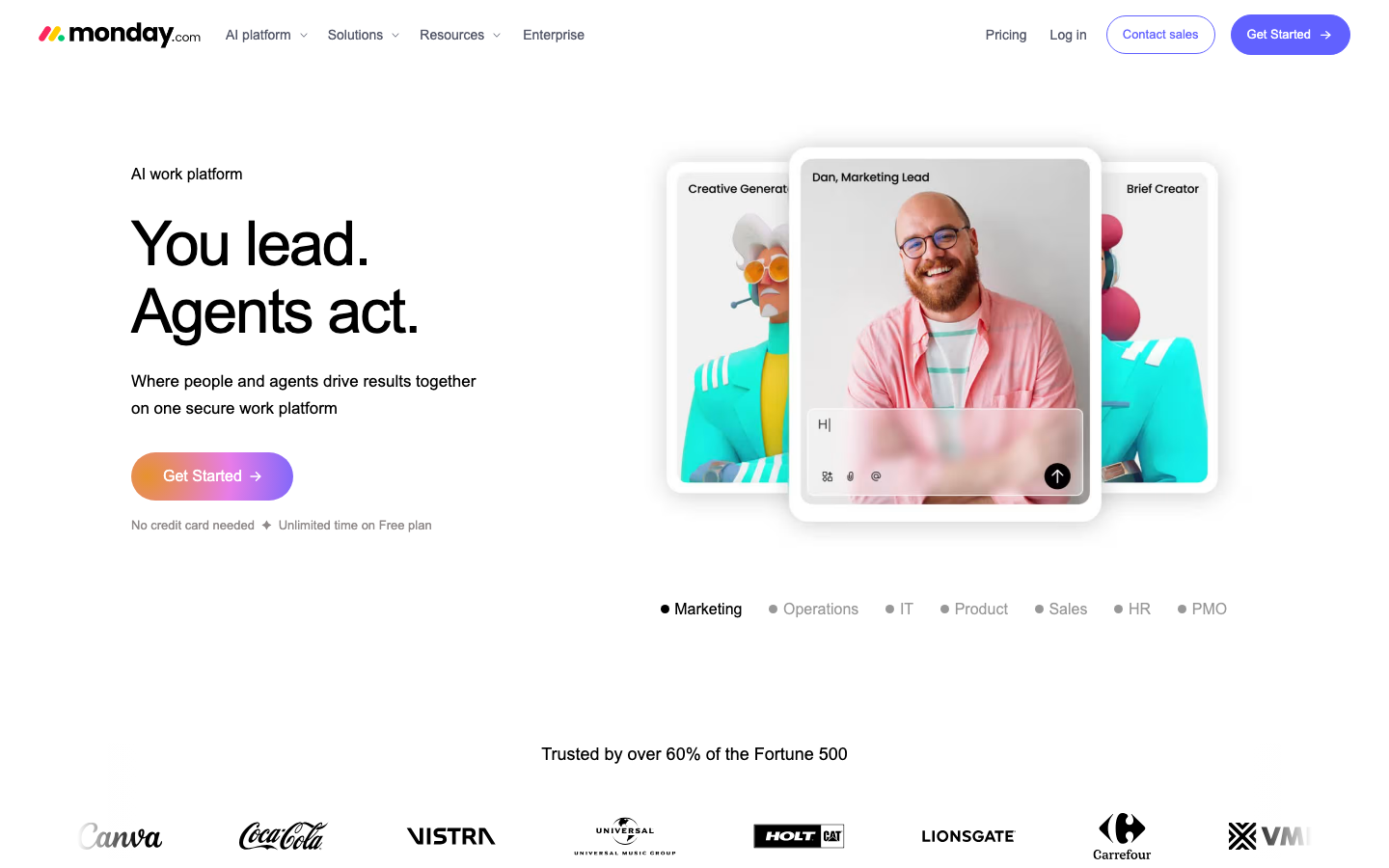
Monday.com AI is the AI capability layer embedded in the Monday work operating system, providing AI Agent, AI formula generator, AI automation rules, intelligent summaries, natural language dashboard creation, AI status prediction, and AI Meeting Notetaker. Based on the AI Credits measurement system, the consumption and payment solutions for AI functions are decoupled, covering marketing, sales, software R&D and operation teams.
Monday.com AI
Monday.com AI core parameters and statistics
Monday.com AI is the AI capability layer embedded in the Monday work operating system (Work OS) and is not an independent product. Compared with track products such as Asana Intelligence and Notion AI, Monday's AI strategy has undergone significant evolution from "lowering the threshold of high-level functions" to "AI Agent matrix + Credits measurement". The AI Agent system launched in Q2 of 2026 will upgrade it from an "in-tool AI assistant" to a "digital workforce that can independently execute workflows."
| Projects | Public Information |
|---|---|
| Product form | Monday.com platform built-in AI layer + AI Agent matrix |
| Core capabilities | AI Agent (6 categories), AI formula generation, AI automation rules, AI columns, AI Meeting Notetaker, Sidekick AI assistant Vibe App Builder, AI Workflow Builder |
| Agent Type | Research, Reporting, Insights, Meeting Assistants, Process Optimizers, Custom Agent |
| Overlay Views | Board, Gantt, Calendar, Kanban, Dashboard, Docs |
| AI measurement method | AI Credits (stratified by plan: 1,000/2,000/3,000 per month) |
| Deployment method | Cloud SaaS, no self-hosted version |
| Pricing model | As part of Monday.com's paid plans, AI features are available in tiered plans |
| Public price | Subject to the real-time page of monday.com/pricing |
| Company Size | Nasdaq listed (MNDY), over 250,000 customers, over 60% of the Fortune 500 adopted |
Positioning difference from competing products: Monday AI is characterized by a "dual-layer AI structure" - the bottom layer is AI functions (formulas, automation rules, summaries, filling) embedded in views and columns, and the upper layer is an independently running AI Agent (which can independently perform tasks such as research, reporting, meeting scheduling, anomaly detection, etc.). This structure allows Monday to serve as both an "AI-enhanced work management tool" and an "AI-driven business process execution platform." Asana Intelligence currently does not have an equivalent Agent matrix, and Notion AI focuses on content generation rather than process execution.
The significance of AI Credits measurement: Monday uses Credits to replace the traditional "hard binding of functions according to the plan" model. Credits consumption reflects the complexity of the task (e.g. 1,000 Credits ≈ 50 resume screens + 5 hours of meeting summaries + hundreds of automated updates), and teams can flexibly allocate based on actual usage rather than paying for unused AI capabilities. Official examples show that a typical team of 3 consumes around 800–1,200 Credits per month.
Monday.com AI users and market recognition
Customer scale and penetration rate: Monday.com officially serves more than 250,000 customers (including more than 20 million global users of the free version), covering more than 200 industries. The share of Enterprise customers ($50K+ annual contracts) continues to grow, with over 60% of Fortune 500 companies using Monday.com in some part of their organization. These numbers come from the official website and investor relations disclosures and are publicly verifiable B-side adoption signals.
Industry Analyst Position: Monday.com is the only work management platform rated a Leader (Work Management CRM, Dev) in three different Gartner Magic Quadrant reports. The Forrester Wave also places Monday.com in the Leadership quadrant. Behind the recognition of third-party analysis agencies is Monday's success in transforming from a "project management tool" to a "work operating system" - covering scenarios that have expanded from simple project management to CRM, DevOps, marketing operations and service desks.
User feedback on AI features: Monday.com AI on G2 scores highly in the dimensions of "ease of use" and "breadth of functionality". Users generally recognize the practical value of the AI formula generator and automated rule generator, believing that they "make Monday's high-level functions no longer intimidating." However, some reviews pointed out that the accuracy of AI output fluctuates greatly in complex cross-table calculation scenarios - this is consistent with Monday's AI strategy: it prioritizes "is it easy to use" rather than "how powerful".
Enterprise case evidence: Official quotes: Motorola achieved 346% ROI through Monday.com (Forrester TEI research), McDonald's achieved 40% production time reduction, and VML saved $250K annually. Implementation examples of AI Agent include reducing a 15-minute manual screening call to a 5-minute AI Agent completion - this data comes from the official customer story page, but has varying degrees of independent third-party verification.
Monday.com The cost advantage of AI
Monday AI's cost structure needs to be dismantled from the three levels of "C-side/Team Subscription", "Developer/API", and "Enterprise/Private", and at the same time superimpose the new measurement dimension of AI Credits.
C-side/Team Subscription Tier: AI functions are opened in layers according to plans, and AI Credits are allocated in levels. The Free plan has limited AI features, Basic ($9/seat/month) includes 3 AI tools and 1,000 Credits/month, Standard ($12/seat/month) includes 5 tools and 2,000 Credits/month, and Pro ($19/seat/month) includes 6 tools and 3,000 Credits/month. The Pro plan is the starting point for a complete experience of AI functions (including AI Agent, full matrix AI Workflow Builder, and AI columns), and the annual payment is approximately $19/seat/month. When the team estimates the cost, it needs to consider both the "seat fee × number of people" and the credit consumption rate, rather than just looking at the unit price of the seat.
Developer/API layer: Monday.com offers a GraphQL API (daily calls starting from 1,000 on Standard plan to 25,000 on Enterprise), but the AI feature does not support standalone API calls. Developers can only consume AI output through the triggering mechanism of the platform UI or AI Agent, and cannot call it by Token like the OpenAI API. This means that teams cannot embed Monday AI’s capabilities into their own systems; it is an AI layer “consumed within the platform.” For teams with custom integration needs, this is a limitation that needs to be acknowledged in advance.
Enterprise Tier: The Enterprise plan adopts customized pricing, and the AI Credits limit can match the actual usage pattern of the team (Custom AI Credits). Enterprise includes full AI capabilities + enterprise-level permissions and auditing + SSO + data export + advanced security compliance (ISO/IEC 27001, 27018). Monday explicitly stated that "your data will not be used to train AI models" - a key provision for corporate procurement in regulated industries.
Hidden costs: AI-generated content (formulas, rules, summaries) requires manual verification before being put into production. The verification takes about 5-10 minutes in simple scenarios, and may exceed 30 minutes in complex scenarios involving cross-table calculations. In addition, there is a monthly reset mechanism for AI Credits consumption, and unused Credits do not accumulate, which may push up the actual cost of frequent use teams. Although Monday provides an AI Cost Center dashboard to track team-level AI usage and expenditures, enterprises still need to confirm the unit price and capping mechanism after the Credits are exceeded before purchasing.
Monday.com AI’s main features
Monday AI's capability system has completed the transition from "Function Assistant" to "Agent Matrix" in Q2 of 2026, and can currently be summarized into six categories:
AI Agent Matrix: This is the most significant capability upgrade of Monday AI in 2026. Officially open six types of Agents - Research Agents (market research, competitive product tracking, supplier discovery), Reporting Agents (executive summary, daily review, status report), Insights Agents (anomaly detection, target tracking, risk analysis), Meeting Assistants (meeting scheduling, transcription summary, follow-up tracking), Process Optimizers (automatic drift detection, duplicate merging, process automation suggestions), Custom Agent (users use natural language to describe any workflow to create exclusive Agents). Each Agent has independent data access rights and execution context in the Monday platform, and its behavior is fully recorded in the Agent Activity log.
AI formula generator: Users describe the calculation logic in natural language ("Calculate the percentage of tasks completed by each member this week to the total"), and AI automatically generates the corresponding Monday formula. This is the most mature feature in Monday AI and has the best user feedback - it reduces the learning curve of Monday formulas from "memorizing function names and syntax" to "describing requirements". The 2026 Q2 version has enhanced support for cross-column calculations. Previously, cross-column reference of formulas was the scenario with the highest error rate in user manual configuration.
AI automated rule generation: Use natural language to describe trigger conditions and execution actions, and AI converts them into Monday automation rules. Similar to the formula generator, its value lies in lowering the threshold for configuring Monday's automation rules language (IFTTT-style). After AI generates rules, you can preview the execution effects in Simulation Mode before deciding whether to enable them.
AI Workflow Builder: Combine AI Agents and automation rules into end-to-end workflows. For example, "Let the Research Agent scan competing product dynamics at 9 a.m. every day, write the results to the Board, and trigger a Slack notification if price changes are found." This is essentially a fusion of Monday’s low-code workflow engine and AI capabilities.
AI Meeting Notetaker and Sidekick AI Assistant: AI Meeting Notetaker automatically joins meetings, generates transcripts and summaries, extracts action items, and syncs to the Board. Sidekick AI Assistant is an always-on conversational assistant embedded in the Monday interface that supports natural language querying of Board data, generating reports and performing simple operations.
Vibe App Builder and AI Column: Vibe App Builder allows users to create a lightweight application (such as voting, feedback collection) using natural language description, and AI automatically generates interfaces and data models. AI columns allow users to add "AI driven" column types in the Board (such as AI summary columns, AI classification columns, AI sentiment analysis columns), and AI automatically performs calculations based on row data.
Expert View: The most unique design of Monday AI is not how powerful a single function is, but the formation of a complete AI consumption link: users describe their needs through Sidekick/NL → AI generates rules/formulas/Agents → Verifies in Simulation Mode → Tracks costs through AI Cost Center → Agent Activity records execution logs. This link covers the entire life cycle of "creation→verification→execution→audit", not just content generation. In contrast, the AI functions of most competing products only cover the "creation" section.
Monday.com AI model and version evolution
Monday AI does not have an independent version number and follows the bi-monthly iteration rhythm of the Monday.com main platform. The following nodes are based on Monday's official release logs and feature announcements. If there is no official precise date, they are marked with ~YYYY-MM.
Initial period (2024)
- AI Smart Fill Beta (~2024-08): The first AI function is implemented, supporting the generation/updating of text content in the Board column. The scope of functions is limited, only covers English language, and is open to a small range of customers with some paid plans. The AI positioning at this stage is "column-level content assistant" and has not yet formed an independent capability layer.
Function expansion period (2025)
- AI Formula Generator and AI Automation Rule Generator (2025-Q2): The first milestone for Monday AI. The common feature of these two functions is to "lower the threshold for using Monday's own high-end functions" rather than introducing new capabilities. At the same time, the Sidekick AI assistant will be available on a small scale.
- AI Kanban Summary, Status Forecast and Story Point Estimation (2025-Q4): AI extends from the "tool layer" to the "decision-making layer". Status prediction is based on historical completion patterns and current progress, and performs better in boards with sufficient data; story point estimation is suitable for Agile teams with frequent demand changes, but the estimation error for new projects or new skill stacks is large.
Agent Transition Period (2026)
- AI Agent Matrix and AI Credits System (2026-Q2): This is the largest architectural upgrade of Monday AI to date. The introduction of six types of AI Agents upgrades Monday from an "AI-enhanced work management tool" to an "AI-driven business process platform." The launch of AI Credits changes the consumption model of AI functions - from "solution binding" to "on-demand metering". At the same time, AI Workflow Builder, AI Meeting Notetaker, AI Cost Center and Simulation Mode were introduced.
Version inspiration: Monday AI’s evolution path is clear—first build the “in-platform AI assistant” and then the “AI Agent matrix.” This means that users before Q2 in 2026 will mainly experience AI assistance functions, and users after that will face an AI workforce that actively performs tasks. For new users, it is recommended to start evaluation directly from the latest version containing the Agent Matrix.
Monday.com The technical advantages of AI
Rule/formula compiler mechanism: The technical core of Monday AI is not in the underlying model (using a public large language model), but in the "rule/formula compiler" - a DSL (domain specific language) that converts natural language descriptions into the Monday platform. The key constraint of this compiler is that the output of the AI must pass Monday's syntax verification and semantic alignment, and cannot be free text. This means that the rules generated by AI have gone through three layers of filtering: "grammar check → semantic verification → simulation preview" before being implemented, and the error rate in production is controllable. In contrast, Notion AI outputs directly rendered content (text, tables) without the constraint layer of platform DSL - Monday's compiler is both a limitation and a quality guardrail.
Cross-view data consistency: AI-generated content shares the same data model in Board, Gantt, Calendar, Kanban, Dashboard, Docs. This is unlike most project management tools—many of which have AI capabilities that process data independently for each view, causing the same information to appear skewed across views. Monday’s data model ensures that AI’s formula calculation results, summary content, and status predictions are output consistently in different views, without the need to repeat calculations for each view.
Enterprise-level AI governance structure: Monday AI introduced a complete set of enterprise AI governance framework in Q2 of 2026, including Agent Activity (real-time audit log), Permissions (Agent-level read and write permission control), Simulation Mode (human-machine collaboration confirmation node), AI Cost Center (tracking AI usage and expenditure by team) and No Data Training commitment. The completeness of this architecture is rare among similar products - Asana Intelligence does not have equivalent agent-level permissions and cost centers, and Notion AI lacks Simulation Mode. This is a differentiator for Monday AI for Enterprise customers with compliance auditing needs.
MCP and BYO Agent capabilities: Monday AI supports connecting external AI tools through MCP (Model Context Protocol), and "Bring Your Own Agent" - allowing users to connect Agents from other AI providers to the Monday platform for execution. This actually turns Monday from a "built-in AI tool" into a "working platform for AI Agents". External agents can use Monday's data context to perform tasks, and the operation results are written back to the Board.
Limitations: The above technical advantages are based on the inherent premise of the Monday platform. Once cross-system execution is required (such as AI linkage with external systems such as Jira and Salesforce), the performance of AI depends on the maturity of each integration, not the capabilities of Monday itself. In addition, Monday does not support privatized deployment and is not suitable for industries with high data sovereignty requirements (military industry, government affairs, financial regulatory agencies).
How to use Monday.com AI
The usage entrance of Monday AI is unified into the Monday.com platform, and the corresponding AI toolset is opened according to the solution level. The actual usage path is divided into two main routes: "Consuming AI Functions" and "Organizing AI Agent".
Consumption of AI functions (lightweight route): Open any Board → Select AI formula generator or AI column in the column menu → Use natural language to describe requirements → AI generates results → Confirm after manual verification. Typical scenarios include having an AI summary report the current project status in Dashboard, and using the Sidekick assistant to write update instructions in Docs. This route is suitable for point-like AI needs in daily work and does not require the configuration of complex trigger conditions.
Organize AI Agent (in-depth route): Enter Agent Management on the left panel of the platform → Select from 6 types of preset Agents (or create a Custom Agent) → Configure the Agent’s data permissions and execution frequency → Preview Agent behavior in Simulation Mode → Enable and set the AI Cost Center budget. Suitable for workflows that require 24/7 automated execution, such as competitive product price monitoring, daily status synchronization, and abnormal data detection.
Use path summary:
| How to use | Suitable for the crowd | Typical actions | Cost correspondence |
|---|---|---|---|
| Sidekick AI Assistant | All users | Conversational query of Board data, generate reports | Free–Enterprise available |
| AI formula / AI automation rules | Business operations / PM | Natural language description → AI generation → Verification and confirmation | Starting from Standard, full version of Pro |
| AI Agent Matrix | Operations/IT/PMO | Select Agent→Configure Permissions→Simulation→Enable | Starting from Pro, Enterprise Customization |
| AI Workflow Builder | IT/Automation Leader | Combine Agent + Rule → End-to-End Workflow | Enterprise |
| AI Meeting Notetaker | All users | Automatically join meetings → Transcribe → Write back action items Board | Standard onwards |
Getting started: The new team recommends starting with the "AI formula generator + AI automation rules" combination. These are the two features with the best feedback from Monday AI users and the lowest learning cost. After verifying the AI generation accuracy and verification time within 1-2 weeks, then evaluate whether to upgrade to the Pro plan and use the AI Agent matrix. Do not enable all AI Agents on the first day, as this will cause Credits to be depleted quickly and the value will be difficult to trace. Monday officially provides a 14-day free trial of the Pro plan, which is enough to cover the above verification period.
Product Pricing for Monday.com AI
The pricing model is subject to the official real-time page. Usually a freemium or subscription system is adopted, basic functions can be used for free, and advanced functions or high-frequency use require payment.
Monday.com AI application scenarios
Monday AI's capabilities cover multiple levels from "personal efficiency improvement" to "enterprise-level process automation." The following is a deduction analysis of three typical scenarios (marked as deduction, unofficial commitment).
Marketing Activity Operation (Quantitative Deduction of Cost Reduction and Efficiency Increase): The typical process of creating activity dashboard for marketing operation includes building field structure → setting formula column → configuring automation rules (status change notification, budget warning) → setting up Dashboard display. It takes about 2 hours purely by hand. Use AI formula generator + AI automated rule generator + natural language Kanban board creation, description + generation takes about 15 minutes, verification and fine-tuning about 30 minutes, totaling about 45 minutes. The efficiency is improved by about 60%, but verification cannot be omitted - the error rate of cross-table formulas generated by AI is about 15-20% when multiple data sources are involved. This scenario is particularly suitable for social media operations and e-commerce promotion teams that frequently create new signboards, but is not suitable for mature projects with low-frequency changes.
Software R&D Sprint Management: AI automatically generates story point estimates and task allocation recommendations based on historical task completion data in the Board. For Agile teams with frequent iterations and sufficient historical data, the accuracy of AI estimates tends to stabilize after 2-3 Sprints. Constraints: Due to the lack of historical data for new projects or new skill stacks, the AI estimation error may exceed 30%. AI status prediction has the highest prediction accuracy in the middle and late stages of the development cycle (task completion rate 40-80% range), and has limited reference value in the early and late stages (when it is just launched or about to be delivered). In this scenario, AI Meeting Notetaker automatically generates Sprint retrospective and stand-up summary, which can reduce the PM's post-meeting organization time (deduction: from 30 minutes to 5 minutes).
Cross-department OKR and portfolio management: AI Agent (Executive Digest in Reporting Agents) aggregates OKR progress from multiple Boards, automatically generates executive summaries and identifies abnormal indicator trends. Suitable for management to get a weekly status snapshot across departments. Key limitation: The quality of AI summaries depends on the degree of standardization of data in each Board - if different departments use different field naming rules (for example, some are called "Completion Rate" and others are called "Done%"), AI's cross-Board summaries will lose consistency. The Enterprise solution recommends establishing a unified field naming convention before enabling the AI cross-board summary function.
Compliance and contract review assistance (atypical scenario): The AI classification column in the AI column can be used to automatically annotate contract terms and compliance items (such as "identify all paragraphs involving data privacy"). This is not the main scenario of Monday AI, but when the legal team uses Monday to manage contract work orders, it can be used as an auxiliary tool to reduce the number of manual browsing. It is not suitable as a basis for formal legal review. AI annotation results require 100% manual review.
Monday.com AI Applicable Groups
Business Operations and Marketing Team: The core beneficiary group of Monday AI. Roles such as marketing operations, sales operations, and product operations need to quickly build workflow dashboards, set formula calculations, and automation rules. The AI formula generator and AI automated rule generator directly reduce their dependence on Monday’s high-level functions. Typical role: The social media operations director needs to build a tracking board for new campaigns every week. AI can free him from "searching for formula syntax in Monday documents and forums".
Project Manager and PMO: Roles that need to manage multiple projects at the same time and report status to management regularly. AI status prediction, AI dashboard summary and AI Agent (Reporting Agents) can reduce the duplication of work in information collection and summary. Deduction benefits: The time the project manager spends on "collecting the status of each project → organizing it into a report" is reduced from about 3 hours to 1 hour per week (including AI summary verification). The premise is that the data integrity of each project Board is no less than 80%, otherwise the AI summary will miss key information.
IT & Automation Lead: The team responsible for governance and automation of cross-departmental workflows. AI Workflow Builder and AI Agent Matrix provide them with a more flexible orchestration method than traditional low-code platforms - instead of handwriting trigger conditions, they use natural language to describe workflow goals and let AI decompose it into execution steps. Custom Agent allows IT teams to build exclusive Agents for specific business scenarios, such as "scanning the CRM every day for leads that have not been followed up for more than 30 days and automatically sending follow-up reminders."
Human-machine collaboration boundary (mandatory): The automation rules generated by AI must be previewed in Simulation Mode before being pushed to production. The first trigger requires manual confirmation by the user. The operations of the AI Agent are subject to the permissions of the Monday platform role - the Agent cannot perform operations beyond the permissions of the creator. Irreversible actions such as deletion operations, permission changes, and payment confirmations are not within the scope of AI automation. The Enterprise solution can configure data policies as precise as "Agent can only read and cannot write".
Dissuade/not suitable for people: 1) Users who have deeply used high-level formulas and automated rules on Monday - the habits of AI-generated formulas may conflict with manual fine-tuning habits, and the time to verify AI output may exceed the cost of writing it themselves; 2) Industries that require localized deployment of data (military industry, government affairs, some financial regulatory agencies) - Monday is a pure cloud SaaS and does not support privatized deployment; 3) Scenarios where the team has not yet used Monday.com - AI functions cannot be separated from Monday.com The platform is used independently. Before evaluating AI, you need to evaluate the suitability of the Monday platform itself.
Monday.com Summary and Outlook of AI
The core value of Monday.com AI has completed a qualitative leap in Q2 of 2026: from "making Monday's high-level functions easier to use" to "making AI Agent an independent execution unit within the Monday platform." The combination of AI Agent Matrix + AI Credits Measurement + Simulation Mode + AI Cost Center constitutes a relatively complete "AI workforce management package" - creation, verification, execution, auditing, and cost attribution all have corresponding product modules. This is a leader in product completeness in the current AI project management track.
Current limitations: 1) AI output (formulas, rules, summaries) still requires manual verification, and the verification cost cannot be ignored in complex cross-table scenarios. This is not unique to Monday in the "generation quality fluctuation" problem common in the current AI industry, but Monday AI's compiler constraints make its verification cost theoretically lower than that of pure text generation AI; 2) AI Credits The non-cumulative, monthly reset mechanism is not friendly to teams with irregular usage patterns; 3) It does not support privatized deployment, limiting adoption in regulated industries; 4) The value of AI Agent is highly dependent on the integrity of the data within the Monday platform. If the Board data is not standard and the fields are incomplete, the execution quality of the Agent will be significantly reduced.
Key evolution directions: 1) Model agnosticization of AI Agent - Monday has begun to support BYO Agent and MCP connections, and may evolve into a "bazaar of AI Agents" in the future, where third-party developers can build and list Agents; 2) Cross-account/cross-organization transfer of AI Credits - currently Credits are valid within a single Workspace, and large organizations with multiple BUs need more flexible cost allocation solutions; 3) Deepening of AI compliance - the current No Data Training commitment and ISO The 27001 certification covers the basics, but with the implementation of regulations such as the EU AI Act, Monday needs to invest further in model interpretability and AI decision-making record retention.
Procurement/Adoption Risk Assessment: AI functions are not priced separately, and cost risks mainly come from the two layers of "paying for excessive consumption of AI Credits" and "upgrading solutions for unnecessary AI functions". It is recommended to adopt a "three-stage verification" strategy: the first stage (14-day free trial period) is to test the accuracy of the AI formula generator and AI automation rule generator in specific business scenarios on the Pro plan; the second stage (1-2 months after the trial) is to enable 1-2 low-risk AI Agents to evaluate the Credits consumption rate and the agent output quality; the third stage (long-term) is to decide whether to upgrade to the Enterprise plan and customize the AI Credits limit based on the data from the first two stages. Before purchasing, enterprises also need to confirm: the SLA commitment to AI response time, the capping mechanism after credits are exceeded, and whether the retention period and export format of AI Activity logs meet compliance requirements.
Related tools:  Notion AI, google-workspace
Monday.com AI version evolution
Monday AI follows the bi-monthly iteration rhythm of the Monday.com main platform and does not have an independent version number. The following are publicly verifiable key version nodes and corresponding AI functional milestones:
| Time window | Main AI feature updates | Capability level |
|---|---|---|
| 2024 (initial version) | AI smart filling (text generation and column update), small-scale Beta | Column-level content assistant |
| 2025-Q2 | AI formula generator + AI automation rule generator + Sidekick AI assistant | Platform-level AI assistance |
| 2025-Q4 | AI Kanban Summary + AI Status Forecast + AI Story Point Estimation + AI Autofill | Decision-Level AI |
| 2026-Q2 (current) | AI Agent Matrix (6 categories) + AI Credits System + AI Workflow Builder + AI Meeting Notetaker + AI Cost Center + Simulation Mode + MCP Connection | Independent AI Workforce |
Evaluation baseline of the current version: The 2026-Q2 version is the most complete feature release of Monday AI to date, and the evaluation should be based on this version. If the team has clear needs for AI Agent, it is recommended to directly choose the Pro plan and above; if only AI auxiliary functions (formulas, summaries) are needed, the Standard plan is cheaper.
Monday.com How to use AI
- Web client: You can use it by visiting the official website and registering an account. Most functions do not require installation.
- API access: Provides RESTful API, developers can obtain the API Key and integrate it into their own applications.
Version Info
- Monday AI 2026 Q2 version (AI Agent + AI Credits) :Introduced the AI Agent matrix (Research, Reporting, Insights, Meeting Assistants, Process Optimizers, Custom Agent), launched the AI Credits measurement system, added AI Meeting Notetaker and AI Workflow Builder, and enhanced the AI formula generator's cross-column calculation and natural language signboard creation.
- Monday AI 2025 Q4 version :Launched AI status prediction, AI billboard summary generation and AI automatic filling functions, Sidekick AI assistant is available to a limited range.
- Monday AI initial version :Introducing AI smart filling (text generation and column updating), small-scale beta testing, no official precise date yet.
User Reviews